Retail Labeling Specs for Custom Pins, Coins and Keychains
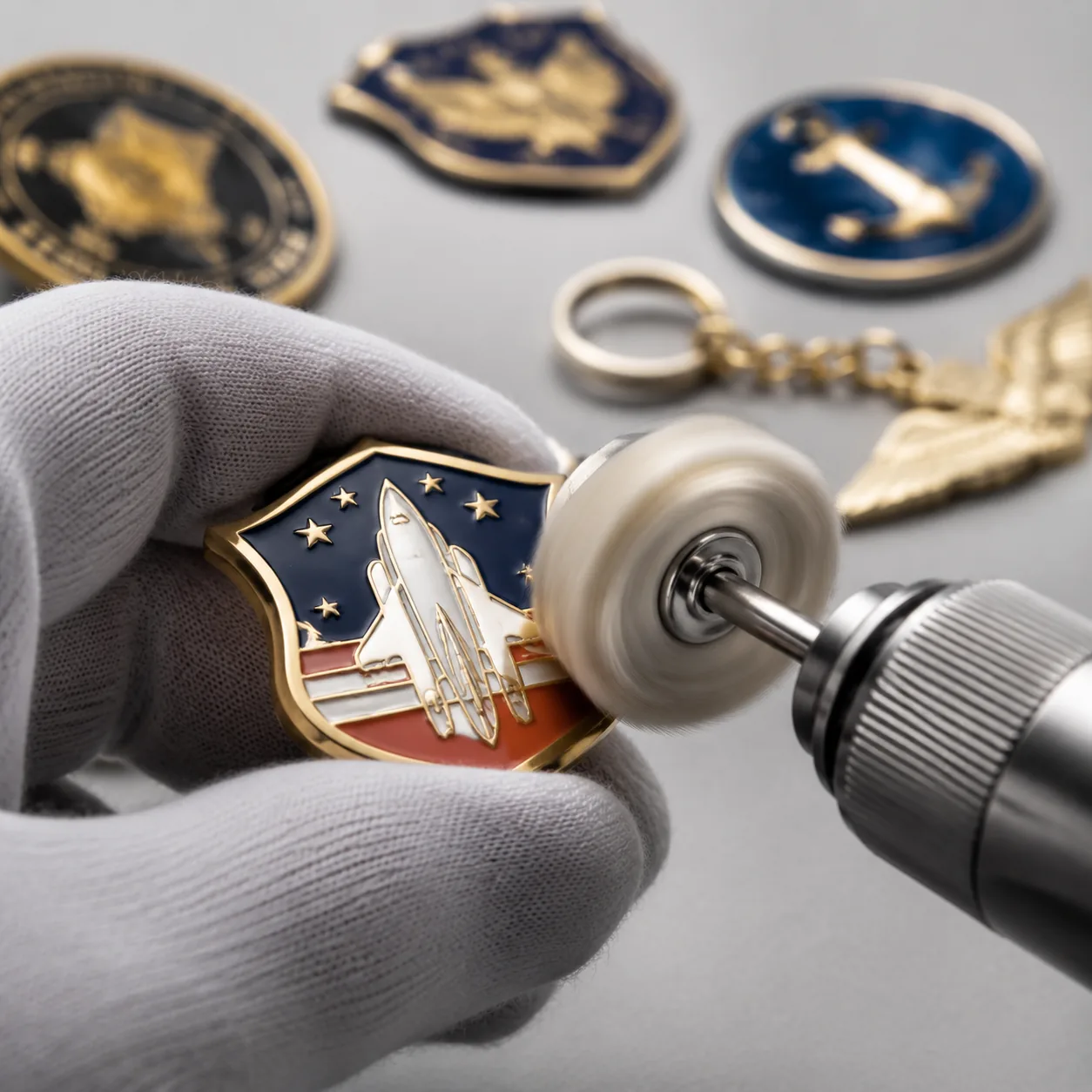
Why finished goods still fail warehouse intake
A custom enamel pin, challenge coin or metal keychain can pass plating, enamel fill, attachment and dimensional inspection, then still miss a launch window because the retail label is wrong. The usual failure is not product quality. It is a mismatch between the purchase order, SKU table, barcode file, unit pack and master carton mark. Third-party warehouses reject cartons when the barcode does not scan, the carton quantity does not match the ASN, the country-of-origin mark is missing, or mixed SKUs are packed without approval.
Labeling should be frozen before mass packing starts. After 10,000 to 20,000 pins are sealed into OPP bags, a late change from a 35 x 20 mm unit label to a 50 x 25 mm barcode label can add 2 to 5 working days. Rework commonly costs USD 0.03 to 0.09 per unit FOB, and more if bags, backing cards or gift boxes must be replaced. For event merchandise and retail replenishment orders, that delay is often more expensive than the labels themselves.
A reliable retail labeling spec does not need to be long. It must define the sellable unit, label position, label material, barcode symbology, barcode data source, scan grade target, country-of-origin placement, carton mark fields, pack quantity and QC method. The buyer should issue this as a controlled SKU table and packing sheet, not as notes scattered across artwork files and emails.
Define the sellable unit before choosing labels
Unit labeling is the label applied to each sellable item or inner pack. For lapel pins and brooches, the unit may be a pin on a backing card inside an OPP bag. For keychains, it may be a bagged item, a header card, or a retail box. For challenge coins, it may be a PVC pouch, velvet pouch, acrylic capsule, or rigid gift box. The label belongs on the unit that the warehouse scans and counts, not necessarily on the metal product itself.
The safest label surface is flat, matte, light-colored and at least 5 mm larger than the printed barcode area on all sides. For most retail and distributor programs, a 50 x 25 mm white thermal-transfer or coated adhesive label is the most flexible size. It can hold a short SKU, UPC-A or EAN-13 barcode, human-readable number, country of origin and batch code. A 35 x 20 mm label works only for short internal SKUs or very simple item IDs; it is usually too small for a compliant retail barcode plus readable text.
Avoid applying barcodes over curved blister packs, textured kraft stock, glossy foil, transparent bag seams or metallic backing cards. A barcode that scans on a loose label roll may fail after bagging because wrinkles distort the bars or glossy surfaces create reflection under warehouse lighting. For soft enamel pins on cards, the card back is usually more reliable than the outer OPP bag. Use an outer-bag label only when the receiving process requires scanning without opening the bag.
| Unit pack type | Recommended label size | Best use | Technical note |
|---|---|---|---|
| OPP bag with pin or keychain | 50 x 25 mm | Distributor intake, event kits, bulk retail replenishment | Low cost, but keep barcode away from seams and trapped air wrinkles |
| Backing card back side | 45 x 20 mm or 50 x 25 mm | Retail pins, museum shops, licensed merchandise | Reserve a blank print area; matte card scans better than gloss lamination |
| PVC pouch or coin capsule sleeve | 50 x 25 mm or 60 x 30 mm | Challenge coins and collectible medallions | Use adhesive tested for PVC migration and edge lift |
| Rigid gift box bottom | 60 x 30 mm | Premium coins, brooches, corporate gifts | Clean presentation, but removal may damage coated paper |
| Header card or hang tag | 40 x 25 mm minimum | Hook-display keychains, patches, lanyards | Good retail visibility, but die-cut tags add setup time |
| Inner carton label | 80 x 40 mm | Multi-pack B2B units or set packs | Efficient for wholesale units, not suitable for individual resale |
Barcode specs that prevent scan failures
The buyer should specify the barcode symbology, not ask the factory to choose it. UPC-A is typical for North American retail. EAN-13 is common for Europe and many international retail channels. Code 128 is better for internal warehouse IDs because it can encode longer alphanumeric SKUs, lot numbers and carton IDs. QR codes are useful for serialized marketing or warranty links, but they should not replace the retailer-required linear barcode unless the receiving system accepts them.
Barcode data should be supplied in a spreadsheet with one row per SKU, plus final vector artwork when retailer formatting is strict. The factory can print and apply the label, but it cannot verify whether a GS1 number belongs to the buyer’s retail system. For UPC-A and EAN-13, keep black bars on a white background, maintain a left and right quiet zone of at least 3 mm, and keep barcode height at 12 mm or more when the label size allows. On a 50 x 25 mm label, avoid long item descriptions; they force the barcode below a practical size.
For Code 128, a 50 x 25 mm label is workable when the encoded string is under about 18 characters. For 18 to 28 characters, use 60 x 30 mm or 70 x 35 mm. For carton labels scanned from a forklift or conveyor, use larger labels and higher bar height. A practical final-pack scan target is ANSI/ISO grade C or better after the label is applied to the actual bag, card, box or pouch. For key retail shipments, require a scan test on the packed pre-production sample and again during final QC.
- Supply barcode data in a locked SKU table with no merged cells and one row per SKU.
- Specify UPC-A, EAN-13, Code 128 or QR code; do not write only “barcode required.”
- Provide human-readable numbers below UPC-A and EAN-13 unless the retailer says otherwise.
- Keep at least 3 mm quiet zone on both horizontal sides of linear barcodes.
- Use 50 x 25 mm as the default unit label; move to 60 x 30 mm for long SKUs or extra compliance text.
- Confirm whether the code must scan through an OPP bag or only before bagging.
- Ask for packed-sample photos and scan results before approving mass packing.
Origin marks, compliance text and batch control
Country-of-origin marking is an import and retail receiving requirement, not a packaging preference. For items made in China, the common wording is “Made in China.” The buyer must define whether it appears on the unit label, backing card, product backstamp, inner carton, master carton or all of these. If the mark appears only on the master carton, individual sellable units may still be rejected by retailers or marketplaces that require unit-level origin labeling.
Backstamping origin into metal is durable but less flexible. For zinc alloy pins, brass pins, iron soft enamel pins and die-struck coins, changing a backstamp after sampling can require mold or die revision and may add USD 35 to 150 per design, plus 1 to 3 working days. Printed unit labels or backing cards are better when the buyer expects artwork, SKU or destination-market changes. If the product is small, do not crowd the metal back with origin, logo, year, license text and safety marks unless the die layout supports legible relief.
Batch codes are useful for reorders, split shipments and defect traceability. A simple code such as PO2408-SKU03-L1 can identify purchase order, SKU and production lot. For pins and keychains, batch codes are usually printed on unit labels, inner cartons and master cartons rather than marked on the product. For premium coins, laser marking or edge marking is possible, but it changes cost, appearance and inspection criteria.
Be conservative with claims. Do not print “nickel-free,” “child safe,” “recycled metal,” “lead free,” “food safe,” or “eco packaging” unless the buyer has defined the test standard, market and age grading. For example, a zinc alloy keychain with nickel-free plating and 3 to 5 microns of finish may meet an internal purchasing requirement, but that does not automatically support a broad consumer compliance claim in every market.
Carton marks and pallet labels for receiving
Carton labels should be written for warehouse staff who have never seen the product. A good master carton label includes buyer code, PO number, SKU, item description, colorway or design version, quantity per carton, carton number, total carton count, gross weight, net weight, carton dimensions and country of origin. If mixed cartons are allowed, list every SKU and quantity on the label or attach a packing list pouch. If mixed cartons are not allowed, write “one SKU per carton” in the packing sheet and inspect against it.
For pins, coins and keychains, common export carton sizes are 35 x 30 x 25 cm, 40 x 30 x 30 cm and 45 x 35 x 30 cm. Dense metal goods should not be overpacked. Keep gross weight under 15 kg for manual handling; 10 to 12 kg is safer for small zinc alloy or iron items because heavy cartons split more easily when dropped. A 32 mm enamel pin on a card and OPP bag may pack 500 to 1,000 pieces per carton. A boxed 45 mm challenge coin may pack only 100 to 250 pieces depending on box weight and insert thickness.
Outer carton labels should normally be 100 x 75 mm or 100 x 100 mm, printed black on white stock. Key fields should use text at least 3 mm high. Carton number format should be fixed before packing, for example CTN 001/048 through CTN 048/048. If pallets are required, specify pallet label size, label position on two adjacent sides, maximum pallet height, stretch-wrap rules and whether carton labels must face outward for scanning.
| Packing level | Typical label size | Required fields | QC tolerance |
|---|---|---|---|
| Unit label | 50 x 25 mm | SKU, barcode, origin, batch code | Correct SKU; readable barcode on AQL sample; label centered within agreed tolerance |
| Inner carton | 80 x 40 mm | SKU, inner quantity, batch, colorway | Quantity tolerance 0 units; label position ±10 mm |
| Master carton | 100 x 75 mm or 100 x 100 mm | PO, SKU, total quantity, carton number, weight, dimensions | Carton sequence and quantities must match packing list |
| Pallet label | 150 x 100 mm | PO, pallet count, carton range, destination | Two-side placement when warehouse or 3PL requires forklift scanning |
Cost, MOQ and lead-time impact
Basic black-and-white adhesive labels are inexpensive, but the real cost includes artwork control, printing, application and inspection. For custom pins, coins and keychains, a simple SKU or barcode label applied to a bag or backing card typically adds USD 0.01 to 0.03 per unit FOB above 1,000 pieces per SKU. At 300 to 500 pieces per SKU, setup and handling often raise the effective add-on to USD 0.04 to 0.08 per unit.
Printed backing cards with integrated barcodes look cleaner for retail but require earlier approval. A common 55 x 85 mm, 300 gsm C1S card with full-color front, black barcode on the reverse and a hang hole usually adds USD 0.05 to 0.12 per unit at 1,000 to 5,000 pieces. Matte varnish or matte lamination improves scan consistency versus gloss, but it can make dark artwork look less sharp. For premium coins, rigid gift box bottom labels usually add USD 0.03 to 0.06 per unit, excluding the box.
Lead-time impact depends mainly on approval timing. If barcode data and carton marks are approved with production artwork, labeling usually adds 0 to 2 working days. Printed cards, hang tags or sleeves typically add 3 to 7 working days after artwork approval. If labels change after packing begins, relabeling a 5,000 to 20,000 piece order commonly adds 2 to 5 working days. If sealed bags or boxes must be opened, expect higher labor cost and a higher risk of handling marks.
| Labeling option | Practical MOQ | FOB add-on range | Lead-time impact |
|---|---|---|---|
| Plain SKU label on OPP bag | 300 pcs per SKU | USD 0.03 to 0.08 at low volume; USD 0.01 to 0.03 above 1,000 pcs | 0 to 2 working days if approved early |
| Barcode label on backing card | 500 pcs per SKU | USD 0.02 to 0.05 excluding card cost | 1 to 3 working days |
| Printed retail backing card | 500 to 1,000 pcs per SKU | USD 0.05 to 0.12 for common pin card sizes | 3 to 6 working days after artwork approval |
| Gift box bottom label | 300 pcs per SKU | USD 0.03 to 0.06 | 1 to 3 working days |
| Retail hang tag with barcode | 1,000 pcs per SKU | USD 0.06 to 0.15 including tag and attachment | 4 to 7 working days |
Inspect labels as part of product QC
Labeling inspection should be included in final QC, not left for the receiving warehouse to discover. For most B2B custom orders, AQL 2.5 for major defects and AQL 4.0 for minor defects is a practical starting point. Major defects include wrong SKU, wrong barcode data, unscannable barcode, missing required origin mark, wrong carton quantity, incorrect carton number, or mixed SKUs packed against instruction. Minor defects include slight label tilt, light scuffing outside the barcode area, or position variation that does not affect readability.
Define realistic position tolerances by pack type. On a 55 x 85 mm backing card, a centered barcode label on the lower back can be held to ±2 mm. On an OPP bag, ±8 to 10 mm is more realistic because bags move during hand application. For rigid gift boxes, ±3 mm is achievable if the label area is flat and the box surface coating accepts adhesive consistently. More important than cosmetic alignment is that the barcode is flat, fully visible, not wrapped around an edge and not covering the product front.
For release, request three types of evidence: close photos of unit labels, scan confirmation for every SKU, and carton label photos showing the full carton sequence. For orders with more than 10 SKUs, inspect the first packed carton of each SKU before continuing. This catches SKU swaps before hundreds of cartons are sealed. For reorder programs, retain one approved packed sample and the final SKU table so the next batch uses the same barcode, carton quantity and label position.
- Check every SKU label against the PO before mass packing starts.
- Do not place barcodes on metallic, transparent, curved or heavily textured surfaces.
- Do not mix unlabeled SKUs in one carton unless the warehouse accepts mixed cartons.
- Do not use uncontrolled file names such as “final-final-barcode.pdf” as the source of truth.
- Do not change origin-mark placement after goods are packed unless relabeling time is approved.
- Do not request removable labels until residue, adhesion and surface coating have been tested.
RFQ checklist for retail-ready packing
Before requesting quotes, prepare a one-page labeling and packing sheet for each product family. Include the sellable unit definition, unit label size, label material, barcode type, barcode data source, origin-mark location, inner pack quantity, master carton quantity, carton label fields, carton number format, maximum gross weight and any retailer routing rules. Attach it to the RFQ with the product artwork so the supplier can quote labor, materials and lead time accurately.
For a first order, approve one fully packed pre-production sample per SKU, not only the loose pin, coin, patch or keychain. Scan the barcode using the same scanner app or warehouse device used by the receiving team. Confirm that the code remains readable after the item is bagged, boxed, bundled and placed in the carton. If the item ships to a 3PL, confirm whether they require ASN matching, pallet labels, UCC-128 carton labels, no mixed cartons, or maximum carton weights below the factory’s normal export pack.
When ordering from ZheCraft, send the SKU table before sampling and flag retailer-specific rules early: carton number format, pallet labeling, maximum carton weight, country-of-origin placement, barcode grade requirement and whether mixed-SKU cartons are prohibited. We can build these checks into pre-shipment QC and retain packing photos for reorder control. The goal is straightforward: the product should arrive well made, correctly labeled and immediately receivable without relabeling, repacking or warehouse chargebacks.
Have a project? Send your artwork and target quantity and we’ll reply with a detailed quotation within 12 working hours.
Ready to get this made?
Send your sketch, target quantity and ship-date. Detailed quotation in 12 hours.



