Retail Enamel Pin Packaging Options: Backing Cards, Pouches, and Boxes
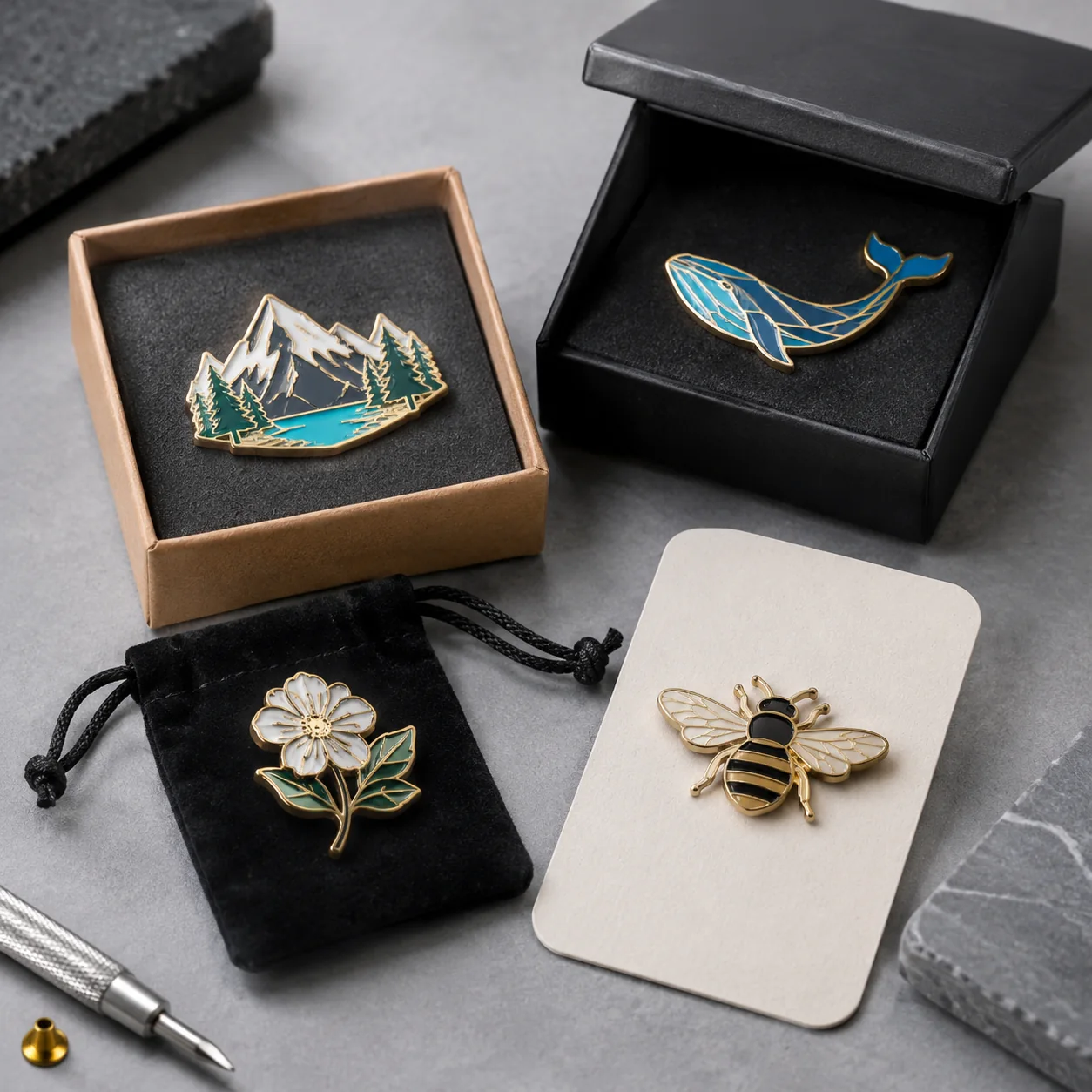
Choose a backing card for a carded retail display, a pouch for a lightweight subscription-box presentation, or a box for a premium gift presentation. Make that choice only after confirming the final pin size, finish, plating, and attachment. Card caliper, pouch or box construction, barcode area, clutch protection, and pack-out are not confirmed product facts, so they require separate written approval before purchase.
Start With the Confirmed Pin Specification
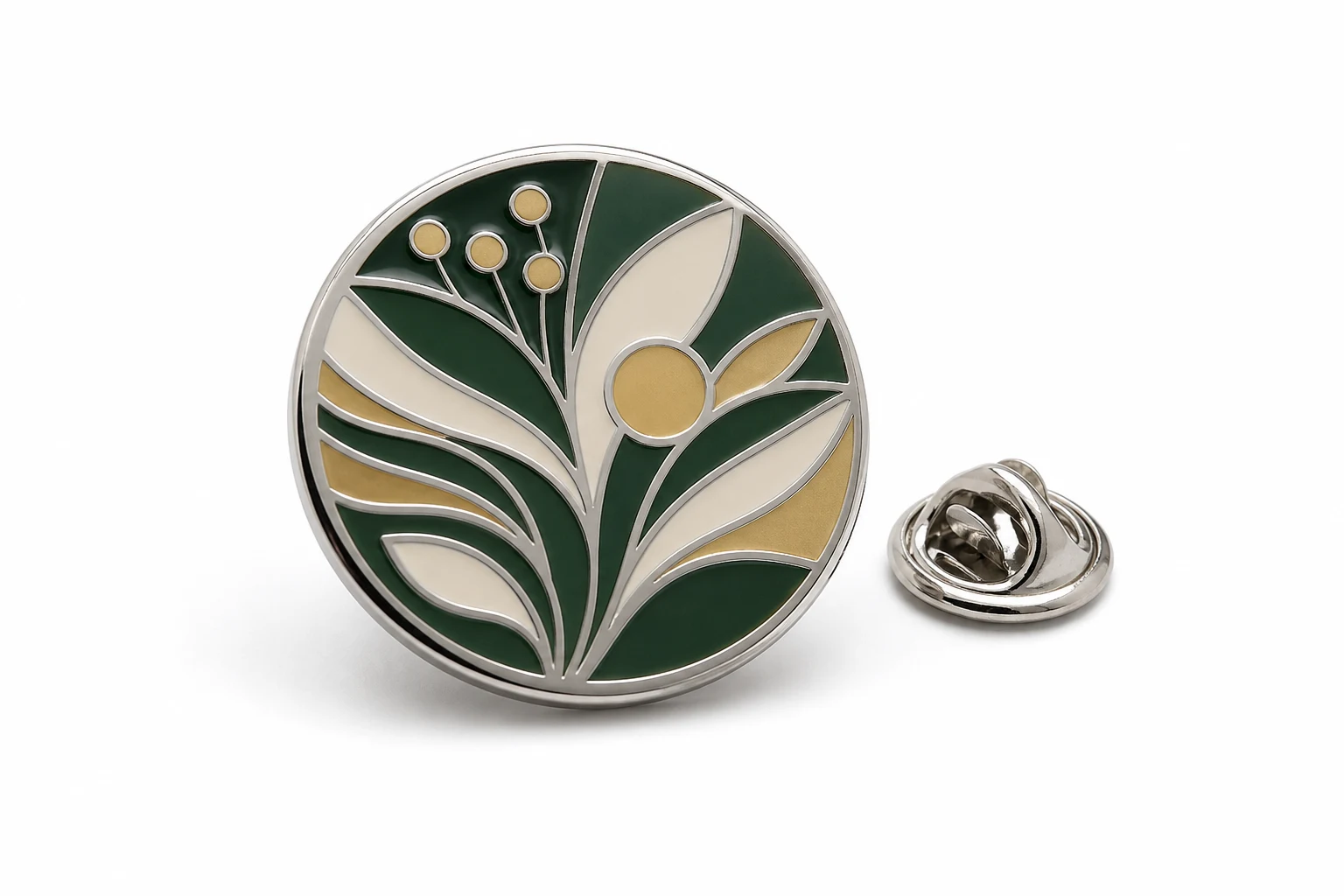
Select packaging around the actual enamel pin rather than treating it as a final artwork add-on. The confirmed product range is 0.75 inch (20 mm) to 2 inch (50 mm), with a 1.2 mm thickness for soft enamel and 1.5 mm for hard enamel. Base metal is brass by default, with copper also available. Retail brands and subscription box teams should put these physical requirements into the packaging brief before choosing a backing card, pouch, or box.
Finish is the first meaningful product trade-off. Soft enamel has recessed color wells and raised metal lines, creating a textured surface. It is the lower-cost and faster option, with a listed price range of $0.30 to $1.20 per piece. Hard enamel is filled and polished flush for a mirror-smooth surface, has a listed range of $0.55 to $1.80 per piece, and is recommended for premium gifting and jewelry-adjacent brands. Packaging should support the intended presentation of the selected finish, but the available product facts do not establish which packaging material or construction provides a particular level of protection.
- Pin size: 0.75 inch (20 mm) to 2 inch (50 mm).
- Pin thickness: 1.2 mm for soft enamel and 1.5 mm for hard enamel.
- Base metal: brass by default, or copper.
- Color capability: up to 8 Pantone colors per design.
- Finish choice: soft enamel with raised lines or hard enamel with a flush polished surface.
- Standard attachment: butterfly clutch; rubber, magnetic, and safety-pin attachments are available.
Separate Product Evidence From Packaging Assumptions
The product information supports decisions about enamel pin material, finish, size, attachment, MOQ, and stated pin lead time. It does not provide a backing-card caliper, pouch material, box dimensions, barcode specification, individual clutch protection method, or pack-out quantity. Procurement teams should not turn those unknowns into assumed supplier commitments. Treat them as fields requiring a written response, a physical sample, or both.
| Decision field | What is confirmed | What still requires approval |
|---|---|---|
| Pin construction | Brass by default or copper; soft or hard enamel | How the selected pin will sit within the chosen package |
| Pin dimensions | 0.75 inch to 2 inch; 1.2 mm soft or 1.5 mm hard | Backing-card, pouch, or box dimensions |
| Attachment | Butterfly clutch standard; rubber, magnetic, and safety-pin attachments available | Clutch protection method and any attachment-specific packing requirement |
| Retail identification | No barcode or labeling details are supplied | Barcode location, label size, code format, and scannable area |
| Pack-out | No unit-per-carton or inner-pack information is supplied | Unit packing, inner packing, carton quantity, and shipment presentation |
This distinction matters when merchandising and fulfillment teams work from different assumptions. A buyer may approve a pin sample and still lack the information needed to approve a sellable retail unit. Likewise, a team can decide that it wants a backing card, pouch, or box without having a usable specification for the selected format. The order brief needs both layers: the confirmed pin specification and the separately approved packaging specification.
Evaluate Backing Cards, Pouches, and Boxes by Use Case
Choose the format according to the intended presentation, then validate it with the actual pin sample. A backing card is the format to evaluate for a carded retail presentation. A pouch is the format to evaluate for a pouch-based subscription-box presentation. A box is the format to evaluate for premium gifting, particularly when hard enamel is already the selected finish. The available product facts do not establish a universal best packaging format.
| Commercial situation | Packaging format to evaluate | Product evidence to carry into the brief | Do not assume |
|---|---|---|---|
| Brand merchandise with a planned carded presentation | Backing card | Pin size, finish, plating, attachment, and color count | Card caliper, printing specification, barcode area, or pack-out |
| Subscription box add-on | Pouch or backing card | Pin size, thickness, attachment, MOQ, and bulk timing | Pouch construction, clutch protection, or unit packing |
| Premium gifting or jewelry-adjacent brand positioning | Box | Hard enamel is recommended for premium gifting; hard enamel is 1.5 mm thick | Box material, dimensions, insert structure, or retail labeling |
| Cost-sensitive or detailed design | Format to validate with a soft enamel sample | Soft enamel is lower cost and faster; it has raised metal lines and recessed wells | That any packaging option is included in the quoted pin price |
The trade-off should remain explicit. Hard enamel supports a premium gifting direction and has a listed price range that starts and ends above the supplied soft enamel range. Soft enamel has a lower listed range and a textured surface, which may suit a detailed or budget-controlled program. Finish alone does not prove the correct packaging choice. Approve the selected complete unit before committing retail, fulfillment, and launch assumptions.
Check Finish and Attachment in the Actual Pack
A packaging sample should contain the final pin specification, not a substitute piece. Soft and hard enamel differ in surface treatment and thickness, while attachment options differ from the standard butterfly clutch. The product facts confirm that rubber, magnetic, and safety-pin attachments are available, but do not state how any attachment should be protected in transit or presented at retail. Approve the actual combination of finish, plating, attachment, and packaging rather than approving those choices separately.
- Confirm whether the design is soft enamel or hard enamel before packaging dimensions are released.
- Record the final pin size in inches and millimeters within the 0.75 inch to 2 inch range.
- Record the pin thickness: 1.2 mm for soft enamel or 1.5 mm for hard enamel.
- State the selected attachment, including whether the standard butterfly clutch or an available alternative is required.
- Include the selected plating in the sample request; 12 standard finishes are available, with gold and silver identified as the most popular.
- Request approval of the completed retail unit, including the pin and proposed packaging, rather than approving artwork alone.
- Document the proposed clutch protection method because no protection method is included in the available product facts.
Reserve Barcode and Label Space Before Artwork Approval
Barcode area is a procurement requirement that cannot be finalized from the available product facts. No barcode format, label dimension, label stock, printed-card specification, or placement rule is provided. Retail teams should define those requirements in their own brief before packaging artwork is approved. Subscription box teams that do not need a retail barcode should still state whether identification, variant handling, or other labeling is required rather than leaving the package unmarked by default.
- State whether a barcode is required for the retail unit.
- Provide the required barcode data and identify the intended placement.
- Specify the area to remain available for the barcode or label; no dimensions are supplied for this area.
- State whether the barcode will be printed as part of packaging artwork or applied separately.
- Identify design, finish, size, and attachment variants that require separate identification.
- Approve a packaging artwork proof only after the required identification space is shown.
Use MOQ and Lead Time as Product Constraints
The MOQ is 100 pieces per design. The stated pin timing is 5 to 7 days for a sample and 18 to 25 days for bulk production. These figures are useful planning constraints for an enamel pin program, but they are not stated as packaging-development, printed-card, pouch, box, labeling, or pack-out lead times. Do not promise a launch date based on the pin timeline alone when packaging remains unapproved.
| Planning input | Supplied product fact | Buyer action |
|---|---|---|
| MOQ | 100 pieces per design | Calculate order quantities by design and confirm whether packaging requirements change the operational plan. |
| Sample timing | 5 to 7 days | Use the sample to evaluate the completed pin and request packaging validation separately. |
| Bulk timing | 18 to 25 days | Keep packaging approval and pack-out confirmation on the critical path. |
| Price range | Soft $0.30 to $1.20 per piece; hard $0.55 to $1.80 per piece | Request a quote that separates the enamel pin from any packaging components not covered by the product facts. |
Where a collection includes several designs, the per-design MOQ is particularly important. Packaging artwork, barcode data, and pack-out instructions should be tracked by design or variant so that a 100-piece minimum is not mistakenly treated as a collection-wide minimum. The same discipline helps subscription box teams avoid approving a single generic package when individual pin designs require separate retail identification.
Release an Order-Ready Packaging Brief
Issue one packaging brief that combines the final enamel pin specification with the unresolved packaging fields. Start with the product choice: brass or copper, soft or hard enamel, selected plating, final size, final attachment, and up to eight Pantone colors. Then name the format to evaluate: backing card, pouch, or box. For premium gifting, hard enamel is the supported product recommendation. For a lower-cost, faster pin with tactile raised metal lines, soft enamel is the supported alternative.
- Confirm the design-specific quantity against the 100-piece MOQ.
- State the selected pin material, finish, size, thickness, plating, colors, and attachment.
- Name the proposed packaging format and attach its artwork or construction specification.
- Request the card caliper, pouch or box material, dimensions, and closure or insert details because they are not supplied.
- Specify clutch protection requirements and approve them in a complete packed sample.
- Reserve and approve barcode or label space before final packaging artwork release.
- Request unit pack, inner-pack, carton quantity, and carton-marking details because no pack-out information is supplied.
- Keep the stated 5 to 7 day sample and 18 to 25 day bulk pin timelines separate from packaging timing until both are confirmed.
Approve the purchase only after the pin sample and proposed retail unit are reviewed together. That final review gives the team a defensible basis to select among enamel pin packaging options while keeping finish, clutch handling, barcode space, MOQ, and pack-out requirements explicit rather than assumed.
Ready to get this made?
Send your sketch, target quantity and ship-date. Detailed quotation in 12 hours.