Retail Brooch Sourcing: RFQ to Bulk Shipment
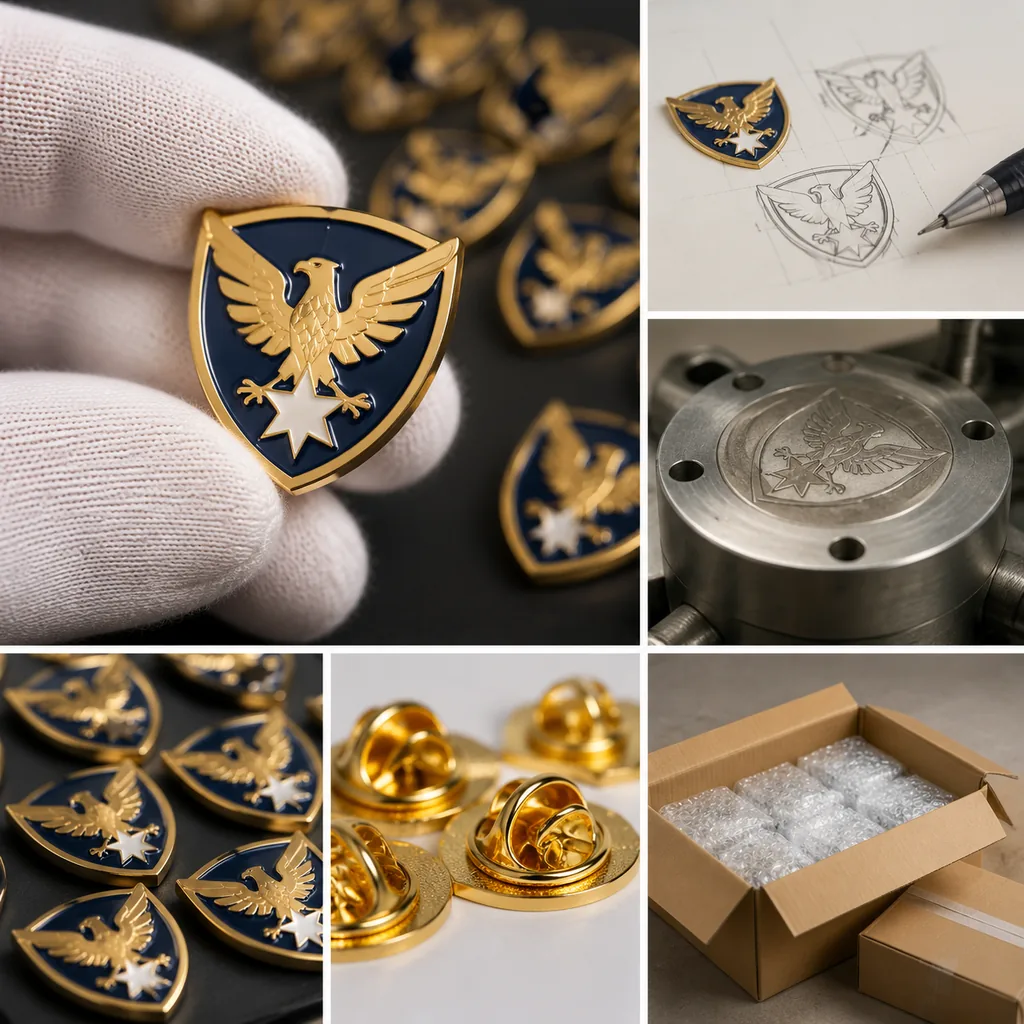
1. Define the wearing use before quoting artwork
Retail brooches are small accessories, but they fail for mechanical reasons: the piece rotates on a lapel, drags down light fabric, scratches on the display card, loses plating on raised edges, or feels too thin for the price point. Start the RFQ with the use case, not only the logo or illustration. A 25 mm uniform pin for daily staff wear, a 38 mm enamel museum brooch, and a 50 mm rhinestone flower for coat merchandising should not be engineered or priced the same way.
Useful starting ranges are 25-45 mm for most fashion brooches, 1.2-2.0 mm finished thickness for die-struck brass, 0.6-1.0 mm for etched budget badges, and 2.0-3.5 mm local thickness for zinc alloy cast shapes. Normal finished weight is 8-22 g for garment wear. Above 25 g, treat balance as a specification. Above 45 mm, or where the design is asymmetric, dangling, or stone-heavy, require an anti-rotation solution such as a longer bar pin, two pin points, a vertical clasp, or a hidden support loop.
- Final artwork in AI, PDF, SVG, or 600 dpi PNG, with finished size in mm and front/back views
- Quantity by design, colorway and SKU; do not quote only the total program volume
- Target fabric use: shirt, knitwear, jacket, coat, scarf, hat, or bag
- Target retail price band and expected presentation: carded, boxed, giftable, or promotional
- Preferred base metal: brass for crisp stamped lines, zinc alloy for sculpted 3D forms, iron only for low-cost flat badges
- Attachment: safety brooch clasp, bar pin, two posts with clutches, magnet, vertical pin, or custom hinge
- Finish requirements: imitation gold, nickel-free silver tone, black nickel, rose gold, antique brass, hard enamel, soft enamel, epoxy dome, stones, pearls, chains, or glitter
- Packaging: OPP bag, printed backing card, anti-tarnish sleeve, PET box, velvet pouch, or rigid retail box
- Trade term: EXW, FOB Ningbo/Shanghai/Shenzhen, or courier door-to-door for trials under 300 pcs
2. Lock the construction route before comparing unit prices
Brooch quotations are easy to misread because suppliers may price different products from the same artwork. One quote may assume etched iron at 0.8 mm, another die-struck brass at 1.5 mm, and a third zinc alloy casting with hand polishing. The cheapest offer may be thinner, flatter, less durable, or packed without retail presentation. Before negotiation, make the construction route part of the RFQ.
Die-struck brass is best for premium flat logos, crests, hard-enamel designs, and museum or brand merchandise where sharp metal separations matter. Zinc alloy casting suits 3D flowers, animals, bows, leaves, raised figures, and simulated jewelry shapes. Photo etching is suitable for thin pieces under about 35 mm, but relief is shallow and perceived value is lower. Multi-part assembly is used for layered petals, moving charms, chains, pearls, or mixed finishes, but it adds inspection risk because soldering, gluing, stone setting, and alignment all become defect points.
| Construction | Best use | Typical finished thickness | MOQ and tooling | Indicative FOB price at 500 pcs |
|---|---|---|---|---|
| Brass die struck | Premium flat logos, crests, hard enamel, crisp metal borders | 1.2-2.0 mm | MOQ 100-300 pcs; tooling USD 45-120 | USD 1.10-2.80 each |
| Zinc alloy cast | 3D flowers, animals, sculpted fashion brooches, raised textures | 2.0-3.5 mm at thick areas | MOQ 100-300 pcs; tooling USD 70-180 | USD 1.40-4.20 each |
| Photo etched iron or brass | Thin budget pieces, simple soft enamel fills, low-profile badges | 0.6-1.0 mm | MOQ 300-500 pcs; tooling USD 35-80 | USD 0.65-1.60 each |
| Multi-part assembled | Dangling charms, layered petals, chains, stones, moving elements | Varies by component | MOQ 300 pcs; multiple tools USD 120-350 | USD 2.20-6.50 each |
| Stone-set or pearl brooch | Jewelry-style retail pieces with rhinestones, glass, acrylic or imitation pearl | 2.0-5.0 mm depending on setting | MOQ 300-500 pcs; tooling plus stone sourcing USD 120-400 | USD 2.80-9.50 each |
3. Turn the design into measurable production specifications
A usable brooch specification does not say only “gold plated with enamel.” It defines metal, thickness, enamel type, plating stack, attachment position, backstamp, edge condition, packaging, tolerances, and inspection criteria. This avoids a common dispute: the buyer approves an attractive rendering, while the factory produces a lighter item with weaker hardware because the engineering was never fixed.
For enamel work, specify minimum raised metal line width and minimum enamel cell width. Practical minimum metal line width is 0.25 mm for hard enamel and 0.20-0.25 mm for soft enamel, but 0.30 mm is safer because polishing can reduce fine ridges. Minimum enamel cell width should be 0.35 mm; below that, color may close up, trap bubbles, or look uneven. Normal finished-size tolerance is ±0.30 mm for pieces under 40 mm and ±0.50 mm for larger cast brooches. Thickness tolerance is commonly ±0.15 mm for stamped pieces and ±0.25 mm for cast pieces unless a tighter limit is agreed before tooling.
Plating should be written as both color and performance. Standard decorative imitation gold, nickel, or rose gold finishes are often a flash layer around 0.03-0.08 microns over copper or nickel underlayers. For better color stability on raised areas, specify 0.10-0.30 microns for gold-tone plating and confirm the cost impact. If the brooch contacts skin or is sold in markets with nickel restrictions, state nickel-free plating and request supplier documentation. Nickel-free processing can add 2-5 days because components, plating baths, and test reports must be controlled.
Attachment placement needs a dimensioned back drawing. For brooches over 40 mm, place the clasp near the visual center of gravity, not automatically at the geometric center. For long horizontal designs, a 25-30 mm bar pin is usually more stable than a 20 mm safety clasp. For tall vertical brooches, a vertical clasp or two fixing points reduces rotation. Specify that pin points must be fully covered when locked and that the closed clasp gap should be under 0.5 mm.
4. Quote tooling, packaging, and MOQ tiers separately
Separate one-time tooling from unit cost. If tooling is buried inside the first order price, reorder economics and mold ownership become unclear. A complete quotation should list mold charge, sample charge, FOB unit price, packaging cost, label or barcode cost, carton quantity, estimated gross weight, sample lead time, bulk lead time, payment terms, and validity period.
Typical MOQ is 100 pcs per design for simple stamped or cast brooches, 300 pcs for multi-color retail assortments, and 500 pcs where custom packaging, stone setting, or complex assembly is involved. Price breaks normally appear at 100, 300, 500, 1,000, and 3,000 pcs. The largest unit-price reduction is usually between 100 and 500 pcs because plating setup, color mixing, polishing, inspection, and packing labor are spread across more units.
| Quantity per design | Typical FOB unit price | Appropriate use | Main sourcing risk |
|---|---|---|---|
| 100 pcs | USD 2.20-6.80 | Boutique launch, market testing, influencer seeding | Tooling may exceed product value; limited leverage on plating and packing |
| 300 pcs | USD 1.60-5.20 | Retail pilot, museum shop, club or brand merchandise | Assortments must be quoted by SKU and colorway, not averaged |
| 500 pcs | USD 1.10-4.20 | Normal replenishment order and distributor test | Check color consistency across the full plating batch |
| 1,000 pcs | USD 0.85-3.50 | Chain retail, seasonal program, event retail | Bulk packing, barcode accuracy, and carton counts become more important |
| 3,000 pcs | USD 0.65-2.80 | Large retail or promotional-retail hybrid run | Confirm carton strength, inner box count, and QC capacity before production |
Packaging can change landed cost more than buyers expect. A plain OPP bag may add USD 0.02-0.05. A printed 300-350 gsm backing card with OPP bag is commonly USD 0.06-0.18 depending on size, lamination, and hole punch. A PET display box may add USD 0.20-0.45. A rigid jewelry-style box can add USD 0.60-1.50 and often increases freight volume more than product cost. Quote packaging as a separate line so merchandising can choose deliberately.
5. Use sampling to approve balance, finish, and retail presentation
A brooch sample normally takes 7-12 days after artwork approval for a simple stamped or cast design. Multi-part assembly, stone setting, dangling charms, epoxy domes, or custom display packaging usually requires 12-18 days. Courier transit adds 3-6 days to North America or Europe. Photo approval is not enough for heavy, asymmetric, or delicate-garment brooches; the physical sample must be tested.
Review the sample as a functional product. Weigh it with the attachment installed. Test it on at least two fabrics: a light shirt fabric around 110-140 gsm and a medium jacket fabric around 250-350 gsm. A 30 mm brooch at 10-14 g can usually use a single safety clasp. A 45 mm brooch at 20-25 g often needs a longer bar pin or double fixing. A brooch over 30 g should be treated as coat, scarf, hat, or bag hardware unless the attachment is specifically engineered for garments.
- Measure finished size against the approved drawing: ±0.30 mm under 40 mm and ±0.50 mm for larger cast pieces unless otherwise agreed
- Check thickness and weight against the RFQ; reject weight changes that affect wearability
- View plating under daylight and warm indoor light, not only under a phone camera
- Rub raised areas with a clean white cotton cloth for 30 seconds to detect polishing residue or weak surface finish
- Check enamel level: hard enamel should be flush within about 0.05 mm; soft enamel should be recessed consistently
- Inspect the back for burrs around the clasp, solder marks, casting gates, and sharp edges
- Confirm the pin point is fully covered and the locked clasp gap is under 0.5 mm
- Wear-test for 10 minutes while walking to see whether the brooch rotates, sags, or pulls fabric
- Photograph the approved sample front, back, side profile, and packaging for the control file
6. Freeze the golden sample and production file
After approval, freeze one physical golden sample and one written production file. The file should contain final artwork, Pantone or enamel color references, plating description, attachment drawing, finished dimensions, tolerances, sample photos, packaging dieline, barcode and SKU rules, carton marks, inspection level, and approved deviations. This prevents different departments from following different versions: sales may have one file, the plating room another, and packing an older card layout.
Normal bulk lead time after sample approval is 12-20 days for 300-1,000 pcs of one simple design. Programs with several SKUs, printed cards, stickers, PET boxes, stones, or assembly normally need 20-35 days. Rush production is possible only when the design is simple and materials are ready. Brooches are risky to rush because soldering, polishing, plating, enamel curing, stone setting, final inspection, and packing must happen in sequence. Compressing one step often creates cosmetic defects that are expensive to sort later.
If reorder potential exists, write mold retention and reorder controls into the purchase order. A typical retention period is 2-3 years when repeat orders are placed, but it should be confirmed in writing. For reorders, keep the plating standard, attachment position, card material, and barcode rules unchanged unless a revision is approved. Even a card change from 300 gsm to 250 gsm can make a brooch feel cheaper on shelf, and a 1-2 mm clasp shift can change how it hangs.
7. Set AQL, defect definitions, and shipment controls before packing
Inspection standards should be agreed before production starts. For retail brooches, a practical default is ANSI/ASQ Z1.4 general inspection level II with AQL 2.5 for major defects and AQL 4.0 for minor defects. Critical defects should be zero tolerance: exposed sharp pin points, broken clasps, sharp burrs that can cut skin, incorrect SKU or barcode labels, contaminated packaging, or unapproved material substitution.
Major defects include wrong plating color, missing enamel, loose stones, loose attachments, visible front scratches over 3 mm, incorrect card artwork, unreadable barcode, cloudy epoxy, or any brooch that cannot fasten securely. Minor defects include tiny back-side plating marks, isolated color specks below about 0.3 mm, small card pressure marks not visible on display, or slight backstamp softness that does not affect retail presentation. For premium jewelry-style brooches, tighten cosmetic acceptance because consumers inspect them at close distance.
| Check point | Recommended standard | Reason |
|---|---|---|
| Attachment pull test | No failure at 2-3 kgf on safety clasp, solder joint, or glued fitting | Reduces returns from broken backs |
| Pin closure | Point fully covered; locked clasp gap under 0.5 mm | Prevents fabric snags and injury complaints |
| Plating adhesion | 3M tape pull with no visible peeling on main front surface | Catches poor cleaning or weak underplating |
| Cosmetic scratches | Reject obvious front scratches over 3 mm or visible at 30 cm | Retail buyers inspect close to shelf distance |
| Enamel and stone placement | No missing fill, no loose stones, no overflow on main front surface | Protects perceived value |
| Packaging match | SKU, barcode, country label, card direction, and quantity 100% correct | Avoids warehouse relabeling and chargebacks |
| Carton packing | Inner boxes fixed; export carton gross weight normally below 15 kg | Protects cards, pin backs, and brooch faces in transit |
Before issuing the PO, send one final control sheet instead of relying on scattered email threads. Include quantity by SKU, approved sample date, construction method, finished size, target weight, plating, attachment, packaging, AQL level, production lead time, Incoterm, shipping address, carton marks, and the person authorized to approve deviations. For a first retail program, 300-500 pcs per design is usually the safest starting point: enough for realistic unit cost and plating stability, but small enough to correct balance, clasp, or packaging issues before a chain-wide order.
Have a project? Send your artwork and target quantity and we’ll reply with a detailed quotation within 12 working hours.
Ready to get this made?
Send your sketch, target quantity and ship-date. Detailed quotation in 12 hours.



