Recycled Metal Pins: Failure Modes and Buyer Specs for 2026
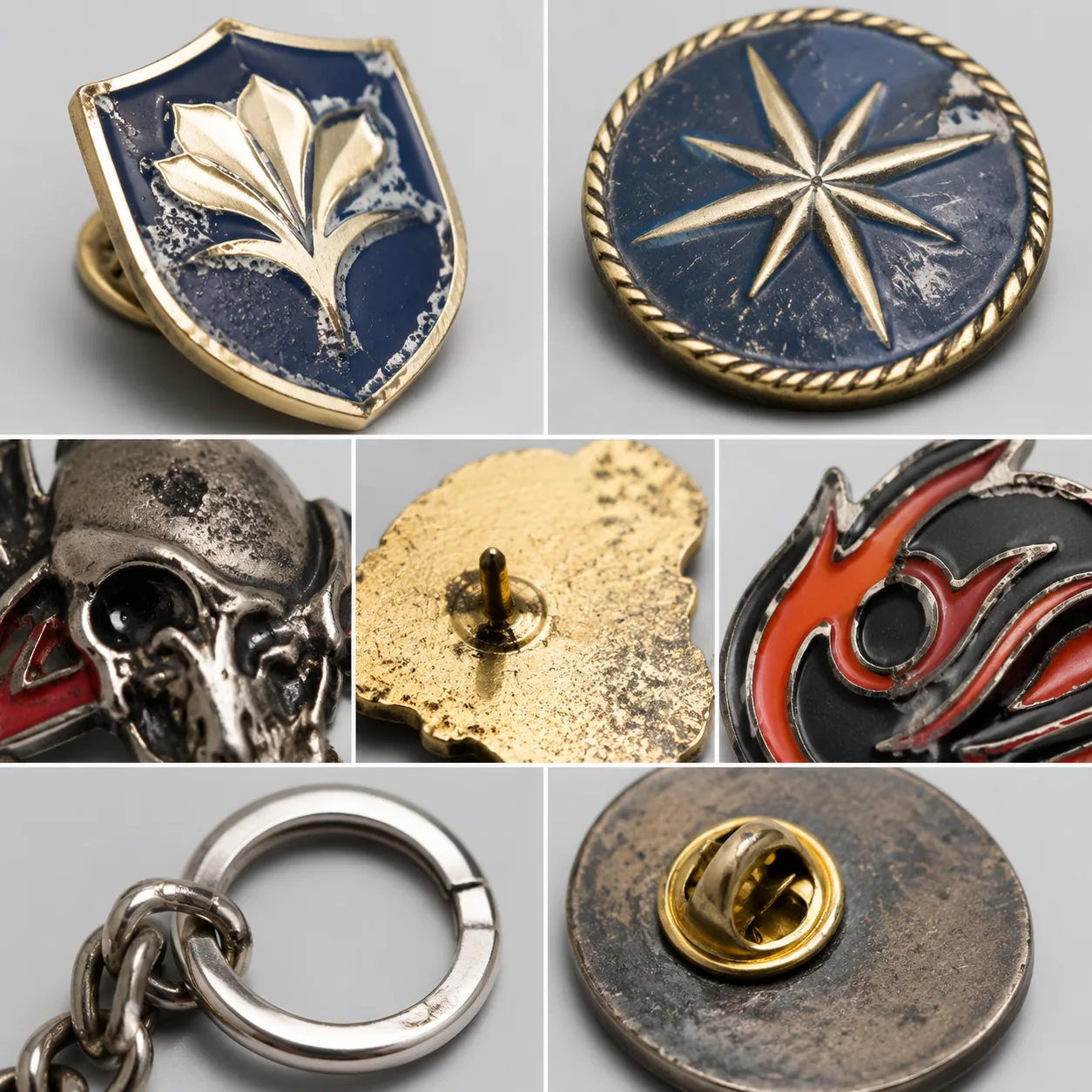
Why recycled-content pins fail when buyers keep virgin-metal specs
Most recycled-metal pin failures start before tooling. Procurement approves a sustainability target, but the drawing, finish callout, and inspection standard still assume a virgin-metal build. Recycled zinc alloy, brass, and iron can behave differently in die fill, porosity, polish response, plating adhesion, and enamel edge retention even when the artwork stays the same. The issue is usually not one catastrophic defect. It is an accumulation of smaller deviations such as softer edges, more micro-pits, slightly wider shade variation, and lower yield on mirror-polished surfaces that pushes the lot outside the old cosmetic window.
In production, recycled-content builds commonly need 2 to 6 percentage points more cosmetic sorting than equivalent virgin-metal runs. On fine-detail or bright-plated designs, scrap can rise by 3 to 8 points. That usually adds 3 to 7 calendar days when re-polishing, re-plating, or selective rework is required. If the RFQ does not state which attributes must match the previous version and which can be relaxed, the factory is forced to chase a virgin-metal appearance on a different process at the same target FOB price.
The practical fix is to rank appearance priorities before sample making. For most B2B pin programs, the order should be logo legibility first, enamel boundary control second, front-face finish tone third, and back-side cosmetics last. Once that hierarchy is explicit, the supplier can adjust geometry, polishing route, plating choice, and AQL without guessing what matters most.
1) Detail loss: die fill, line sharpness, and minimum-feature limits
Recycled-content metal is not a single stable grade. Within the same alloy family, melt cleanliness, scrap ratio, and impurity control can vary enough to affect edge retention and casting flow. On die-struck iron or brass, the typical risk is softened text, rounded borders, and reduced crispness after polishing. On die-cast zinc alloy, the higher-risk points are incomplete fill at sharp corners, shallow-relief collapse, and inside cutouts that lose definition after deburring and plating.
Designs become fragile when they run below proven process limits. For 2026 recycled-content programs, buyers should use slightly more conservative geometry than many older virgin-metal drawings. A solid baseline is metal line width of at least 0.30 mm on pins under 40 mm, 0.35 mm on high-contrast faces, recessed text stroke width of at least 0.30 mm, and soft-enamel recess depth of 0.40 to 0.50 mm. Unsupported spikes should stay above 0.50 mm width, and inside corner radii on cast parts should be at least 0.20 to 0.25 mm. If the design insists on 0.20 to 0.25 mm raised lines, buyers should expect lower yield, more hand-sorting, and either a higher unit price or a route change to photo-etch or brass stamping.
For a stable 25 to 40 mm soft-enamel lapel pin in recycled iron or brass, a practical spec is 1.5 to 1.8 mm finished thickness, 0.30 mm minimum border width, and 0.40 mm minimum enamel recess depth. For a 50 to 65 mm recycled-zinc keychain, raised edges should be at least 0.40 mm wide, narrow tabs should be shortened or bridged, and inside corner radii should be 0.25 mm or larger. On first-run recycled programs, these geometry changes often reduce sorting loss by 3 to 5 points without changing the visible concept or logo readability.
2) Surface failure: pits, plating shade drift, and adhesion loss
Surface finish is where recycled builds are judged hardest because pits and color drift are immediately visible. Recycled castings generally carry more porosity risk, while recycled stamped parts more often show wider polishing variation. After nickel, imitation gold, black nickel, gunmetal, or antique finishing, the common defects are micro-pits, local haze, uneven luster, edge burn, and clear-coat inconsistency between lots.
Bright mirror finishes are the least forgiving choice. If the face must still look premium, matte nickel, satin gunmetal, antique silver, antique bronze, or sandblast plus clear coat are more stable than full bright gold or bright silver. For decorative pin plating, a realistic stack is 3 to 5 microns of nickel undercoat with decorative top layers typically around 0.03 to 0.08 microns for imitation gold, black nickel, or gunmetal. For antique finishes, the protective clear coat often matters more to appearance consistency than a thicker decorative flash layer. Clear coat thickness is usually thin and not tightly specified, but buyers should require even coverage with no tackiness, pooling, or visible edge buildup.
Adhesion failures usually appear later than visual plating defects. Soft enamel can lift from overly tapered walls, painted fills can chip at sharp edges, and UV print on polished plating can fail tape test if surface preparation is weak. A practical control plan is to verify plating continuity after polishing and before fill, then run a cross-hatch tape test on at least 5 pieces per lot for painted or printed areas. For high-contact items such as keychains and bag charms, buyers can request a 24-hour neutral salt spray reference and a 1-meter drop test on 10 samples, but these should be treated as product-specific controls rather than universal defaults for every promotional pin.
| Build area | Higher-risk choice on recycled metal | Safer 2026 buyer spec |
|---|---|---|
| Fine die-struck pin under 30 mm | Metal lines below 0.25 mm | Metal lines 0.30 to 0.35 mm minimum |
| Front-face finish | Full mirror bright gold or silver | Matte nickel, satin gunmetal, antique silver, or sandblast plus clear coat |
| Enamel cell geometry | Relief depth under 0.35 mm | Relief depth 0.40 to 0.50 mm |
| Large cast keychain over 50 mm | Sharp inside corners and thin spikes | 0.25 mm minimum inside radius and 0.40 mm raised edges |
| Flat badge with polished field | Mirror-polish standard across full face | Satin or selective-polish standard on raised zones only |
| Inspection standard | AQL 1.0 on all cosmetics | AQL 1.5 major / 2.5 minor with sealed limit samples |
| Plating stack | Undefined finish name only | Nickel undercoat 3 to 5 microns plus named top finish |
| Viewing condition | No inspection lighting stated | 30 cm viewing distance under 5000K to 6500K light |
3) Mechanical mismatch: weight, thickness, attachment, and feel-in-hand
A recycled-material change affects more than the recycled claim. It changes density, edge sharpness, rigidity, and perceived value in the hand. A 50 mm keychain in recycled zinc alloy at 3.0 mm thickness will not feel like a stamped brass version at 2.0 mm, even if the outline is identical. A die-struck iron badge may preserve sharper lines but feel lighter than expected; a zinc version may feel heavier but lose fine relief.
The common mistake is controlling thickness but not unit weight. Buyers should specify both. For pins and badges under 20 g, a practical unit-weight tolerance is plus or minus 8 percent. Above 20 g, plus or minus 5 percent is more realistic. Finished thickness tolerances can be written as 1.5 mm ±0.10 mm for die-struck pins, 2.0 mm ±0.12 mm for badges, and 3.0 mm ±0.15 mm for cast keychains, depending on finish build-up and whether epoxy doming is included. Attachment placement also needs a numeric tolerance: for example, pin post center offset not to exceed 1.0 mm, and keychain hole or jump-ring alignment not to exceed 0.8 mm off drawing centerline.
Weight control also affects freight and packing. If a 5,000-piece order arrives 3 g heavier per piece than quoted, that adds 15 kg before cards, trays, and master cartons. On FOB programs, that can change carton count, pallet count, and airfreight price breaks. Buyers should request estimated unit weight, net weight per 1,000 pieces, and gross export-carton weight at quotation stage rather than after sample approval. For larger medallions or challenge-coin style items, it is also worth specifying carton pack count, for example 100 pieces per inner box and 500 pieces per master carton, because over-weight cartons create handling problems even when piece quality is acceptable.
4) Claim mismatch: recycled-content wording versus actual BOM
A pin sold as recycled is often only partly recycled. The main body may use recycled zinc alloy or recycled iron, while the butterfly clutch, jump ring, split ring, magnet, epoxy dome, enamel resin, backing card, or polybag remains standard stock. That is not automatically misleading, but it becomes a compliance problem when the quote, carton label, or product page implies total-product recycled content without defining which components are covered.
The safest practice is to state the claim by component and by approximate share of finished-product mass. On a 35 mm die-cast badge with butterfly clutch and paper card, the metal body may account for roughly 70 to 80 percent of total finished weight, hardware 5 to 10 percent, backing card 10 to 20 percent, and coatings plus inks the balance. If only the body uses recycled input, the documentation should say recycled metal body or body material contains X percent recycled content. It should not say fully recycled badge unless every meaningful component is within that claim.
This matters most in distributor programs, public-sector tenders, licensed merchandise, and event items where legal or procurement teams may review the claim after shipment. Buyers should request a BOM summary during sampling that states which components are inside the claim, whether percentages are calculated by component mass or finished-product mass, and which excluded parts remain standard. That one-page statement prevents more disputes than broad sustainability wording in the quotation.
5) Commercial drift: scrap, MOQ tiers, lead times, and real FOB cost
Recycled-content products are rarely a simple material swap. On fine-detail designs, higher polishing loss, broader cosmetic sorting, and more plating fallout can raise scrap by 3 to 8 percentage points versus a standard build. Factories usually manage that risk by increasing MOQ, widening unit-price bands, charging for pre-production samples, or softening cosmetic limits. If those controls are not visible in the quotation, the buyer is comparing incomplete prices.
For custom programs, recycled-content builds are usually commercially sensible at 500 to 2,000 pieces because tooling and sorting overhead are spread across volume. Typical 2026 MOQ tiers are 100 pieces for simple repeat orders on existing tooling, 300 pieces for new custom lapel pins, 500 pieces for keychains or medallions, and 1,000 pieces where custom card packing, multiple attachments, or mixed finishes are involved. Quantity tolerance should be written into the PO, usually plus or minus 3 to 5 percent unless exact quantity is negotiated and priced separately.
As a realistic 2026 FOB reference, a 30 mm soft-enamel recycled-iron pin with standard butterfly clutch and individual polybag typically lands around USD 0.68 to 1.10 at 300 pieces, USD 0.48 to 0.85 at 1,000 pieces, and USD 0.38 to 0.70 at 3,000 pieces. A 35 mm recycled-brass die-struck pin with two posts and antique finish is often USD 0.72 to 1.25 FOB at 1,000 pieces. A 50 mm recycled-zinc keychain with antique nickel or antique bronze finish usually falls around USD 1.10 to 1.95 FOB at 1,000 pieces and USD 0.92 to 1.65 at 3,000 pieces. New tooling for moderate-detail shapes often runs USD 60 to 150 for pins and USD 90 to 220 for larger keychains, while pre-production samples are commonly USD 35 to 80 and may be credited back on volume orders.
Lead times should always be written in days, not described as fast or standard. A realistic planning range is 7 to 10 days for revised samples on existing tooling, 10 to 14 days for new-tooling samples, and 12 to 18 production days after sample approval for standard quantities. Large orders above 10,000 pieces, specialty plating, epoxy doming, laser numbering, or custom card packing can extend production to 20 to 25 days. Buyers should also ask whether the quoted lead time already includes cosmetic sorting and rework allowance, because some suppliers quote only line production time and leave final sorting risk unstated.
6) QC failure: inspecting recycled builds to the wrong standard
Many recycled-metal orders fail in final inspection because QC is still checking against an older virgin-metal control sample. Sales promises sustainability, engineering adjusts the route, but QC continues to use a flawless bright-plated benchmark that the recycled build was never quoted to match. The result is predictable: production says the lot is within recycled-process tolerance, QC says appearance is downgraded, and shipment slips while the factory re-sorts pieces that were never outside the intended spec.
The fix is to seal a limit-sample set instead of one perfect golden sample. At pre-production stage, approve three references: a target sample, an acceptable lower-limit sample, and a clearly rejectable sample. Define them numerically by attribute wherever possible. For example, front-face pits visible at 30 cm under neutral white light are reject; no more than one visible pit above 0.15 mm in the main logo zone is acceptable; enamel overflow above 0.10 mm across a raised line is reject; attachment misalignment greater than 1.0 mm off-center is reject; burrs that snag a cotton glove are reject; and backside tone variation is acceptable unless it is visible from the front during normal use.
For most B2B promotional orders, AQL 1.5 for major defects and 2.5 for minor defects remains a practical baseline. Premium retail or licensed resale items may move to AQL 1.0 and 1.5, but buyers should then expect higher FOB pricing, lower usable yield, or narrower finish options when recycled input is mandatory. A usable QC plan should also record viewing distance, inspection light source, carton sampling method, pull-test or twist-test needs for attachments, and the exact remedy threshold for remake, credit, or discount so the standard is operational rather than subjective.
- Approve a finish hierarchy before tooling: legibility, enamel boundaries, plating tone, then back-side cosmetics
- Set inspection conditions at 30 cm viewing distance under 5000K to 6500K neutral white light
- Define numeric reject points for pits, enamel overflow over 0.10 mm, plating peel, burrs, and attachment misalignment over 1.0 mm
- Seal three references before mass production: target sample, lower-limit sample, and reject sample
- Write AQL, carton pack, quantity tolerance, and remake or credit trigger directly into the PO
- Request first-run reject photos and defect counts by defect type on all new recycled builds
7) Launch plan: how to switch without avoidable rework
Start with one controlled pilot SKU instead of converting a full range at once. Pins, badges, keychains, medallions, and challenge coins do not respond the same way to recycled-content metal because geometry, weight, finish visibility, and handling differ. The best pilot is usually a 25 to 40 mm medium-detail pin with no mirror-polished face, no ultra-fine text below 0.30 mm stroke width, and no large flat bright-plated field. That gives engineering room to stabilize yield before the buyer extends the claim to more difficult SKUs.
In the RFQ, specify the base metal, recycled-content claim scope, target finish, minimum line width, minimum relief depth, plating stack, unit-weight tolerance, thickness tolerance, AQL, attachment type, and packaging configuration. Then request a dual quotation: one for the current standard build and one for the recycled-content build with revised tolerances. That side-by-side comparison exposes the real trade-offs in line sharpness, finish risk, MOQ, FOB price band, scrap allowance, and lead time instead of hiding them inside one blended number.
The most effective launch document is a one-page buyer spec sheet that converts sustainability intent into production controls. At minimum it should include the approved artwork revision, geometry limits, finish and plating callouts, inspection conditions, quantity tolerance, packaging details, and claim wording by component. If the factory receives those controls at the start, the recycled-metal program becomes a managed sourcing decision rather than a marketing change that production has to absorb later.
Have a project? Send your artwork and target quantity and we’ll reply with a detailed quotation within 12 working hours.
Ready to get this made?
Send your sketch, target quantity and ship-date. Detailed quotation in 12 hours.



