Rack Marks on Custom Metal Giveaways: Buyer Specs
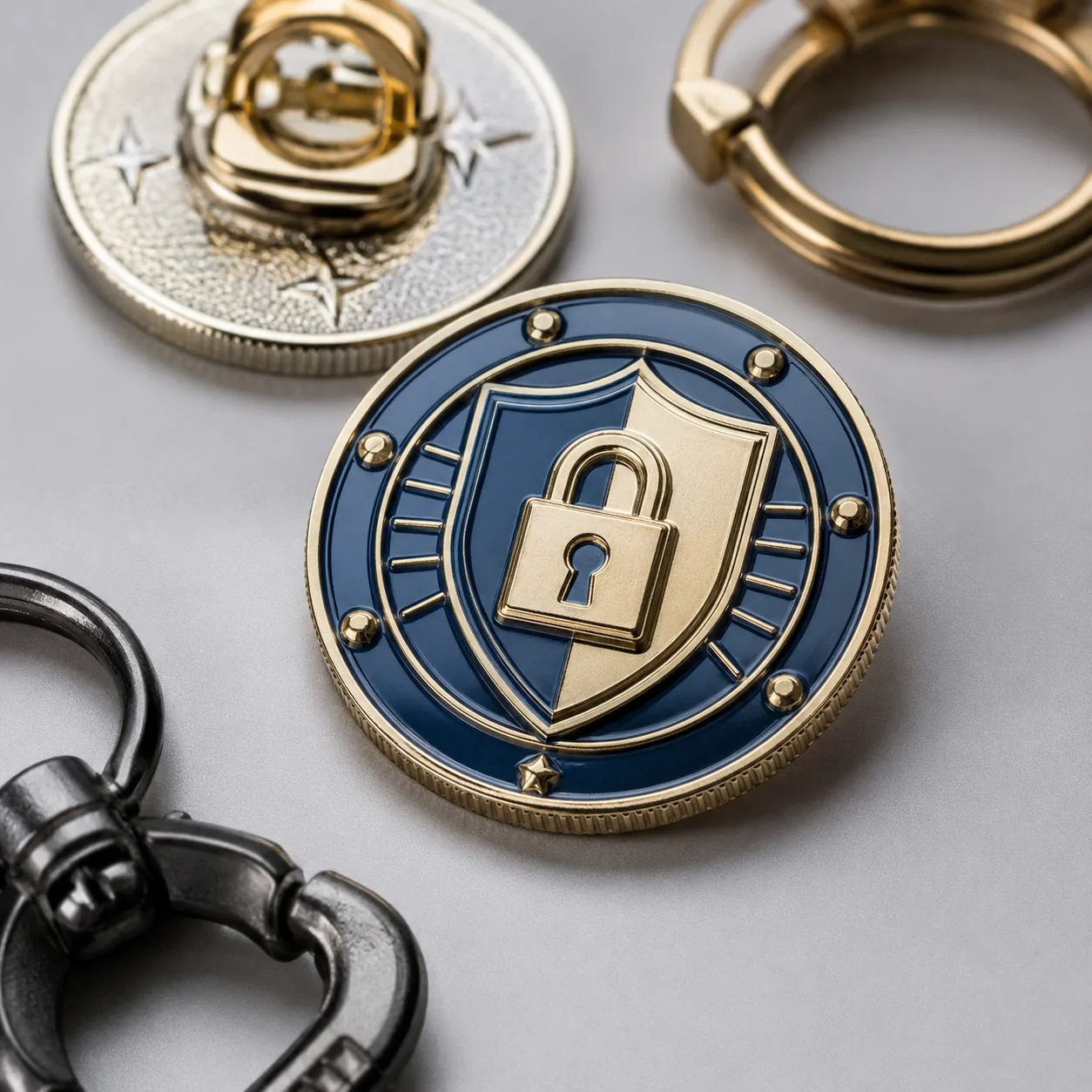
Why Buyers Reject the Back, Not the Logo Face
Rack-mark disputes usually start after an otherwise good shipment reaches a distributor warehouse. The logo face of the pin, coin, keychain or badge looks correct, but the reverse edge has a dark dot, hook shadow, small bare patch or raised bite mark. The buyer expected a fully decorative item on every surface; the factory treated the mark as the normal electrical contact point required for plating.
Electroplated metal parts cannot float freely in the bath. Brass, iron, zinc alloy, copper and stainless steel parts must be clipped, wired, hung or barrel-plated so electrical current reaches the surface. That contact point interrupts plating coverage and can leave a mark after nickel, gold, black nickel, antique brass or e-coat is applied. If the RFQ does not define where the contact may sit, how large it may be and how it will be inspected, the final inspection becomes subjective.
A practical rack-mark clause is more useful than a blanket demand for “no marks.” For typical promotional metal goods, a workable starting point is one reverse or edge contact mark up to 1.0 mm diameter on pins under 35 mm, or up to two rim marks of 1.5 mm on a 45 to 50 mm challenge coin. For retail jewelry-style programs, the limit may tighten to 0.6 to 0.8 mm, but the design must provide a hidden contact zone or accept extra cost for special racking and rework.
The buyer’s goal should be control, not wishful thinking. Confirm the rack position at sample stage, mark it on the approved sample photo, and classify out-of-zone marks as measurable defects. Moving a contact point after mass plating may require new racks, stripping and replating, or remaking parts, which can add 3 to 7 production days and create color variation between batches.
How Rack Marks Form in Plating
Rack marks are a result of current density, mechanical holding force and plating sequence. In rack plating, the part is held by a copper or stainless contact that must grip firmly enough to carry current and prevent movement. If the contact is weak, the part may swing, collide with neighboring parts, or plate unevenly. If the contact is too tight, it can leave a visible bite, indentation or raised burr after polishing and plating.
Soft enamel pins made from stamped iron or brass are commonly polished, plated, color-filled and baked, depending on the factory process and finish. Hard enamel pins are filled, baked, ground flush, polished and then plated, so the contact mark is often placed on the back edge or a non-customer-facing reverse area. A later polishing step can reduce minor shadows, but it will not remove a deep hook bite or exposed base metal.
Thicker products need stronger contact. A 45 mm coin at 3.0 mm thickness can weigh several times more than a 25 mm lapel pin, so the rack must hold the rim tightly enough to avoid movement. A poor contact can cause grey nickel haze, copper bleed, burning near raised details or thin plating in recessed areas. A heavy clamp can leave a dent deeper than 0.15 to 0.25 mm, which may be unacceptable on a smooth rim or polished reverse.
Barrel plating can reduce obvious hook marks on very small, simple metal parts, but it is not a universal solution. Parts tumble against each other, which can scratch mirror nickel, chip enamel walls, flatten small raised text or damage painted fills. For custom promotional products with logos, enamel, polished surfaces or controlled orientation, rack plating remains the safer method even though it requires an agreed contact point.
Choose Contact Zones by Product Type
The best rack location depends on viewing angle, assembly and end use. For lapel pins, the front decorative face should be free of rack marks under normal visual inspection at 30 cm. Preferred contact zones are the back edge, a reverse recess, or a flat back area that will be covered by a backing card and will not interfere with the post weld, clutch, magnet or brooch bar.
For keychains, the cleanest contact point is often inside the jump-ring hole or on the top edge hidden by the split ring. This only works if the hole is large enough. For small zinc alloy charms, specify a minimum hole diameter of 3.0 mm after plating; for heavier brass or iron keychains, 4.0 mm is safer. A hole that is too small can distort during racking, collect plating buildup or leave a burr that cuts the jump ring during use.
For challenge coins, keep rack marks on the outside rim or reverse lower edge, not in the artwork field. On a 40 to 50 mm coin, a practical instruction is: rack marks allowed only on the edge between 5 o’clock and 7 o’clock, no marks crossing raised text, serial numbers, QR codes or date lines. For antique finishes, also specify that antique wipe must not darken the rack point more than surrounding recesses.
For magnets, brooches and adhesive-backed badges, the rack zone must avoid functional assembly areas. A burr as small as 0.15 mm can reduce magnet or foam-tape contact, creating returns when the part detaches from a package, fridge surface or garment. If the back needs to sit flat, define both cosmetic and flatness limits, not only visual appearance.
| Product type | Preferred rack zone | Practical acceptance limit | Tighten the spec when |
|---|---|---|---|
| Soft enamel pin, 20-35 mm | Back edge or reverse recess | 1 mark max 1.0 mm diameter; burr max 0.10 mm; no front marks | Retail packaging, pale enamel, bright gold or white nickel |
| Hard enamel pin, 20-40 mm | Back edge away from post weld | 1 mark max 0.8 mm after polishing; no exposed base metal over 0.3 mm | Mirror nickel, black nickel, jewelry-grade presentation |
| Challenge coin, 40-50 mm | Outer rim or reverse lower edge | Up to 2 marks max 1.5 mm each; no artwork-field marks | Two-sided artwork, rim text, serial numbers, clean proof-like finish |
| Metal keychain charm, 30-60 mm | Inside ring hole or top edge | 1-2 marks max 1.2 mm; no burr that catches a ring or nail | Rotating hardware, daily-use campaigns, plated split rings |
| Fridge magnet or badge, 40-70 mm | Back edge outside adhesive area | 1-2 marks max 1.5 mm; back flat within 0.15 mm under adhesive | Thin magnet sheet, foam tape, glossy retail cards |
Write Measurable Acceptance Limits
A good rack-mark clause defines location, size, burr height, color exposure, inspection distance and defect class. For example: “No rack marks on front decorative face. Reverse rack mark allowed only inside approved zone shown on signed sample photo. Maximum diameter 1.0 mm, maximum raised burr 0.10 mm, no sharp edge, and no exposed base metal larger than 0.3 mm. Inspect at 30 cm under 600 to 800 lux before using magnification for measurement.”
Separate cosmetic shadow from exposed substrate. A darker nickel shadow inside an approved reverse zone may be acceptable on a low-cost giveaway. Exposed zinc, iron or copper outside the approved zone should normally be a major defect because it can corrode, stain packaging or create a visible color break. For black nickel, specify whether a grey contact dot in the approved zone is acceptable; black nickel often makes contact points look lighter than surrounding areas.
Plating thickness should also be realistic. Many promotional pins use copper underplate of 3 to 5 microns, nickel of 3 to 5 microns, and gold flash of 0.03 to 0.10 microns. Premium programs may specify nickel at 5 to 8 microns plus gold at 0.10 to 0.30 microns, or add clear electrophoretic coating at 8 to 12 microns for wear resistance. A higher thickness target may improve color stability but does not eliminate the need for a contact point.
For corrosion-sensitive orders, define test targets rather than relying on finish names. A daily-use keychain may need a 24 to 48 hour neutral salt spray target, especially for nickel, black nickel or gold-color finishes over zinc alloy. If the product ships to humid coastal markets or is attached to keys, bags or outdoor gear, a thin decorative flash alone is usually not enough.
Tolerances should match the product and inspection method. For ordinary promotional pins, rack-mark diameter can be measured to 0.1 mm with a caliper or optical ruler. Burr height only needs measurement when the mark affects flatness, adhesion, fabric safety or hardware movement. Do not reject a mark visible only under 10x magnification unless the purchase order explicitly sets a magnified inspection standard.
Match the Spec to Metal and Finish
Base metal affects how cleanly the part plates. Brass and copper-based materials usually accept plating more evenly and show fewer porosity problems, but they cost more and require suitable stamping or casting methods. Brass is a strong choice for hard enamel pins, premium brooches and coins where sharp edges, clean polishing and stable plating matter. Iron is economical for stamped pins and magnets but can rust quickly if exposed at a rack mark. Zinc alloy is cost-effective for 3D shapes and larger keychains, yet porosity near deep recesses and contact points must be controlled.
Finish choice changes the visibility of the same physical mark. Bright nickel, bright gold and black nickel show contact shadows more clearly because smooth reflective surfaces highlight color and texture changes. Antique brass, antique copper and antique silver hide minor contact points better, but antique wiping can clog fine text or make an approved rack zone look dirty if not controlled. Matte gold reduces glare but can reveal uneven brushing around the contact point.
For high-use products, wear resistance should outrank a microscopic hidden mark. A 50 mm zinc alloy keychain with 0.05 micron gold flash may look attractive in approval photos but wear quickly on corners and ring holes. A more durable specification would use nickel underplate of at least 5 microns, controlled deburring at the ring hole, optional clear e-coat of 8 to 12 microns, and no sharp burrs after 20 manual ring-rotation checks.
| Finish | Rack-mark visibility | Buyer note |
|---|---|---|
| Bright nickel | High | Keep marks off smooth backs and logo edges; reflective surfaces amplify shadows. |
| Gold flash | Medium to high | Thin gold can reveal nickel shadow; specify 0.10 micron or higher for better color stability. |
| Black nickel | High | Contact points can appear grey or coppery; avoid front faces and exposed rim text. |
| Antique brass or silver | Low to medium | Good for hiding marks, but control antique wipe around fine lettering. |
| Matte gold | Medium | Less glare than bright gold, but brushing must remain uniform near the contact point. |
| Clear e-coat over plating | Medium | Can bridge minor discoloration, but it will not hide sharp burrs or dents. |
Sampling and AQL Inspection Method
Rack control should be approved before mass plating. Ask for front, back and edge photos at 1:1 scale, plus a close-up of the planned rack zone with a ruler or caliper in frame. For physical samples, circle the approved contact location on the sample photo and store it with the signed golden sample file. That image becomes the reference for the plating line and the final inspector.
Use AQL inspection with clear defect classes. Many promotional metal orders use AQL 2.5 for major defects and AQL 4.0 for minor cosmetic defects, with critical defects at zero tolerance. A front-face rack mark, sharp burr, exposed base metal outside the approved zone, mark on a QR code or interference with a post, magnet, adhesive pad or key ring should be major. A small color shadow inside the approved zone and within the size limit can be acceptable or minor, depending on the buyer’s standard.
Inspection conditions must be stated. Normal cosmetic checks should be made under 600 to 800 lux neutral light at 30 cm viewing distance, with the part held at typical viewing angles. Use 5x magnification only to confirm suspected exposed base metal, burrs or cracks, not to create a stricter standard after production. If retail jewelry-level inspection is required, state it in the RFQ and expect higher sorting cost.
For functional surfaces, add simple handling checks. Run a cotton cloth across the rack zone to detect sharp burrs. Rotate the split ring through the keychain hole 20 times to check scraping. Press magnet or adhesive-backed badges on a flat plate to confirm no rocking caused by a raised contact point. These checks catch problems that a visual-only inspection may miss.
- Approve the rack-mark location on the pre-production sample photo before mass plating.
- State maximum diameter, burr height, exposed-base-metal allowance and inspection distance.
- Classify any front-face rack mark as major unless the design intentionally hides it.
- Use AQL 2.5 for major defects and AQL 4.0 for minor cosmetic defects unless the brand standard is stricter.
- Inspect at 600-800 lux and 30 cm before using 5x magnification for measurement.
- Reject burrs that catch fabric, cut skin, rock an adhesive pad or interfere with keychain hardware.
- Keep the approved rack-zone photo with the PO, artwork proof and golden sample record.
Cost, MOQ and Lead-Time Impact
Tighter rack-mark requirements add cost because they slow loading, require better fixtures, increase sorting and may raise the reject rate. For a standard 25 to 35 mm soft enamel pin, typical FOB pricing is about USD 0.45 to 1.20 at 500 to 3,000 pieces, depending on size, plating, colors, backing card and packing. MOQ is often 100 pieces for basic pins, but pricing becomes more efficient at 300, 500 and 1,000 pieces. A hidden-contact requirement, extra reverse polishing and 100 percent back inspection can add USD 0.03 to 0.12 per piece.
For hard enamel pins, pricing commonly ranges from USD 0.75 to 1.80 FOB at 500 to 2,000 pieces because grinding and polishing add labor. A stricter rack limit below 0.8 mm may require more careful hanging and rework, adding 2 to 4 days if the first sample shows a visible contact shadow. If the buyer also requires retail carding, individual polybags and barcode labels, cosmetic sorting should be completed before packing, not after carton sealing.
Challenge coins have higher sensitivity because the rim is often part of the design. A 45 to 50 mm coin at 3.0 mm thickness may price around USD 1.80 to 4.50 FOB at 300 to 1,000 pieces, depending on edge type, enamel, antique finish, numbering and packaging. Premium edge-control requirements can add USD 0.10 to 0.35 per piece due to stronger racks, slower plating and manual rim inspection.
Keychains and assembled metal accessories need both cosmetic and functional control. A 40 to 60 mm zinc alloy keychain may price around USD 0.80 to 2.20 FOB at 500 to 3,000 pieces, with higher costs for rotating parts, epoxy domes, bottle openers or custom split rings. Hiding the rack point inside a precise hole and deburring it after plating can add USD 0.04 to 0.18 per piece.
Lead time should be planned around approval gates. Standard pins often need 12 to 20 days after artwork and sample approval. Coins, brooches and complex keychains commonly need 18 to 30 days. Add 2 to 5 days for custom rack setup, plating trials, extra polishing or enhanced inspection. Rush orders are where rack disputes become most expensive because stripping and replating can dull details, shift color and miss the ship date.
RFQ Wording That Prevents Disputes
The weakest instruction is “no defects.” It sounds strict but gives the plating line no usable direction. A production-ready RFQ tells the factory where to hang the part, which surfaces are customer-facing, what size mark is acceptable, and how the buyer will inspect it. The same purchase order should also identify no-contact zones such as post welds, magnets, adhesive pads, brooch bars, QR codes, serial numbers and retail-facing logos.
Do not approve only the front artwork render. A 2D render does not show back attachments, rim thickness, split-ring access, magnet pads or rack clearance. For any custom metal item over 20 mm, include front, back and side views. If the product ships on a display card, specify which reverse areas remain visible to the consumer after packaging, because a mark hidden by a clutch or card may be acceptable while the same mark on an exposed retail back may not be.
Mixed-product promo sets need item-by-item limits. A pin, coin and keychain in one gift box may use different metals, thicknesses and plating racks. One universal cosmetic standard can be either too loose for the pin face or too strict for the coin rim. A better instruction is: pin reverse mark max 1.0 mm; coin rim marks max 1.5 mm each; keychain hole mark max 1.2 mm with burr below 0.10 mm and no hardware scraping.
For a balanced starting specification, use: no rack marks on front decorative surfaces; approved reverse or edge contact zone shown on sample photo; one mark up to 1.0 mm for pins under 35 mm; up to two rim marks of 1.5 mm for coins over 40 mm; no sharp burrs; no exposed base metal outside the approved zone; inspection at 30 cm under 600 to 800 lux; AQL 2.5 major and AQL 4.0 minor unless a stricter brand standard is agreed before quotation.
When working with ZheCraft on pins, brooches, keychains, fridge magnets or challenge coins, send both front and back artwork and identify the customer-facing surfaces after packaging. We can mark the proposed rack location on the pre-production sample photo, advise when a design needs a larger ring hole or hidden tab, and quote the difference between standard plating control and premium cosmetic control before tooling begins.
Have a project? Send your artwork and target quantity and we’ll reply with a detailed quotation within 12 working hours.
Ready to get this made?
Send your sketch, target quantity and ship-date. Detailed quotation in 12 hours.



