Quantity Breakpoints for Custom Pins: When to Order More
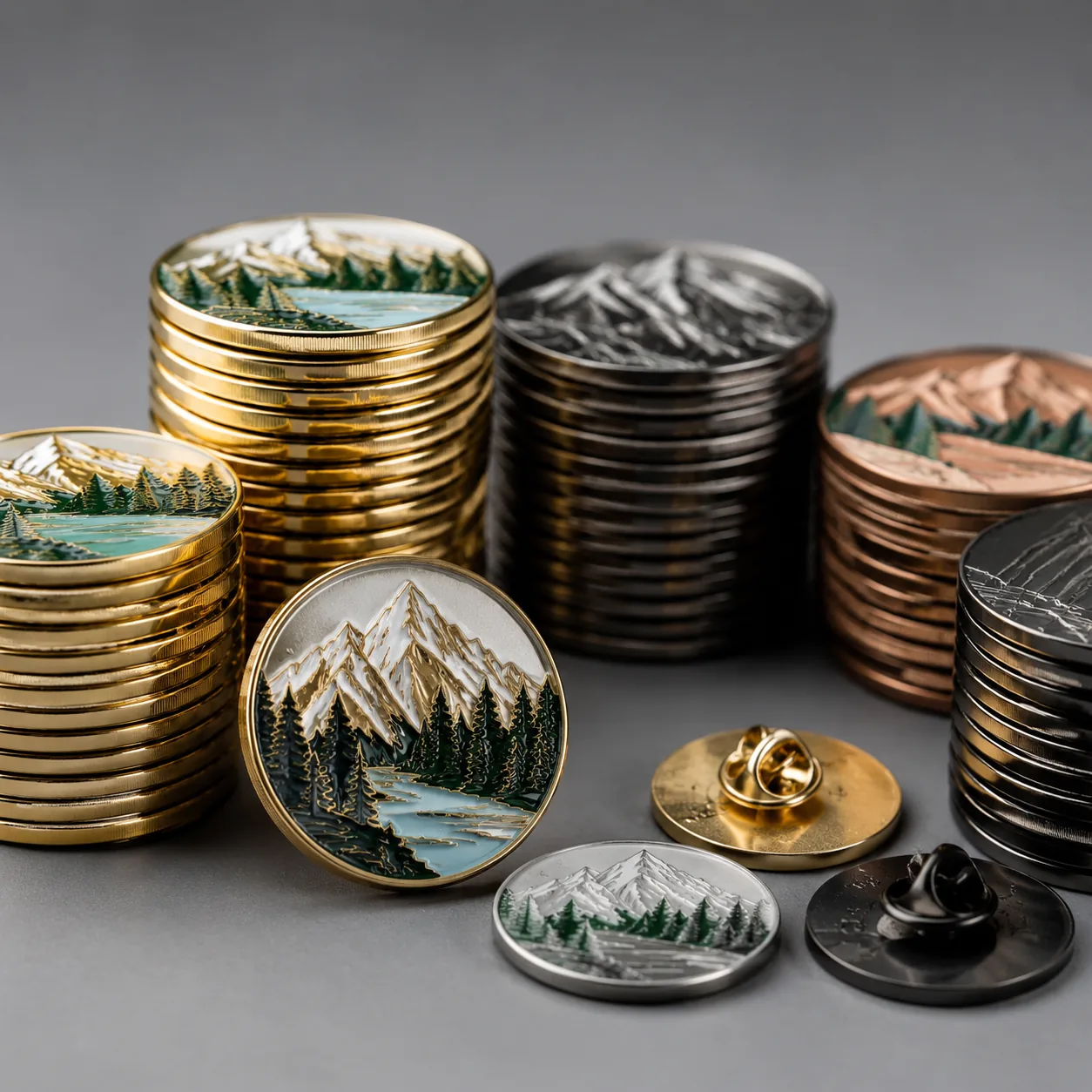
The real decision: 300, 500 or 1,000 pieces?
Most custom pin RFQs start with an uncertain quantity. The event team asks for 300 pieces, the distributor wants a 500-piece option, and finance asks whether 1,000 pieces lowers the cost enough to justify extra stock. The unit price usually falls as volume rises, but the lowest unit price is not always the lowest business cost. If the design includes a date, sponsor, campaign slogan or QR code that may change, surplus pins can become dead inventory.
For enamel pins, the first meaningful price break comes when fixed setup costs are spread across enough units. Mold cutting, artwork separation, plating setup, enamel color preparation and first-article checking do not double when the order doubles. Metal consumption, plating area, enamel filling, polishing, attachment soldering, packing and final inspection still rise with quantity.
At ZheCraft, we treat quantity selection as a margin and risk calculation. The right order size protects the campaign budget, meets the delivery date and avoids locking the buyer into obsolete branding. A good RFQ compares not only 300, 500 and 1,000 pieces, but also the usable life of the artwork, reorder probability, warehousing cost and inspection standard.
Cost elements that change with quantity
A standard 25 mm to 30 mm soft enamel pin in stamped iron or zinc alloy often carries a one-time mold charge of USD 40 to USD 90 for simple 2D artwork. A 40 mm to 50 mm badge with cutouts, recessed text, multiple levels or 3D relief can require USD 90 to USD 180 in tooling. If the mold charge is hidden inside the unit price, the first tier looks high; if tooling is shown separately, the unit price looks cleaner. The total factory cost is the same.
Variable costs are less flexible. A 30 mm iron soft enamel pin, 1.2 mm thick, with 3 to 5 micron decorative nickel plating, one butterfly clutch and one individual OPP bag may move from about USD 0.58 to USD 0.42 FOB when the order rises from 300 to 1,000 pieces. It will not honestly fall to USD 0.20 unless the size, thickness, plating, packing, inspection level or attachment has changed.
Buyers should keep the specification constant across all quoted tiers. A fair comparison uses the same base metal, thickness, enamel type, plating finish, attachment, packing and QC requirement. Normal production tolerances for stamped iron or brass pins are about plus or minus 0.2 mm on outside shape, plus or minus 0.1 mm on thickness and plus or minus 1 mm on printed card dimensions. Enamel colors should be checked against Pantone references under D65 lighting, with visual inspection commonly set at AQL 2.5 for major defects and AQL 4.0 for minor defects.
Typical enamel pin quantity breakpoints
The following ranges apply to standard 25 mm to 35 mm soft enamel pins made from iron or zinc alloy, 1.2 mm to 1.5 mm thick, with nickel, gold, black nickel or antique plating, one butterfly clutch and individual OPP packing. They assume four to six enamel colors, no epoxy dome, no backing card and no retail box. Hard enamel, brass, dual posts, magnets, safety pins, backing cards or gift boxes increase both price and lead time.
| Order quantity | Typical FOB unit range | Commercial meaning | Normal lead time after approval |
|---|---|---|---|
| 100 to 199 pcs | USD 0.95 to 1.60 | Useful for paid samples, VIP runs or proof-of-market orders; setup dominates cost | 12 to 18 days |
| 200 to 499 pcs | USD 0.58 to 1.05 | First practical MOQ for many promotional pins; manual labor remains high per piece | 14 to 20 days |
| 500 to 999 pcs | USD 0.42 to 0.78 | Common first price break; mold amortization, plating racks and enamel mixing improve | 16 to 24 days |
| 1,000 to 2,999 pcs | USD 0.32 to 0.62 | Stable distributor tier; packing and inspection become more efficient | 18 to 28 days |
| 3,000 to 5,000 pcs | USD 0.26 to 0.52 | Better material purchasing and line scheduling; carton rules should be fixed | 24 to 35 days |
| 10,000 pcs and above | Project quoted | Dedicated scheduling may be possible; staged QC and shipment planning are needed | 30 to 45 days |
For many B2B buyers, the most important breakpoint is 500 pieces. Below 500, setup cost is spread across too few units. Above 1,000, the price may still improve, but the savings per additional piece are smaller. The buyer then needs to ask whether the extra pins will sell, be distributed or support a confirmed reorder program.
When a larger order becomes expensive
Do not increase quantity only because the unit price is lower. A 1,000-piece order at USD 0.42 each plus a USD 60 mold costs USD 480 FOB. A 500-piece order at USD 0.55 plus the same mold costs USD 335 FOB. The larger order looks cheaper per purchased piece, but if only 600 pins are used before the campaign ends, the effective factory cost becomes USD 0.80 per used piece, before freight, duty and storage.
Large first orders are also risky when the product construction is unproven. A 50 mm brooch, magnet-backed badge, spinner pin, sliding element or design with raised metal lines below 0.25 mm should be sampled before mass production. Thin lines can fill with enamel, small text can lose legibility, magnets can be too weak for fabric weight, and oversized badges can rotate if they use only one post.
- Avoid large first orders when the logo may change within 3 to 6 months.
- Avoid excess inventory when the artwork includes a year, city, sponsor list, campaign code or short-lived QR link.
- Avoid scaling before confirming attachment strength, color approval, plating finish and packing fit.
- Avoid combining multiple artwork versions into one tier unless tooling, color setup and packing costs are shown for each version.
- Avoid a lower tier price if it depends on thinner metal, lighter plating, cheaper attachments or looser inspection.
A practical rule is to calculate expected usable pieces, not purchased pieces. If reorder probability is above 80 percent and the artwork is evergreen, move closer to the next price break. If reorder probability is closer to 50 percent, keep the first run lean and lock the mold, Pantone colors, plating finish, attachment and packing file for a faster reorder.
Specifications that shift the breakpoint
Size is the first cost driver. A 20 mm pin can be efficient at 300 to 500 pieces. A 50 mm badge uses more metal, plating capacity and polishing time, so the useful breakpoint may move to 1,000 or 2,000 pieces. For iron pins, 0.8 mm to 1.0 mm thickness can work for small giveaways, but 1.2 mm to 1.5 mm is more common for corporate pins. Premium badges and challenge-style pieces may use 1.8 mm to 2.5 mm.
Finish and material also change the economics. Standard nickel, gold, black nickel and antique finishes are efficient when the plating bath is already scheduled, with decorative plating commonly targeted at 3 to 5 microns. Nickel-free plating, double plating, selective plating, matte finishes or thicker precious-color finishes add cost and may require higher MOQs because the line needs additional cleaning, testing and inspection.
Color complexity affects labor more than buyers expect. Four broad enamel colors fill faster than nine small color islands. Soft enamel is more forgiving because raised metal borders separate the colors. Hard enamel requires overfill, baking and polishing, which increases labor and rejection risk when gaps are below 0.3 mm or raised metal borders are too narrow.
| Specification choice | Efficient starting tier | Better pricing tier | Buyer note |
|---|---|---|---|
| Iron soft enamel, 25 to 30 mm | 300 to 500 pcs | 1,000 pcs | Best for mass giveaways where slight magnetic attraction is acceptable |
| Brass hard enamel, 25 to 35 mm | 500 to 1,000 pcs | 3,000 pcs | Premium polish and feel, but higher metal and finishing cost |
| Zinc alloy 3D badge, 40 to 55 mm | 500 pcs | 2,000 pcs | Good for relief and cutouts; check weight, edges and attachment strength |
| Dual post or brooch bar | 500 pcs | 1,000 pcs | Reduces rotation but adds hardware, soldering and pull-test inspection |
| Backing card plus OPP bag | 1,000 pcs | 3,000 pcs | Card printing and hand assembly are inefficient at low volume |
| Epoxy dome coating | 500 pcs | 1,000 pcs | Adds gloss and protection; requires curing time and dust control |
Lead time, freight and cash-flow effects
Quantity affects schedule, but not in a straight line. A 300-piece order may need 14 to 20 days after artwork approval; 1,000 pieces may need 18 to 28 days. The difference is usually caused by plating slots, enamel drying, epoxy curing, packing labor and final inspection, not only by stamping or casting.
A realistic timeline separates each step: 1 to 2 days for production artwork, 3 to 5 days for mold cutting and raw sample, 2 to 3 days for sample finishing and approval photos, 7 to 18 days for mass production depending on quantity and complexity, and 2 to 4 days for QC and export packing. Air freight can shorten transit, but it cannot recover time lost to late artwork approval, missing Pantone numbers or a failed pre-production sample.
Cash flow matters for distributors. Larger orders require a higher deposit, more warehouse space and slower inventory turnover. If the customer has not approved final artwork, backing card text, barcode data and delivery address, a smaller confirmed batch plus a written reorder price valid for 30 to 60 days is safer. Reorder prices should state that they remain subject to metal, plating chemical and exchange-rate movement.
Inspection and packing at higher quantities
At 100 pieces, a factory can inspect every unit closely without major schedule impact. At 5,000 pieces, inspection must follow a defined plan. For promotional metal pins, a common baseline is general inspection level II, AQL 0 for critical defects, AQL 2.5 for major defects and AQL 4.0 for minor defects. Retail, children’s products or licensed merchandise may require tighter limits and additional compliance checks.
Major defects include wrong plating color, missing enamel, broken posts, weak solder joints, wrong attachment, unreadable logo text, severe front-face scratches or mixed artwork versions. Minor defects include small back-side marks, slight polishing variation, tiny enamel dust or minor OPP bag wrinkles that do not affect presentation. Functional checks can include post pull force, magnet holding strength, sharp-edge review and carton drop condition.
Packing becomes more important as quantity rises. Export cartons for pins are often kept below 12 kg to 15 kg gross weight. Inner bags, inner boxes and carton labels should separate SKUs clearly. For carded pins, specify card tolerance at plus or minus 1 mm, pin placement tolerance at plus or minus 2 mm, barcode position, carton mark format and whether cartons may mix designs.
- Confirm the sampling standard before production, usually general inspection level II unless tighter control is required.
- State AQL limits for critical, major and minor defects on the purchase order.
- Define front-face scratch limits by length and viewing distance, such as 30 cm under normal light.
- Require carton labels showing PO number, SKU, design name, quantity, gross weight and carton count.
- Ask for random packed-carton photos before shipment, not only loose product photos.
- For multi-SKU orders, require carton-level separation or a clear mixed-carton packing list.
A practical reorder-based buying method
Use total expected cost rather than unit price alone. Add tooling, unit cost, packing upgrades, China inland handling if quoted, export freight, import duty and expected leftover value. Then divide by the number of pieces likely to be used or sold during the artwork’s useful life. This exposes the real cost of overbuying.
For a new program, request three practical tiers such as 300, 500 and 1,000 pieces, or 1,000, 3,000 and 5,000 pieces for distributor replenishment. Ask the supplier to separate tooling, sample cost, unit price, packing cost and lead time. If the lower price depends on a thinner base, different plating, bulk packing or reduced inspection, it is not a true quantity break.
If the design is new, order the smallest tier that still supports the campaign, approve a physical pre-production sample and lock the reorder file. If the design is evergreen and sell-through is proven, move to the next breakpoint with fixed QC and packing rules. When the approved mold, Pantone references, plating finish, attachment and packing artwork are retained, a standard reorder can often ship in 10 to 20 production days after confirmation, unless the artwork changes or the mold requires repair.
Have a project? Send your artwork and target quantity and we’ll reply with a detailed quotation within 12 working hours.
Ready to get this made?
Send your sketch, target quantity and ship-date. Detailed quotation in 12 hours.



