QC Respec Sheet for Custom Pins in 2026: 12 Lines to Lock
Why legacy pin specs fail in 2026 sourcing
Many repeat pin programs still rely on phrases such as standard plating, Pantone match, no sharp edges, or attach securely. Those phrases are too subjective for multi-factory quoting, repeat reorders, and third-party inspection. In 2026, the bigger sourcing risk is usually not one dramatic factory error. It is lot-to-lot drift: raised metal lines thinning from 0.35 mm to 0.22 mm, enamel wells polishing through at corners, post spacing shifting enough to let a pin rotate on fabric, card punches landing off-center by 2 mm, or nickel tone changing noticeably between reorder lots.
A usable respec sheet converts preference into measurable acceptance criteria. Each critical line should be checkable by caliper, pin gauge, micrometer, coating-thickness gauge, color reference, pull tester, angle check, or AQL inspection. On most 25 mm to 40 mm custom pins, tightening the spec usually changes FOB by only USD 0.01 to 0.08 per piece, depending on whether the buyer adds thicker plating, upgraded clutches, tighter carding alignment, or a higher inspection threshold. That is typically cheaper than one partial remake, one expedited air correction, or one retailer chargeback.
The best savings rarely come from pushing another USD 0.02 out of unit cost. They come from controlling the lines that cause preventable disputes: process choice, tolerance stack-up, enamel geometry, plating definition, attachment security, packaging presentation, and shipment release rules. If an inspector cannot decide pass or fail in under 30 seconds using the sheet and the golden sample, the specification is still too vague.
1) Lock construction, metal, thickness, and process limits
The first line should identify build method, base metal, finish family, and nominal thickness in one sentence. Example: stamped iron soft enamel pin, bright nickel plating, nominal body thickness 1.5 mm before posts. That prevents a supplier from quietly substituting die-cast zinc alloy, photo-etched brass, or printed steel, which may look similar in artwork review but behave differently in edge definition, weight, polish response, and unit cost.
Tie tolerances to the actual process. For stamped iron pins up to 40 mm, a practical finished outline tolerance is +/- 0.15 mm, body thickness tolerance +/- 0.10 mm, and flatness bow not more than 0.30 mm measured across the longest axis on a flat plate. For die-cast zinc alloy, outline tolerance is more commonly +/- 0.20 mm because mold shrink and trimming variation are higher, while flatness up to 0.40 mm may still be acceptable on thicker 3D pieces. Photo-etched brass can hold very fine separators, but body thickness is commonly 0.8 to 1.2 mm, which some buyers consider too light for premium retail or corporate recognition programs.
Use process capability to guide artwork before sampling. If internal cutouts drop below 1.2 mm, arms are long and unsupported, or relief depth exceeds 0.6 mm, die-cast zinc alloy is usually safer than stamped iron. If the design depends on 0.25 to 0.30 mm separators, fine hatch detail, or small text, photo-etched brass or printed metal is often the more reliable path. Typical tooling remains modest by hard-goods standards: stamped die USD 50 to 120, zinc alloy mold USD 80 to 180, photo-etch film and tool USD 50 to 100. Sample lead time is commonly 5 to 7 days for etched styles, 7 to 10 days for stamped styles, and 8 to 12 days for zinc alloy castings.
| Spec item | Stamped iron | Die-cast zinc alloy | Photo-etched brass |
|---|---|---|---|
| Best use | Crisp outlines, standard soft enamel, routine promo pins | Complex cutouts, thicker body, 3D relief | Fine detail, thin profile, badge-style graphics |
| Typical thickness | 1.2 to 2.0 mm | 1.5 to 3.0 mm | 0.8 to 1.2 mm |
| Practical MOQ | 100 to 300 pcs | 100 to 300 pcs | 100 to 300 pcs |
| Typical tooling | USD 50 to 120 | USD 80 to 180 | USD 50 to 100 |
| Usual outline tolerance | +/- 0.15 mm | +/- 0.20 mm | +/- 0.15 mm |
| Main trade-off | Less suited to deep relief | Edges slightly softer after casting and polishing | Lighter feel and lower perceived mass |
2) Define size, post geometry, and attachment strength
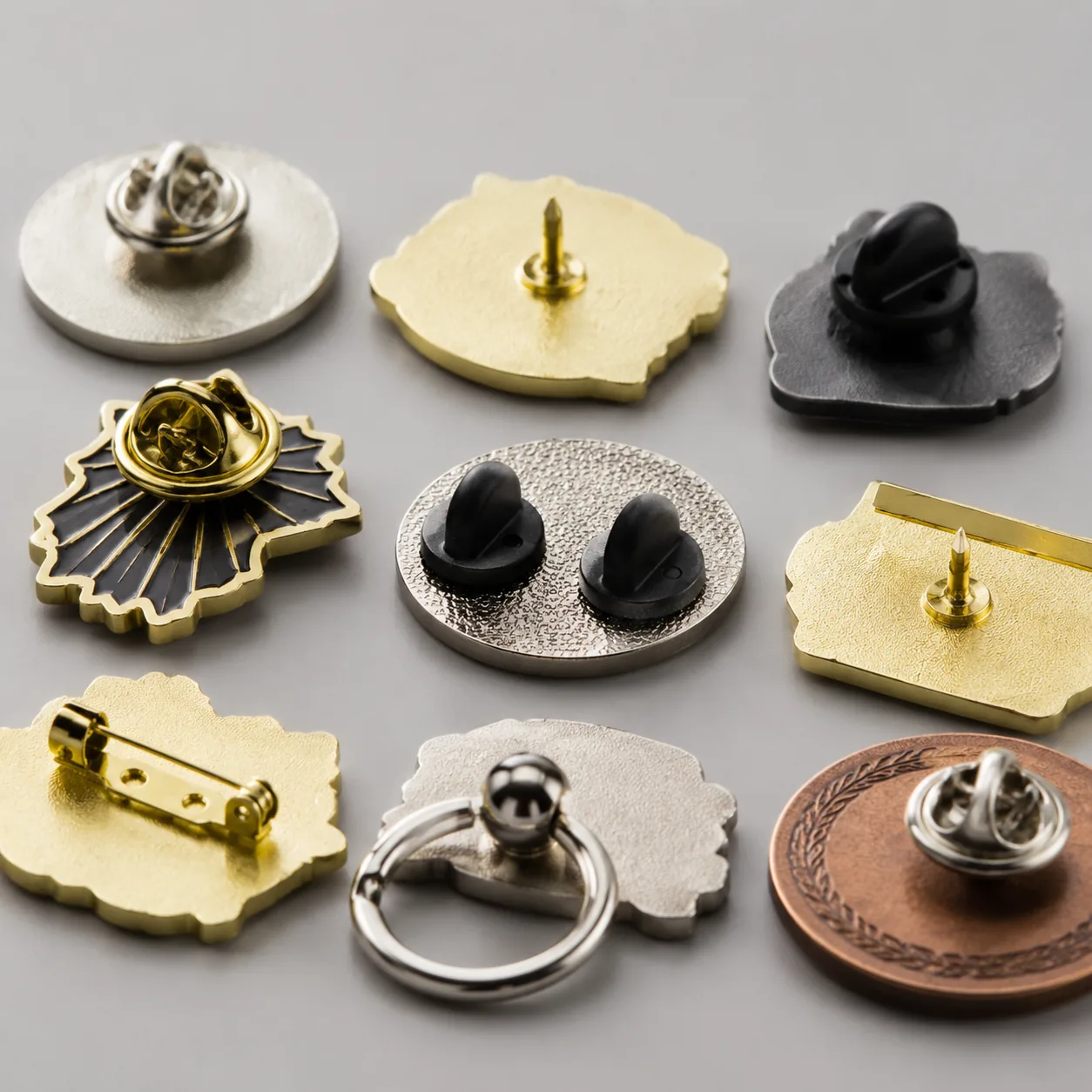
Attachment complaints are often geometry problems disguised as assembly problems. The spec should state finished size, post count, post diameter, usable post length, post spacing, backing type, and pull requirement. Example: finished size 38.0 mm x 24.0 mm, tolerance +/- 0.15 mm; two posts, 0.9 mm diameter, 5.5 mm usable length; post center spacing 20.0 mm +/- 0.5 mm; nickel butterfly clutches. That makes the design inspectable and reduces spin, tilt, loose mounting, and crooked presentation on backing cards.
As a working rule, one post is usually acceptable for round or near-square pins up to about 25 mm and under 8 g. Above 32 mm width, or where aspect ratio exceeds 1.5:1, two posts are the safer default. Above 45 mm or roughly 12 g, many buyers move to two posts with rubber or locking clutches. Standard butterfly clutches usually add little or no cost at scale, while locking clutches often add about USD 0.03 to 0.08 per set and reduce fallout claims for uniforms, events, and resale packaging.
Strength needs a number, not a promise. For soldered or welded posts on standard lapel pins, a practical minimum retention target is 3 kgf axial pull for 10 seconds with no detachment, cracking, or visible separation at the joint. For heavier badge bars or thicker cast pieces, 4 to 5 kgf may be more appropriate. If a badge bar is used, specify alignment the same way: 20 mm safety bar centered within +/- 1.0 mm, hinge and catch parallel to top edge within 1 degree, adhesive not accepted as the primary fixing method unless the buyer explicitly approves it.
3) Make the artwork manufacturable before it becomes scrap
Most preventable art-to-production drift starts in metal and enamel geometry. For standard stamped soft enamel, a reliable baseline is minimum raised metal line width 0.30 mm, preferred 0.35 mm; minimum isolated recessed enamel area 0.50 mm; minimum backstamp stroke width 0.40 mm; minimum backstamp text height 1.2 mm for consistent legibility; and enamel fill target 0.08 to 0.15 mm below the raised metal after bake and polish. Those limits are realistic for volume production and can be checked against retained samples and critical dimensions on the approved drawing.
If those limits are omitted, factories often try to preserve detail that the process cannot consistently hold. The result is merged borders, uneven sinking, exposed corners after polishing, or fragile metal islands that chip during handling and packing. Buyers sometimes insist on 0.20 mm separators on low-cost stamped pins, then question why reject rates rise above 8 to 10 percent or why the supplier recommends etching instead. That is usually a process-capability mismatch, not simply poor execution.
Special fills need their own acceptance line. Glitter, glow, pearl, transparent, and translucent enamels can follow the same geometry minimums, but visual variation is naturally wider because particle density, base-coat brightness, and light transmission affect perceived depth. A more practical standard is approval against a pre-production sample under D65 or 5000 K neutral light at 30 to 40 cm viewing distance, rather than insisting on an exact Pantone-style match for effect colors. For standard opaque enamel, many buyers accept Delta E below 2.0 to 2.5 against the approved chip, with the understanding that very small areas and dark metallic surrounds can shift visual perception.
4) Specify plating by finish, microns, and visible defect standard
Standard gold or standard nickel is not a workable QC instruction. A usable plating line should define finish family, appearance, coating thickness if critical, and unacceptable defects. Example: bright nickel, mirror finish, no antique wipe; visible face free from pits, blistering, exposed base metal, burn marks, stains, and sharp burrs when inspected at 40 cm under white light. If antique plating is required, specify wipe depth or contrast expectation, because antique variation is one of the most common causes of reorder disputes.
For decorative indoor pins, a common finish stack includes copper and nickel underlayers with a thin decorative top finish. Flash gold is often around 0.03 to 0.10 microns, while bright nickel appearance depends more on the underlying nickel layer and polish quality than on a simple color name. When buyers want better tone stability or wear resistance, they often specify a thicker total decorative stack in the 3 to 5 micron range or add a clear e-coat or lacquer topcoat. On a 30 mm to 35 mm pin, that upgrade commonly adds USD 0.02 to 0.06 per piece. It improves consistency and tarnish resistance, but it does not turn a decorative lapel pin into corrosion-proof hardware.
Match plating performance to use. Indoor event giveaways can usually accept standard decorative plating. Collector retail, hospitality, museum, or souvenir programs may justify thicker plating or a protective clear topcoat. If the pin will contact sweat, cosmetics, humidity, or frequent abrasion, say so in the RFQ and define a realistic test, such as 24 to 48 hours neutral salt spray for comparative screening only, not as a guarantee of field life. The key acceptance line on receipt is simple: no visible pitting, no bare spots on the face, no burrs that catch fabric or skin, and no plating tone outside the approved sample.
5) Treat packaging and presentation as controlled quality points
A pin can pass tray inspection and still disappoint the customer because the presentation is poor. Common failure modes are off-center card punching, tilted mounting, scuffing from loose clutches, scratched polished faces, or thin OPP bags that collapse and trap dust. Packaging should sit on the same spec sheet as the metal part. Example: each pin mounted on 350 gsm coated card, card size 90 mm x 55 mm +/- 1.0 mm, card hole position +/- 0.75 mm, logo top edge parallel to card top within 2 degrees, packed in self-seal OPP bag 0.04 mm thick.
For mirror-polish plating, large black enamel areas, or premium gift presentation, specify whether a protective tissue, PET sleeve, or removable surface film is required. Do not over-specify protection where it adds more labor than value. Typical packing cost adders are modest but worth naming early: plain bulk polybag near zero to USD 0.01, individual OPP bag USD 0.005 to 0.015, custom carding and mounted assembly about USD 0.03 to 0.12, and rigid gift box much higher depending on insert, print finish, and hand assembly.
If clutches are packed separately, say so. If they must be attached on card before bagging, state that instead. These details materially change scratch risk, assembly speed, and unboxing quality. Retailers and distributors usually judge quality from the complete packed unit, not the loose metal part in a sample tray.
6) Set shipment release rules: golden sample, defect list, and AQL
Email photos are not enough for shipment control. The release standard should identify the controlling master: approved pre-production sample, sealed golden sample, or golden sample plus dimensional report. For repeat orders, the cleanest instruction is shipment must match the sealed golden sample for plating tone, enamel placement, attachment location, and carding orientation, subject to the measurable tolerances on the sheet.
Then define the inspection plan. For most promotional pins, ANSI/ASQ Z1.4 General Inspection Level II with AQL 2.5 for major defects and 4.0 for minor defects is a workable baseline. Premium retail, museum, or membership programs often tighten to major 1.5 and minor 2.5. Major defects typically include wrong artwork or wording, size outside tolerance, missing or loose attachment, post detachment under pull test, plating blistering, exposed base metal on the front face, sharp burrs, wrong finish family, or incorrect backing hardware. Minor defects usually include limited backside marks, slight color drift within approved tolerance, or small card misalignment that does not affect display or function.
- List major and minor defects in writing before sampling starts
- State inspection level and AQL on the PO, artwork sheet, and final QC sheet
- Name the controlling golden sample for every repeat order
- Require random packed-carton photos, not only loose beauty shots
- Record carton quantity, net weight, gross weight, and outer carton size on the packing list
- Define post pull test, burr check, and card alignment as standard release items
Carton data matters beyond freight booking. It helps catch underpacking, mixed lots, and last-minute substitutions in card stock, bag thickness, or backing hardware. On air shipments, even a 5 percent gross-weight variance can shift landed cost enough to erase margin on a tight promotion. On consolidated seafreight, wrong carton count or dimensions can trigger avoidable receiving disputes and chargebacks.
7) Use a 12-line respec suppliers can quote and QC can inspect
A strong respec sheet is detailed enough that two suppliers quote the same product rather than two different interpretations. The template below reflects what many factories can hold consistently on a standard 30 mm to 35 mm stamped soft enamel pin without pushing the process into abnormal reject risk.
| Spec line | Example wording |
|---|---|
| 1. Construction | Stamped iron soft enamel pin, bright nickel finish, nominal thickness 1.5 mm |
| 2. Size | Finished size 32.0 mm x 28.0 mm, outline tolerance +/- 0.15 mm |
| 3. Flatness | Maximum bow 0.30 mm across longest axis |
| 4. Artwork limits | Minimum raised metal line 0.30 mm; preferred 0.35 mm; minimum isolated enamel area 0.50 mm |
| 5. Fill standard | Soft enamel fill 0.08 to 0.15 mm below raised metal after bake and polish |
| 6. Attachment | Two posts, 0.9 mm diameter, 18.0 mm spacing +/- 0.5 mm, butterfly clutches |
| 7. Pull test | Post joint withstands 3 kgf pull for 10 seconds without failure |
| 8. Back detail | Backstamp centered; minimum stroke width 0.40 mm; minimum text height 1.2 mm |
| 9. Finish quality | Visible face free from pits, burrs, plating blistering, and exposed base metal at 40 cm inspection |
| 10. Packaging | Mounted on 350 gsm card, hole position +/- 0.75 mm, individually bagged in 0.04 mm OPP |
| 11. Inspection | ANSI/ASQ Z1.4 General Level II, AQL 2.5 major / 4.0 minor |
| 12. Shipment control | Golden sample controls shipment; carton count, GW, NW, and dimensions required |
For a straightforward 30 mm to 35 mm stamped iron soft enamel pin with 4 to 6 colors, bright nickel, two posts, and individual bagging, realistic FOB ranges are about USD 0.48 to 0.95 each at 100 to 300 pcs, USD 0.34 to 0.62 each at 500 pcs, USD 0.29 to 0.55 each at 1,000 pcs, and USD 0.24 to 0.46 each at 3,000 pcs, excluding duty and freight. MOQs below 100 pcs are possible with some factories, but unit cost usually rises sharply and process control narrows. Add roughly USD 0.02 to 0.06 for locking clutches, thicker plating, clear topcoat, or tighter carding control. Die-cast zinc alloy with deeper relief or complex cutouts generally sits above those ranges by about USD 0.05 to 0.20 depending on weight and cavity complexity.
Lead times should also be written in days, not described as fast. A practical baseline is artwork review 1 to 2 days, pre-production sample 7 to 10 days after artwork confirmation, mass production 10 to 18 days after sample approval, carding and final assembly 1 to 3 additional days, and third-party inspection booking 1 to 2 days if scheduled early. During peak gifting and event seasons, queue time can add 5 to 10 days, which is often a larger risk than the metal process itself.
What to change on your next PO
Start with one active pin SKU and mark every phrase that cannot be checked with a tool, approved sample, or written defect definition. Replace premium, standard, smooth, correct color, and secure attachment with numbers or observable criteria. On repeat orders, compare the last approved sample, current PO, and supplier order confirmation line by line. Missing details usually cluster around thickness, post geometry, plating finish, card orientation, or hardware packing.
Do not tighten everything at once. Prioritize the three lines that are costing the most money when they drift: plating consistency, clutch security, enamel geometry, or carding accuracy. Lock those first. If the supplier resists, ask a process-capability question instead of arguing preference: what tolerance can you hold consistently at 100 pcs, 500 pcs, and 5,000 pcs without reject rates above 3 to 5 percent? That shifts the conversation from opinion to manufacturability.
Finally, keep the revised respec as one controlled document that travels with artwork approval, pre-production sample approval, and final QC instructions. That discipline stabilizes repeat orders far more effectively than chasing another cent off FOB. The same logic applies across pins, keychains, badges, medallions, and coins: if the line cannot be made consistently and rejected consistently, it is not yet a real specification.
Have a project? Send your artwork and target quantity and we’ll reply with a detailed quotation within 12 working hours.
Ready to get this made?
Send your sketch, target quantity and ship-date. Detailed quotation in 12 hours.



