QC-First Respec Workflow for Custom Promo Orders
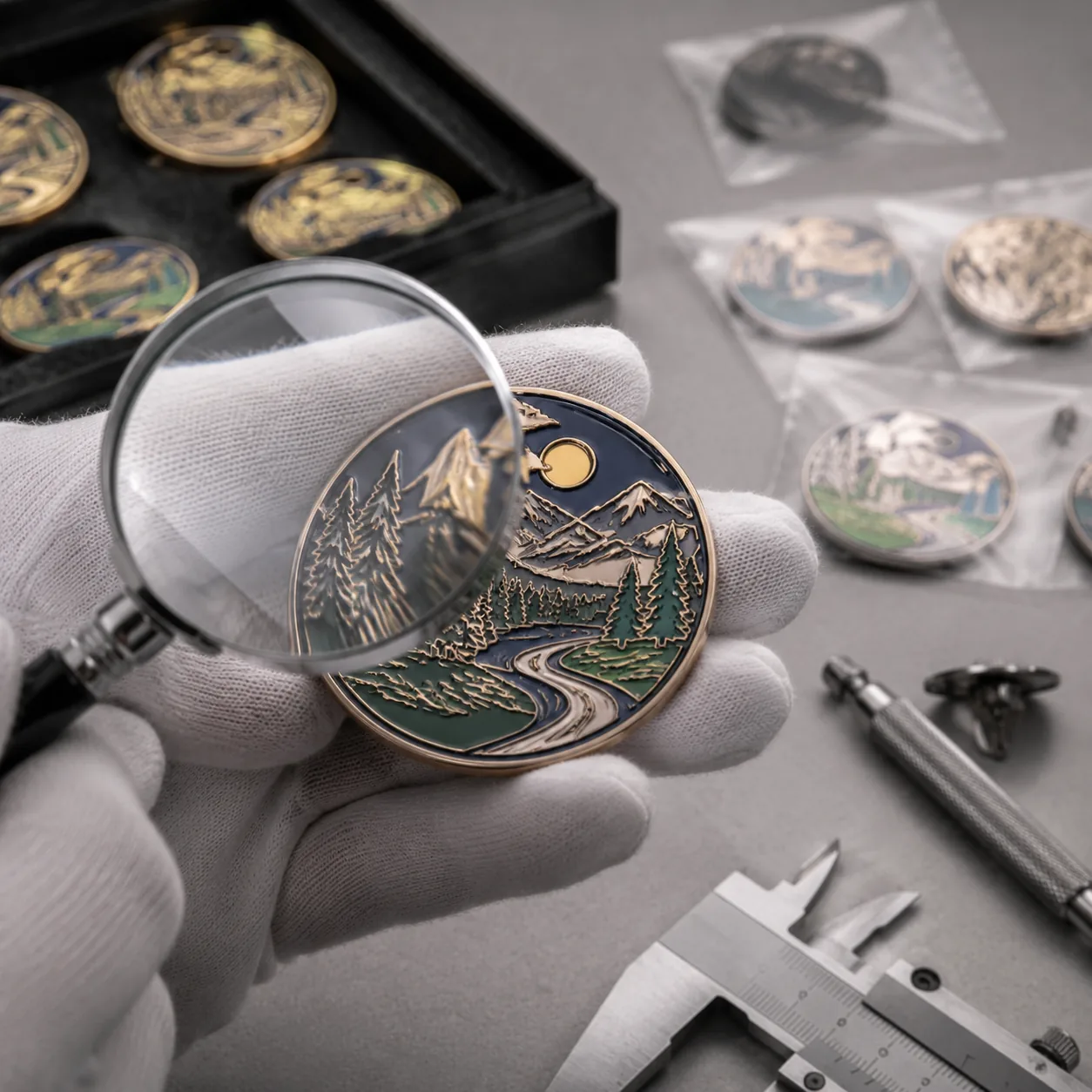
1. Convert the RFQ into an inspection-ready specification
Most disputes on custom promotional products start before sampling. A buyer requests a “35 mm hard enamel pin with antique gold plating and individual packing,” but the RFQ does not define plating thickness, enamel level, attachment strength, carton weight, barcode location, nickel limits or cosmetic acceptance. The factory quotes a normal promotional item; the brand, licensing or retail team later inspects it against a higher standard that was never priced.
Rewrite the RFQ as an inspection plan before final quoting. For pins, coins and keychains, define size tolerance, thickness tolerance, base metal, plating type, plating thickness, enamel process, attachment test, packing method, inspection level and AQL. Practical dimensional tolerances are ±0.3 mm for metal items under 50 mm, ±0.5 mm for 50-80 mm items, and ±0.2 mm on thickness for stamped or die-cast products. For molded PVC keychains, use ±0.5 mm on overall size and ±0.3 mm on thickness because shrinkage varies by color, mold temperature and part geometry.
Plating language must be specific. Low-cost decorative plating is often only 0.03-0.05 microns. Standard promotional metal goods are commonly 0.05-0.10 microns. Better retail handling, darker antique relief or improved tarnish resistance usually needs 0.10-0.20 microns plus longer polishing and racking time. Do not imply jewelry-grade plating, real gold content or long-term skin-contact performance unless the item is engineered, priced and tested for that use.
Set AQL before sampling. For Class B promotional goods, use Critical 0, Major 1.5 and Minor 4.0 under General Inspection Level II. For retail, licensed or child-facing goods, use Critical 0, Major 1.0 and Minor 2.5, with 100% checks on safety-related functions such as posts, magnets, clasps, sharp edges and small detachable parts. For woven patches, specify ±2 mm overall size tolerance, merrow border 3 mm ±0.5 mm, no loose thread longer than 3 mm, and color approval against physical Pantone, yarn cards or signed limit samples under D65 light.
A clarified spec changes price, but it prevents false savings. A 40 mm zinc alloy soft enamel keychain at 2.5 mm thickness may quote at USD 0.78-1.25 FOB Ningbo or Shanghai at 1,000 pcs with standard plating and one OPP bag. Adding 0.10-0.20 micron plating, epoxy dome, 30 mm split ring, printed backing card, barcode label and tighter AQL can move the same item to USD 1.15-1.85 FOB. That difference should be a buying decision, not a post-shipment dispute.
2. Classify risk before comparing factories
A one-day conference giveaway, a nickel-free retail brooch and a children’s keychain should not share the same approval route. Assign a risk class first, then require each supplier to quote to that class. This stops one factory from pricing a budget item while another prices a retail-safe product.
| Risk class | Typical items | Required controls | MOQ, lead time and FOB range |
|---|---|---|---|
| Class A | Nickel-free pins, brooches, children’s keychains, museum retail coins, wearable licensed goods | Pre-production sample; material declaration; Critical 0 / Major 1.0 / Minor 2.5; 0.10-0.20 micron plating where applicable; 100% function check on attachments; nickel release, lead or cadmium testing when required by market | MOQ 500-1,000 pcs; sample 7-14 days; bulk 22-35 days after approval; typical pins USD 0.75-1.80 FOB |
| Class B | Corporate pins, convention coins, branded magnets, distributor patches, standard loyalty merchandise | Pre-production sample or signed top-of-production sample; Critical 0 / Major 1.5 / Minor 4.0; 0.05-0.10 micron plating; normal export packing | MOQ 300-500 pcs; sample 5-10 days; bulk 15-25 days; typical pins USD 0.42-1.10 FOB |
| Class C | Budget handouts, internal event keychains, simple fridge magnets, short-life campaign items | Approved artwork or golden sample; Critical 0 / Major 2.5 / Minor 6.5; simplified packing and carton check | MOQ 100-300 pcs; digital proof 1-2 days; bulk 10-18 days; simple PVC, iron or acrylic items USD 0.25-0.70 FOB |
Do not over-spec the wrong product. Retail mirror polishing on distressed antique plating creates artificial rejection because antique finish is intentionally uneven. Conversely, do not under-spec wearable or child-facing goods that need smooth edges, secure posts, small-parts control or nickel compliance. A small MOQ does not make a safety requirement optional.
3. Engineer artwork before tooling or weaving files are approved
Many “production defects” are artwork engineering failures. Thin raised lines, tiny enamel islands, sharp cutouts, unsupported text and weak attachment positions may look acceptable in a PDF but fail during stamping, casting, polishing, weaving or assembly. Respec the artwork before the mold, die or weaving program is released.
For soft enamel and hard enamel pins, keep raised metal lines at 0.25 mm minimum for stamped iron or brass and 0.30 mm minimum for zinc alloy casting. Enamel cells should be at least 0.35 mm wide, with 0.40 mm preferred where dark enamel borders polished metal. Internal cutout radii should be at least 0.5 mm to reduce rough plating, trapped polishing compound and weak corners. For printed pins, epoxy stickers or offset-printed coins, keep text above 1.2 mm cap height; smaller text should move to a backing card, insert or label.
For patches, match process to artwork. Woven patches can hold clean uppercase letters around 4-5 mm high. Embroidered patches usually need 6-7 mm uppercase text and wider strokes. A merrow border normally needs a simple outer shape; sharp star points, thin tails and tight concave corners are better with laser-cut woven or printed patches. QR codes should not be woven below about 25 x 25 mm, and every sample must pass a phone scan test before approval.
Engineer the back side at the same time. A 25-35 mm pin often uses one 8 mm post. A 40-55 mm badge should normally use two posts spaced 18-28 mm apart to prevent rotation. A brooch over 45 mm wide or over 18 g should use a 25-35 mm safety brooch bar instead of a single butterfly clutch. Wide fridge magnets should be rotation-tested; two 8 x 2 mm neodymium magnets near the ends often hold better than one center magnet.
- Mark every color with Pantone C or U, plus a physical chip, yarn card or signed color limit for critical colors.
- State whether outlines are raised metal, printed ink or recessed enamel separation.
- Confirm minimum metal line width, enamel island size and internal cutout radius before mold approval.
- Show attachment position, post spacing, magnet location or brooch-bar direction on a back-view drawing.
- Define the front finish: recessed soft enamel, flush hard enamel, epoxy dome, printed face, antique relief, polished metal or matte plating.
- Move tiny legal text, QR codes, gradients and serial data to labels, backing cards or inserts when the base process cannot reproduce them.
4. Quote one controlled product, not three interpretations
After respecing the RFQ, send suppliers a quote sheet that forces identical assumptions. Otherwise one supplier may quote 1.2 mm iron soft enamel, another 2.5 mm zinc alloy, and a third brass hard enamel with thicker plating. The lowest price may simply be a lighter item with weaker attachments and looser packing.
For a 35 mm soft enamel pin, specify base metal, thickness, finish, plating thickness, enamel type, epoxy yes/no, backing, packaging, color count, inspection level and MOQ tiers. Ask for FOB prices at 300, 500, 1,000 and 3,000 pcs. At 1,000 pcs, a normal 35 mm iron soft enamel pin is often USD 0.42-0.85 FOB, depending on colors, plating and clutch type. A brass hard enamel pin of similar size is more often USD 0.85-1.60 FOB because brass cost, polishing, enamel grinding and rejection risk are higher.
For challenge coins, quote by diameter, thickness, metal and estimated weight. A 45 mm zinc alloy coin at 3.0 mm may run USD 1.40-2.30 FOB at 1,000 pcs. A 50 mm brass coin at 4.0 mm with two-side enamel and antique plating may be USD 2.40-4.20 FOB. For keychains, require ring size and wire diameter; a “standard ring” could mean a weak 20 mm ring with 1.4 mm wire or a stronger 30 mm ring with 2.0 mm wire.
| Spec line | Weak RFQ wording | QC-driven respec |
|---|---|---|
| Pin material | Metal pin | Iron soft enamel, 35 mm, 1.5 mm thickness, size ±0.3 mm, thickness ±0.2 mm |
| Plating | Gold plating | Imitation gold plating, 0.05-0.10 microns, no exposed base metal on front face |
| Attachment | Butterfly clutch | 8 mm post with brass butterfly clutch; pull test 3 kg for 10 seconds |
| Keychain ring | Standard ring | 25 mm split ring, 1.8 mm wire, nickel plated, no open gap over 0.5 mm |
| Patch border | Merrow border | Merrowed edge, 3 mm ±0.5 mm, no loose threads over 3 mm |
| Packing | Individually packed | 1 pc per 6 x 8 cm OPP bag, 100 pcs per inner bag, export carton below 15 kg gross |
5. Approve samples against measurable limits
A pre-production sample should prove that the factory can manufacture the approved specification. It should not become a new design meeting unless the original spec was incomplete. For most pins, coins and keychains, sample lead time is 5-9 days for standard plating and enamel, and 8-14 days for 3D relief, transparent enamel, glitter, glow pigment, epoxy domes, rotating parts or custom attachments. Patch samples are usually 4-7 days for woven or embroidered designs, and 7-12 days when backing, laser cutting or printed labels are added.
Measure samples instead of relying on photos. Use a caliper for size and thickness, a gram scale for weight, and a D65 light box or consistent daylight source for color. If instruments are available, define color tolerance such as ΔE ≤ 2.0 for printed labels and ΔE ≤ 3.0 for enamel or yarn. If not, approve against a physical Pantone chip, yarn card or signed limit sample. Screenshots are not color standards.
Add simple function tests. For pin posts and brooch bars, use a 3 kg pull test for 10 seconds for standard promotional goods and 5 kg for heavier retail brooches where the base metal supports it. For keychains, rotate the split ring 20 times and confirm it closes fully. For magnets, test on painted steel with the intended backing card or polybag in place because packaging thickness reduces holding force. For epoxy domes, reject bubbles over 0.5 mm in the focal logo area, edge overflow, yellowing or tacky surfaces after curing.
- Reject immediately for sharp burrs, exposed base metal on the front, wrong logo shape, missing enamel color, unsafe attachment failure or mixed artwork versions.
- Hold for engineering review for minor enamel underfill, slight antique darkness variation, small polishing waves or tight packaging fit.
- Accept with a signed limit sample only when the cosmetic condition is repeatable and agreed, such as back-side polishing marks under 0.5 mm.
- Do not approve Class A orders, nickel-free items, moving parts, magnets for children or multi-piece gift sets from photos only.
6. Freeze the control sample, packing plan and change rules
Once the sample is approved, freeze it. The control package should include the physical sample, final artwork, dimension drawing, material and finish specification, Pantone or yarn references, packing method, approved defect limits and inspection level. If the buyer later sends a revised logo, new barcode, changed backing card or updated legal label, treat it as a change order with a new revision number, not as a harmless file update.
A useful control label includes customer name, item code, revision number, approval date, production order number, supplier name and factory contact. This matters for reorders because polishing time, enamel viscosity, plating bath condition, yarn lot, magnet grade and epoxy curing can change appearance. A reorder without a retained control sample is effectively a new order with old expectations.
Freeze the carton plan before mass packing. Keep export cartons below 15 kg gross weight where practical, and use inner bags, paper interleaves or small boxes to prevent metal-on-metal scratching. Enamel pins on backing cards commonly pack 100 pcs per inner carton and 500-1,000 pcs per master carton. Heavy 50 mm coins may need only 100-200 pcs per master carton, with corner protection, to avoid crushed retail boxes and failed drop handling. Define barcode location, carton marks, SKU separation and mixed-carton rules before labels are printed.
7. Inspect early production and apply the agreed AQL
The best time to catch defects is the first 5-10% of production, not the final day. A top-of-production check confirms tooling, plating, enamel fill, printing, attachments and packing against the approved sample before the batch is committed. This is especially important for antique plating, transparent enamel, epoxy domes, woven QR codes, rotating parts, mixed gift sets and any order above 5,000 pcs.
Ask for early production photos with a ruler, thickness reading, front and back views, packing view and a short function-test video. For higher-risk or time-critical orders, use an in-line inspection. Sorting 300 early pieces is manageable; sorting 30,000 finished pieces is slow, expensive and less reliable. If a defect is found, separate affected lots by production date, plating batch, operator line or packing team instead of mixing all goods.
Final inspection should follow the agreed AQL and defect definitions. For a 1,000-piece Class B order under General Inspection Level II, the common sample size is 80 pcs. Under Major 1.5, acceptance is typically 3 major defects maximum and rejection at 4. Under Minor 4.0, acceptance is typically 7 minor defects maximum and rejection at 8. Confirm the sampling standard used, such as ANSI/ASQ Z1.4 or ISO 2859-1, before inspection.
| Defect type | Major defect example | Minor defect example |
|---|---|---|
| Color | Wrong Pantone family, such as navy produced as black | Slight shade variation within approved limit sample |
| Metal finish | Peeling plating or exposed base metal on front face | Back-side polishing mark under 0.5 mm |
| Enamel | Missing fill, wrong color area or large bubble on logo | Tiny recessed dot outside focal logo area |
| Attachment | Post breaks, magnet detaches or split ring gap over 0.5 mm | Slight clutch tightness variation that still holds |
| Packing | Wrong barcode, missing safety label or mixed SKUs | Wrinkled OPP bag with undamaged product |
For the next order, issue a one-page respec pack before asking for the best price. Include dimensions, material, thickness, finish, color references, attachment, packaging, MOQ tiers, lead-time target, inspection level and defect classification. A practical timeline is: respec RFQ in 1 day, receive comparable quotes in 2-3 days, approve proof in 1 day, sample in 5-14 days, freeze the control sample, produce bulk in 10-35 days, then inspect before shipment. The rule is simple: decide how the product will be judged before anyone starts making it.
Have a project? Send your artwork and target quantity and we’ll reply with a detailed quotation within 12 working hours.
Ready to get this made?
Send your sketch, target quantity and ship-date. Detailed quotation in 12 hours.



