PVC vs Silicone Patches: Technical Specs for Apparel and Gear Buyers
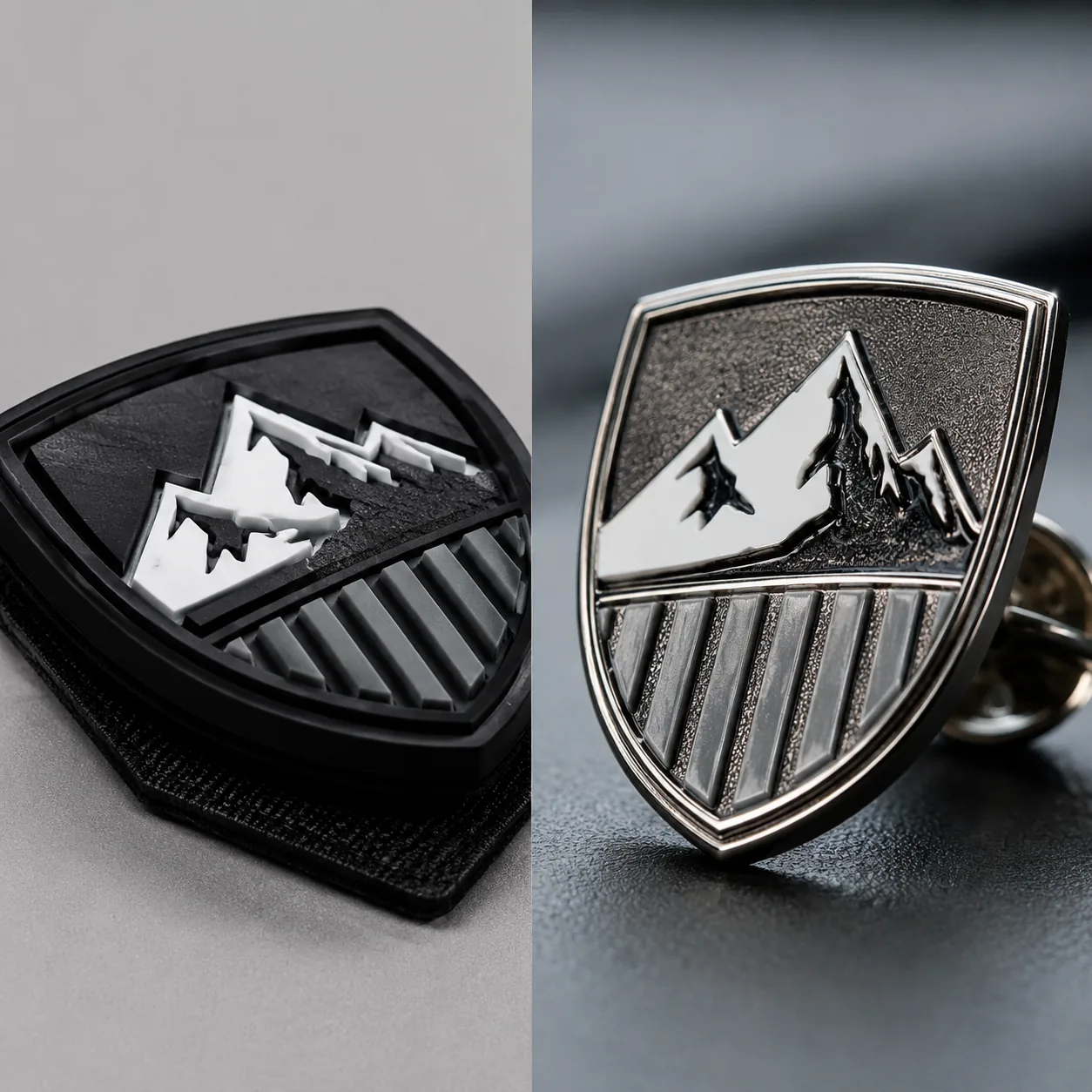
Buyer Risk: Similar Mockups, Different Production Behavior
A buyer may send one vector logo and request “rubber patches,” but most factories will quote two different molded constructions: soft PVC and silicone. They can look nearly identical in a PDF proof, yet they do not sew, flex, age, or price the same way. The wrong choice usually fails after the patch is attached to the finished product: corners lift, small letters fill in, the badge feels too stiff on a sleeve, or the brand color looks flat under retail lighting.
This comparison is for bulk trims where the patch contributes to perceived product value, not for the cheapest possible giveaway label. Common finished sizes are 40 to 90 mm for chest, sleeve, and cap patches; 70 to 120 mm for backpack and luggage badges; and 25 to 45 mm for zipper pulls, key fobs, and cord tabs. Most apparel patches work best at 1.5 to 3.0 mm total thickness. Bag and tactical patches can go heavier, but weight and sewability must be checked before approving bulk.
The practical rule is simple: choose PVC for rugged dimensional detail and controlled cost; choose silicone for a softer, cleaner, more premium feel, especially on apparel or skin-contact accessories. Procurement still needs tighter numbers than that. A useful RFQ should define size, thickness, Shore hardness, relief height, minimum line width, backing, color standard, tolerance, inspection level, packing, and the actual attachment process.
Technical Spec Table: PVC vs Silicone
| Spec point | Soft PVC patch | Silicone patch |
|---|---|---|
| Typical base material | Phthalate-restricted soft PVC compound; request CPSIA, REACH, or Prop 65 compliance when relevant | Molded silicone rubber; request food-grade or skin-contact grade only when required by the use case |
| Typical hardness | 60 to 75 Shore A; 65 Shore A is a common balance for sew-on patches | 45 to 65 Shore A; 50 to 55 Shore A is common for soft apparel trims |
| Best size range | 35 to 120 mm; larger patches are possible but become heavy and less flexible | 25 to 100 mm; large thin pieces can stretch during sewing if not supported |
| Typical thickness | 2.0 to 4.0 mm total; 2.5 mm is common for apparel and caps | 1.2 to 3.0 mm total; 1.5 to 2.0 mm is common for garments |
| Relief height | 0.4 to 1.2 mm above base; strong for bold borders and icons | 0.2 to 0.8 mm above base; better for shallow premium detail |
| Minimum raised line | 0.45 mm safe; 0.35 mm only for simple geometry after sampling | 0.35 mm safe; 0.25 mm possible on precision molds with sample approval |
| Minimum recessed gap | 0.40 to 0.50 mm to reduce color merge and weak walls | 0.30 to 0.40 mm for cleaner negative spaces |
| Small text guidance | 2.0 mm letter height minimum; 2.5 mm safer for mass production | 1.5 mm possible for block letters; 2.0 mm safer for consistent fill |
| Pantone matching | Good, but neon, translucent, and very light colors require sample approval | Very good on solid colors; matte texture can make colors appear slightly muted |
| Heat resistance | Typically suitable to 60 to 70°C continuous exposure, depending compound | Often stable at 120°C or higher, depending grade and pigment system |
| Cold flexibility | Good for normal outdoor use; can stiffen in low temperatures | Better low-temperature flexibility for winter gear and outdoor accessories |
| MOQ planning | 100 to 299 pcs sample or small run; 300 to 499 pcs workable; 500+ pcs efficient | 100 to 299 pcs possible; 300 to 499 pcs workable; 500+ pcs preferred for pricing |
| Tooling cost | USD 40 to 120 for common 2D molds; USD 120 to 250 for complex multi-level tooling | USD 60 to 180 for standard molds; USD 180 to 350 for precision multi-color tools |
| FOB unit range at 500 pcs | USD 0.45 to 1.60 for 50 to 80 mm patches, excluding special packing | USD 0.70 to 2.40 for 50 to 80 mm patches, excluding special packing |
| Sample lead time | 7 to 10 days after artwork, Pantone, and backing approval | 8 to 12 days after artwork, Pantone, and backing approval |
| Mass lead time | 12 to 20 days after sample approval for 500 to 5,000 pcs | 14 to 24 days after sample approval for 500 to 5,000 pcs |
| Common attachment | Sew-on channel, Velcro, pressure-sensitive adhesive, key ring, cord loop | Sew-on channel, heat-transfer film, Velcro, adhesive, cord loop |
| Inspection baseline | AQL 2.5 major / 4.0 minor for standard trims; tighter for retail-critical programs | AQL 2.5 major / 4.0 minor; add peel or wash testing for heat-transfer backs |
These are planning ranges, not universal guarantees. A 12-color 95 mm badge with 1.6 mm letters will not price or mold like a 3-color 55 mm sleeve patch. For comparable quotes, send one controlled RFQ package: vector artwork, final size, thickness, color count, Pantone references, backing method, quantity tier, packing method, compliance requirements, and whether the supplier must attach the patch to a finished product.
Where PVC Wins: Bold Relief and Lower Unit Cost
Soft PVC is usually the better construction when the design needs thick dimensional relief, strong color separation, and a rugged outdoor look. It is common on tactical-style patches, backpack labels, sports merchandise, luggage tags, rubber keychains, and promotional gear that will be handled roughly. PVC is especially effective for raised borders, shield shapes, large icons, molded channels, and high-contrast logos with 2 to 5 colors.
For a 70 mm wide, 3-color, 2.5 mm thick sew-on PVC patch, a realistic FOB range at 500 pieces is USD 0.65 to 1.20, with tooling around USD 60 to 120. At 1,000 pieces, the same design may fall to USD 0.50 to 0.95. At 3,000 to 5,000 pieces, a simple design may reach USD 0.38 to 0.75, assuming no stitched Velcro, individual retail carding, or unusual compliance testing. Tooling can often be reused for reorders if size, relief, and backing do not change.
PVC is less suitable for very fine typography, luxury soft-touch trims, or high-temperature applications. Strokes below 0.45 mm can swell after molding, and enclosed spaces below 0.40 mm may close or trap color. If the patch will sit on lightweight knitwear, baby apparel, yoga wear, or a product that touches skin for long periods, silicone usually deserves a side-by-side sample even when the quote is 20 to 60 percent higher.
Where Silicone Wins: Soft Handfeel and Fine Molded Detail
Silicone is preferred when touch, flexibility, and a clean surface matter more than the lowest unit price. It is used on athleisure garments, premium caps, waterproof bags, baby and pet accessories, smartwatch straps, zipper pulls, and retail apparel trims. A matte dry-touch silicone patch usually feels smoother and less plasticky than PVC, and it bends more naturally on thinner fabrics.
For detailed logos, silicone can hold cleaner shallow relief if the mold and artwork are engineered correctly. A 0.35 mm raised line and a 0.30 to 0.40 mm recessed gap are practical targets for production. Simple block lettering at 1.5 mm height may pass on a good tool, but 2.0 mm or larger is safer for repeat orders. For embossed or debossed areas, 0.20 to 0.40 mm depth usually gives visible definition without weakening the part.
The cost increase comes from higher material cost, mold precision, slower handling, and stricter surface control. A 60 mm, 3-color silicone patch at 500 pieces often sits at USD 0.80 to 1.60 FOB. A 5-color version with heat-transfer film, matte finish, and individual bagging can exceed USD 2.00 to 2.80. Silicone is not the best route for a low-cost giveaway, but it is often the better trim for retail garments where the customer will notice touch, flexibility, and finish quality.
Artwork Engineering Before Tooling
The same logo file should not go to PVC and silicone tooling unchanged. PVC needs bolder walls between color fields so liquid material does not merge, underfill, or create weak dividers. Silicone can handle finer shallow details, but long unsupported bridges can stretch, flash, or tear if the patch is too soft or too thin. Engineering the artwork before tooling is cheaper than remaking a mold after a failed sample.
All text should be converted to outlines, each color should be assigned a Pantone reference, and the drawing should show the patch at 1:1 scale. A production drawing should state total thickness, base thickness, relief height, border width, sewing channel width, backing type, edge profile, hardness, and tolerance. For typical molded trims, use ±0.5 mm size tolerance below 80 mm, ±0.8 mm from 80 to 120 mm, and ±0.2 mm to ±0.3 mm for thickness unless the supplier confirms tighter capability.
- Keep sew-on border width at 2.0 to 3.0 mm so the needle path does not cut through raised logo areas.
- Use 0.45 mm minimum raised lines for PVC; use 0.35 mm only after sample confirmation.
- Use 0.35 mm minimum raised lines for silicone; reserve 0.25 mm for precision molds and simple shapes.
- Keep molded color count to 6 or fewer when possible; 7 to 8 colors raise labor time and reject risk.
- Specify matte, semi-matte, or glossy finish in writing instead of approving finish from photos only.
- Approve molded color against a physical sample under D65 daylight or light-box conditions.
- Avoid placing thin loops, holes, or cord slots closer than 2.0 mm from the outer edge.
Pantone matching on molded rubber is not the same as printing ink on paper. Material opacity, pigment loading, surface texture, and thickness all change perceived color. The enforceable standard should be the signed physical pre-production sample, not a coated paper Pantone chip viewed on a desk.
Attachment Method: Sewing, Velcro, Heat Film, Adhesive
Attachment choice can determine field performance more than the base material. A well-molded silicone patch can fail if the heat film is wrong for the fabric. A basic PVC patch can last for years if it has a flat sewing channel and the needle path avoids thick relief. Buyers should lock the attachment method before approving thickness, edge shape, and backing.
Sew-on construction is the most reliable option for jackets, caps, backpacks, uniforms, and heavy garments. The patch should include a flat channel 2.0 to 3.0 mm wide, with no raised details crossing the stitch path. For PVC, 2.5 to 3.0 mm total thickness is common. For silicone apparel trims, 1.5 to 2.0 mm is easier to sew and reduces edge lift. If the factory will sew the patch to finished goods, confirm thread color, stitch density, margin from edge, and whether the part will be sewn before or after garment washing.
Velcro is strong for tactical, uniform, and reusable event patches, but it adds bulk and cost. Hook-and-loop backing typically adds USD 0.15 to 0.45 per piece depending on size, material grade, and stitch pattern. Heat-transfer film is more common with silicone than PVC and must be tested on the buyer’s actual fabric. A common starting point is 145 to 160°C, 12 to 18 seconds, and medium pressure, but the approved setting must come from peel and wash testing, not a generic data sheet.
| Attachment | Best with PVC | Best with silicone | Buyer warning |
|---|---|---|---|
| Sew-on | Excellent for bags, jackets, caps, and uniforms | Excellent for apparel and soft goods | Use a flat 2.0 to 3.0 mm needle path and avoid thick corners |
| Velcro | Excellent for tactical and removable patches | Good, but less common for thin fashion trims | Adds thickness; check peel strength and edge stitching |
| Heat-transfer film | Possible, but less common and fabric-dependent | Good for apparel trims when tested correctly | Validate press temperature, dwell time, pressure, and wash cycle |
| Pressure-sensitive adhesive | Useful for packaging, samples, or temporary labels | Useful for temporary placement | Not suitable for durable garments, washing, or hot storage |
| Key ring or cord loop | Strong for rubber key fobs and zipper pulls | Good for soft zipper pulls and cord tabs | Reinforce hole area and keep at least 2.0 mm wall thickness |
QC Criteria and Functional Testing
Inspection should cover more than logo appearance. Common PVC defects include color overflow, trapped bubbles, dirt specks, uneven trimming, warping after cooling, strong odor, and underfilled corners. Common silicone defects include flashing, dust contamination, weak color fill, tacky surface, tear marks at thin bridges, and inconsistent matte finish. Any defect that changes branding, attachment strength, safety, or usability should be treated as major.
A practical baseline for promotional and apparel trims is AQL 2.5 for major defects and AQL 4.0 for minor defects. Major defects include wrong material, wrong Pantone family, wrong backing, missing logo elements, broken attachment, heavy contamination, cracked walls, size outside tolerance, or heat-transfer failure. Minor defects include small specks, light edge burrs, slight color variation from the approved sample, or surface marks not visible at 50 cm under normal light.
Functional tests should match the product. For sew-on patches, check thickness, edge strength, and flexibility after 20 cycles of 180-degree bending. For Velcro patches, check stitching security and peel resistance after repeated removal. For heat-transfer silicone patches, test initial peel and then retest after at least 5 home-laundry cycles on the actual garment fabric. For outdoor gear, add cold-flex and heat-exposure checks, especially for bags stored in cars, winter sports accessories, or products exposed to direct sun.
Cost, MOQ, and Lead-Time Planning
PVC is often cheaper at the same size and color count, but the lowest quote is not always the lowest total cost. If a PVC patch is too thick for a garment, sewing time increases and the edge may look bulky. If a silicone patch is quoted with a low-grade mold, the savings can disappear through poor detail, sampling delays, or high rejection. Compare quotes on the same drawing, not only on the same logo image.
MOQ is usually negotiable, but pricing changes sharply below 300 pieces because tooling, setup, and color preparation dominate the cost. At 100 pieces, a 60 mm PVC patch may be USD 1.20 to 2.50 FOB before packaging, while silicone may be USD 1.60 to 3.50. At 500 pieces, both materials usually become commercially efficient. At 1,000 to 5,000 pieces, the unit price improves further, but lead time may extend if the order includes Velcro stitching, individual polybags, barcode labels, or factory attachment to garments.
Plan 7 to 12 days for molded samples after artwork and Pantone approval, then 12 to 24 days for mass production after sample sign-off for 500 to 5,000 pieces. Add 3 to 7 days for stitched Velcro assembly, custom retail packing, or lab testing. For repeat programs, confirm mold storage terms, mold life, reorder minimums, and whether a new sample is required when changing backing, hardness, color, or finish.
Selection Checklist for RFQs and Sample Approval
Start with the product use case, then lock the material. For rugged promotional gear, tactical-style branding, luggage trims, and bold dimensional logos, PVC is usually the first sample route. Specify 2.5 to 3.0 mm thickness, 60 to 75 Shore A hardness, 0.45 mm minimum raised lines, 2.0 to 3.0 mm sewing channel, Pantone colors, and AQL 2.5 major / 4.0 minor. Ask the supplier to mark any artwork areas that cannot mold cleanly before opening the tool.
For retail apparel, soft accessories, skin-contact products, or a premium matte feel, start with silicone. Specify 1.5 to 2.0 mm garment thickness, 45 to 65 Shore A hardness, 0.35 mm minimum raised lines, finish, backing, and any wash or peel test requirement. Do not approve silicone from a photo alone. Approve a physical pre-production sample for color, handfeel, flexibility, surface finish, and attachment strength.
- Send final vector artwork with size, Pantone colors, thickness target, hardness, and backing method in one RFQ.
- Ask for PVC and silicone quotes when the use case is not fixed or when retail feel matters.
- Request an annotated production drawing before tooling, not only a front-view mockup.
- Approve a physical sample for color, relief, edge quality, hardness, odor, and attachment performance.
- Test apparel patches on the actual fabric before mass approval, especially for heat-transfer backs.
- Lock the signed sample as the inspection standard for bulk shipment and future reorders.
Mixed programs often use both materials in one campaign. A cap patch and garment sleeve badge may work better in silicone, while a matching keychain, luggage tag, or backpack badge may be better in PVC. ZheCraft can quote both routes from the same artwork, keep brand colors and logo relief consistent, and adjust thickness, backing, and hardness for each product’s function.
Have a project? Send your artwork and target quantity and we’ll reply with a detailed quotation within 12 working hours.
Ready to get this made?
Send your sketch, target quantity and ship-date. Detailed quotation in 12 hours.



