PVC vs Metal Fridge Magnets: Buyer Specification Comparison
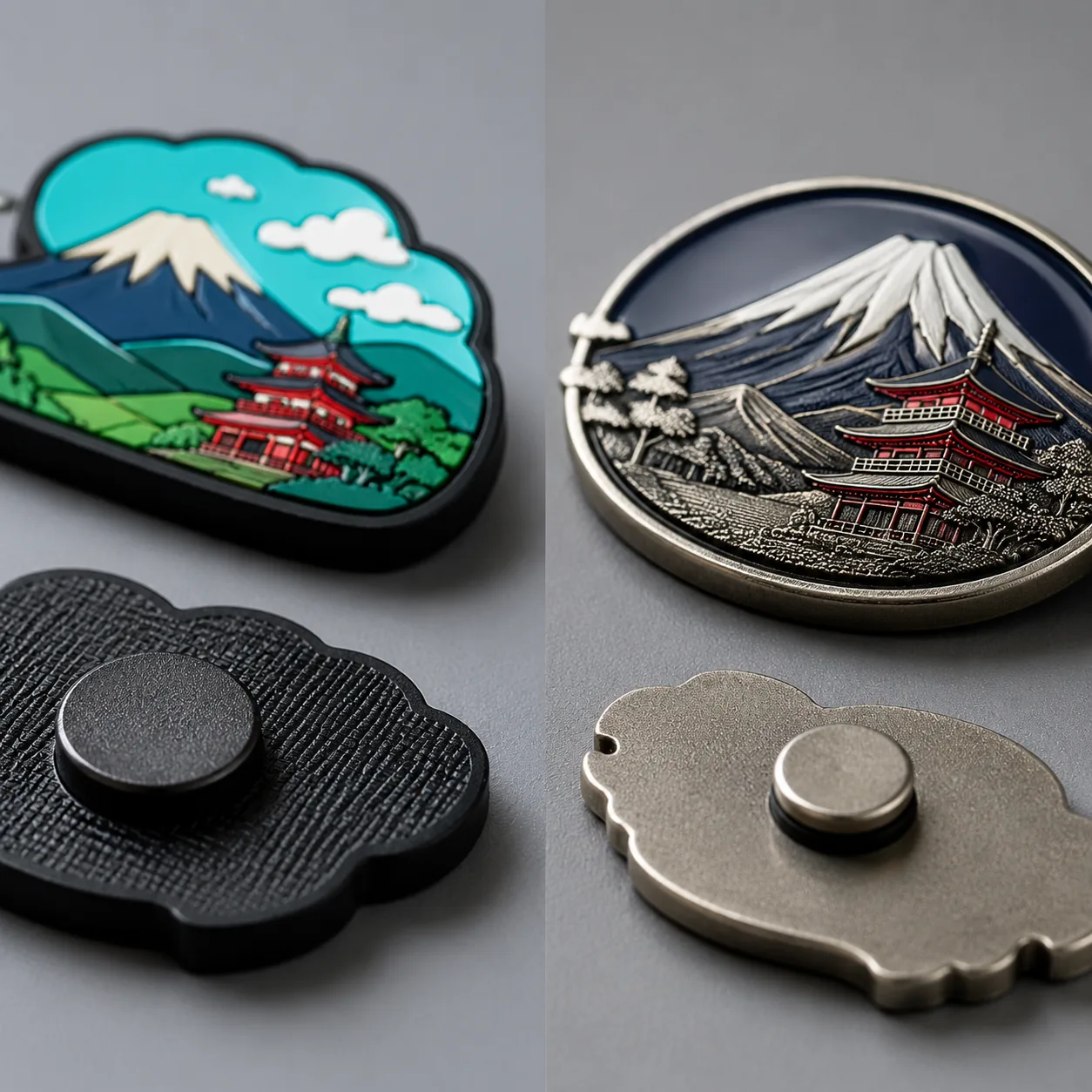
Why One Artwork Produces Two Different Magnet Quotes
A buyer sends the same 70 mm cartoon mascot to three suppliers and receives two different recommendations: soft PVC at USD 0.42 FOB per piece and die-cast zinc alloy with enamel at USD 1.15 FOB per piece. Both are described as “custom fridge magnets,” but they will not feel, weigh, pack, age, or pass inspection in the same way. If the RFQ does not define size, body thickness, magnet type, pull force, surface standard, packaging, and inspection level, the lowest quote may win on paper and fail in the user’s hand.
This comparison is written for promotional-product distributors, museum shops, tourism brands, event teams, food brands, and corporate buyers choosing between soft PVC and metal fridge magnets. The question is not which material is better in general. PVC is usually stronger for playful shapes, many solid colors, soft edges, and lower unit cost. Metal is stronger for premium perceived value, crisp raised borders, plating finishes, and collectible souvenir positioning.
At ZheCraft in Yiwu, we produce both soft PVC and metal enamel magnets, and the main production risk usually appears before tooling. Artwork designed for a flat sticker is approved for a molded part without simplifying fine lines, color islands, raised borders, magnet placement, or weight distribution. The result is a sample that looks acceptable in a PDF but becomes too heavy, too soft in detail, or too weak on a refrigerator door.
RFQ Specification Table: PVC vs Metal
Use the following ranges as practical starting points for B2B orders between 1,000 and 10,000 pieces. They are not universal limits, but they make supplier quotes comparable. If the design is over 80 mm, heavier than 35 g, or packed for retail, ask the supplier to confirm carton weight, drop-test assumptions, and magnet pull before price approval.
| Spec Item | Soft PVC Fridge Magnet | Metal Fridge Magnet |
|---|---|---|
| Best size range | 40 to 90 mm longest side; 2D mascot designs can reach 100 mm if weight stays controlled | 25 to 70 mm longest side; above 75 mm becomes heavy and increases carton and freight cost |
| Body thickness | 3.0 to 5.0 mm molded PVC body plus 0.8 to 2.0 mm magnet | 1.2 to 2.5 mm stamped or cast body plus 1.0 to 2.0 mm magnet |
| Common materials | Phthalate-controlled soft PVC, Shore A 60 to 75 | Zinc alloy die casting, stamped iron, stamped brass, or stainless steel depending on detail and budget |
| Surface and color method | Pigmented PVC filled by color zones; matte or semi-gloss surface; no plating | Soft enamel, imitation hard enamel, print with epoxy, antique finish, nickel, gold, black nickel, or painted plating |
| Minimum raised line | 0.35 to 0.45 mm possible; 0.50 mm safer for stable mass production | 0.25 to 0.35 mm for stamped metal; 0.40 mm safer for zinc alloy casting |
| Minimum color area | 0.60 mm recommended to avoid dirty color fill | 0.50 mm for enamel; printed micro-details need epoxy or varnish protection |
| Color tolerance | Pantone reference with typical Delta E 2 to 4 after approved sample | Pantone enamel match typically Delta E 2 to 4; plating shade must be approved by physical sample |
| Magnet pull target | 80 to 180 g for light PVC; 180 to 250 g for large PVC over 30 g | 150 to 350 g depending on body weight, magnet size, and test surface |
| Typical unit weight | 8 to 25 g for 50 to 80 mm designs | 15 to 55 g for 35 to 70 mm designs |
| MOQ tiers | 500 pcs possible; 1,000 pcs normal; 3,000 and 5,000 pcs give better color-fill efficiency | 300 to 500 pcs possible; 1,000 pcs normal; 3,000 pcs improves plating, polishing, and enamel setup cost |
| Tooling cost | USD 60 to 180 for common 2D PVC molds; higher for deep 3D relief | USD 80 to 250 for stamping or die-cast molds; USD 250+ for complex 3D or multi-level relief |
| FOB price at 1,000 pcs | USD 0.35 to 0.95 depending on size, colors, thickness, and magnet | USD 0.75 to 2.60 depending on size, base metal, plating, enamel, polishing, and packaging |
| Sampling lead time | 5 to 8 days after artwork and mold drawing approval | 7 to 12 days after artwork, plating, and enamel approval |
| Mass production lead time | 10 to 18 days after signed sample approval | 14 to 25 days after signed sample approval; longer for antique plating or premium sorting |
| Dimensional tolerance | ±0.30 mm on outer shape and thickness; ±0.50 mm may be needed on large soft parts | ±0.20 mm for stamped metal; ±0.30 mm for zinc alloy casting |
| Suggested inspection level | AQL 2.5 major, AQL 4.0 minor; check flash, color bleed, warping, and magnet alignment | AQL 2.5 major, AQL 4.0 minor; check plating pits, burrs, enamel level, corrosion, and loose magnets |
Cost, MOQ, and Tooling Economics
PVC usually gives the lower FOB unit cost when the design is large, colorful, and casual. A 70 mm tourism mascot with six solid colors may be USD 0.45 to 0.75 FOB at 1,000 pieces in PVC. The same size in die-cast zinc alloy with enamel may be USD 1.40 to 2.20 before retail packaging because metal adds casting or stamping, polishing, plating, enamel filling, baking, and stricter visual sorting.
Metal can still be more economical for small premium magnets. A 35 mm stamped iron logo badge with nickel plating and two enamel colors may quote around USD 0.75 to 1.10 FOB at 1,000 pieces if the outline is simple. A PVC version may be cheaper by unit price, but it can look thick, toy-like, or too casual for a bank, university, hotel, automotive brand, or paid museum souvenir.
MOQ should be evaluated with setup cost, not only supplier willingness. PVC factories may accept 500 pieces because the mold is moderate and color filling is flexible. Metal magnets can also start at 300 to 500 pieces, but the buyer should expect a higher unit price because plating racks, enamel setup, polishing, and inspection do not scale down cleanly. For both materials, 1,000 pieces is usually the first sensible commercial tier. At 3,000 pieces, a PVC magnet may fall by 8% to 15%; a metal magnet may fall by 10% to 20% if plating and enamel loss rates are stable. At 5,000 pieces, packaging and carton optimization become more important than mold amortization.
Detail, Color, and Artwork Limits
PVC is more forgiving for cartoon characters, food shapes, sports mascots, children’s campaigns, and designs with rounded 2D layers. It can carry eight or more solid colors without the same cost jump that enamel often creates in metal. The trade-off is that PVC colors are mixed from pigments, so exact Pantone matching should be approved by a physical sample under daylight or D65 light. A practical production tolerance is Delta E 2 to 4 unless the buyer pays for tighter color control and rejects more pieces.
Metal gives sharper perceived edges when the design uses raised plated borders around recessed enamel. It is usually the better choice for thin type, coat-of-arms details, coin-style borders, antique finishes, and premium souvenir lines. Set minimum line width at 0.30 mm for stamped iron or brass, 0.40 mm for zinc alloy casting, and minimum enamel pocket width at 0.50 mm. Smaller areas may trap bubbles, show dirty fill, or lose definition after polishing.
Neither material should be treated like offset print. QR codes under 18 to 20 mm, photo gradients, and 4 pt text are risky in molded PVC and enamel metal. If the buyer needs photographic detail, use printed metal with epoxy or a printed PVC label construction. Specify epoxy thickness at 0.8 to 1.2 mm, surface scratch criteria, and whether slight yellowing after UV exposure is acceptable. For paid retail souvenirs, also request a 3M tape pull check or equivalent adhesion test for printed layers.
Weight, Magnet Pull, and Real Refrigerator Performance
A fridge magnet is not successful because it sticks once during sample review. It must hold on painted steel, powder-coated refrigerators, office whiteboards, and sometimes curved vending machines after shipping vibration and carton compression. For PVC magnets under 20 g, a flexible rubber magnet or small ferrite magnet with 80 to 150 g pull is often enough. For large PVC pieces over 30 g, specify 180 to 250 g pull. For metal magnets over 30 g, specify 200 to 350 g pull depending on the back area and intended surface.
Magnet size is often under-specified. A 10 mm round ferrite magnet may hold a light PVC piece but can rotate or slide on a 50 g metal souvenir. For metal magnets, a 15 to 20 mm diameter ferrite magnet or a 20 x 10 mm rectangular magnet is more realistic, bonded with epoxy or high-strength adhesive. For large PVC designs, a full flexible magnet sheet reduces rotation and improves contact area, but it increases material cost and may curl if stored under heat or pressure.
Define a simple approval test in the RFQ: place the sample on a vertical painted steel panel for 24 hours at 20 to 25°C, then tap the panel five times by hand. For heavier items, repeat the test on a textured powder-coated surface. If the product must hold paper, state the requirement clearly, such as “hold one A4 sheet of 80 gsm paper for 24 hours.” Without a pull-force target in grams and a defined test surface, inspection becomes subjective.
Durability, Safety, and Compliance
PVC feels softer and is less likely to scratch refrigerator paint, which suits family promotions, school campaigns, food delivery gifts, and cartoon IP. The main concern is formulation control. Buyers selling into the EU, UK, or North America should specify phthalate-controlled PVC and request applicable test reports when the item is distributed near children. If the magnet is detachable and small enough to swallow, the construction should be changed; small magnets are a serious ingestion hazard and should not be treated as ordinary giveaway parts.
Metal has higher perceived value but introduces hard edges, plating variables, and corrosion risk if the finish is poorly controlled. For standard nickel, gold, black nickel, copper, or antique finishes, plating thickness around 3 to 5 microns is common for promotional magnets. Premium retail orders may request 5 to 8 microns plus lacquer, but cost and lead time increase. Even though fridge magnets have less skin contact than lapel pins, buyers should specify nickel-free or low-nickel plating if the product is sold in regulated retail channels or bundled with apparel.
Adhesive control matters for both constructions. The magnet should not peel after a 24-hour room-temperature cure, a light hand-pull test, and normal carton compression. For heavy metal magnets, avoid stacking pieces face-to-face without interleaving because magnets can attract through thin polybags and plated faces can rub. For PVC, avoid high-heat storage and overly tight shrink packing because soft bodies can deform, especially around thin raised borders.
Inspection Standards and Defect Definitions
PVC defects are usually color bleeding, dust in molded surfaces, incomplete fill, warped bodies, rough trimming, visible flash, or magnet misalignment. Define acceptable flash before production; for example, edge flash under 0.30 mm and not visible from 50 cm under normal light may be treated as minor. Color patches should remain inside raised borders, and magnet placement should stay within ±1.0 mm unless the back design requires tighter alignment.
Metal defects are usually plating pits, scratches, enamel underfill, enamel overflow, over-polishing, burrs, bubbles, uneven antique finish, exposed base metal, or weak magnet bonding. For polished nickel or gold plating, inspection should be stricter because scratches reflect strongly. A practical standard is AQL 2.5 for major defects such as loose magnets, sharp burrs, wrong plating, wrong color, corrosion, or exposed base metal, and AQL 4.0 for minor cosmetic defects such as tiny pits outside the logo area.
Do not use one generic QC checklist for both materials. PVC inspection needs color-zone, trimming, softness, warping, and back-magnet checks. Metal inspection needs plating, enamel level, burr, corrosion, polishing, and bond-strength checks. For mixed souvenir sets, ZheCraft separates inspection criteria by item type and then adds a final packing check for assortment ratio, barcode labels, inner-box count, carton marks, and gross weight.
- Confirm outer size and tolerance: ±0.30 mm for PVC, ±0.20 mm for stamped metal, and ±0.30 mm for cast zinc alloy.
- State body thickness, magnet thickness, target unit weight, and maximum acceptable weight before sample making.
- Specify magnet pull in grams, test surface, test duration, and whether the magnet must hold paper.
- Approve a signed golden sample showing front, back, side thickness, magnet position, color, plating, and packaging.
- List unacceptable defects separately for PVC and metal instead of using one generic cosmetic standard.
- Use AQL 2.5 for major defects and AQL 4.0 for minor defects unless the retail channel requires tighter sorting.
- Confirm carton count, inner packing, barcode placement, drop-test needs, and carton gross weight before mass production.
Packaging, Freight, and Final Selection
PVC magnets are usually lighter and less likely to scratch each other, so bulk polybag packing, 50 pieces per inner bag, or simple master-carton packing is often acceptable for giveaways. For retail, a printed backing card with one OPP bag usually adds USD 0.04 to 0.12 per piece depending on card size, paper weight, print coverage, hang hole, and bag thickness. Avoid tight shrink wrapping on raised PVC designs because heat and pressure can distort thin edges.
Metal magnets require more protection. Individual polybags are normally the minimum, and premium plated pieces may need tissue, foam, or card separation. A 45 g metal magnet packed 200 pieces per carton creates 9 kg net weight before inner boxes and export carton weight. For heavy sea shipments, double-wall cartons and smaller inner counts reduce rubbing and carton failure. For air freight, weight can reverse the price advantage: 5,000 PVC magnets at 20 g equal about 100 kg net, while 5,000 metal magnets at 45 g equal about 225 kg net before packaging.
Choose PVC when the promotion needs a playful shape, large size, many solid colors, soft edges, and low unit cost for broad distribution. Typical orders include food brands, schools, cartoon IP, sports mascots, and city tourism giveaways in the 60 to 90 mm range. Choose metal when the magnet must feel substantial, match coins or pins, carry fine borders, or sit in a museum, university, hotel, corporate gift, or paid souvenir range. Keep metal sizes controlled, usually 30 to 60 mm, and specify magnet pull carefully because body weight is higher.
Before requesting quotes, send one RFQ that includes size, material preference, thickness, color references, magnet pull target, packaging, MOQ tiers, sampling deadline, FOB port, inspection level, and required compliance reports. Ask suppliers to quote 1,000, 3,000, and 5,000 pieces so tooling, setup, and packaging costs are visible. If the design could work in either material, ZheCraft can review the artwork and return a side-by-side PVC versus metal specification proposal before tooling, which is far cheaper than correcting the product after a failed sample.
Have a project? Send your artwork and target quantity and we’ll reply with a detailed quotation within 12 working hours.
Ready to get this made?
Send your sketch, target quantity and ship-date. Detailed quotation in 12 hours.



