PVC Keychain Spec Sheet: Hardness, Layers and Hardware
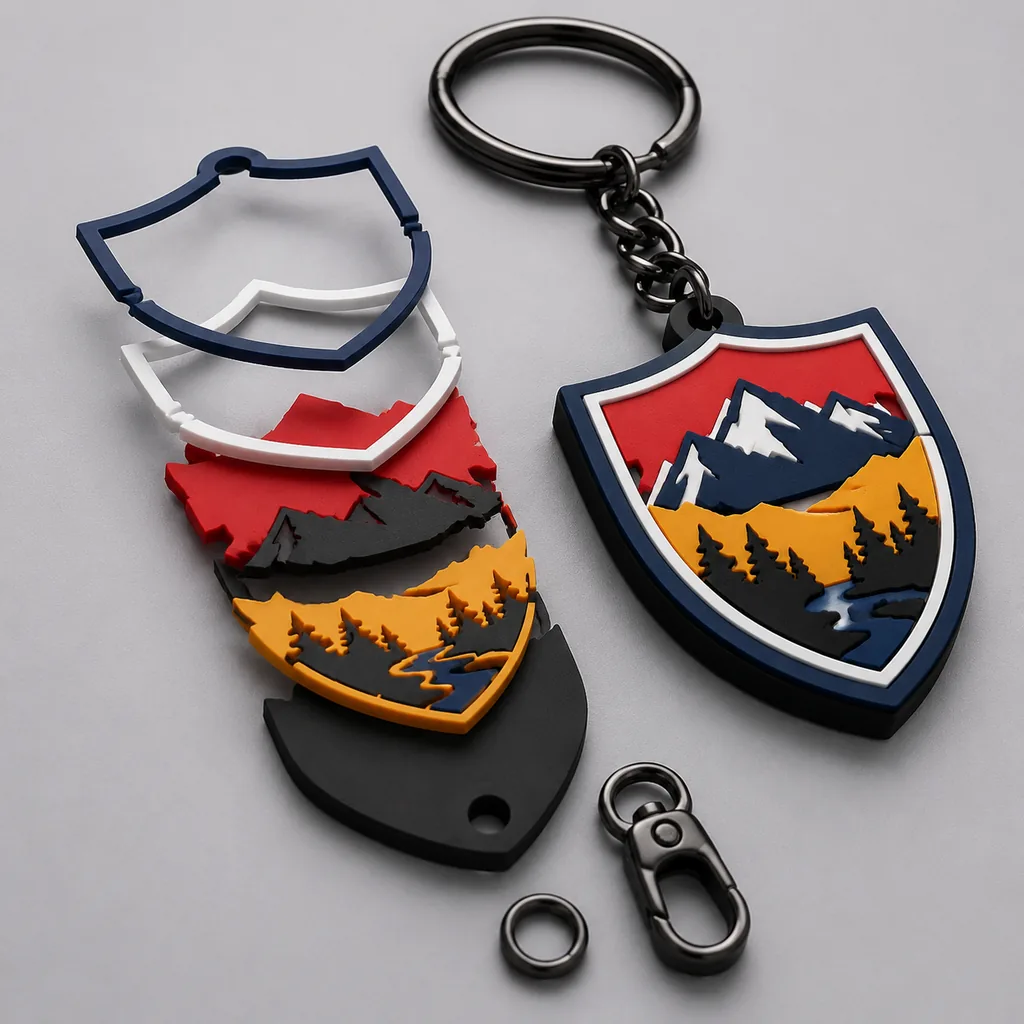
1. Start with construction, size and molded geometry
“Custom PVC keychain” is not a production specification. The RFQ should state the build type first: soft PVC keychain, single-sided or double-sided, 2D layered or 3D sculpted, with defined ring and connector. For promotional and retail programs, the most practical longest-side size is 45 to 70 mm. Below 40 mm, color separation, small text and mascot facial detail become unreliable. Above 80 mm, the item feels bulky on keys, unit weight rises quickly, and air freight is affected because cartons become dense rather than merely large.
For 2D soft PVC, the artwork must be converted into manufacturable relief. Raised borders should be at least 0.8 mm wide; recessed color channels should be at least 1.0 mm wide; unsupported extensions such as tails, antennae, shoelaces or thin logo strokes should be at least 2.0 mm wide where they leave the body. On a 60 mm keychain, a 1.2 mm free-standing tab may look correct in vector art but can bend, whiten at the root or tear during daily use.
Specify dimensional tolerances separately from artwork approval. For standard shapes up to 70 mm, use +/-0.5 mm on length and width. For irregular silhouettes above 70 mm, or designs with soft appendages, +/-0.8 mm is more realistic. Hole position needs its own tolerance because a visually good molded body still fails if it hangs crooked.
| Spec item | Recommended RFQ line | Why it matters |
|---|---|---|
| Overall size | 60 mm longest side; tolerance +/-0.5 mm | Controls mold cavity, unit weight, packing density and perceived value |
| Shape | Custom die-cut outline; no free-standing extension under 2.0 mm wide | Reduces tearing, curling and bent molded details |
| Sidedness | Single-sided 2D front; flat black, white or same-color back | Lowest tooling cost and shortest approval path |
| Relief detail | Raised line min. 0.8 mm; recessed color fill min. 1.0 mm | Prevents merged colors and weak relief edges |
| Logo clearance | No critical text within 1.5 mm of outside edge or ring hole | Allows for molding flow, trimming and hole tolerance |
| Finished weight | Target 12 to 22 g for a 50 to 65 mm item | Keeps the keychain comfortable and avoids undersized hardware |
2. Specify PVC compound and Shore A hardness
Soft PVC keychains are normally made from PVC compound with pigment mixed into the material before dispensing or injection. Do not specify only “soft” or “hard.” One factory may treat 60A as soft, while another quotes 75A as standard. Use Shore A hardness: 60A to 65A for a rubber-like feel, 70A to 75A for the most common promotional keychain, and 80A to 85A when the silhouette has narrow sections or the buyer wants a stiffer retail feel.
The trade-off is flexibility versus shape stability. A 60A item bends easily and feels pleasant, but a long narrow design can curl after tight packing or heat exposure. An 85A item holds its outline better, but feels closer to plastic and may show stress whitening when repeatedly bent. For corporate gifts, sports events and tourist souvenirs, a practical default is Shore A 70 +/-5 measured on the thickest flat area.
Hardness testing has limits on thin products. ASTM D2240 is intended for a sufficiently thick, flat test area; on a 3.5 to 4.0 mm keychain, readings can vary by operator and test location. The signed golden sample should therefore be the working feel reference, while the written hardness range prevents the supplier from changing to a noticeably softer or cheaper compound in mass production.
Compliance must be stated separately. A standard PVC quote does not automatically include phthalate testing, REACH SVHC screening, CPSIA, California Proposition 65 review, EN71-3 heavy metals, RoHS, or nickel release testing on metal parts. If the keychain is for children, food promotions, EU retail, California distribution or a major chain store, list the exact test standard, test lab requirement, number of colors tested and whether testing is on raw material, finished product or both.
3. Control thickness, layer height and relief depth
Thickness is a direct cost driver because PVC consumption follows material volume, mold fill time and cooling time. Standard single-sided soft PVC keychains are usually 3.5 to 4.5 mm thick. Double-sided molded keychains are normally 5.0 to 6.0 mm. A 60 mm single-sided item at 4.0 mm generally feels solid; increasing it to 6.0 mm can add 15 to 30 percent to the unit price without improving daily use.
For 2D designs, define both base thickness and raised height. A stable specification is a 3.0 mm base plus 0.8 to 1.2 mm raised details, for a total thickness of 3.8 to 4.2 mm. A thinner promotional build, such as a 2.8 mm base plus 0.7 mm relief, can work for low-cost giveaways but is less premium and more prone to warping. For double-sided designs, avoid full relief on both faces if the item has a thin edge; alignment and demolding become less consistent.
3D PVC should not be quoted as if it were layered 2D PVC. A sculpted mascot face, shoe, bottle or character may need 4.5 to 6.5 mm total thickness and up to 2.5 mm local relief. Fine legal copy, QR codes, hairline brand geometry and photographic gradients should not be molded in 3D PVC. Use pad printing, a printed PVC insert or another material if the design depends on tiny copy or continuous tones.
| Build type | Typical total thickness | Relief specification | Best use | Avoid when |
|---|---|---|---|---|
| Single-sided 2D | 3.5 to 4.5 mm | Raised areas 0.8 to 1.2 mm above base | Events, mascots, budget retail souvenirs | Back side requires molded artwork |
| Double-sided 2D | 5.0 to 6.0 mm | Both faces raised 0.7 to 1.0 mm | Tourism, hotels, character goods | Budget or approval time is tight |
| Single-sided 3D | 4.5 to 6.5 mm | Sculpted relief up to 2.5 mm | Characters, animals, product miniatures | Tiny text, QR codes or strict flat logos are required |
| Printed flat PVC | 2.5 to 3.5 mm | No molded relief; ink film typically 8 to 15 microns | Photos, gradients, low-relief graphics | Print must survive heavy abrasion for years |
4. Lock color count, Pantone tolerance and fine details
PVC color is usually made by mixing pigment into the compound, not by painting the molded surface. This gives durable color, but every color adds a dispensing step, setup time and operator risk. A common custom PVC keychain uses 3 to 6 colors. More than 8 colors increases cycle time, overflow risk and rejection rate, especially when color areas are small or separated by thin raised walls.
Use coated Pantone references and define the viewing method. A workable line is: “Pantone C visual match under D65 light; acceptable Delta E 3 to 5 for standard opaque colors where instrument reading is possible.” Do not apply the same tolerance to fluorescent, translucent, metallic, glitter or glow-in-the-dark PVC; these effects are visually variable and should be approved by physical chips or a pre-production sample.
Set minimum text dimensions before tooling. Raised PVC letters should generally be at least 2.5 mm high with stroke width of 0.45 mm or more. Recessed filled letters should be at least 3.0 mm high because the color fill needs room to sit cleanly. A trademark symbol under 1.5 mm, a 0.3 mm line, or a complete URL molded into soft PVC will usually become soft or unreadable. If micro text is mandatory, isolate it for pad printing and accept that printed ink is less abrasion-resistant than molded color.
For pad printing, specify ink color, print location and registration tolerance. For a 50 to 70 mm keychain, +/-0.5 mm print registration is practical. Printed ink film is typically 8 to 15 microns, so it should not be placed on raised corners, high-touch edges or bend points unless a clear coat or revised construction is approved during sampling.
5. Engineer hardware, hole position and pull strength
The PVC body often outlasts the connector, so hardware belongs in the main specification rather than the packing note. Standard keychains use a 25 mm or 28 mm iron split ring with nickel, black nickel, gunmetal, antique brass or gold-tone plating. Common split ring wire is 1.6 to 1.8 mm. A 1.2 mm wire ring can save a few cents but feels cheap and opens more easily. For items above 25 g, specify a 30 mm split ring or a stronger connector system.
Connector options include a 6 to 8 mm jump ring, triangular ring, short chain, ball chain, lobster clasp or embedded metal eyelet. The hole or molded loop should sit at least 4.0 mm from the outer edge and have at least 2.5 mm PVC wall thickness around it. If the artwork has a narrow top tab, increase local thickness to 5.0 mm or use a metal eyelet to spread load.
Plating should be defined for retail programs. Decorative nickel or gunmetal plating on low-cost hardware is commonly about 3 to 8 microns, depending on finish and supplier grade. For low-allergy or nickel-controlled markets, “nickel-free” must be quoted and tested separately; black nickel and gunmetal finishes should not be assumed nickel-free.
- Ring diameter: 25 mm for light giveaways; 28 to 30 mm for retail, hotel and heavier designs.
- Wire thickness: 1.6 to 1.8 mm for normal split rings; avoid 1.2 mm rings on daily-use items.
- Connector: 6 to 8 mm jump ring for standard use; triangular ring or eyelet for better hanging alignment.
- Pull test: no separation at 5 kg for 10 seconds for giveaways; 8 kg for 10 seconds for retail or luggage-style use.
- Hole position: show centerline and edge distance on artwork; tolerance +/-1.0 mm.
- Hanging angle: approved sample should hang within 10 degrees of intended vertical orientation unless intentionally angled.
6. Confirm tooling, sampling and approval tolerances
PVC keychain molds are usually aluminum or copper alloy tooling, selected by design complexity, heat transfer and expected order life. For a 50 to 70 mm 2D design, tooling commonly ranges from USD 60 to USD 180 per design. Double-sided or 3D sculpted molds typically run USD 180 to USD 450. Complex character work can exceed that if digital sculpting is required. Mold cost is normally per design and per size; changing a 60 mm design to 70 mm usually means new tooling.
A realistic sampling schedule is 1 to 2 working days for artwork cleanup after receiving vector files, 3 to 6 working days for mold making after artwork approval, and 5 to 8 working days for physical samples after tooling is ready. If the first sample needs color correction, relief adjustment or hardware relocation, allow another 4 to 7 working days. Buyers often lose more time in approval loops than factories lose in molding.
The approved sample should record measurable attributes, not only appearance. Document size, thickness, hardness, colors, hardware, weight, back style, logo orientation, ring position, packing and compliance marks. Practical mass-production tolerances for standard PVC keychains are +/-0.5 mm on size, +/-0.3 mm on thickness, +/-5 Shore A hardness, +/-1.0 mm on hole position and +/-0.5 mm on pad-print position.
Do not approve from one front photo. Request front, back, side-thickness view, hardware close-up, weight on a scale and a short bend video if the design has narrow parts. Keep the signed sample with the production file so reorders do not quietly change ring diameter, back color, compound hardness or packing method six months later.
7. Define inspection, packing and defect categories
PVC keychain inspection becomes subjective unless defect categories are written before production. Use ANSI/ASQ Z1.4 single sampling, general inspection level II, with AQL 2.5 for major defects and AQL 4.0 for minor defects. Critical defects should be zero tolerance: sharp metal burrs, broken connectors, wrong logo, unsafe contamination, detached small parts on child-targeted goods or mixed customer artwork.
Major defects include size outside tolerance, wrong Pantone family, missing color area, visible dirt embedded on the front, ring detachment under the agreed pull test, severe warping, odor stronger than the approved sample, or mixed designs in the same inner bag. Minor defects include a surface speck under 0.5 mm, slight flow mark on the back, small color overflow not visible from 50 cm, or a non-critical shade difference inside the approved range.
Packing affects both cost and defects. Bulk packing is usually 50 to 100 pieces per polybag, then 500 to 1,000 pieces per export carton depending on item weight. Keep export cartons below 15 kg gross weight where possible to reduce crushing and handling damage. For sea shipment or humid seasons, specify dry cartons, clean polybags, desiccant if required and no strong odor from recycled packing materials.
Typical packing adders are USD 0.02 to USD 0.05 per piece for individual OPP bags, USD 0.05 to USD 0.15 for printed backing cards, and USD 0.08 to USD 0.20 for retail header bags depending on card size, print coverage and labor. Barcode labels, carton marks, inner-box quantities and Amazon-style prep requirements should be quoted before production, not after finished goods are packed.
8. Use realistic MOQ, FOB pricing and lead-time tiers
For a Yiwu or Guangdong soft PVC factory, a realistic MOQ is 300 pieces per design for simple 2D items, 500 pieces for workable unit pricing, and 1,000 pieces for more stable color batching and lower handling cost. Orders below 300 pieces are possible at some workshops, but mold, setup and color mixing dominate the unit price. If the buyer needs multiple designs, ask whether MOQ applies per design or across an assortment; most factories price and control production per design.
| Order tier | Typical FOB China unit price for 50 to 60 mm single-sided 2D, 4 to 6 colors | Tooling | Normal mass production after sample approval |
|---|---|---|---|
| 300 pcs | USD 0.55 to 1.10 | Usually charged separately, USD 60 to 180 | 10 to 16 working days |
| 500 pcs | USD 0.38 to 0.85 | Often charged separately or partly refundable on large reorder | 12 to 18 working days |
| 1,000 pcs | USD 0.28 to 0.60 | Sometimes negotiable depending on design and supplier | 14 to 20 working days |
| 5,000 pcs | USD 0.20 to 0.45 | Often amortized or waived for simple 2D designs | 18 to 28 working days |
| 10,000 to 50,000 pcs | USD 0.16 to 0.38 | Negotiable; extra cavities may be needed | 20 to 35 working days |
These ranges assume standard PVC, standard split ring, bulk or simple individual packing, and no special compliance testing. Double-sided molding, 3D sculpting, glow PVC, glitter, translucent colors, upgraded hardware, retail carding, barcode labeling and third-party testing all move the price upward. PVC keychains are dense; a 60 mm item may weigh 15 to 25 g before packing, so air freight can change the landed cost sharply.
Plan in working days. A realistic new-project schedule is 1 to 2 days for quotation and artwork review, 3 to 6 days for tooling, 5 to 8 days for samples, 2 to 4 days for buyer approval, and 12 to 20 days for mass production under 5,000 pieces. Add 2 to 5 days for pre-shipment inspection booking and corrective action if required. Chinese public holidays, especially Lunar New Year and National Day, should not be counted as production days.
Before asking for final price, convert the artwork into a one-page spec sheet. Include size, thickness, Shore A hardness, Pantone colors, sidedness, 2D or 3D relief, hardware, packing, AQL level, compliance tests, target delivery date and quantity tiers. With those lines and a vector file, ZheCraft can quote by tier, flag risky thin areas and advise whether soft PVC, metal, acrylic or silicone is the better construction before tooling is cut.
Have a project? Send your artwork and target quantity and we’ll reply with a detailed quotation within 12 working hours.
Ready to get this made?
Send your sketch, target quantity and ship-date. Detailed quotation in 12 hours.



