Promo Giveaway Shortlist for a January 2026 Conference Booth
Byline: Vincent Xi, Editorial Author. Author profile: https://www.zhecraft.com/authors/vincent-xi/. Article/BlogPosting structured data for publication should use a Person author named Vincent Xi, jobTitle Editorial Author, and URL https://www.zhecraft.com/authors/vincent-xi/.
Scenario and Comparison Basis
A booth giveaway order is a deadline-control exercise before it is a product-selection exercise. In this January 2026 planning scenario, the buyer needs 2,500 custom pieces for one conference booth, with finished goods ready for the freight window within 42 calendar days after artwork approval. The item must carry the brand clearly, move quickly across a counter, fit attendee bags and survive normal travel handling without bent hardware, chipped plating or unreadable detail.
Scope for comparison: one buyer-supplied vector artwork file, one custom design, one physical pre-production sample, standard export packing from Yiwu, Zhejiang, and FOB pricing for quote comparison. The product scope follows ZheCraft first-party product categories for enamel pins, brooches, keychains, fridge magnets, challenge coins, patches and lanyards, plus the approved Vincent Xi author profile page for author attribution. All USD FOB ranges, lead times, weights, micron figures, tolerances and AQL settings below are January 2026 planning examples or buyer-defined assumptions to verify in supplier quotations; they are not freight, tariff, certification, availability or delivered-cost guarantees.
Shortlist by Use Case, MOQ and Risk
The right format depends on booth traffic, perceived value, defect visibility, packing weight and approval speed. For this comparison, the buyer has no licensed artwork, no child-use claim, no retail compliance program and no destination-specific chemical test requirement unless added to the RFQ. Quote the same artwork across at least two formats so the cost difference reflects the product choice, not a different scope.
| Rank | Best use case | MOQ tiers to request | Scenario specification | Example FOB range to verify | Lead time after artwork approval | Main risk |
|---|---|---|---|---|---|---|
| 1 | High-volume walk-up handout | 500, 1,000, 2,500 and 5,000 pieces for the January 2026 booth scenario; quote mold fee separately | 25 mm soft enamel pin, iron base, 1.2 mm thickness, 0.8 mm minimum raised metal line, butterfly clutch, individual polybag | USD 0.45 to USD 0.95 per piece at 2,500 pieces, January 2026 FOB Yiwu/Ningbo planning range from supplier-quote benchmarking, to verify | 14 to 24 calendar days for proof, sample, production, plating, packing and inspection, January 2026 planning range | Small face limits text; every enamel color needs raised metal separation |
| 2 | Useful daily-carry item | 500, 1,000, 2,500 and 5,000 pieces for the January 2026 booth scenario; price ring and connector hardware separately | 50 mm metal keychain, zinc alloy or iron, 2.5 mm body thickness, 25 mm split ring, 1.2 mm to 1.4 mm ring wire | USD 0.75 to USD 1.80 per piece at 2,500 pieces, January 2026 FOB Yiwu/Ningbo planning range from supplier-quote benchmarking, to verify | 18 to 28 calendar days for tooling, sample, production, assembly and inspection, January 2026 planning range | Weak jump rings, thin split rings and sharp internal corners fail visibly |
| 3 | VIP meeting or sponsor gift | 300, 500, 1,000 and 2,500 pieces for the January 2026 booth scenario; expect higher tooling cost | 45 mm challenge coin, zinc alloy or brass, 3.5 mm thickness, antique nickel or antique brass, recessed enamel, capsule or pouch | USD 1.60 to USD 4.20 per piece at 2,500 pieces, January 2026 FOB Yiwu/Ningbo planning range from supplier-quote benchmarking, to verify | 20 to 32 calendar days for tooling, sample, plating, enamel, packing and inspection, January 2026 planning range | Higher perceived value, but heavier cartons and more visible plating defects |
| 4 | Community kit or staff apparel | 300, 500, 1,000, 2,500 and 5,000 pieces for the January 2026 booth scenario; backing changes price | 80 mm woven or embroidered patch, merrowed or heat-cut edge, iron-on or hook backing, finished-size tolerance target +/-1.0 mm | USD 0.55 to USD 1.70 per piece at 2,500 pieces, January 2026 FOB Yiwu/Ningbo planning range from supplier-quote benchmarking, to verify | 12 to 22 calendar days for sampling, weaving or embroidery, backing, trimming and packing, January 2026 planning range | Good identity item, but less immediate utility for a walk-up visitor |
| 5 | Badge function and repeated brand exposure | 1,000, 2,500, 5,000 and 10,000 pieces for the January 2026 booth scenario; hardware and breakaway affect price | 20 mm polyester lanyard, 900 mm finished loop length, dye sublimation or screen print, metal hook, optional safety breakaway | USD 0.35 to USD 1.10 per piece at 2,500 pieces, January 2026 FOB Yiwu/Ningbo planning range from supplier-quote benchmarking, to verify | 10 to 20 calendar days for proof, production, sewing, hardware assembly and packing, January 2026 planning range | Common item; print sharpness, comfort and hardware quality decide whether it feels cheap |
Format Choices That Change the Quote
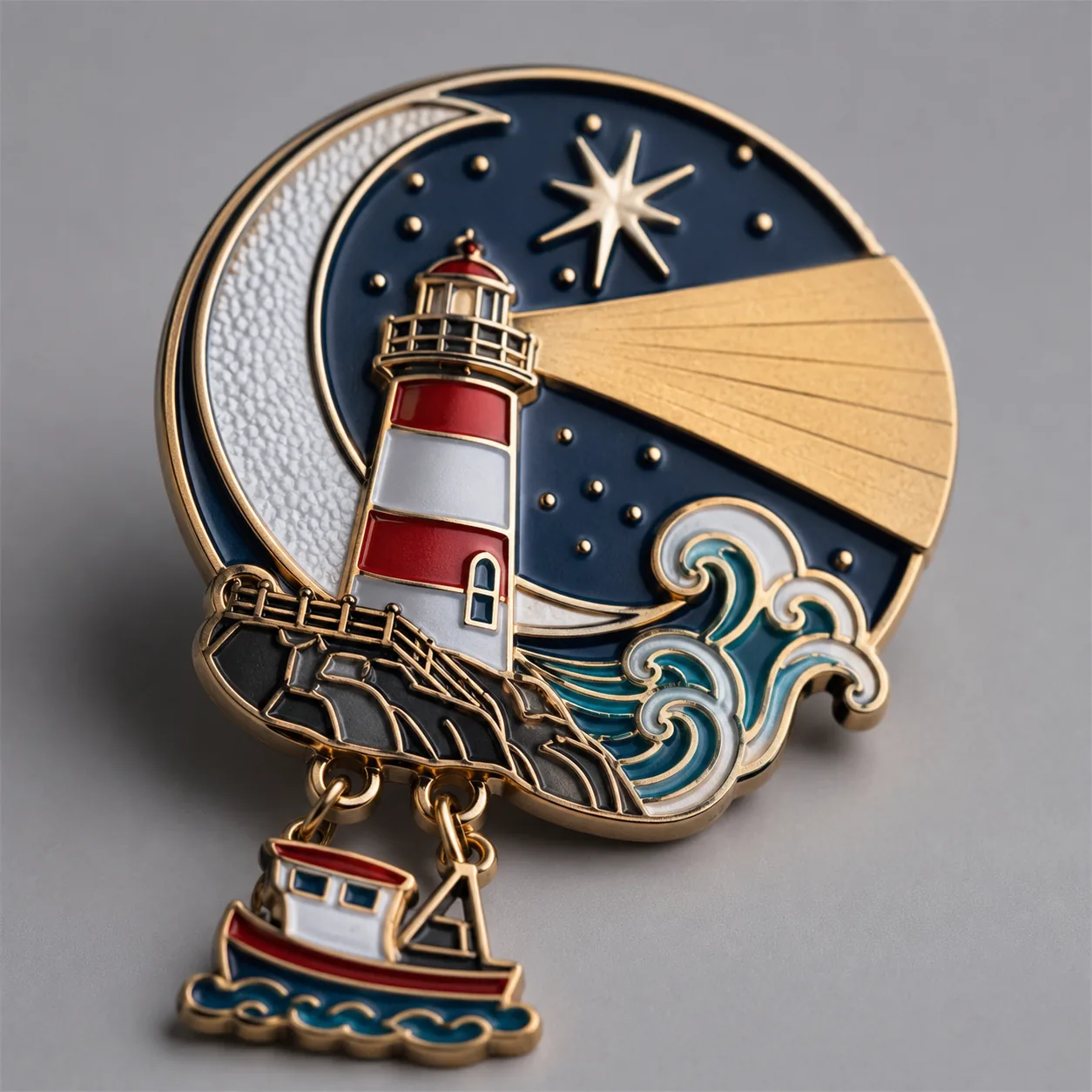
For heavy booth traffic, start with a 25 mm soft enamel pin because it is compact, light and fast to distribute. The RFQ should state base metal, finished thickness, plating color, clutch type, enamel count, backing-card size and bagging method. In this January 2026 example, a 25 mm iron pin at 1.2 mm thickness with one butterfly clutch and individual polybag is the low-risk baseline. A custom backing card, epoxy dome, glitter enamel, magnetic back, dual clutch or more than 6 enamel fills can raise both tooling time and unit cost, so price those options as separate adders.
A keychain is stronger when the marketing goal is daily use after the event. Do not quote only the charm size. Specify a 25 mm outside-diameter split ring, 1.2 mm to 1.4 mm ring wire, connector type, hole position and pull-test target as buyer requirements to verify. As a January 2026 example specification, a 50 mm zinc alloy body at 2.5 mm thickness with 1.4 mm ring wire should be priced separately from a 1.0 mm ring-wire version because the thinner ring can deform more easily in luggage. Keep open slots at least 1.2 mm wide and outside corners at a minimum 1.0 mm radius as buyer-defined design limits to reduce bending, sharp edges and plating chips.
Challenge coins and brooches fit sponsor meetings, executive dinners and award moments. A 45 mm coin at 3.5 mm thickness with antique plating, recessed enamel and a capsule feels deliberate, but it is inefficient for every passerby. As an example weight assumption to verify by CAD volume and material density, one 45 mm zinc alloy coin at 3.5 mm thickness may weigh about 35 g to 45 g in the January 2026 planning model. For 2,500 pieces, product weight alone is about 87.5 kg to 112.5 kg before capsules, inner boxes and export cartons, which affects carton count, courier cost and booth handling.
Patches and lanyards work best when the event has a community, uniform or badge function. Woven patches handle small lettering better because the face is flatter; embroidered patches give more texture but distort fine type and tight curves. For patches under 100 mm finished width, use a buyer target of +/-1.0 mm finished-size tolerance to verify with the supplier. For lanyards, a 20 mm polyester width gives more printable area than 10 mm tape and is usually more comfortable; the quote must also state one-side or two-side print, 900 mm finished loop length, hook style, breakaway option and whether the artwork repeats cleanly across the sewn joint.
RFQ Checklist That Prevents Requoting
The fastest way to lose a week is to ask for a final price before the supplier knows the physical constraints. A useful RFQ separates fixed requirements from optional upgrades, then asks the supplier to price two or three formats against the same event date and inspection plan.
- State event date, required delivery date, destination country and trade term, such as FOB Ningbo, FOB Shanghai or EXW Yiwu, for the January 2026 quote comparison.
- Request quantity tiers of 1,000 pieces, 2,500 pieces and 5,000 pieces for the same artwork, with tooling, pre-production sample, packaging and inspection charges shown as separate line items.
- Give finished size in millimeters, thickness in millimeters and any maximum piece weight in grams; for example, cap a coin or keychain at 45 g per piece as a January 2026 buyer assumption to verify if booth staff must hand-carry cartons.
- Supply vector artwork, Pantone Solid Coated references where color matching matters, and the smallest required readable text size in points; avoid type below 4 pt on metal item faces as a buyer-defined legibility limit to verify by sample.
- Specify material and finish: iron, zinc alloy, brass, polyester or woven yarn; plating color; antique or bright surface; epoxy dome; attachment; and hardware type.
- Define unit packaging, such as individual polybag, 54 mm x 85 mm backing card, OPP bag, velvet pouch, coin capsule, inner box or export carton, with dimensions treated as January 2026 RFQ examples to verify.
- Name the inspection plan, defect classes and approval owner; for example, buyer inspection using ANSI/ASQ Z1.4 general inspection level II with AQL 2.5 for major defects and AQL 4.0 for minor defects as a buyer-defined sampling plan, not a certification claim.
QC Specs: Tolerances, Microns and AQL
QC should start before mass production. The first checkpoint is the digital proof, where size, thickness, material, plating, enamel colors, attachment, packaging and carton marks are frozen. The second checkpoint is the physical pre-production sample, where the buyer checks scale, color separation, attachment strength and appearance under normal indoor light. Do not approve mass production from a rendering alone when the design has small text, thin metal bridges, antique plating, tight fabric detail or safety-sensitive hardware.
For metal giveaways, define plating as a measurable stack to verify, not only a color name. A January 2026 buyer planning range for decorative flash gold-tone plating on small promotional metal items is 0.03 microns to 0.10 microns on the visible surface, while nickel underlayers in comparable quote files are often planned around 3 microns to 8 microns; the supplier must confirm the actual stack, substrate and test method for the production batch. Thicker plating may improve wear resistance, but it can soften fine relief on coins and pins. If nickel release, lead, cadmium, food-contact, child-use or market-access rules may apply, require current test reports for the exact material, finish and batch.
For final inspection, define defect examples before cartons are sealed. Loose clutch, loose split ring, wrong plating color, missing enamel, front-face contamination, unreadable logo, mixed design and damaged retail packaging should be major defects. Small back-side polishing marks, slight polybag wrinkles and carton label scuffs may be minor unless the item is retail-packed. ANSI/ASQ Z1.4 is relevant only as sampling terminology when selected by the buyer; it does not certify the factory, product or order. As an example handling check to verify with the freight method, keep export cartons under 15 kg gross weight and inspect tape strength, corner crushing, inner-bag movement and carton mark accuracy after a handling simulation.
Schedule and Budget Example
A 42-calendar-day window should not be spent entirely on manufacturing. In this January 2026 scenario, a workable schedule assigns 1 to 2 working days for digital proof, 5 to 8 calendar days for pre-production sample creation and approval, 12 to 20 calendar days for mass production on pins or lanyards, 3 to 5 calendar days for packing and final inspection, and the remaining time for export booking, document checks and contingency. Coins and complex keychains need more buffer because tooling, plating and assembly steps are harder to compress.
The budget gap is large enough to decide the product. Using the January 2026 planning ranges above, 2,500 soft enamel pins at USD 0.45 to USD 0.95 per piece equal USD 1,125 to USD 2,375 FOB before tooling, freight, duty and tax. The same 2,500-piece quantity of 50 mm keychains at USD 0.75 to USD 1.80 per piece equals USD 1,875 to USD 4,500 FOB before tooling, freight, duty and tax. A 2,500-piece order of 45 mm coins at USD 1.60 to USD 4.20 per piece equals USD 4,000 to USD 10,500 FOB before tooling, freight, duty and tax. These are example calculations to verify in supplier quotations, but they show when higher perceived value also brings higher carton weight and inspection exposure.
Evidence, Method and Limits
This article uses two source contexts: ZheCraft's first-party author and product-scope pages, including the approved Vincent Xi author profile, and common buyer RFQ and inspection practices used for small custom promotional products. The method groups product specifications, MOQ tiers, order quantities, lead-time ranges and inspection checkpoints into one 2,500-piece conference-booth scenario as of January 2026. Price, lead-time, weight, tolerance, micron and AQL figures are planning ranges or buyer-defined examples for quote comparison, not promises of availability, certification, compliance or delivered cost.
The visible author basis is Vincent Xi, Editorial Author, as listed at the ZheCraft author profile URL. No additional credentials, factory visits, test results, client outcomes or first-person experience claims are used here. Limits to verify before purchase include final artwork complexity, mold method, material grade, plating stack, color standard, packaging, carton weight, inspection scope, exchange rate, freight term, customs requirements and any safety or chemical test reports required for the destination market. Standards should be treated carefully: ANSI/ASQ Z1.4 can define a sampling plan when selected by the buyer, but it is not a product-performance standard and does not prove certification.
Decision Path and Visual Brief
For the 2,500-piece January 2026 booth scenario, request a pin quote and a keychain quote first, using the same artwork, deadline, packaging and inspection plan. Add a coin only if the event has a VIP or sponsor segment, and add a lanyard only if badge function is part of the event plan. Do not approve mass production until the digital proof confirms size, thickness, finish, attachment, packaging and carton marks, and the pre-production sample proves that the physical item still works at real scale.
Visual brief / imagePrompt: Create a realistic editorial product-process image for a B2B sourcing article about selecting custom conference giveaways. Show a clean Yiwu-style merchandise QC table with five true-to-scale samples arranged as a buyer shortlist: a 25 mm soft enamel lapel pin with butterfly clutch beside a plain white backing card, a 50 mm metal keychain with 25 mm split ring, a 45 mm antique challenge coin in a clear capsule, an 80 mm woven patch with merrowed edge, and a 20 mm polyester lanyard segment with metal hook. Include digital calipers measuring a metal item, a color chip fan with no readable text, a simple inspection sheet with no legible words, clear polybags, inner cartons and one partially open export carton. Use neutral daylight, realistic metal reflections, visible woven and embroidered texture, practical tabletop spacing and shallow but not blurry depth of field. No text, logos, watermarks, impossible machinery or identifiable people.
Have a project? Send your artwork and target quantity and we’ll reply with a detailed quotation within 12 working hours.
Ready to get this made?
Send your sketch, target quantity and ship-date. Detailed quotation in 12 hours.



