Printed Pins vs Enamel Pins for Detailed Logos
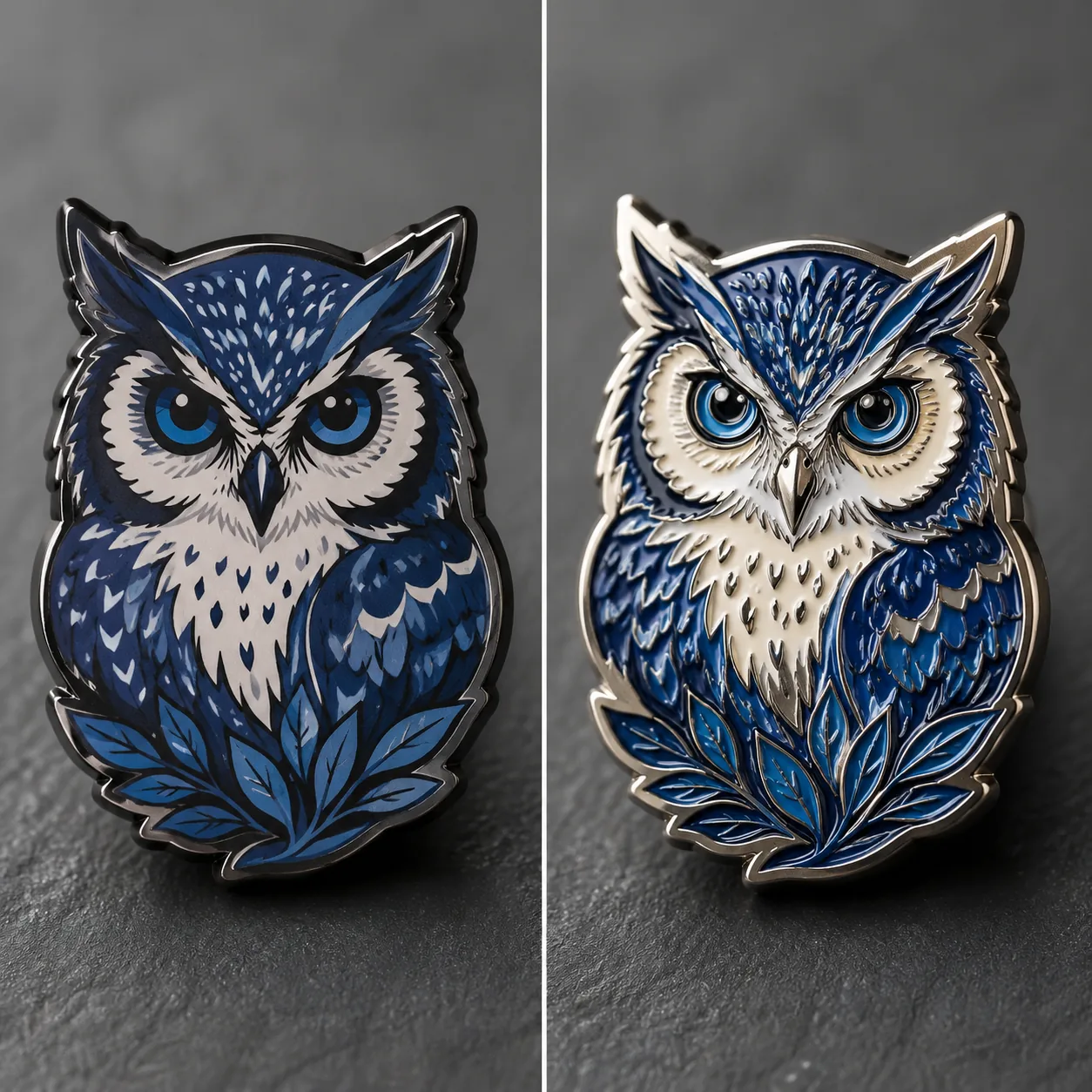
The sourcing problem: detailed artwork shrinks badly at pin size
A clean vector logo is not automatically a manufacturable 25 mm lapel pin. At final size, a slogan may become unreadable, a gradient may flatten, a mascot’s eyes may close up, or a registered trademark symbol may turn into a plated dot. Buyers often request “enamel pins” because the term is familiar, but enamel is a process with physical limits. For detailed logos, the real sourcing decision is usually between a die-struck enamel pin and a printed metal pin protected by epoxy or a clear coating.
This issue appears on corporate anniversary pins, university crests, event sponsor pins, esports merchandise, museum souvenirs and staff recognition badges. The buyer wants small type, thin outlines, shaded illustrations or photographic detail. If the process is chosen after tooling, the order can lose 5 to 10 calendar days to artwork simplification, sample remake and brand re-approval. Worse, the shipment may pass quantity, size and plating checks while still failing the brand team’s visual expectations.
The process should be selected before mold making, color separation and sample production. Printed pins reproduce small visual information better. Enamel pins feel more permanent and tactile when the artwork can be reduced to bold metal lines and solid color fills.
Construction and spec comparison
Printed and enamel pins may look similar from one meter away, but they are built differently. Enamel pins use raised metal walls to separate recessed or polished color areas. Printed pins place ink on a flat metal surface, then add a clear epoxy dome or a flat protective coating. That construction difference controls artwork tolerance, color accuracy, lead time, unit cost and defect risk.
| Spec item | Printed pin with epoxy or clear coat | Soft or hard enamel pin |
|---|---|---|
| Best artwork type | Gradients, small text, photos, QR-style graphics, shaded mascots, sponsor panels | Bold logos, separated color blocks, simple icons, crests with metal outlines |
| Typical B2B size range | 18 to 60 mm; most orders 25 to 40 mm | 15 to 50 mm; most orders 20 to 35 mm |
| Minimum readable text height | 1.0 to 1.2 mm for dark text on light ground; 1.5 mm safer for reverse text | 1.8 to 2.2 mm for simple sans serif; 2.5 mm safer for serif, plated or small-cap lettering |
| Minimum line width | 0.10 to 0.15 mm printed line; 0.20 mm safer under epoxy glare | 0.25 mm raised metal line; 0.35 mm safer for polishing and gold plating |
| Color system | CMYK or UV print; Pantone simulation possible but not exact on gradients | Pantone solid enamel colors; commonly 1 to 8 colors |
| Gradient support | Yes, if artwork is 300 to 600 dpi at final size | No true gradient; must convert to solid steps or simplify |
| Surface feel | Smooth epoxy dome, about 0.3 to 0.8 mm, or flat clear coat | Soft enamel has recessed color; hard enamel is filled and polished flat |
| Common base material | Iron, brass, zinc alloy or stainless steel; stainless is common for thin printed badges | Iron, brass or zinc alloy, selected by relief depth, edge detail and budget |
| Common thickness | 0.8 to 1.2 mm metal plus coating | 1.2 to 1.8 mm for lapel pins; 2.0 mm for heavier commemorative badges |
| Plating reference | Nickel underlayer 3 to 5 µm; decorative gold, silver or black nickel 0.05 to 0.15 µm | Nickel underlayer 3 to 5 µm; decorative top layer 0.05 to 0.25 µm |
| Factory MOQ | 100 pcs possible; 300 pcs more economical; 500 pcs standard for B2B quoting | 100 pcs possible; 300 to 500 pcs better for mold cost absorption |
| FOB China price, 30 mm, 500 pcs | USD 0.55 to 1.25 each with butterfly clutch and OPP bag | USD 0.65 to 1.60 each; hard enamel, antique plating and many colors add cost |
| Setup or mold cost | Print setup USD 20 to 60; cutting die USD 30 to 80 for custom outline | Metal mold USD 45 to 120 for common 2D designs; more for cutouts or 3D relief |
| Pre-production sample lead time | 5 to 8 days after approved artwork | 7 to 12 days after approved artwork |
| Mass production lead time | 10 to 18 days after sample approval for 500 to 5,000 pcs | 14 to 25 days after sample approval for 500 to 5,000 pcs |
| Main QC risk | Print registration, color shift, dust under epoxy, bubbles, coating overflow, edge lift | Wall breakage, enamel overflow, low fill, polishing scratches, plating stains, burrs |
| Recommended inspection level | Critical defects 0; AQL 2.5 major, 4.0 minor | Critical defects 0; AQL 2.5 major, 4.0 minor |
These figures are practical RFQ references, not universal guarantees. A 45 mm full-color mascot pin with two posts, backing card and retail bag can cost more than a 25 mm two-color enamel logo. A simple round printed badge can be faster and cheaper than enamel because it avoids die striking, manual enamel filling and polishing.
When printed pins are the better engineering choice
Choose printed construction when the design includes information that cannot be separated by metal walls. Typical examples include employee portrait pins, esports mascots with shadows, event graphics adapted from posters, sponsor-logo grids, city skylines, small university seals and legal marks. If the smallest important line is below 0.25 mm, printing is usually the safer process.
For printed pins, supply vector artwork where possible and embed raster images at 300 to 600 dpi at final size. A 30 mm pin should not use a logo pulled from a website or presentation slide. For standard round, square and rectangular shapes, print positioning is normally controllable within ±0.20 mm. For custom cut shapes or print aligned to a raised rim, allow ±0.30 mm. If the artwork has a border, make it at least 0.8 mm wide so normal registration movement is not obvious.
Printed pins also support faster sampling. A simple printed epoxy sample can often be ready in 5 to 8 days after artwork approval because the factory avoids enamel filling, baking and polishing. Reorders using the same outline and print file may ship in 8 to 14 days for 500 to 2,000 pcs if metal blanks, plating and clutches are standard.
The trade-off is perceived durability. The visible image is ink protected by epoxy or coating. Epoxy resists moisture and gives a smooth retail appearance, but it can scratch, yellow slightly after long UV exposure, or lift at the edge if the metal is thin or poorly cleaned before coating. For conferences, short campaign merchandise and promotional retail, this is usually acceptable. For a five-year service award or executive gift, enamel often feels more permanent.
When enamel pins justify the constraints
Enamel pins are the better choice when the artwork can be simplified into solid color zones. A 30 mm pin with 3 to 5 Pantone colors, raised metal lines of at least 0.25 mm, no gradient and no text below 2.0 mm is a strong candidate. Soft enamel gives a textured surface with recessed color and raised metal. Hard enamel is filled higher and polished flat, creating a smoother, jewelry-like finish.
Enamel uses metal as part of the design, not only as an edge. Gold, nickel, copper, black nickel, dyed black and antique finishes can define borders, lettering and internal lines. For most promotional pins, a 3 to 5 µm nickel underlayer and 0.05 to 0.15 µm decorative top layer are adequate. Thicker precious-metal plating increases cost and is usually unnecessary unless the buyer specifies higher wear resistance, a premium gift standard or a skin-contact compliance requirement.
The limitation is artwork conversion. Gradients must become solid colors. Tiny facial features must be enlarged. Serif text may need to be removed, simplified or moved to the backing card. Enamel cannot reproduce photographic detail. If the brand team will not accept simplification, an enamel quote may look attractive but the pre-production sample will likely create conflict.
Complex outlines also need practical metal structure. Very narrow protruding points can bend, snag fabric or create sharp edges. Internal cutouts below about 1.5 to 2.0 mm are difficult to polish cleanly and may trap plating residue. For premium enamel, the best result usually comes from simplifying the silhouette and letting plating, relief and color blocking carry the design.
MOQ, price and lead-time ranges for RFQs
At 500 pcs and 30 mm, printed pins often start lower because there is less manual filling and finishing. A typical FOB China range is USD 0.55 to 1.25 each for printed metal with epoxy, butterfly clutch and individual OPP bag. Enamel in the same size is commonly USD 0.65 to 1.60 each, depending on color count, metal thickness, plating, polishing time and whether the buyer selects soft or hard enamel.
MOQ changes the real cost. At 100 pcs, setup or mold charges are spread across few units, so unit pricing may be high: printed pins may be USD 0.95 to 2.20 each, while enamel may be USD 1.10 to 2.80 each depending on complexity. At 300 pcs, pricing usually becomes more stable. At 1,000 pcs, a standard 30 mm printed epoxy pin may fall around USD 0.45 to 0.95, and a standard enamel pin around USD 0.55 to 1.30, assuming normal plating, one post and simple packaging.
Do not compare only the lowest unit price. Specify the construction. For professional use, a printed pin should have at least 0.8 mm metal thickness; enamel should usually be 1.2 mm or thicker. Pin posts are commonly about 1.0 mm diameter and 8 to 10 mm long. A reasonable clutch pull-off target is at least 2.0 kgf on random checks. Very thin badges bend in transit, weaken the post weld and increase epoxy edge-lift risk.
Packaging can change both cost and defect perception. A plain OPP bag usually adds USD 0.01 to 0.03 each. A printed 300 gsm backing card with assembly and bagging may add USD 0.05 to 0.15 each depending on size, print coverage, hole punching and labor. If the pin contains tiny legal text, sponsor names or event dates, moving that information to the backing card can improve the pin and reduce front-face rejects.
Artwork approval rules before tooling
Do not approve a pin from a large digital mockup alone. Request a 1:1 scale PDF and print it on office paper. View it at a normal distance, about 30 to 40 cm. If a manager cannot read the text on paper at actual size, metal production will not make it readable.
- For printed pins, keep important text at 1.2 mm high minimum; use 1.5 mm or larger for reverse text, thin fonts or dark backgrounds.
- For enamel pins, keep text at 2.0 mm high minimum; 2.5 mm is safer for serif fonts, plated letters and small caps.
- For printed borders, use at least 0.8 mm width; for enamel metal lines, use 0.25 mm minimum and 0.35 mm for safer polishing.
- Keep critical graphics at least 0.5 mm from a printed pin’s cut edge to allow for cutting tolerance and epoxy flow.
- Limit enamel colors to 8 or fewer unless the design genuinely needs more; each added color increases filling labor and inspection points.
- Convert gradients to printed artwork, or redesign them as 3 to 5 solid color steps if enamel is required.
- For QR codes, use printed construction and test scanning at final size; enamel QR codes are rarely reliable below 35 to 40 mm.
- Use two pin posts for pieces over about 35 mm wide or for horizontal badges that may rotate on fabric.
The buyer should define which details are critical before sampling. A trademark symbol may be legally required, or it may be acceptable to print it on the backing card. A mascot’s eyes may be essential, while a shaded background may be optional. These decisions are cheaper before sample production than after the factory exposes the limitation.
Quality control: inspect each process differently
Printed pins need inspection for image and coating defects. Check color consistency against the approved sample, print sharpness, print-to-edge registration, dust trapped under epoxy, bubbles larger than 0.3 mm, coating overflow, scratches and edge lifting. A practical tolerance is ±0.20 mm for centered print on standard shapes and ±0.30 mm where print aligns with a custom cut outline or metal rim.
Enamel pins need inspection for fill quality and metal finishing. Check missing enamel, wrong color, enamel overflow, low-fill areas, metal wall breaks, polishing scratches, plating stains, burrs and weak post attachment. Soft enamel recess depth will not be perfectly identical across every piece, but a visible low-fill patch on the front face at 30 cm should be treated as a major defect. Hard enamel should feel smooth, with no obvious pits, over-polished metal lines or cloudy polishing residue.
For both types, use critical defects 0, AQL 2.5 for major defects and AQL 4.0 for minor defects unless your company standard is stricter. Critical defects include exposed sharp points, broken posts, wrong logo, wrong safety warning, severe contamination or any defect that makes the item unsafe to handle. For orders with multiple SKUs or colorways, inspect each SKU separately rather than averaging the total shipment.
Pre-shipment inspection should include carton count, SKU segregation, size check, thickness check, plating appearance, backing hardware, packaging, barcode or label accuracy and a simple wear simulation such as attaching and removing the clutch several times. For retail programs, inspect the front face through the packaging because scuffed OPP bags and misaligned backing cards can make acceptable pins look defective on shelf.
Decision matrix and RFQ wording
The best method depends on the failure the buyer cannot accept. If unreadable detail or inaccurate artwork is the main risk, choose printed pins. If weak perceived value or lack of metal texture is the main risk, choose enamel. Hybrid construction is possible, such as enamel with a small printed insert, but it increases registration risk, sample time and cost. For most B2B orders under 5,000 pcs, a clean choice between printed and enamel is more reliable.
| Buyer priority | Better choice | Reason |
|---|---|---|
| Tiny sponsor logos or legal marks | Printed pin | Ink can reproduce smaller detail than raised enamel walls |
| Premium corporate anniversary gift | Hard enamel pin | Flat polished surface and metal lines feel more permanent |
| Low-cost event giveaway with full-color mascot | Printed pin with epoxy | Good detail at lower labor cost and shorter lead time |
| Retail collectible with simple icon | Soft or hard enamel pin | Collectors often expect enamel texture and visible metal outlines |
| Photo, gradient or shaded illustration | Printed pin | Enamel cannot reproduce true gradients |
| Exact Pantone solid color approval | Enamel pin | Solid enamel colors are easier to approve than CMYK simulations |
| Fast reorder under 15 days | Printed pin if outline and files are unchanged | Printing setup is usually quicker than enamel filling and polishing |
| Outdoor staff badge for repeated use | Depends on design | Printed epoxy resists moisture; enamel better resists image abrasion if the design is simple |
A useful RFQ should state the artwork, size, quantity, deadline, material expectations and inspection standard. For example: 30 mm custom lapel pin, detailed mascot with small text; quote printed epoxy and enamel only if technically feasible; minimum 0.8 mm metal for printed or 1.2 mm for enamel; nickel plating; butterfly clutch; individual OPP bag; AQL 2.5 major and 4.0 minor; quote 500 and 1,000 pcs FOB China; pre-production sample required.
If the artwork is borderline, ask the supplier to mark it in three groups: details safe for enamel, details requiring print and details that should move to the backing card. That review prevents the most expensive mistake in pin sourcing: approving an attractive mockup that no 30 mm metal product can reproduce accurately.
Have a project? Send your artwork and target quantity and we’ll reply with a detailed quotation within 12 working hours.
Ready to get this made?
Send your sketch, target quantity and ship-date. Detailed quotation in 12 hours.



