Printed Pins vs Enamel Pins for Detailed Logos
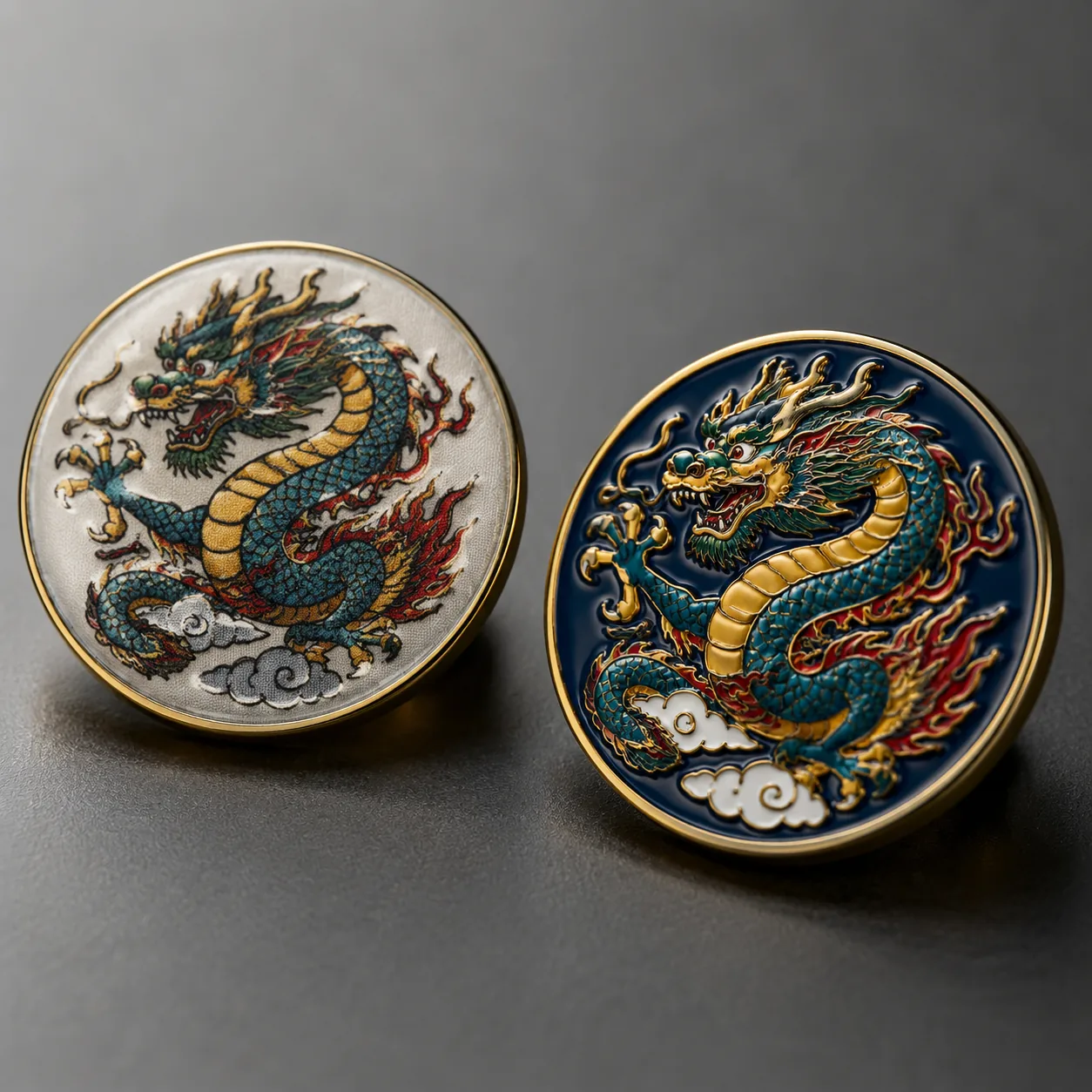
Start With the Logo Risk, Not the Pin Type
A 22 mm logo with a 0.25 mm slogan, a gradient icon and four controlled brand colors can be quoted two ways: as a printed pin sealed with epoxy, or as a soft or hard enamel pin with raised metal lines. Both samples may look acceptable in a sales photo. In production, they behave differently: printing protects small graphics; enamel protects the premium metal feel.
The buyer’s risk is usually not that the factory cannot make pins. The risk is approving a process that cannot hold the artwork at the ordered size. Common failures include unreadable text, merged enamel walls, cloudy epoxy, color drift after clear coating, plating tone variation, burrs around the outline and pins that feel cheaper than the campaign brief expected.
At ZheCraft, we manufacture both printed and enamel pins in Yiwu, so the process recommendation should follow measurable requirements: minimum readable text height, line width, color tolerance, event deadline, inspection level and landed-cost target. If those details are not fixed before quoting, suppliers may quote different constructions and the lowest price may not represent the same product.
Quote-Stage Specification Table
Use the table before requesting samples. Figures reflect common B2B promotional and retail-adjacent orders, not jewelry-grade production. Pricing assumes 25 to 35 mm custom metal pins, standard nickel/gold/black nickel plating, butterfly clutch, individual polybag, no backing card and FOB China terms. Oversize shapes, glitter enamel, backing cards, rubber clutches or custom cartons change both cost and lead time.
| Spec Item | Printed Pin With Epoxy | Soft or Hard Enamel Pin |
|---|---|---|
| Best artwork fit | Gradients, photos, QR-style graphics, mascot faces, sponsor blocks, small text with stroke width above 0.15 mm | Flat Pantone colors, bold icons, separated color zones, text with stroke width above 0.30 mm |
| Common base metal | Iron or zinc alloy, 0.8 to 1.2 mm plate plus 0.6 to 1.2 mm epoxy dome | Iron, brass or zinc alloy, usually 1.2 to 1.8 mm thick before polishing |
| Surface construction | CMYK, UV or spot-color print on plated or painted metal, sealed with clear epoxy resin | Raised metal borders with recessed soft enamel or polished hard enamel filled level with metal |
| Minimum detail tolerance | Printed lines down to 0.12 to 0.18 mm; registration drift normally ±0.05 to ±0.10 mm | Raised metal lines 0.20 to 0.25 mm for soft enamel; 0.25 to 0.30 mm for hard enamel |
| Readable text guide | 1.0 to 1.2 mm high for simple sans serif text on 25 to 30 mm pins | 1.8 to 2.2 mm high for enamel-filled or metal-separated text |
| Color tolerance | Pantone spot print or CMYK proof; Delta E 3 to 5 is realistic after epoxy | Pantone enamel match usually Delta E 2 to 4, influenced by plating reflection and enamel batch |
| Plating thickness | Nickel, gold or black nickel commonly 0.15 to 0.30 microns before print | Nickel, gold, black nickel or antique plating commonly 0.20 to 0.50 microns |
| MOQ tiers | 100 pcs possible; 300 pcs efficient; 500 to 1000 pcs better for setup cost | 100 pcs possible for simple designs; 300 to 500 pcs economical; 1000 pcs improves fill labor cost |
| FOB China price range | USD 0.48 to 0.95 at 500 pcs; USD 0.36 to 0.72 at 3000 pcs | USD 0.62 to 1.35 at 500 pcs; USD 0.45 to 1.15 at 3000 pcs |
| Sample lead time | 5 to 8 days after artwork approval | 7 to 10 days for soft enamel; 9 to 14 days for hard enamel |
| Mass lead time | 10 to 16 days after sample approval for 500 to 3000 pcs | 14 to 22 days for soft enamel; 18 to 28 days for hard enamel |
| Main defect risks | Epoxy yellowing, scratches, dust inclusions, edge lifting, print blur, color shift | Enamel pits, underfill, overfill, plating burns, broken metal lines, polishing loss |
| Inspection level | AQL general level II, major 2.5, minor 4.0; 100% legibility screening for brand-critical logos | AQL general level II, major 2.5, minor 4.0; added checks for fill height, burrs and plating color |
The table shows the main trade-off. Printed pins reproduce complex graphics at small size. Enamel pins create stronger tactile value but require simplified artwork and wider separations. A 0.2 mm tagline may remain readable on a 30 mm printed pin; the same text may need to be enlarged, removed or moved to a backing card for enamel.
Artwork Detail and File Control
Printing is usually safer when the logo includes gradients, photographic shading, mascot faces, city skylines, small sponsor logos or multi-color crests. Offset, UV and screen printing do not require each color to be separated by raised metal. For a 25 to 30 mm printed pin, ZheCraft normally recommends critical text at least 1.0 to 1.2 mm high, stroke widths of 0.15 mm or above and a 0.20 mm safety gap from the trim edge.
The weak point is proof control. CMYK on metal can print darker than a monitor proof, and clear epoxy increases gloss, contrast and perceived saturation. If a brand color is controlled, specify Pantone Solid Coated references for spot areas, provide vector artwork plus a flattened PNG, and define acceptance tolerance. A practical standard is Delta E 4 maximum for primary logo colors and Delta E 5 for secondary colors, measured against the approved sample rather than a screen image.
Enamel is less forgiving because every color area needs a stable metal boundary. For soft enamel, allow 0.25 mm minimum raised metal lines and 0.35 mm minimum enamel channels. For hard enamel, use wider separations where possible because grinding and polishing can soften corners or remove fine peaks. Letter counters, skyline windows and eye details below 0.30 mm should be converted to print, simplified or deleted before sampling.
Surface Feel and Perceived Value
Enamel pins have the tactile advantage. Soft enamel leaves raised metal ridges with recessed color, giving a textured badge feel associated with clubs, service awards, collectibles and event merchandise. Hard enamel is filled and polished flatter, typically within about 0.05 to 0.10 mm surface variation on promotional-grade work, and feels closer to a jewelry-style badge when the artwork is simple enough.
Printed pins are more graphic and flatter. The epoxy dome adds gloss and thickness, usually 0.6 to 1.2 mm above the metal plate, but the image remains a printed layer sealed under resin. This works well for illustrated characters, esports logos, campaign graphics, destination icons and short-run sponsor pins where accurate reproduction matters more than metal relief.
Do not select printing only because the unit price is lower if the stakeholder expects raised metal craftsmanship. Conversely, do not force enamel onto detailed artwork that will be judged against a digital brand file. The approval criteria should be stated in the RFQ: exact graphic accuracy, premium hand feel, long wear life or lowest landed cost.
Durability, Plating and Failure Modes
For indoor events, staff giveaways and short campaigns, both constructions are reliable when packed and inspected correctly. Printed epoxy pins resist fingerprints and casual rubbing, but the dome can scratch against keys, coins or other pins. For bag or jacket use, request a 500-cycle dry-rub check, tape-pull adhesion test on the print layer and visual rejection of epoxy bubbles larger than 0.30 mm in the logo area.
Enamel pins usually handle longer wear better when plating and fill are controlled. Typical defects are plating discoloration, enamel pits, underfilled pockets, overfilled color spreading onto metal lines, polishing scratches and sharp burrs. For promotional pins, a practical inspection plan is AQL general level II with major defects at 2.5 and minor defects at 4.0, plus 100% screening for sharp points on child-facing, school or uniform products.
Outdoor exposure changes the recommendation. Epoxy can yellow under UV and may lift at edges if the metal surface was not cleaned before coating. Enamel is generally safer for longer outdoor wear, but plating must be specified. Nickel or black nickel at 0.25 to 0.40 microns is common for promotional pins. Thin imitation gold can fade faster in sweat, humidity and salt air, so high-contact programs should add a 24-hour humidity check or sweat-resistance check before shipment.
Cost, MOQ and Lead Time by Quantity
At 100 to 300 pieces, printed pins often save money because the mold can be simpler and the print carries the visual complexity. A 30 mm printed iron pin with epoxy may quote around USD 0.58 to 0.98 FOB at 300 pieces, including standard plating and polybag packing. A detailed soft enamel version of the same size may be USD 0.78 to 1.30 because of mold detail, enamel filling, drying and polishing labor. Hard enamel typically adds USD 0.15 to 0.45 per piece at this quantity.
At 500 pieces, common FOB ranges are USD 0.48 to 0.95 for printed epoxy pins, USD 0.62 to 1.15 for soft enamel and USD 0.82 to 1.45 for hard enamel. At 3000 pieces, mold cost is diluted: printed epoxy may fall to USD 0.36 to 0.72, soft enamel to USD 0.45 to 0.90 and hard enamel to USD 0.62 to 1.15. Exact pricing depends on size, shape complexity, color count, plating, attachment, packaging and sorting standard.
Lead time is also different. Printed pins can often move from approved sample to mass shipment in 10 to 16 days for quantities under 3000 pieces. Soft enamel usually needs 14 to 22 days. Hard enamel often needs 18 to 28 days because polishing and color rework take longer. For fixed events, the RFQ should state the in-hand date, sample approval deadline, freight method, carton-label requirements and whether partial shipment is acceptable.
Quality Checklist Before Mass Production
Sample approval should define measurable defects, not only confirm that the sample looks acceptable. Printed and enamel pins fail in different ways, so the checklist must match the chosen process and the buyer’s risk level.
- For printed pins, keep logo registration drift within ±0.10 mm on key areas and reject ghosting, double images or blurred text.
- For printed pins, reject epoxy bubbles over 0.30 mm in the logo area, visible dust inclusions, cloudy resin and dome overflow onto the edge.
- For enamel pins, check raised metal lines against approved artwork and reject broken lines, filled cut gaps, merged letters and lost counters.
- For enamel pins, set enamel underfill or overfill tolerance at about 0.10 mm for standard promotional pins and tighter for retail-grade work.
- For both types, confirm pin post weld strength with a pull test, commonly 5 kg for 10 seconds on random samples.
- For both types, inspect plating under consistent D65-style lighting and keep one sealed golden sample for color and surface comparison.
- For both types, apply AQL general level II, major 2.5 and minor 4.0 unless the project requires 100% visual sorting.
For ZheCraft orders, the approved sample and production reference photos stay at the workstation during mass production. This reduces the shift-handover problem where early pieces match the sample but later polishing pressure, enamel fill level or print density drifts. Buyers should also request carton photos, random close-ups and defect-sorting photos before balance payment.
Decision Rules and RFQ Details
Choose printed epoxy pins when the approval team cares most about exact graphic reproduction. This includes gradients, face likeness, shaded icons, detailed mascots, small sponsor logos and artwork that will be compared directly against a digital brand file. Printing is also useful when the project has several artwork versions and the buyer wants to avoid multiple complex molds.
Choose enamel pins when the product must feel like a heritage badge, service award, club collectible or retail pin. Enamel is the stronger option when the artwork uses flat spot colors, clear metal outlines and readable shapes at 25 to 35 mm. It also tends to age better than epoxy in rough wear, provided plating thickness, fill quality and burr control are properly inspected.
Avoid enamel if the design depends on a gradient, tiny slogan, detailed skyline or sponsor block with several small logos. The supplier may simplify it into separated enamel zones, but that becomes a different design. Avoid printed epoxy if the pin will face long outdoor exposure, high-heat storage, rough keychain-style use or stakeholders expecting raised metal texture.
A hybrid pin can solve borderline cases: die-struck metal and enamel for the main areas, with printed detail added on top. This works for small eyes, tiny letters or a gradient inside one panel, but it increases QC difficulty. Hybrid pins need print-position tolerance of ±0.10 mm, a physical sample cycle and agreement on which details may be simplified if the sample fails.
Send one structured RFQ so suppliers quote the same assumptions. Include final size in millimeters, quantity tiers such as 300, 500, 1000 and 3000 pieces, base metal, plating finish, attachment type, packing method, delivery deadline and whether artwork can be simplified. Attach vector artwork plus a PNG showing intended colors. If small text is present, state which words must remain readable and which can move to a backing card. For orders above 500 pieces or any brand-critical project, approve a physical sample, keep one sealed golden sample and confirm the inspection standard before mass production.
Have a project? Send your artwork and target quantity and we’ll reply with a detailed quotation within 12 working hours.
Ready to get this made?
Send your sketch, target quantity and ship-date. Detailed quotation in 12 hours.



