Printed Epoxy Pins vs Enamel Pins: Buyer Spec Comparison
Choose by Artwork Limits, Not Product Name
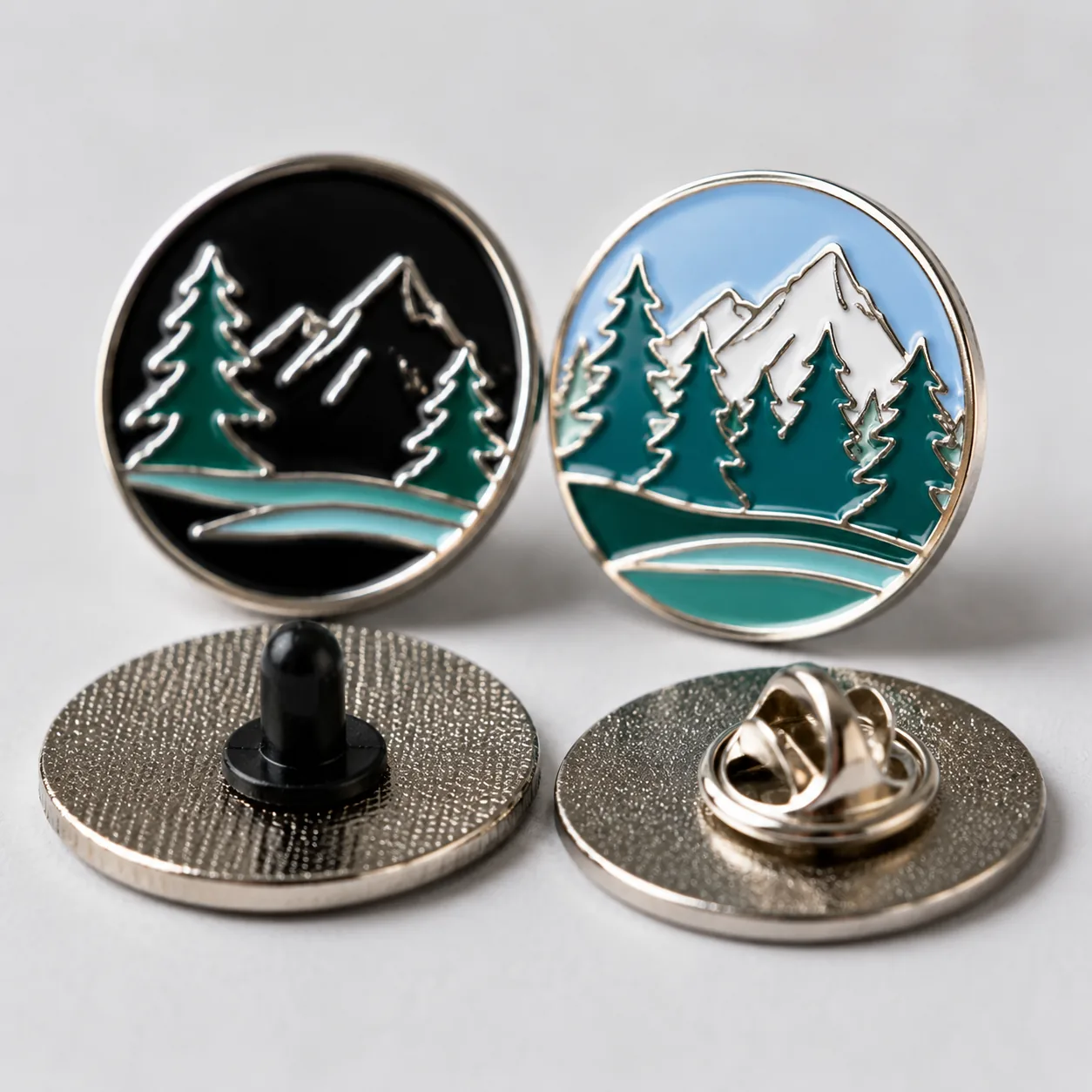
Printed epoxy pins and enamel pins are both sold as custom lapel pins, but they solve different production problems. Printed epoxy pins reproduce the approved image by printing on a plated metal blank, then sealing the print under a clear polyurethane or epoxy dome. Enamel pins are die-struck or cast with raised metal walls, filled with color, cured and finished. Soft enamel leaves the metal higher than the color. Hard enamel is filled closer to the metal surface and polished flat.
The first buying decision should be artwork physics. If the design includes gradients, photographic shadows, QR-like detail, sponsor blocks, halftones or text below 1.0 mm, printed epoxy is usually the safer production route. If the design uses solid Pantone colors, bold outlines and separated color fields, enamel gives a more traditional metal badge appearance.
This guide assumes one-sided pins in the 20-35 mm range, the common size for corporate gifts, events, school badges, loyalty programs and retail collectibles. Typical bases are iron for economy, brass for sharper stamped detail and zinc alloy for thicker or 3D shapes. Standard attachments include butterfly clutch, rubber clutch, deluxe clutch, magnet, safety brooch and double-post fittings. The major differences are not the attachment or base metal; they are artwork tolerance, surface wear, labor content, lead time and inspection risk.
Factory Spec Comparison for 20-35 mm Pins
The ranges below reflect normal export production with standard plating, one attachment, individual polybag packing and FOB China pricing. They are useful for RFQ control, not a substitute for an artwork-based quote. Size, color count, plating thickness, backing card, barcode labels, retail packing and final sorting can move the unit price quickly.
| Spec Item | Printed Epoxy Pin | Soft or Hard Enamel Pin |
|---|---|---|
| Best artwork fit | CMYK artwork, gradients, mascot shading, fine sponsor logos, simulated texture | Vector artwork with solid Pantone colors, separated cells and visible metal borders |
| Practical size range | 18-45 mm; fine detail is more stable at 25 mm and above | 15-50 mm; small metal islands become risky below 20 mm |
| Minimum readable text | 0.6-0.8 mm letter height with open fonts; 1.0 mm preferred for approvals | 1.0-1.2 mm letter height; 1.5 mm safer for retail or licensed marks |
| Minimum line detail | Printed lines of 0.12-0.18 mm can remain visible under clear resin | Raised metal lines 0.25-0.30 mm minimum; enamel channels 0.35 mm minimum |
| Color method | Offset, screen or UV print sealed under 0.5-1.0 mm clear dome | Enamel filled into recessed cells; soft enamel textured, hard enamel polished flush |
| Color cost impact | Low for full-color CMYK; no separate fill for each shade | Medium to high; each color requires separation, filling and curing control |
| Base thickness | Iron or brass 1.2-1.8 mm plus dome; zinc alloy 1.5-2.5 mm | Iron or brass 1.2-1.6 mm; zinc alloy 1.5-2.5 mm for thick shapes |
| Plating thickness | Flash 0.03-0.08 microns; improved wear 0.10-0.20 microns | Same options, but raised exposed metal makes plating flaws more visible |
| MOQ reality | 100 pcs possible; 300 pcs is the first efficient tier | 100 pcs possible; 300-500 pcs normally quotes better because mold and color setup dominate |
| FOB at 300 pcs | USD 0.70-1.55 each for 25-30 mm standard pins | USD 0.80-1.90 soft enamel; USD 0.95-2.30 hard enamel |
| FOB at 1000 pcs | USD 0.42-0.95 each for 25-30 mm standard pins | USD 0.50-1.25 soft enamel; USD 0.65-1.55 hard enamel |
| Sample lead time | 5-8 days after artwork approval | 7-10 days soft enamel; 9-12 days hard enamel |
| Mass lead time | 10-16 days after sample approval for 500-3000 pcs | 12-20 days soft enamel; 15-24 days hard enamel |
| Common failure mode | Dust, bubbles, yellowing, epoxy overflow, print shift, uneven dome height | Low fill, color overflow, pitting, tarnish, polishing marks, distorted borders |
| Recommended inspection | AQL 2.5 major, 4.0 minor; verify print registration and resin clarity | AQL 2.5 major, 4.0 minor; verify enamel level, plating, burrs and polish marks |
Printed epoxy usually wins on cost when the art has eight or more colors or photo-like detail because CMYK printing avoids separate enamel filling. Enamel becomes competitive when the design uses two to six flat colors and the buyer values raised metal, plated outlines and a conventional badge feel. Hard enamel typically adds USD 0.15-0.45 per piece over soft enamel on a 25-35 mm pin because polishing increases labor and cosmetic rejection.
Artwork Detail, Color and Tolerances
For printed epoxy, the practical production target is image registration within ±0.15 mm against the plated outline. Many promotional orders can accept ±0.20 mm, but visible print shift over 0.30 mm should be defined as a major defect. The clear dome slightly magnifies the artwork, which can make colors look brighter but also soften tiny characters near the curved edge.
A 0.6 mm printed letter can be possible, but it is not a safe promise for every font or background. For sponsor names, legal text or scannable details, use an open sans-serif font at 0.8-1.0 mm minimum and proof the artwork at actual pin size before sampling. Avoid placing critical microtext within 1.0 mm of the dome edge, where resin curvature and light reflection reduce readability.
Enamel pins require physical metal barriers. For soft enamel, specify raised metal lines of at least 0.25 mm, enamel channels of at least 0.35 mm and spacing between adjacent color cells of at least 0.20 mm. For hard enamel, 0.30 mm metal lines are safer because grinding and polishing can flatten edges or expose thin borders. Small isolated metal islands can shift, fill poorly or polish unevenly.
Color control is also different. Printed epoxy normally uses CMYK or UV print values, so Pantone matching is approximate unless spot colors are printed separately. Enamel uses mixed solid colors and can be closer to Pantone chips, but translucent, glitter, metallic and neon enamels vary more by batch. For brand programs, specify Pantone tolerance of ±1 shade, require a signed color chip or approved physical sample, and list which colors are critical.
Durability, Plating and Wear Conditions
The epoxy dome protects the printed image from direct rubbing, fingerprints and light moisture. Standard dome height is 0.5-0.8 mm for small pins and up to 1.0-1.2 mm for larger designs. The weak point is the resin surface. Once scratched, especially over black or navy artwork, the pin can look cloudy even if the printed layer is intact. Low-grade resin may also yellow under UV exposure, most visibly over white areas.
Soft enamel handles abrasion through the raised plated metal lines while the color sits lower. It is suitable for event badges, school pins, club pins and campaign giveaways. Hard enamel is smoother and usually better for retail collectibles, uniforms and membership pins because the polished surface resists dirt buildup and feels more premium. It is not indestructible; polishing marks, pinholes and plating wear still need inspection.
Plating thickness should be stated in the RFQ. Economy flash plating at 0.03-0.08 microns is common for short-term giveaways. For daily wear or retail programs, specify 0.10-0.20 microns on nickel, black nickel, brass, gold, rose gold or antique finishes. If pins may contact sweat, rain or salt air, request a 24-hour neutral salt spray check on the approved sample. For uniform or retail programs, 48 hours is a more conservative target.
Neither process should be treated as an outdoor industrial component. Epoxy can haze, soften or yellow under prolonged sun and heat. Enamel and plating can tarnish in humid or salty conditions. If pins are for outdoor staff, festivals, sports teams or backpacks, tell the supplier the expected wear duration, fabric type and storage conditions. A 35 mm pin on thick fabric often needs two posts or a brooch fitting to prevent rotation.
MOQ, Price Tiers and Lead-Time Drivers
At 100 pieces, both constructions carry setup pressure because artwork preparation, mold making, plating setup, sampling and packing are spread across a small quantity. A 25 mm printed epoxy pin may quote around USD 0.90-1.80 FOB at 100 pcs. Comparable soft enamel may be USD 1.00-2.20, and hard enamel may be USD 1.20-2.60. At 500 pcs, printed epoxy often drops to USD 0.55-1.25, soft enamel to USD 0.65-1.60 and hard enamel to USD 0.80-1.95.
The most useful RFQ tiers are 300, 500, 1000 and 3000 pcs. Below 300 pcs, setup dominates. At 1000 pcs, printing, filling, plating and packing run more efficiently. At 3000 pcs, price can improve again, but not linearly because inspection, individual packing, reject replacement and carton handling remain variable costs.
Lead time should be counted from written artwork approval, not from the first inquiry. Printed epoxy samples usually take 5-8 days, with mass production of 500-3000 pcs taking 10-16 days after sample approval. Soft enamel samples usually take 7-10 days, with mass production taking 12-20 days. Hard enamel samples usually take 9-12 days, with mass production taking 15-24 days. Add 3-7 days for backing cards, barcode labels, retail boxes, custom cartons or strict final sorting.
Rush orders are possible only when the artwork is production-ready, plating is standard and packing is simple. Special plating, glitter enamel, translucent enamel, oversized molds, double-post fixtures and retail card assembly reduce schedule flexibility. For seasonal campaigns, approve samples at least 30-40 days before the required ship date if ocean consolidation or third-party inspection is involved.
QC Criteria That Prevent Sample Disputes
Printed epoxy failures usually occur during printing and resin application. Inspect for dust trapped under the dome, edge bubbles, resin overflow, yellow cast, low dome height, uneven resin spread and print misregistration. Dome height variation over ±0.20 mm can be visible when multiple pins sit on the same backing card. Epoxy overflow should be major if it changes the outline, sticks to packing or covers plated borders.
Enamel failures usually occur during filling, curing, polishing and plating. Soft enamel can show low fill, color overflow onto metal lines, uneven gloss and contamination in pale colors. Hard enamel can show pinholes, sanding marks, polishing waves or exposed metal caused by over-polishing. White, yellow and pastel enamel fields need closer inspection because dirt and pitting are more visible.
For promotional orders, a practical default is AQL 2.5 for major defects and AQL 4.0 for minor cosmetic defects. Retail, licensed merchandise and uniform programs may require AQL 1.5 major and 2.5 minor plus 100% visual screening for logo, plating and attachment defects. Define the inspection level before quoting because tighter sorting adds labor and increases the replacement allowance.
Major defects should include wrong artwork, wrong size outside ±0.30 mm, wrong plating, missing color, broken epoxy, severe tarnish, sharp burrs, loose clutch, incorrect attachment, enamel overflow that changes the design and print shift over 0.30 mm. Minor defects can include tiny surface specks, slight gloss variation or small plating marks not visible at 30-40 cm under standard white light.
RFQ Checklist for Comparable Quotes
A strong RFQ prevents suppliers from quoting different constructions under the same product name. Send vector artwork when available, but also include a flattened PDF or PNG showing the approved visual appearance. If the method is not fixed, request printed epoxy, soft enamel and hard enamel as separate quote lines using the same size, plating, attachment, packing and inspection assumptions.
- Final pin size in millimeters, measured by longest width or height, with tolerance such as ±0.30 mm
- Artwork in AI, EPS, PDF or high-resolution PNG, with critical small text, QR-like detail and sponsor logos marked
- Construction requested: printed epoxy, soft enamel, hard enamel or side-by-side comparison quote
- Base metal preference: iron for economy, brass for sharper stamping or zinc alloy for thicker 3D shapes
- Plating finish and target thickness, such as black nickel at 0.10-0.20 microns for improved wear
- Attachment type: butterfly clutch, rubber clutch, deluxe clutch, magnet, safety brooch or double-post fitting
- Packing method: individual polybag, backing card plus OPP bag, barcode label, retail box or master carton only
- Inspection standard, including AQL level, major defect list, color tolerance and any salt spray or UV request
- Quantity tiers for 300, 500, 1000 and 3000 pcs, plus required sample date, shipment date and Incoterm
Include use conditions when they affect construction. A 20 mm lapel pin for a conference can often use one post, butterfly clutch and polybag packing. A 35 mm uniform pin may need two posts or a brooch fitting. A retail collectible may need backing card artwork, carton drop protection, tighter cosmetic sorting and a higher plating specification.
Decision Rules Before Mass Production
Do not choose printed epoxy when the buyer expects a jewelry-like, all-metal premium feel. The resin dome can look promotional, and scratches are more visible on dark artwork. It is also a poor fit for long outdoor exposure, high heat or designs requiring a flat polished surface. If the artwork is simple and the perceived value matters, soft or hard enamel is usually stronger.
Do not choose enamel when the artwork depends on photographic shading, soft gradients, complex mascots or small sponsor blocks. Simplifying the artwork may be possible, but that is a design revision, not a production adjustment. Enamel also becomes slower and less economical when ten or more colors require separate filling, curing and inspection.
For retail collectibles, hard enamel often gives the best perceived value if the artwork is suitable. For conferences, product launches, school events and full-color campaigns, printed epoxy often gives the best balance of accuracy, cost and speed. For classic club pins, service awards and brand badges with strong outlines, soft enamel is usually the practical middle ground.
Before mass production, require one spec sheet showing decoration method, base metal, base thickness, plating finish and thickness, epoxy height if used, attachment, packing, sample lead time, mass lead time, FOB price tiers and inspection standard. Do not approve mass production from a photo alone when color, surface or retail quality matters. Approve a physical pre-production sample, then check size, plating, clutch strength, surface defects, color accuracy, packing fit and carton marking before release.
Have a project? Send your artwork and target quantity and we’ll reply with a detailed quotation within 12 working hours.
Ready to get this made?
Send your sketch, target quantity and ship-date. Detailed quotation in 12 hours.



