Presentation Box Specs for Pins, Coins and Promo Sets
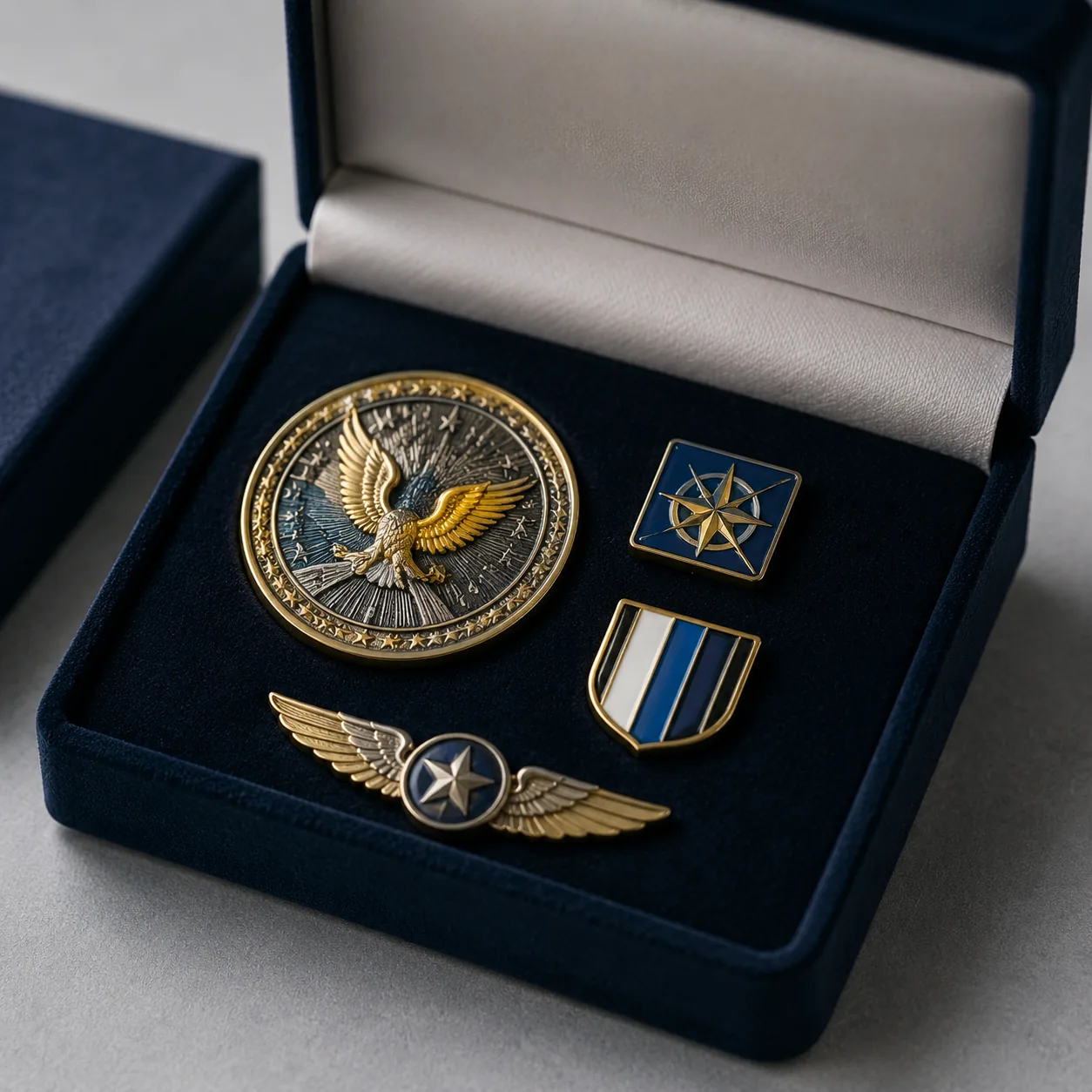
Why Premium Boxes Fail After Sample Approval
Most presentation-box problems are mechanical, not cosmetic. A 45 mm challenge coin can look perfect in a velvet clamshell sample, then rotate during courier handling and arrive with hairline scratches. A lapel pin set may photograph well, but if the EVA insert is cut 1.5 mm oversized, every pin sits at a different angle. A rigid corporate gift box can pass logo approval and still ship with crushed corners because the board is too thin, the insert is not bonded, or the master carton has no compression margin.
For pins, coins, medals, brooches, keychains and mixed promo sets, the box must control position, contact, moisture and carton load. Treat the package as part of the product specification: product thickness, attachment height, plating finish, insert material, paper wrap, glue area and inspection criteria all need to connect. A vague RFQ such as “premium black gift box with insert” usually produces the cheapest structure that looks acceptable in photos, not the one that survives packing, air freight and event distribution.
A complete packaging spec should state the box style, internal dimensions, board or shell material, insert material and hardness, cutout dimensions, decoration method, carton packing, AQL level and approved control sample. This prevents late changes when the metal goods are finished but the packaging cannot hold them safely.
Select the Box Structure Before the Insert
The box structure determines internal depth, opening force and compression behavior. A hinged clamshell protects a single coin or medal well, but it may crush a tall butterfly clutch if the insert is too shallow. A lift-off rigid box gives a clean premium reveal, but the lid can loosen in transit unless lid friction is specified or a paper sleeve is added. Magnetic flap boxes feel more expensive, but they add weight and carton volume; drawer boxes display sets well but are more vulnerable to side compression.
For most metal promo items, usable internal clearance should equal product thickness plus attachment height plus 1.0 to 1.5 mm. A 2.0 mm soft enamel pin with a 6.8 mm butterfly clutch needs about 9.8 to 10.3 mm of internal vertical space if shipped assembled. If clutches are packed separately under the insert, a 3 to 5 mm EVA top insert may be enough, but the buyer must accept extra assembly by the recipient.
Do not approve a box from an exterior render only. Ask for internal length, width and depth, wall thickness, insert thickness, cavity depth and final packed weight. Practical tolerances are ±0.5 mm for hand-wrapped rigid boxes, ±0.3 mm for injection-molded plastic boxes and ±0.8 mm for folded PET boxes. For mixed sets, design around the tallest or heaviest item first because it controls box depth, insert compression and freight volume.
| Box type | Best use | Typical specification | FOB price at 1,000 pcs | Avoid when |
|---|---|---|---|---|
| Velvet clamshell | Single coin, medal or brooch | Flocked plastic shell, snap hinge, 15-25 mm internal depth | USD 0.45-1.20 | Multi-pin layouts need precise spacing |
| Rigid lift-off box | Premium pin, coin or patch sets | 1.5-2.0 mm greyboard, 120-157 gsm wrap, EVA or paper insert | USD 0.80-2.80 | Rush orders under 10 days |
| Magnetic flap box | Executive gifts and high-value sets | 1.8-2.5 mm board, 2-4 magnets, wrapped paper or PU | USD 1.30-3.80 | Low-budget giveaways or high air-freight sensitivity |
| Sliding drawer box | Lanyard, keychain and pin combinations | Rigid sleeve and drawer, optional ribbon pull | USD 1.00-3.20 | Heavy coins or weak master cartons |
| Tin box | Reusable outdoor or retail packaging | 0.23-0.28 mm tinplate, printed or embossed lid | USD 0.70-2.10 | Mirror plating without a protective insert |
| Clear PET box | Retail visibility and low-cost kits | 0.25-0.40 mm PET sheet, folded lock tabs | USD 0.18-0.65 | Coins over 80 g or courier drop risk |
Specify the Insert Like a Fitted Component
The insert is the most common failure point. It must hold the item without scratching it, bending posts or making removal difficult. For coins, EVA or foam cavities should normally be product diameter plus 0.3 to 0.6 mm. A 45.0 mm coin usually works with a 45.5 mm cavity, 2.5 to 4.0 mm cavity depth and an 8 to 12 mm thumb notch. If the coin should sit flush, specify visible height, such as 0.0 to 0.5 mm above the insert surface, rather than saying “fit neatly.”
For pins, specify post-hole spacing from the final artwork or production drawing. A 25 mm pin with two posts should use hole spacing tolerance of ±0.5 mm, visible face alignment of ±0.7 mm in rows and foam thickness of 3 to 5 mm when clutches are packed separately. Brooches with 25 to 35 mm safety pin backs need a recessed channel so the pin bar does not tilt the face. Keychains and medals need clearance for rings, chains and ribbon folds, not just the metal emblem.
Insert material should match weight and finish. EVA at 38 to 55 Shore C is stable and clean for multi-item sets. Medium-density PU foam is cheaper and compresses well, but it can deform under heavy coins. Flocked sponge looks soft but sheds lint; satin is attractive for medals but slippery unless paired with a recess or ribbon pull.
- State insert material, thickness, color and hardness where available.
- Dimension every cavity in mm, including depth and thumb notches.
- Confirm whether clutches, chains or rings ship installed or separately.
- Set cutout tolerance: ±0.3 mm for EVA, ±0.5 mm for PU foam, ±0.8 mm for hand-cut sponge.
- Set visible alignment tolerance: ±1.0 mm for single items and ±0.7 mm for multi-item rows.
- Require a packed sample when the set contains more than three different items.
Choose Materials for Strength, Finish and Handling
A presentation box is a layered assembly. The exterior may be wrapped paper, velvet, PU leather, PET, tinplate or flocked plastic. The interior may be EVA, PU foam, satin, flocked sponge, paper card or molded pulp. Each material has a different tolerance, odor risk, color stability and cost profile.
Small rigid paper boxes typically use 1.5 to 2.0 mm greyboard. Coin sets above 150 g total packed weight should use 2.0 to 2.5 mm board, especially if boxes are stacked in master cartons. Standard wrap paper is 120 to 157 gsm; textured or specialty paper may be 180 gsm, but sharp corners can crack if the wrap is too stiff. For black, navy and red wraps, require rub testing because dark surfaces show white edge cracks, glue marks and paper dust more easily.
For plated metal items, surface contact matters. Mirror nickel, polished gold, black nickel and enamel with clear epoxy should not touch tinplate, exposed staples, rough paper edges or another metal part. Use tissue paper, PET protective film or a recessed insert where needed. If the shipment crosses humid routes or sits in storage, add 1 to 2 g silica gel per small box or 5 to 10 g per inner carton for mirror-plated goods and tin boxes.
| Material | Typical grade | Tolerance to request | Strengths | Risks |
|---|---|---|---|---|
| Greyboard | 1.5, 2.0 or 2.5 mm | Board thickness ±0.2 mm | Economical, rigid, easy to wrap | Corner crush if board or carton is underspecified |
| EVA insert | 3-12 mm, 38-55 Shore C | Cutout ±0.3 mm | Clean edges, stable support, good for rows | Higher cost, tooling marks if blade is dull |
| PU foam | 3-10 mm medium density | Cutout ±0.5 mm | Low cost, good compression | Can yellow, deform or tear around posts |
| Satin lining | 80-120 gsm fabric | No wrinkles, stains or loose threads | Premium appearance for medals | Slippery unless recess is added |
| Tinplate | 0.23-0.28 mm | Box dimension ±0.5 mm | Reusable, moisture resistant | Can scratch plating if insert shifts |
| PET sheet | 0.25-0.40 mm | Fold position ±0.8 mm | Low cost, retail visibility | Cracks at corners under heavy load |
Control Logos, Printing and Brand Color
Decoration should be chosen for the surface, not just the artwork. Offset printing is suitable for wrapped paper, paper sleeves and tinplate. Hot foil stamping gives sharper metallic logos on rigid paper boxes, especially for simple marks and event names. Screen printing works on PU and velvet, but fine text fills in quickly on textured surfaces.
For foil stamping, specify foil color, logo size, placement and heat-mark tolerance. A practical logo-position tolerance is ±1.0 mm for boxes under 120 mm wide and ±1.5 mm for larger boxes. Minimum foil line width can be 0.3 mm on smooth paper, but 0.5 mm is safer on textured stock. Embossing or debossing depth is usually 0.3 to 0.6 mm on rigid paper; deeper tooling can crack the wrap or distort thin lids.
For brand color, approve a physical drawdown or production swatch, not only a PDF proof. Pantone spot colors are better for logos, while CMYK is acceptable for full artwork where exact corporate color is less critical. Do not expect the same Pantone code to look identical on enamel, lanyard fabric, embroidered patches, paper wrap and satin lining. Keep a sealed control sample for repeat orders and define an acceptable visual range under D65 or office lighting.
- Logo placement tolerance: ±1.0 mm for small boxes, ±1.5 mm for large boxes.
- Foil line width: 0.3 mm minimum on smooth paper, 0.5 mm safer on textured paper.
- Screen print minimum text height: 2.0 mm on smooth PU, 3.0 mm on velvet or fabric.
- Emboss or deboss depth: 0.3-0.6 mm for most rigid paper boxes.
- Reject glue stains, foil breaks or pinholes on the main viewing face.
- Avoid large solid ink areas on folded PET because scuffing and cracking are common.
Plan MOQ, Lead Time and FOB Cost Early
Packaging MOQ is driven by material, decoration and tooling more than by the pin or coin MOQ. Stock velvet boxes may be available at 100 to 300 pcs. A custom rigid box with foil logo and die-cut EVA insert usually starts at 500 pcs. Custom tin boxes often require 1,000 to 3,000 pcs because printing setup and forming tools are less flexible.
Lead time should be added to the product schedule, not treated as a final packing step. Stock boxes with no logo can ship in 2 to 5 days. Stock boxes with logo printing usually need 3 to 7 days after artwork approval. Custom rigid boxes require 10 to 18 days; magnetic flap and drawer boxes require 15 to 25 days because of hand assembly and drying time. Printed tin boxes often need 20 to 35 days and can become the project critical path.
FOB price is only part of the cost. A USD 1.80 magnetic box can double carton volume compared with a USD 1.10 lift-off box, making express freight more expensive than the upgrade itself. For event orders with fixed arrival dates, a slimmer 2.0 mm board box may be safer than a bulky luxury structure. Ask suppliers to quote box, insert, printing and master-carton packing separately so cost reductions are visible.
| Scenario | Practical MOQ | Lead time after approval | Typical FOB range | Best fit |
|---|---|---|---|---|
| Stock velvet box, no logo | 100-300 pcs | 2-5 days | USD 0.25-0.80 | Fast coin or medal orders |
| Stock box with printed logo | 300-500 pcs | 3-7 days | USD 0.35-1.10 | Small corporate gifts |
| Custom rigid box with EVA insert | 500-1,000 pcs | 10-18 days | USD 0.80-2.80 | Premium pin and coin sets |
| Magnetic flap gift box | 500-1,000 pcs | 15-25 days | USD 1.30-3.80 | Executive sets with higher budget |
| Custom printed tin box | 1,000-3,000 pcs | 20-35 days | USD 0.70-2.10 | Retail or reusable packaging |
| PET retail box | 500-1,000 pcs | 7-12 days | USD 0.18-0.65 | Lightweight visible kits |
Inspect Fit, Appearance and Transit Performance
Packaging QC should check appearance and function together. A box may look clean but fail if the coin is hard to remove, the pin posts pierce the bottom paper or the insert lifts when the item is pulled out. For premium packaging, use AQL 2.5 for major defects, AQL 4.0 for minor defects and zero acceptance for critical defects such as wrong product, sharp exposed metal, mold, broken hinges or detached magnets.
Major defects include wrong logo color, missing foil, crushed visible corners, loose inserts, glue stains on the display face, broken drawer pulls, magnets with weak closure and product movement that causes scratches. Minor defects include small paper specks outside the main viewing area, light scuffs within the approved sample range and slight wrap color variation. Measure at least a sample set of internal dimensions, not just exterior size.
For courier shipments, run a 60 to 80 cm carton drop test on packed goods and a basic shake test on individual boxes containing coins, keychains or multi-metal sets. The item should not leave the cavity, rotate beyond the approved alignment tolerance or contact another metal part. For ocean freight or humid seasons, check moisture protection: inner polybags, desiccant, dry cartons and no wet glue odor before sealing.
- Verify internal dimensions, insert thickness and cavity depth against the signed sample.
- Check insert bonding before loading products; loose inserts often fail after packing.
- Open and close hinged, drawer or magnetic boxes at least 5 times during sampling.
- Run a white tissue rub test on dark paper, velvet, PU and printed surfaces.
- Confirm no metal-to-metal contact after a shake test.
- Record carton compression, corner crush and moisture issues before final sealing.
Build the RFQ Around the Final Packed Sample
The safest workflow is to define the product and packaging together. List every item in the set with final size, thickness, attachment height, weight, finish and packing orientation. Then choose whether the package is mainly protective, retail-visible or premium presentation. That decision controls box structure, insert material, decoration method and freight exposure.
For a reliable RFQ, send product drawings, artwork, target quantity, target FOB budget, deadline, shipping method, preferred box style, brand-color requirements and any sustainability constraints. Request a packaging drawing showing internal dimensions, insert cutouts, tolerances and logo placement before tooling or mass assembly. If cost is too high, adjust the structure first: change magnetic flap to lift-off, reduce board from 2.5 mm to 2.0 mm, simplify foil coverage or replace satin with flocked EVA.
Before production, approve one complete packed sample: final item, insert, box, logo, inner protection, carton method and desiccant if used. Keep that sample sealed as the inspection standard. At ZheCraft, we coordinate the metal product and matching presentation packaging in the same project file, which reduces insert mismatch, late packaging delays and avoidable freight surprises.
Have a project? Send your artwork and target quantity and we’ll reply with a detailed quotation within 12 working hours.
Ready to get this made?
Send your sketch, target quantity and ship-date. Detailed quotation in 12 hours.



