Pre-Shipment Inspection Specs for Custom Metal Giveaways
Why PSI matters after the sample is approved
The highest commercial risk in a custom giveaway order is often the final week before shipment. Tooling is finished, the supplier requests balance payment, and the goods are already packed. At that point, a buyer may receive 20 to 200 export cartons of pins, coins, keychains, patches, magnets or lanyards that look close to the approved sample but fail in plating shade, enamel fill, attachment strength, carton count, SKU separation or retailer labeling.
A pre-shipment inspection, or PSI, should not be a warehouse photo session. It is a written acceptance standard covering sample size, AQL, critical defects, dimensional tolerance, finish limits, functional tests, packing checks and required documents. For custom metal and mixed promotional products, the PSI sheet should be approved before mass production starts, so the factory prices and controls the correct quality level from the beginning.
For standard enamel pins, die-struck badges, zinc alloy keychains, challenge coins, fridge magnets and lanyards, ZheCraft normally schedules final internal QC after 100% production and before final export carton sealing. Practical inspection time is 1 working day for orders below 50,000 pcs, 2 working days for mixed-SKU orders up to about 120,000 pcs, and 3 to 4 working days for national campaigns with many SKUs, retail packing or documented pull-test requirements.
Lock the inspection timing and payment trigger
For most custom metal giveaways, PSI should happen when 100% of goods are finished and at least 80% are packed. If the buyer requires carton drop testing, shipping mark verification or pallet label checks, the inspection should wait until export cartons are packed but before pallet wrapping. Inspecting too early may catch enamel or plating defects, but it will miss shortages, mixed cartons, weak carton sealing and incorrect carton numbering.
A realistic schedule is sample approval on day 0, tooling and mass production for 12 to 25 calendar days, packing for 1 to 3 days, PSI for 1 day, corrective sorting or rework for 1 to 3 days if needed, and then balance payment plus shipment booking. Complex coins, spinner keychains, epoxy domed badges and retail carded sets can need 20 to 35 days after artwork approval because plating, drying, assembly and packing steps cannot all be compressed safely.
For FOB Yiwu, Ningbo or Shanghai orders, a third-party inspection commonly costs USD 180 to 320 per man-day, excluding travel to remote factories. Factory internal PSI is usually included in the unit price, but it is not a substitute for buyer-defined acceptance criteria. If the order value is below USD 1,000, a third-party inspection may be uneconomical; in that case, require a structured factory QC report with measured results, carton photos and a retained balance until the packing list and inspection evidence are complete.
Use AQL levels that match product risk
Most promotional products can be inspected under ISO 2859-1, general inspection level II, with AQL 0 for critical defects, AQL 2.5 for major defects and AQL 4.0 for minor defects. For child-facing accessories, nickel-free claims, magnetic products, security event badges, moving hardware or retail resale programs, tighten to AQL 0 critical, AQL 1.5 major and AQL 2.5 minor. Avoid AQL 6.5 for appearance-heavy enamel goods unless the buyer accepts a visible number of small flaws in the shipment.
Critical defects are safety, legal or brand failures: exposed sharp burrs over 0.2 mm, pin posts that detach by hand, loose magnets, incorrect warning labels, wrong logo, wrong QR code, incorrect licensed artwork or nickel-release non-compliance where nickel-free was specified. Major defects affect saleability or use: wrong plating, missing enamel, attachment failure, visible front scratches over 3 mm, wrong SKU label, carton shortage or mixed sets. Minor defects are limited cosmetic issues that do not affect function, such as rear-side polishing marks, tiny dust dots under epoxy below 0.3 mm or slight color variation within the approved range.
| Lot quantity | ISO level II sample size | Common acceptance setting | Use tighter limits when |
|---|---|---|---|
| 500 to 1,200 pcs | 80 pcs | 0 critical, 2.5 major, 4.0 minor | VIP gifts, retail resale, safety claims |
| 1,201 to 3,200 pcs | 125 pcs | 0 critical, 2.5 major, 4.0 minor | Multiple platings, epoxy domes, carded packing |
| 3,201 to 10,000 pcs | 200 pcs | 0 critical, 2.5 major, 4.0 minor | Licensed artwork, mixed designs, event kits |
| 10,001 to 35,000 pcs | 315 pcs | 0 critical, 1.5 or 2.5 major, 2.5 or 4.0 minor | Magnets, moving parts, national launch dates |
| 35,001 to 150,000 pcs | 500 pcs | 0 critical, 1.5 major, 2.5 minor | Retailer orders, strict routing guides, child-use items |
Define tolerances for size, color and plating
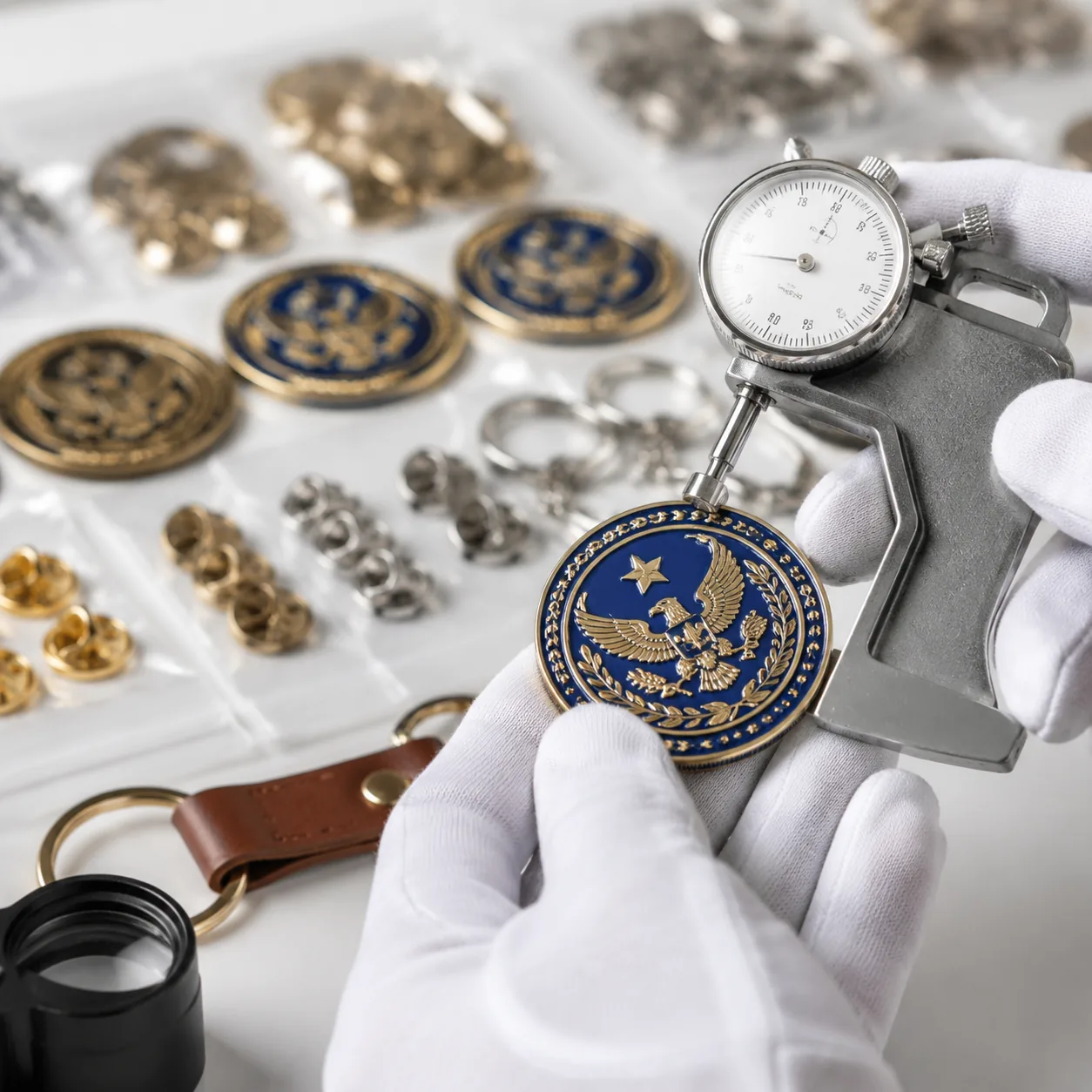
The inspection report should compare production against both the sealed golden sample and the final production drawing. For die-struck, cast or etched metal items, practical finished-size tolerance is usually ±0.3 mm for items under 40 mm, ±0.5 mm for 40 to 80 mm items and ±0.8 mm for large buckles or medals above 80 mm. Thickness tolerance is commonly ±0.2 mm for pins and badges, ±0.3 mm for standard keychains and ±0.5 mm for challenge coins or bottle-opener coins.
Enamel and print color should be specified before inspection. A practical standard is visual match under D65 light at 30 to 40 cm with no obvious mismatch against the approved sample. For instrument checking, many brand buyers use Delta E under 2.0 for solid corporate colors and under 3.0 for normal promotional colors. Transparent enamel, glitter enamel, metallic ink and plated backgrounds can give inconsistent meter readings, so visual approval against a physical sample remains important.
Plating must be judged for coverage, adhesion, shade consistency and abrasion risk. Decorative flash gold, nickel, silver or black nickel on low-cost promotional pins is often 0.05 to 0.10 micron. Better decorative plating is usually 0.10 to 0.30 micron. Products handled daily, such as keychains, bottle openers and bag charms, should specify 0.30 to 0.50 micron or choose antique finish to reduce visible wear. Mirror gold flash can look premium in photos, but it shows scratches quickly if the product is loose-packed or used on keys.
MOQ and price expectations should also be realistic. Soft enamel pins often start at 100 pcs per design, with typical FOB China pricing of USD 0.45 to 0.95 per pc at 1,000 pcs depending on size, plating and backing. Zinc alloy keychains often start at 300 pcs, commonly USD 0.80 to 1.80 FOB at 1,000 pcs. Challenge coins normally start at 100 to 300 pcs per design, with 45 to 50 mm coins often USD 1.20 to 3.50 FOB depending on thickness, edge style, enamel, numbering and packaging.
Test function, attachments and safety points
Many defective orders look acceptable in carton photos but fail when used. Butterfly clutches should grip the nail without wobble, rubber clutches should not split after five push-on and pull-off cycles, split rings should close with a residual gap under 0.3 mm, and brooch pins should close securely without permanent bending under light hand pressure. Any sharp point, loose post, detached magnet or broken ring should be treated as a critical defect, not a minor workmanship issue.
For keychains, inspect each load-bearing part separately: jump ring, chain, split ring, lobster clasp, swivel, screw fitting and charm eyelet. A useful production test is a 5 kg static pull for 10 seconds on standard keychains and 8 to 10 kg for heavier bottle openers, hotel-style key tags or zinc alloy charms above 50 g. If the product includes a rotating or sliding part, cycle at least 20 samples per SKU through five full movements and record any sticking, plating rub or looseness.
Magnets need objective checks because weak magnetism creates complaints even when artwork is correct. For a 30 to 50 mm metal fridge magnet, 300 to 600 g pull force on a clean steel plate is a reasonable range. Larger bottle-opener magnets may require 800 g or more. Thin flexible magnets can be cheaper, often USD 0.18 to 0.45 FOB for simple printed pieces at 1,000 pcs, but they are not suitable for heavy cast metal pieces unless the magnetic area and adhesive are engineered for the load.
- Test at least 20 functional samples per SKU, or all inspected samples for high-risk hardware.
- Cycle each clasp, brooch pin, swivel hook, breakaway buckle or rubber clutch at least 5 times.
- Record pull-test load, duration and failure mode instead of writing only passed.
- Reject loose magnets, detached pin posts, sharp burrs over 0.2 mm and broken rings as critical defects.
- Compare function against the sealed golden sample and drawing, not a verbal expectation after packing.
Control packing, counts and mixed-SKU risk
Packing defects often cost more than product defects because they appear at the distributor warehouse, retailer DC or event venue. PSI should verify inner quantity, backing-card orientation, barcode or SKU label, OPP bag thickness, master carton count, carton weight and shipping marks. For small pins, common packing is 1 pc per OPP bag, 50 to 100 pcs per inner bag or box and 500 to 1,000 pcs per export carton depending on weight and backing card size.
Carton weight matters because metal items become dense quickly. For manual handling, keep export cartons under 15 kg where possible and under 18 kg unless the buyer approves heavier cartons. A 5-ply corrugated carton is preferable for coins, bottle openers and heavy keychains. For loose giveaways, a small inner-count deviation may be acceptable only if the total carton and order quantity are correct. For retail sets, event kits or subscription boxes, zero shortage per set should be required.
Mixed-SKU orders need SKU-level sampling. If an order includes several designs, plating colors, backing cards, language versions or barcodes, inspection must open cartons across all SKU groups. Enamel pin sets should be checked as complete sets, not only loose item counts. A 3% wrong clutch color may be tolerable for a free event giveaway, but the same error can fail a retail set if the packaging is visible or barcode-specific.
| Packing item | Practical specification | Common failure | Inspection method |
|---|---|---|---|
| OPP bag | 0.03 to 0.05 mm film | Torn bags, cloudy film, wrong warning text | Measure film, rub print, open random bags |
| Backing card | 300 to 400 gsm card | Wrong orientation, bent corners, color shift | Compare with approved proof and golden sample |
| Inner box | 50 to 200 pcs by item weight | Mixed SKU, shortage, crushed corners | Open selected inners and recount |
| Export carton | 5-ply corrugated for heavy metal goods | Weak tape, overweight carton, poor edge crush | Check size, gross weight and sealing |
| Shipping mark | PO, SKU, quantity, carton number | Wrong consignee, missing sequence, bad barcode | Match labels to packing list and PO |
Adjust inspection depth by product type
Inspection cost should be proportional to order value and failure risk. A 1,000 pc soft enamel pin order at USD 0.45 to 0.95 FOB per pc may not justify a full third-party inspection if the buyer has approved a strong pre-production sample and uses simple bag packing. A 20,000 pc retail keychain order at USD 0.80 to 1.80 FOB per pc should normally have formal PSI because hardware, plating, barcode and packing defects multiply quickly across cartons.
Challenge coins need closer checks because weight, relief and finish are central to perceived quality. Inspect diameter, thickness, weight tolerance, edge plating, enamel fill, numbering, relief sharpness and capsule or velvet-box packing. A practical weight tolerance is ±5% against the approved sample for cast or stamped coins, unless the drawing specifies exact brass or zinc alloy weight. Coin-face scratches over 2 mm should usually be major defects because the flat polished surface makes damage obvious.
For embroidered, woven and PVC patches, the PSI should shift toward thread color, border consistency, heat-cut edges, hook-and-loop adhesion and backing glue. Normal patch MOQs are often 100 to 300 pcs per design, with lead times around 10 to 18 days after artwork approval. Dimensional tolerance of ±1 mm is realistic for small patches, while large dense embroidery may need ±2 mm because fabric tension changes after stitching and heat pressing.
For lanyards, verify print registration, webbing width, loop length, hardware plating and safety breakaway function. A 20 mm polyester lanyard should usually measure within ±1 mm in width and ±10 mm in total loop length. Dye-sublimated lanyards need edge and back-side checks because artwork can shift during heat transfer. If the order is for schools, transport passes or conferences, require breakaway buckles to open under the agreed load and reclose without cracking.
Put the PSI clause in the purchase order
The purchase order should state who performs inspection, when it happens, which standard applies and what happens if the lot fails. A clear clause can state that shipment and balance payment are subject to final inspection under ISO 2859-1, general level II, AQL 0 critical, 2.5 major and 4.0 minor, based on the sealed golden sample, final artwork, drawing revision and packing list. It should also state that the supplier must sort, rework or replace failed goods at its cost when defects exceed acceptance limits.
Avoid vague phrases such as best quality, no scratches or same as sample. Same as sample is useful only when the sample is sealed, dated and tied to a drawing revision. If the approved sample had a small rear polishing mark but the buyer later rejects every rear mark, the standard becomes subjective. PSI clauses should distinguish front-face defects, rear-side marks, functional failures and packing errors so the decision is repeatable.
ZheCraft supports PSI clauses by keeping sealed golden samples, production drawings, Pantone references, packing approvals and batch QC records under the same order number. This helps distributors manage repeat orders across pins, coins, keychains, patches, magnets and lanyards because the inspection basis remains stable even when the reorder is placed months later.
- Attach final artwork with revision number, Pantone codes and approved finish to the PO.
- List AQL levels for critical, major and minor defects.
- Define dimensional tolerance, plating thickness expectation and color standard.
- State whether third-party inspection is allowed and how many days of notice are required.
- Require corrective action and re-inspection rules if the first PSI fails.
- Hold balance payment until the inspection report, packing list and carton photos are complete.
Before the next order enters production, prepare a one-page PSI sheet for each product type. Include SKU, quantity, golden sample reference, AQL level, key dimensions, functional tests, packing method, carton marks and required documents. Send it with the RFQ or PO so the factory quotes the correct quality level instead of discovering stricter expectations after goods are packed.
Have a project? Send your artwork and target quantity and we’ll reply with a detailed quotation within 12 working hours.
Ready to get this made?
Send your sketch, target quantity and ship-date. Detailed quotation in 12 hours.



