Pre-Production Samples for Custom Pins: Approval Specs That Matter
Do not approve appearance without production rules
A pre-production sample can look excellent on a desk and still fail as a manufacturing reference. The bulk order may arrive with a warmer gold tone, looser clutch backs, thinner enamel, softer logo edges, or packaging that does not match the retail plan. The supplier may call these differences normal production variance. The buyer may expect every piece to match the approved sample exactly. The conflict usually starts because the sample approval froze the look, but not the measurable rules behind it.
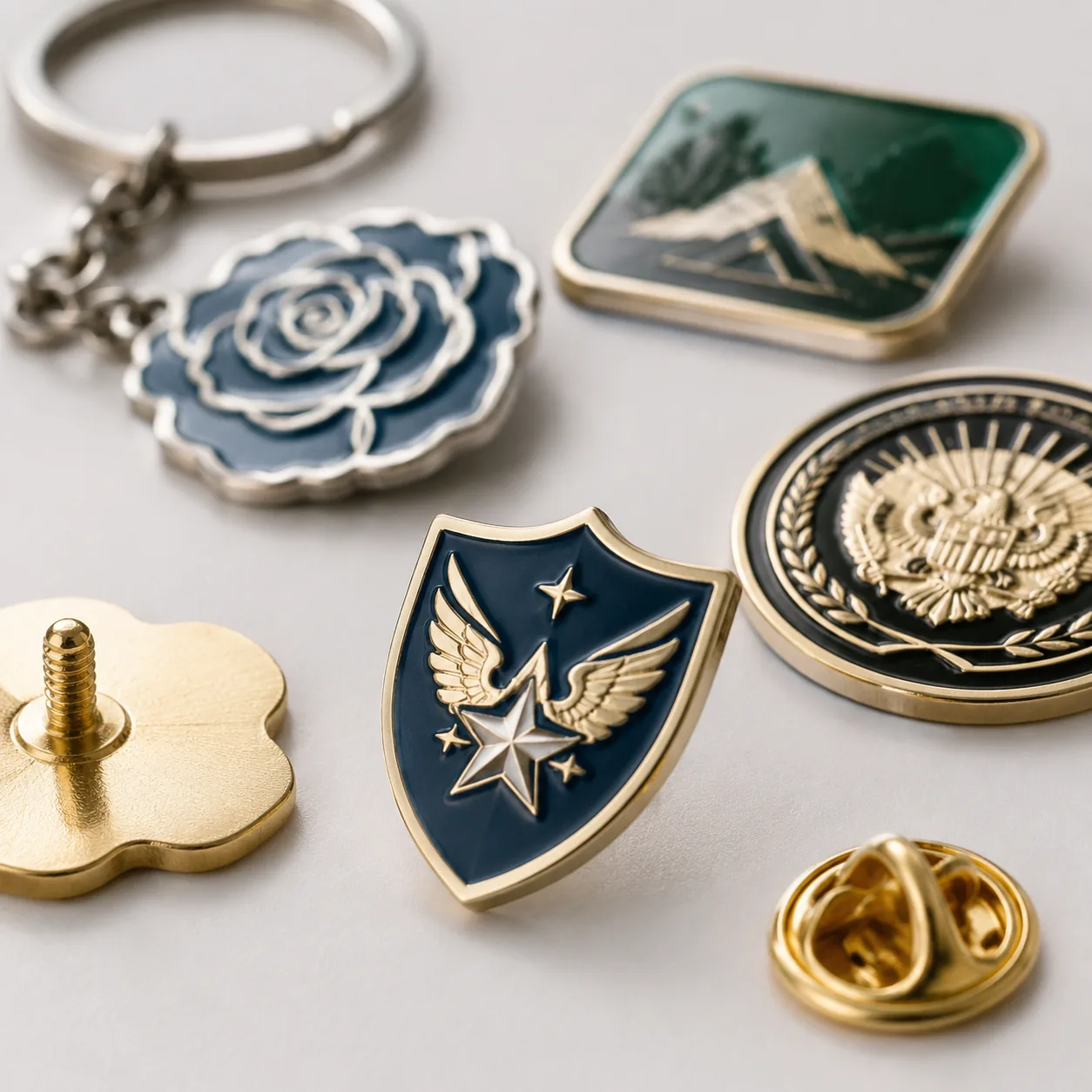
For custom enamel pins, brooches, keychains, challenge coins, badges, and magnetic items, the sample should be treated as a controlled reference part. At ZheCraft, we recommend approving the sample together with a short technical sheet covering size, metal thickness, plating thickness, Pantone targets, attachment strength, packaging, acceptable tolerances, and inspection level. This turns approval from a subjective yes into a production instruction.
Not every order needs a physical sample. For 100 simple soft enamel pins for an internal event, a digital proof, plating reference photo, and previous production photos may be enough. For 500 pieces or more, retail packaging, licensed artwork, QR codes, safety-sensitive attachments, wearable brooches, magnets, or reorder programs, the extra 7 to 15 days for sampling is usually cheaper than sorting or remaking a failed bulk order.
When the sample is worth the cost
A typical custom metal sample costs USD 45 to USD 120 for enamel pins, USD 60 to USD 160 for keychains or magnets, and USD 120 to USD 300 for challenge coins, 3D badges, or multi-process pieces. The range depends on mold size, relief depth, number of enamel colors, plating finish, attachment type, and whether the mold can be reused for bulk production. Sample lead time is usually 7 to 12 days after artwork approval for stamped enamel pins, 10 to 15 days for zinc alloy casting or 3D relief, and 12 to 20 days for items requiring printing, epoxy, assembly, or special packaging.
The sample fee is not the price of one unit. It covers die cutting or mold setup, test stamping or casting, trimming, polishing, plating rack setup, enamel mixing, hand filling, baking, attachment welding or riveting, packaging trial, and QC review. If a buyer cancels after sampling, the factory has already absorbed most of the technical setup work.
For repeat or retail programs, confirm that the sample uses the same process route as bulk production. A CNC-cut production die, actual plating bath, and normal enamel fill sequence are more reliable than a hand-finished display piece. If the factory creates one perfect sample by extra polishing, manual paint correction, or a different attachment method, the buyer has approved an exception rather than a repeatable production standard.
| Order type | MOQ and FOB guide | Sample recommendation | Sample cost | Sample lead time |
|---|---|---|---|---|
| Simple soft enamel pin | 100 to 300 pcs; USD 0.45 to 1.10 FOB | Digital proof usually enough | USD 0 to 45 | 2 to 4 days for proof only |
| Retail enamel pin | 500 to 5,000 pcs; USD 0.55 to 1.60 FOB | Physical pre-production sample | USD 45 to 120 | 7 to 12 days |
| Brooch or heavy badge | 300 to 3,000 pcs; USD 0.90 to 2.80 FOB | Wearable sample strongly advised | USD 70 to 180 | 9 to 14 days |
| Challenge coin or 3D badge | 100 to 5,000 pcs; USD 1.20 to 5.50 FOB | Physical sample required | USD 120 to 300 | 12 to 18 days |
| Multi-item promotional set | 500 to 10,000 sets; USD 1.50 to 8.00 FOB | Full assembled sample advised | USD 120 to 380 | 12 to 20 days |
Freeze construction before decoration
Start approval with construction because tooling errors are expensive to correct. For stamped pins and badges, a practical size tolerance is ±0.20 mm for outlines under 40 mm, ±0.30 mm for 40 to 70 mm pieces, and ±0.50 mm for cast or openwork designs. Metal thickness should be stated at a flat area, not at a raised rim: 1.2 mm is common for small promotional soft enamel pins, 1.5 mm for premium lapel pins, 2.0 mm for keychain charms, and 3.0 to 4.0 mm for most challenge coins.
Weight tolerance matters for coins, brooches, magnets, and anything mailed at scale. A 35 to 40 mm enamel pin may reasonably vary by ±1 g. A 50 mm coin may vary by ±3 g depending on relief depth, edge style, and polishing loss. If postage cost, garment sagging, or retail feel is important, approve a target weight and acceptable range instead of relying on visual review.
Also check edges, cutouts, and back details. Internal cutouts normally need a minimum radius of 0.3 to 0.5 mm to avoid tearing during stamping and weak plating coverage. Bridges between open areas should usually be at least 0.8 mm for small pins and 1.2 mm for heavier badges. Raised text below 0.6 mm height, recessed text below 0.8 mm height, or metal lines below 0.25 to 0.30 mm can fill with enamel, lose definition during polishing, or disappear under plating.
- Confirm final size in millimeters with tolerance by product type.
- Measure metal thickness with calipers at a flat area, not at the rim.
- Approve back stamp depth, text height, logo orientation, and post position.
- Check cutouts for minimum radius and bridge width before mold release.
- Define whether sample weight is a target, minimum, maximum, or reference only.
Control color, plating, and surface finish
Color disputes are common because enamel, ink, plating, and epoxy do not reflect light like a printed proof. Enamel colors should be matched to Pantone Solid Coated references when possible, but the approval should still name the actual method: soft enamel, hard enamel, screen print, offset print, UV print, or epoxy-covered print. For printed surfaces, a practical tolerance is Delta E 2.0 to 3.0 when measured under D65 daylight. For enamel fills, most buyers use visual match within one Pantone step under a consistent 5000K or D65 light source.
Plating should be specified by finish and thickness, not only by color name. Standard promotional pins commonly use 3 to 5 microns total deposit for nickel, black nickel, imitation gold, rose gold, or matte finishes. Higher-wear items such as keychains, zipper pulls, bottle openers, and coins should use 5 to 8 microns where the design allows it. More plating is not always better; heavy deposit can soften fine linework, reduce enamel channel depth, and make small text less legible.
Antique finishes, rainbow plating, oil-slick plating, and hand-brushed effects need range approval. These finishes are intentionally variable because polishing pressure, bath position, and oxidation removal affect the final tone. If brand consistency is more important than visual effect, choose polished nickel, matte black, black dye, or controlled enamel color instead of a variable electroplated finish.
| Feature | Approval method | Practical tolerance | Risk to watch |
|---|---|---|---|
| Soft enamel color | Pantone chip plus physical sample | Visual match within one Pantone step | Raised metal edges make color appear darker |
| Hard enamel color | Pantone chip plus polished sample | Visual match within one Pantone step | Polishing can lighten or smear small areas |
| Printed logo | Pantone or CMYK target with sample | Delta E 2.0 to 3.0 | Text below 0.8 mm may blur |
| Standard plating | Finish name plus thickness | 3 to 5 microns | Fine lines may soften if overplated |
| High-wear plating | Finish name plus thickness | 5 to 8 microns | Cost and lead time may increase |
| Antique plating | Photo range plus sample | Approved visual range | Recess darkness varies by polishing pressure |
Test attachments under real use
A pin that looks correct but falls off a jacket is a failed product. Butterfly clutch posts are typically about 1.0 mm in diameter with 7 to 8 mm exposed length. The clutch should grip firmly after repeated removal and reinstallation. Rubber clutches are more comfortable for events and children’s merchandise, but low-grade rubber can loosen faster, especially on pins above 12 g or on thick fabric.
For brooches, the hinge, pin bar, and catch are more important than the decorative face. A 35 mm wide brooch usually needs a 25 to 30 mm safety pin bar. A 50 mm brooch may need a 35 to 45 mm bar, two posts, or a wider backing plate to prevent rotation. For thin fabric, avoid heavy cast bodies above 25 g unless the attachment spreads the load.
Magnets require separate validation because pull force changes sharply with magnet grade, diameter, thickness, and steel surface. A light 30 mm badge may work with one 10 mm by 2 mm neodymium magnet. A heavier 50 mm metal piece may need two magnets or one 12 mm by 3 mm magnet. Do not approve magnet strength by sticking the sample to a factory steel table. Test it on a painted refrigerator surface with one or two sheets of paper, then leave it vertically mounted for at least 24 hours.
- Remove and reinstall each clutch 10 times, then check wobble and grip.
- Rotate the sample on fabric to confirm whether one post prevents spinning.
- Check brooch catches for burrs, incomplete closure, and hinge looseness.
- Pull split rings and jump rings with at least 5 kg force for standard promo use.
- Test magnets on painted vertical steel, not only on bare factory tables.
Turn the sample into inspection criteria
The approved sample should become the baseline for mass production QC. For most custom pins, keychains, badges, and coins, ANSI/ASQ Z1.4 normal inspection with AQL 2.5 for major defects and AQL 4.0 for minor defects is practical. Retail chains, licensed goods, and safety-sensitive programs may tighten major defects to AQL 1.5, but tighter limits can add sorting cost and 1 to 3 days to the schedule.
Define major defects as issues affecting function, brand appearance, safety, or saleability: wrong plating, missing enamel, loose post, weak magnet, broken clasp, unreadable QR code, incorrect barcode, visible rust, sharp burr, or missing warning label. Minor defects may include fine polishing hairlines, tiny dust under epoxy, slight enamel meniscus variation, or shade movement inside the approved range. Without this distinction, inspectors may reject harmless cosmetic variation while passing functional failures.
ZheCraft keeps a sealed golden sample beside production during enamel filling, polishing, plating review, attachment assembly, and final QC. For larger orders, keep three references: one at the factory, one with the buyer, and one with the inspection company if third-party QC is planned. Each sample should be labeled with project code, artwork revision, approval date, plating finish, color references, and packaging version.
| Defect category | Major example | Minor example | Suggested AQL |
|---|---|---|---|
| Brand accuracy | Wrong Pantone family, missing logo, unreadable QR code | Slight shade shift inside approved range | 2.5 major, 4.0 minor |
| Function | Loose post, weak magnet, broken clasp, split ring failure | Slightly stiff clutch that remains usable | 2.5 major, 4.0 minor |
| Surface finish | Rust, peeling plating, burnt plating, exposed base metal | Fine polishing mark visible only within 100 mm | 2.5 major, 4.0 minor |
| Safety | Sharp burr, detached small part, exposed wire | Slightly rough back edge after polishing | 1.5 to 2.5 major |
| Packaging | Wrong barcode, missing warning, incorrect retail card | Small carton scuff not affecting retail pack | 2.5 major, 4.0 minor |
Know what changes require resampling
Not every post-approval change requires another shipped sample, but structural and process changes usually do. Request a revised sample, or at minimum a first-article production approval, if the outline, size, thickness, relief height, attachment location, plating finish, enamel layout, or number of colors changes. These variables affect tooling, plating flow, fill quality, durability, and visual balance.
Digital approval is usually acceptable for non-structural changes such as backing card text, barcode position, carton marks, polybag warnings, or instruction sheet revisions. Be more cautious with front-side artwork. Even a small logo adjustment may require resampling if text height falls below 0.8 mm, metal line width drops below 0.30 mm, enamel islands become too small to fill, or a printed area must align tightly with raised metal.
Rush orders often create pressure to skip revised samples. A safer compromise is first-article approval: the factory produces 20 to 50 pieces using mass production setup, sends front, back, side, attachment, packaging, and measurement photos, then pauses before running the balance. This does not replace a shipped sample for high-risk projects, but it catches obvious production drift without adding courier time.
- Request a new physical sample when tooling, plating, attachment, or enamel layout changes.
- Use digital approval only for packaging text, carton marks, or non-structural revisions.
- Ask for first-article photos and measurements when timing prevents a second sample.
- Do not approve changes through chat screenshots without a revised proof number.
- Record who approved the change, the approval date, and the version it replaces.
Build sample approval into the commercial timeline
Sampling adds cost and calendar time, but it usually lowers total project risk. For a 1,000-piece soft enamel pin order, FOB bulk pricing often ranges from USD 0.55 to USD 1.40 per piece depending on size, plating, colors, backing card, and attachment. A USD 60 to USD 100 sample and 7 to 12 days of lead time are reasonable when the order is retail-facing, boxed, brand-sensitive, or part of a reorder program.
For a 5,000-piece keychain order at USD 0.80 to USD 1.90 FOB per piece, the larger risk is not the sample fee. It is losing the production slot because revised approval arrives late. A realistic timeline is 1 to 3 days for artwork proof, 7 to 15 days for sampling, 1 to 3 days for buyer review, 12 to 25 days for bulk production, 1 to 2 days for inspection, and 1 to 3 days for packing and export handover. Courier, air, rail, or sea transit should be planned separately.
MOQ also affects the decision. Many factories can run enamel pins from 100 pieces, keychains from 100 to 300 pieces, challenge coins from 100 pieces, patches from 100 to 500 pieces, and lanyards from 300 to 500 pieces depending on process. At very low MOQ, a physical sample may cost nearly as much as production setup. Reserve it for products where failure cost exceeds sample cost: retail launch dates, licensed artwork, safety-sensitive wearables, magnetic items, or exact reorders.
Before final approval, convert the sample into a one-page record. Include product name, artwork revision, final size, thickness, target weight, plating finish and microns, Pantone colors, attachment type, packaging version, tolerance limits, and AQL level. Add photos of the front, back, side edge, attachment, and packaging. Also state what the sample does not prove: full bulk consistency, long-term tarnish resistance, carton strength, or every unit’s plating durability. Those require production inspection, wear checks, salt spray testing where relevant, and carton drop or compression checks.
- Approve only after measuring size, thickness, weight, and attachment function.
- Write acceptable tolerances beside each critical feature before mass production.
- Keep one sealed sample with the buyer and one sealed sample at the factory.
- Define AQL levels before goods are produced, not after cartons are packed.
- Use first-article approval when the schedule is too tight for another shipped sample.
Have a project? Send your artwork and target quantity and we’ll reply with a detailed quotation within 12 working hours.
Ready to get this made?
Send your sketch, target quantity and ship-date. Detailed quotation in 12 hours.



