Post-Tariff Cost Cutting Failures in Custom Promo Products
Failure 1: Mistaking Low FOB for Lower Landed Cost
In 2026, the riskiest quote is often not the highest one. It is the FOB Ningbo, FOB Shenzhen or FOB Shanghai offer that looks 12 to 18 percent cheaper but does not say what was removed to reach the number. A 1.18 USD enamel pin can cost more than a 1.34 USD pin if it ships with 4 percent rejects, repacking labor, short cartons, weak clutches, emergency air freight or a reorder that no longer matches the approved sample.
Small promotional metal goods have real cost drivers: base metal, thickness, tool complexity, polishing time, plating chemistry, enamel count, attachment hardware, packing and inspection level. At 1,000 pieces, a 25 mm soft enamel iron pin at 1.2 to 1.5 mm thickness commonly lands around 0.52 to 0.95 USD FOB before freight, duty and inland charges. A 45 mm zinc alloy keychain with a 25 mm split ring is typically 1.05 to 2.20 USD FOB. A 45 to 50 mm challenge coin at 3.0 mm thickness usually runs 2.20 to 5.80 USD FOB at 500 pieces, depending on 2D versus 3D relief, edge style, enamel count, plating and packing.
MOQ changes the comparison more than many buyers expect. For pins, 100 pieces may carry enough mold and setup burden to lift the unit price to 1.40 to 2.80 USD, while 1,000 pieces can fall below 1.00 USD for a simple iron design. For challenge coins, 100 pieces often remain above 6.00 USD because tooling, polishing and plating are spread across too few units; 500 pieces is normally the first practical comparison tier. After proof approval, realistic production lead times are 12 to 18 days for enamel pins, 16 to 24 days for zinc alloy keychains, 18 to 28 days for challenge coins and 10 to 18 days for embroidered patches, before freight.
Compare quotes on landed cost using the same drawing, material, thickness, attachment, packing method, carton configuration and AQL level. If a tariff-adjusted budget cannot work, the engineering discussion should be diameter, thickness, quantity, attachment or packaging. It should not be a request for the same appearance while plating time, inspection scope or carton protection quietly disappear.
Failure 2: Removing Metal Until the Product Feels Cheap
The fastest tariff-offset saving is often base metal reduction. A 0.2 mm reduction may be acceptable on a compact lapel pin, but it can fail on large badges, coins and keychains where rigidity and hand feel carry much of the perceived value. A 50 mm zinc alloy keychain reduced from 2.5 mm to 1.8 mm may save several grams, but it can flex at narrow logo bridges and feel closer to a stamped tag than a premium gift.
The RFQ should state nominal thickness and tolerance, not only outside size. For soft enamel pins under 30 mm, 1.2 to 1.5 mm iron is usually workable. For 30 to 45 mm pins or offset badges, 1.5 to 2.0 mm is safer. Zinc alloy keychains normally sit between 2.0 and 3.0 mm, with 2.5 mm a practical middle specification for 45 to 55 mm pieces. Challenge coins are commonly 3.0 mm for economy programs; 3.5 to 4.0 mm gives better edge detail and weight for military, association or executive use.
| Product | Risky cost-down spec | Safer 2026 buying spec | Typical FOB impact |
|---|---|---|---|
| 25 mm soft enamel pin | 1.0 mm iron, no tolerance stated | 1.2 to 1.5 mm iron, +/-0.15 mm | Adds about 0.03 to 0.08 USD per piece |
| 50 mm zinc alloy keychain | 1.6 to 1.8 mm body | 2.3 to 2.8 mm body, +/-0.20 mm | Adds about 0.12 to 0.35 USD per piece |
| 45 mm challenge coin | 2.5 mm thickness | 3.0 to 3.5 mm thickness, +/-0.20 mm | Adds about 0.25 to 0.75 USD per piece |
| 75 mm embroidered patch | Light twill and sparse stitch fill | 230 to 260 gsm twill, 75 to 85 percent embroidery coverage | Adds about 0.05 to 0.18 USD per piece |
Record actual weight on the approved sample and first shipment. A practical reorder tolerance for many small metal promo items is +/-0.20 mm on thickness, +/-0.30 mm on outside dimensions under 50 mm and +/-5 percent on unit weight when alloy, shape and plating remain unchanged. Without those numbers, a reorder can pass a quick visual check while arriving lighter and cheaper in the hand.
Failure 3: Shortening Plating, Polishing and Corrosion Controls
Plating is a common hidden cost cut because the defect may not appear in the pre-production sample. Samples are often polished and plated in small batches with extra care. Mass production problems appear later as dark spots, weak gold tone, tarnish around recessed enamel, fingerprints on mirror finishes or corrosion after ocean freight and humid storage.
Ask for plating targets in microns and a test method that fits the use case. Decorative nickel, copper or brass base layers are often around 3 to 5 microns. Decorative gold, imitation gold, silver, antique gold or black nickel top layers may be only 0.03 to 0.10 microns, enough for appearance but not heavy abrasion. If the item is retail, outdoor, long-storage or high-value, specify stronger corrosion resistance. A 24-hour neutral salt spray target is common for basic promotional metal goods; 48 hours may be needed for outdoor or marine-adjacent use, but it raises cost and can limit finish choices.
Finish selection should match handling risk. Bright gold looks strong in a render but shows fingerprints, polish lines and color variation quickly. Antique brass, antique nickel and satin nickel hide minor handling marks better for high-volume events. Black nickel is attractive but exposes scratches and pinholes, especially on keychains that rub against steel rings. For nickel-sensitive markets, specify nickel-free or low-nickel construction separately; a gold-colored surface does not automatically make the product nickel-free.
Failure 4: Letting Color and Line Detail Drift
Tariff pressure often pushes buyers toward fewer enamel colors, cheaper print passes or loose Pantone control. The defect is not always one clearly wrong color. More often, the pin, patch, lanyard and keychain all carry the same logo but look as if they came from different campaigns. That is a real failure for franchise launches, sports merchandise, employee recognition and distributor-managed brand programs.
For enamel pins and coins, specify Pantone Coated references and identify critical colors. A practical factory target is Delta E under 2.0 for critical brand colors and under 3.0 for secondary colors when the supplier has a calibrated spectrophotometer and both sides agree on the standard. Metallic plating, transparent enamel, glow pigment and glitter can make instrument readings unreliable, so approved physical samples still matter. For embroidered patches and lanyards, thread cannot always match Pantone ink exactly; approve thread cards, dyed yarn samples or stitched swatches before mass production.
If cost must come down, remove non-critical colors first. Moving from eight enamel colors to five can reduce setup time and hand-filling labor without weakening metal or plating. Do not remove white, black or outline colors that create logo legibility unless the artwork is redrawn at final size. On a 25 mm pin, a 0.15 mm line can disappear after stamping, polishing and plating. A safer raised metal line is 0.25 to 0.30 mm, with 0.35 mm preferred for dark plating, antique finishes or recessed enamel next to fine text.
Failure 5: Downgrading Hardware Below the Use Case
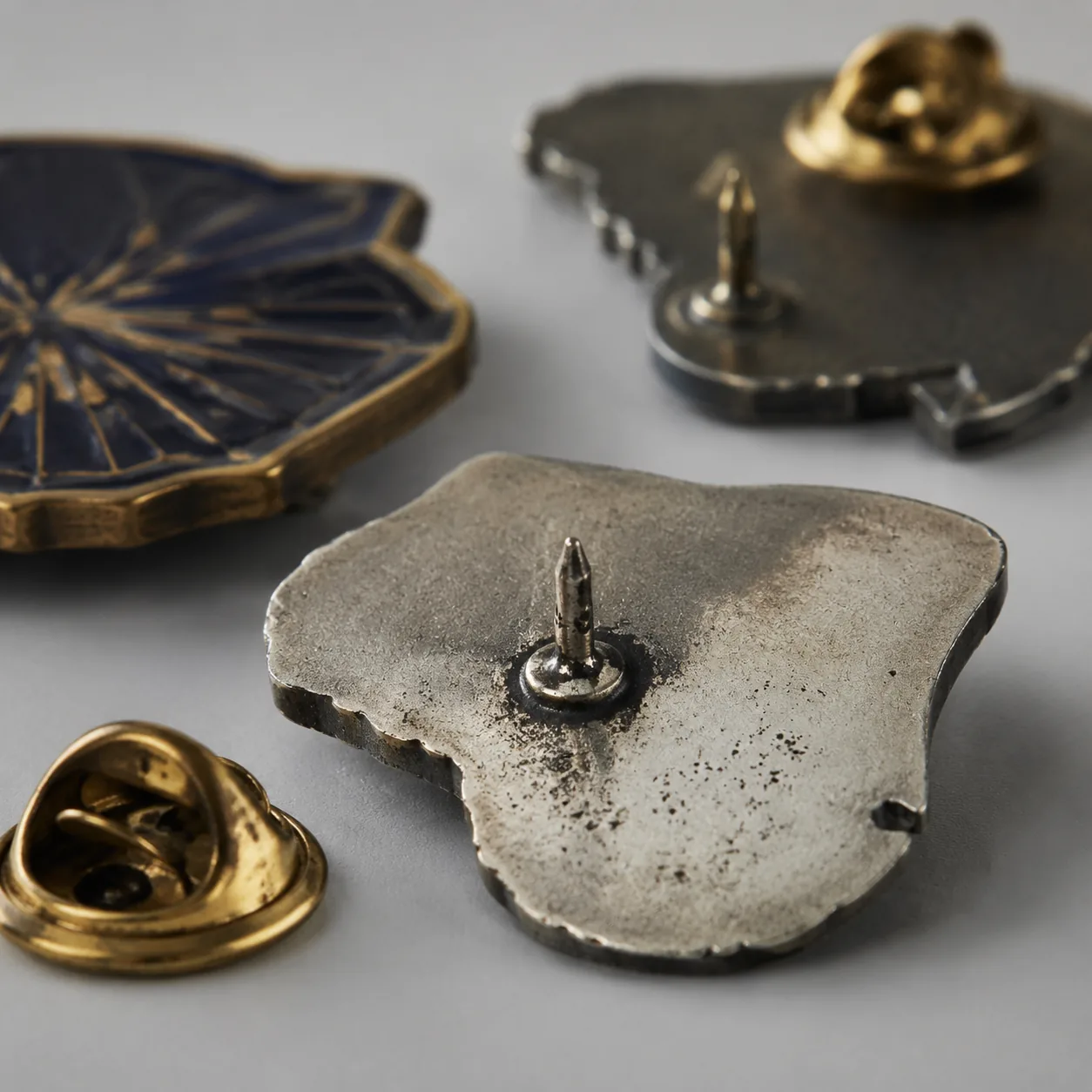
Attachment hardware is easy to miss because it sits on the back or is treated as a commodity part. A pin can look correct and still fail if the clutch loosens, the magnet cracks, the jump ring opens or the brooch bar rotates on fabric. These failures often appear after distribution, which makes them more expensive than defects caught at final inspection.
For lapel pins under 30 mm, a single 8 mm butterfly clutch or rubber clutch can be acceptable. Pins over 30 mm, tall shapes and offset-weight designs should usually use two posts spaced at least 12 mm apart. For brooches above 45 mm, specify a 25 to 35 mm bar pin and require solder pull strength checks. For keychains, a 25 to 30 mm split ring is common, but the connector jump ring should be at least 1.2 mm wire diameter for medium zinc alloy pieces. Heavy coin keychains may need a thicker connector or swivel fitting to prevent twisting and gap opening.
- Specify attachment type, material and size on the artwork proof, not only in email notes.
- Use two posts for pins over 30 mm unless the shape is compact and balanced.
- Define magnet pull force in grams or kilograms on a flat steel plate, not only magnet diameter.
- For keychains, specify split ring diameter, wire diameter and connector style.
- For brooches, confirm bar length, orientation and solder position before sampling.
- Require a pull test or functional check in the final inspection report.
- Keep one approved hardware sample with the reorder file.
Failure 6: Saving on Packaging and Paying for Damage
Packaging is a tempting target when buyers need to offset duty and freight increases. Moving from a velvet box to an OPP bag may reduce FOB cost by roughly 0.25 to 1.20 USD per unit, depending on size and insert material. The problem is that packaging also controls abrasion, bending, moisture exposure, retail presentation and counting accuracy. Poor packing can make a good product look defective.
For low-cost pins, a 6 by 8 cm or 7 by 9 cm OPP bag with a backing card is usually adequate if the pin is light and has no sharp protrusions. For mirror-finish coins, use a PVC pouch, acrylic capsule, velvet pouch or rigid box when the face must remain scratch-free. Loose bulk packing is suitable only for internal tokens or low-grade giveaways. For keychains, separate metal parts so rings do not rub against enamel, epoxy domes or black nickel surfaces during transit. Heavy metal goods should normally use 5-ply export cartons and stay under 15 kg gross weight for manual handling.
Packaging should be included in the AQL plan. A typical promotional order may use AQL 2.5 for major defects and AQL 4.0 for minor defects, with critical defects set at 0. Retail, child-use or regulated items need stricter checks for barcode accuracy, choking hazard warnings, sharp edges, labeling and polybag suffocation notices where applicable. Separate appearance defects from packing defects in the report; a scratched coin, wrong carton mark and short-packed inner box each require a different correction.
Failure 7: Weak Inspection Plans That Hide Defect Rate
Inspection often gets reduced when tariff pressure hits, yet it is one of the few controls that can catch a bad production lot before it becomes a customer problem. A supplier photo set is not an inspection plan. It may show 20 attractive pieces while missing short cartons, mixed finishes, loose posts, color drift or scratches on the bottom layers of the carton.
For most custom promo orders, define inspection by sample size, AQL level and defect classification. A common baseline is ANSI/ASQ Z1.4 general inspection level II, AQL 0 for critical defects, 2.5 for major defects and 4.0 for minor defects. Critical defects include sharp burrs, unsafe magnets, wrong regulatory labels, choking hazards and product contamination. Major defects include wrong plating, wrong attachment, missing enamel, loose posts, cracked epoxy, incorrect packing or dimension outside tolerance. Minor defects include small polish marks, slight enamel overflow or acceptable shade variation within the approved standard.
Dimensional checks should use calipers, not estimates from photos. For metal promo goods, measure at least length, width, thickness and post position. For patches, measure finished size after backing and heat pressing, because heat can shrink or distort the shape. For lanyards, check width, finished length, clip function, safety breakaway strength and print registration. Inspection reports should show defect counts by category, not only a pass or fail conclusion.
Failure 8: Reorders Failing Because the Version Was Never Locked
A buyer may approve a tariff-offset version during a price spike and reorder six months later expecting the same item. The failure appears when the second batch is lighter, the antique finish is darker, the patch border is wider or the lanyard buckle comes from a different lot. Photos and old proforma invoices are not enough for repeatable production.
The reorder file should include final artwork, mold number, material, thickness, plating, enamel colors, attachment, packaging, carton marks and approved golden sample photos. For metal items, record actual measured dimensions and weight from the approved batch. For patches, record thread numbers, backing type, border width, merrow or laser-cut edge, heat-press temperature if used and actual sample dimensions after pressing. For lanyards, record fabric width, print method, clip type, buckle, safety breakaway, Pantone references and finished length.
Name any approved cost-down change as a new version. For example, V2 may be 1.5 mm iron instead of 1.8 mm zinc alloy, or OPP bag packing instead of a rigid gift box. This prevents a distributor from promising an exact repeat while the factory prepares an economy build. It also gives purchasing a clean way to compare V1 and V2 on landed cost, defect risk and delivery time.
Before placing a post-tariff order, ask the supplier to show exactly where the savings come from. A responsible factory can explain visible trade-offs: reducing a coin from 50 mm to 45 mm, changing a simple pin from zinc alloy to iron, using a backing card instead of a box, or increasing order quantity to spread mold and setup cost. If the answer is vague, assume the savings may be coming from thickness, plating, inspection, packing or unapproved subcontracting.
ZheCraft can support this process by marking drawings with manufacturable line widths, thickness, plating, hardware and packing notes before sampling. For buyers managing pins, keychains, coins, patches and lanyards together, that early engineering review is usually cheaper than correcting defects after production. The best post-tariff cost control is not the lowest unit price in isolation. It is a product that survives inspection, transport, distribution and reorder without creating costs that were never shown on the quote.
Have a project? Send your artwork and target quantity and we’ll reply with a detailed quotation within 12 working hours.
Ready to get this made?
Send your sketch, target quantity and ship-date. Detailed quotation in 12 hours.



