Polyester vs Nylon vs RPET Lanyards: Buyer Spec Comparison
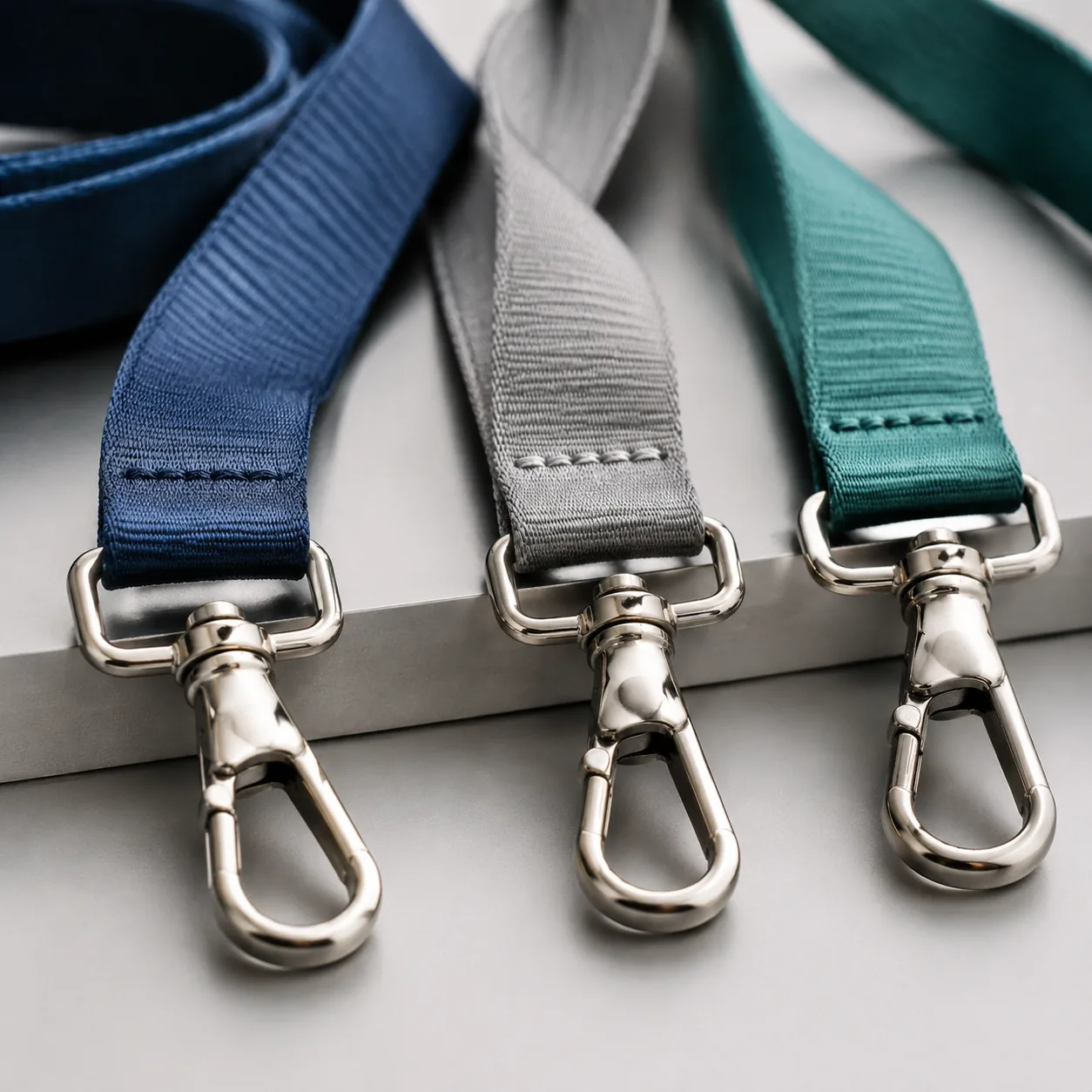
Buyer problem: three straps that look similar but perform differently
A distributor may send the same RFQ to three factories and receive quotes that look close on paper: 20 mm strap, full-color logo, metal hook, 5,000 pieces. The samples tell a different story. One strap prints sharply, one looks richer in hand but softens small text, and one carries a recycled claim that may or may not be backed by documentation.
The issue is not only supplier quality. Polyester, nylon and RPET lanyards behave differently in printing, sewing, abrasion, heat exposure and cost structure. If the RFQ only says “custom lanyard,” the factory will choose the easiest production route, not necessarily the one that fits the event, artwork or compliance target.
For B2B buyers, the right sequence is material first, then print method, then hardware and packing. A strap choice changes artwork limits, reject rate, lead time, FOB price and how the lanyard feels after eight hours on a delegate’s neck.
Spec snapshot: polyester vs nylon vs RPET
The table below reflects common export-grade custom lanyards from China, not retail accessories. Pricing varies by width, print coverage, hardware, packaging and inspection scope, but the ranges are realistic for standard production at 1,000-10,000 pieces.
| Spec item | Polyester lanyard | Nylon lanyard | RPET lanyard |
|---|---|---|---|
| Typical strap width | 10, 15, 20, 25 mm; 20 mm is the standard event size | 15, 20, 25 mm; 20-25 mm is common for premium badges | 15, 20, 25 mm; 20 mm is most common |
| Typical strap thickness | 0.75-1.10 mm woven tape | 0.90-1.30 mm, denser and smoother | 0.75-1.10 mm; feel depends on recycled yarn batch |
| Common decoration | Silkscreen, dye sublimation, heat transfer, woven jacquard | Silkscreen, heat transfer; sublimation is usually a poor fit | Silkscreen, dye sublimation, heat transfer |
| Best logo type | Full-color event artwork, repeated sponsor logos, QR-style badge graphics | Simple premium wordmarks, solid logos, low-detail branding | Full-color campaigns where recycled content matters |
| Small text limit | 4 pt with sublimation on smooth white tape; 6 pt safer for silkscreen | 6-7 pt minimum because ink spread is more visible on the surface | 4-5 pt with sublimation; 6 pt safer for silkscreen |
| Pantone control | Good for silkscreen; sublimation is close but base yarn affects tone | Good for solid colors; glossy surface can shift visual appearance | Good, but recycled yarn shade may make whites warmer or duller |
| Tensile strength target | 90-120 kgf for 20 mm strap before hardware failure | 110-150 kgf for 20 mm strap | 80-110 kgf for 20 mm strap |
| Heat behavior in production | Stable for sublimation at about 190-205 C | Less stable under sublimation heat; distortion risk is higher | Good, but settings should be tested by yarn batch |
| FOB China price, 20 mm x 900 mm, metal hook | USD 0.28-0.55 at 5,000 pcs | USD 0.42-0.75 at 5,000 pcs | USD 0.35-0.68 at 5,000 pcs |
| Practical MOQ | 500 pcs possible; 1,000 pcs is the efficient tier | 1,000 pcs practical; 3,000+ better for custom color stability | 1,000 pcs practical; 3,000+ better when proof documents are needed |
| Sample lead time | 5-7 days for screen print; 6-9 days for sublimation | 6-9 days | 6-10 days depending on yarn stock |
| Mass lead time | 10-16 days after approval for 1,000-10,000 pcs | 12-18 days after approval | 12-20 days after approval; longer with documentation requests |
| Dimensional tolerance | Length ±10 mm; width ±1 mm; print registration ±1.5 mm | Length ±10 mm; width ±1 mm; print registration ±2 mm | Length ±10 mm; width ±1 mm; print registration ±1.5 mm |
| Best use case | Conferences, schools, exhibitions, sports events | VIP passes, hotel staff badges, premium corporate programs | ESG campaigns, universities, tech events, brand activations |
| When not to choose | If the buyer wants a glossy luxury look without changing process | If full-color photographic printing is required | If recycled-content proof is not important to the end client |
Print quality: where artwork succeeds or fails
Polyester is usually the safest choice for printed event lanyards because it accepts both silkscreen and dye sublimation well. On white polyester, sublimation can reproduce gradients, shadows and multi-color artwork without charging per color. For repeated sponsor logos and badge-level detail, a 20 mm polyester strap with sublimation is typically the lowest-risk route.
Nylon has a smoother and slightly glossier surface, which looks premium in hand but is less forgiving with fine print. Ink sits differently on nylon, and small letters can appear heavier after curing. If the logo is a one-color corporate wordmark, nylon can look excellent. If the artwork includes a 5-color event pattern and 4 pt text, it is the wrong material.
RPET behaves close to polyester because it is also a polyester family material, but the yarn source can shift the base tone. White RPET tape may not be as bright as virgin white polyester, especially when the buyer wants a visibly recycled look. For Pantone-critical brands, approve a physical strap swatch, not only a digital proof.
A practical artwork rule is simple: if the smallest readable element is under 5 pt, avoid relying on a glossy strap surface. For two-sided branding, keep critical text away from folds and hardware because the usable print window is usually 760-820 mm on a standard 900 mm flat length lanyard.
Feel, strength and day-to-day wear
A lanyard is worn on the neck, so comfort matters more than many buyers expect. Standard polyester is lightweight and slightly textured. It is comfortable for one-day or three-day events, and when the cut edge is heat sealed correctly and the fold is flat, complaint rates are usually low.
Nylon feels denser and smoother. That supports premium badge programs, hotel staff passes and VIP credentials, especially with a 25 mm strap and metal lobster hook. The trade-off is weight and cost. A wide nylon strap with a zinc alloy hook can feel excessive for children’s events or long volunteer shifts.
RPET can feel nearly identical to polyester if the yarn is fine and the weave is tight. Lower-cost RPET may feel softer or slightly fuzzy after abrasion. For reusable staff lanyards, ask for a simple wear check: 50 dry cloth rub cycles on the printed area and an inspection for pilling, cracking and edge fray.
When buyers ask for durability, factories should speak in measurable terms. For standard 20 mm promotional lanyards, pull testing at 5-10 kg static load for 10 seconds is a reasonable in-house check. For heavy-duty use, such as key sets or radios, the load requirement should be specified separately, because the hardware usually fails before the strap does.
Sustainability claims: useful, but only if the paperwork matches
RPET is often chosen because the end client wants a recycled-content story. That is valid, but the buyer should separate the physical product specification from the marketing claim. A lanyard can be made with recycled polyester yarn, yet the level of proof depends on the yarn supplier, the order size and the paperwork requested.
Do not assume that a small RPET order automatically includes formal chain-of-custody evidence. At 500-1,000 pieces, the practical documentation may be a supplier declaration, yarn purchase record and batch traceability notes. If the end client requires formal recycled-content verification, state that in the RFQ before quotation, because it can affect yarn selection, MOQ, lead time and unit price.
Polyester and nylon are not automatically poor choices because they are virgin materials. If the event is short, budget-sensitive and needs exact full-color branding, polyester may reduce waste by avoiding reprints and rejected samples. If the lanyard is a long-use staff item, nylon’s durability can be the more responsible choice than a low-grade recycled strap that fails early.
A practical sustainability brief should name the claim type: recycled content percentage, third-party certification, or supplier declaration only. If the buyer does not define the claim, suppliers will quote different documentation levels and the price comparison will be misleading.
Price, MOQ and lead time: what really changes the quote
At 1,000 pieces, polyester usually gives the best balance of price and artwork flexibility. A 20 mm x 900 mm polyester lanyard with one metal J hook, safety breakaway and one-color silkscreen often lands around USD 0.30-0.48 FOB China. Full sublimation may be similar or slightly higher depending on print coverage, print sides and packing.
Nylon usually costs 20-45% more than comparable polyester. The webbing itself is more expensive, and reject rates can rise if the design demands very clean edges on a glossy surface. Buyers should not choose nylon simply because the event is important; choose it when the brief calls for a smoother premium strap and the artwork is simple enough to suit the material.
RPET is often priced between polyester and nylon, although small orders can move closer to nylon if special yarn is needed. A practical MOQ is 1,000 pieces, but 3,000 pieces usually gives better leverage on yarn sourcing and documentation. For 10,000 pieces and above, lot consistency improves if one yarn batch is reserved for the full production run.
Lead time is affected more by artwork approvals and hardware selection than by the strap itself. Standard sample turnaround is 5-10 days depending on material and print method. Mass production for 1,000-10,000 pieces is typically 10-20 days after approval, while custom RPET documentation or nonstandard hardware can add several days.
Attachment, sewing and tolerance specs that change the result
Material is only half the decision. The same strap can fail if the attachment is weak, the sewing is too short or the safety breakaway does not match the user group. For standard badges, a 20 mm strap with a metal J hook or swivel lobster hook is enough. For heavier badge holders, radios or key sets, specify reinforced sewing and stronger hardware.
For sewing, a typical production spec is a folded end length of 25-30 mm with a box stitch or dense bar tack. Thread is usually polyester, around 210D/3 or equivalent, with stitch spacing of roughly 2.5-3.5 mm. The fold should not cover printed artwork unless the file includes a 35 mm no-print zone near both ends.
Safety breakaways are recommended for schools, factories, hospitals and large public events. They add a visible plastic component and a small cost, usually about USD 0.03-0.08 per piece depending on quality. For children’s programs, do not replace the breakaway with a strong metal buckle just to improve appearance.
- Specify finished circumference or flat length; a common adult flat length is 900 mm before folding, but 850 mm and 950 mm are also used.
- State strap width and tolerance, for example 20 mm ±1 mm.
- Confirm one-side or two-side printing; two-side registration should allow ±2 mm unless you pay for tighter control.
- Define hardware material: iron, zinc alloy, stainless steel or plastic; do not write only “metal hook.”
- Add a breakaway requirement if the lanyard is for children, industrial sites or public access events.
- Reserve no-print zones at folds, clips and buckles to avoid logo loss.
- Request an inspection level; AQL 2.5 for major defects and 4.0 for minor defects is common for promotional orders.
Quality control: what to inspect before shipment
Most lanyard disputes are not about catastrophic failure. They are about color, print position, dirty straps, weak hooks, inconsistent lengths and poor packing. A sensible inspection plan checks both appearance and function. For B2B promotional orders, AQL 2.5 major and 4.0 minor is standard, with critical defects set to zero for sharp burrs, broken needles or unsafe attachments.
Measure at least 13 pieces across cartons for length and width on smaller lots, and more for larger AQL sampling plans. Finished flat length tolerance should be agreed in advance, usually ±10 mm, because fabric stretch and heat processing change length slightly. Print position tolerance of ±1.5 mm is realistic for polyester and RPET; nylon may need ±2 mm for some designs.
Functional checks should include strap-to-hook pull testing and breakaway performance. For a standard event lanyard, a 5-10 kg static pull for 10 seconds is a practical factory check. Also check color rub with a dry white cloth and, for dark straps, a damp cloth test to catch poor dye fixation before the goods reach the event site.
For higher-value programs, ask for carton drop tests and hardware pull tests on the first approved sample. A simple sample standard is often more useful than a long spec sheet: if the golden sample passes, the bulk order should be built to match it.
Which strap should you choose?
Choose polyester when the buyer needs the safest all-round option: good print detail, low cost, fast lead time and broad factory availability. It is the default for exhibitions, conferences, student events, concerts and most promotional giveaways. If the buyer is unsure, 20 mm polyester with sublimation or silkscreen is usually the lowest-risk starting point.
Choose nylon when feel and finish matter more than full-color artwork or the lowest price. It works well for VIP credentials, executive events, durable staff passes and simple brand logos. Avoid nylon if the design contains photographic gradients, tiny sponsor text or strict budget limits.
Choose RPET when the recycled-material message is part of the campaign and the buyer is willing to manage documentation expectations. It is a good fit for universities, sustainability teams, tech events and consumer brands that want a better material story. Do not choose RPET only because it sounds greener; choose it when the end client values the claim enough to accept the possible cost and lead-time impact.
If the project is still undecided, sample all three materials at the same width, hardware and print method. A side-by-side physical comparison is usually faster and more accurate than debating on screenshots.
What to put in the RFQ so factories can quote accurately
Before asking for prices, decide the material shortlist and the non-negotiables. If the artwork is full color with gradients, ask for polyester and RPET pricing first, not nylon. If the brief says premium, simple and reusable, request nylon and polyester side by side so the buyer can feel the difference.
A clean RFQ should include strap width, flat length, material, print method if known, number of print sides, Pantone colors, hardware type, safety buckle, badge holder size, packing method and required delivery date. Attach vector artwork and mark any no-print zones near folds or clips. If recycled content matters, state exactly what proof is required before the factory quotes.
For repeat orders, lock the strap material, yarn color, print process, hardware code, sewing style and packing spec in one reorder sheet. That prevents a “same lanyard” reorder from turning into a new product with new risks. For first-time programs, approve a physical pre-production sample or a signed golden sample before mass production, especially when Pantone color, RPET yarn shade or nylon surface finish matters.
Have a project? Send your artwork and target quantity and we’ll reply with a detailed quotation within 12 working hours.
Ready to get this made?
Send your sketch, target quantity and ship-date. Detailed quotation in 12 hours.



