Pin RFQ Spec Sheet: The 12 Lines Suppliers Need
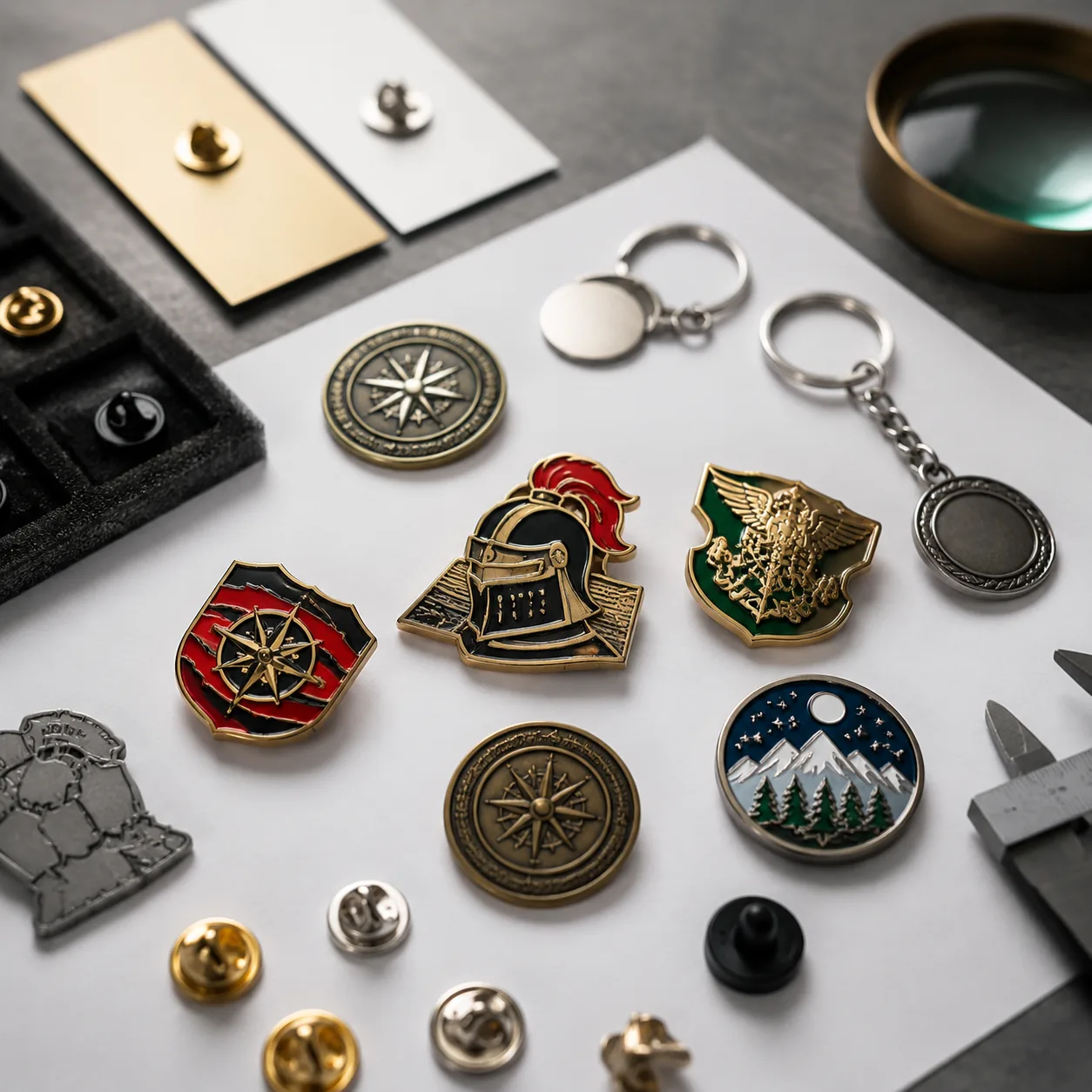
Start With the Seven Specs That Change the Quote
Most bad pin quotes start with a vague brief: a size, a shape, and a reference image. That is not enough for a factory to price correctly because the biggest cost drivers sit in the lines that define tooling, plating, enamel fill, backing hardware, and packing labor. If those lines are open, each supplier will quote different assumptions and the lowest price usually hides exclusions.
For custom enamel pins, a 2 mm change in outer size, a switch from soft enamel to hard enamel, or a request for a black nickel finish can move the unit price by 10% to 30% and the tooling cost by 15% to 40%. A workable RFQ should force every supplier to answer the same variables in the same order. That is how you compare like-for-like, not apples to a partially plated orange.
- Product type: lapel pin, brooch, badge, or keychain-style pin
- Outer size: width and height in mm, not just approximate inches
- Metal build: stamped brass, iron, zinc alloy, or die-cast
- Plating: nickel, black nickel, gold, antique brass, antique silver
- Enamel style: soft enamel, hard enamel, or printed
- Attachment: butterfly clutch, rubber clutch, safety pin, or magnet
- Packaging: bulk, polybag, backing card, velvet pouch, or box
A useful quote request also states whether the design is a first article, a pilot run, or repeat production. Many factories price a 100-piece sampling run at roughly USD 1.20 to 3.50 per piece depending on size and finish, while 300 to 500 pieces often land in the USD 0.65 to 2.80 FOB range for standard soft enamel pins. That context prevents buyers from mistaking sample pricing for mass-production pricing.
Dimension Lines: Where Small Gaps Create Big Rework
Dimension is not just a drawing note; it controls mold cut depth, metal wall width, color separations, and whether the pin can actually hold detail at production scale. Buyers often send artwork in pixels or vague screenshots, but factories need a final physical size. A 30 mm pin and a 35 mm pin may look similar on screen, yet the line width, cavity count, and unit cost can differ enough to break the quote.
Specify outer size to the nearest 0.1 mm and state allowable tolerance. A common factory tolerance for small pins is ±0.3 mm on overall dimensions, ±0.2 mm on post position, and ±0.1 to 0.15 mm on critical line spacing for hard enamel. For larger or irregular shapes, ±0.5 mm is common on overall size. If the design includes cutouts, state minimum bridge width and minimum hole diameter so the factory does not thicken or close features during polishing.
| Spec line | Good RFQ entry | Common mistake |
|---|---|---|
| Outer size | 32.0 mm x 28.5 mm, tolerance ±0.3 mm | About 1.25 in wide |
| Thickness | 1.2 mm metal base, total 1.6 mm with fill | Thin metal |
| Cutouts | Minimum bridge 0.8 mm, minimum hole 1.5 mm | Openwork like artwork |
| Edge finish | Polished edge, burr height under 0.05 mm | Smooth edge |
If the art has tiny lettering, ask the factory to confirm the smallest readable character height. As a rule, letters below 1.2 mm high can become weak in stamped brass; below 0.8 mm, they often require simplification or laser engraving instead of conventional stamping.
Build Line: Match the Metal to the Geometry
The build method decides how much detail survives production. Stamped brass works well for crisp 2D outlines, fine lines, and clean hard enamel boundaries, usually at 1.0 to 1.2 mm base thickness for small and medium pins. Iron is common for cost-sensitive flat items, while zinc alloy is better when the shape is highly irregular, heavily layered, or requires 3D relief. Zinc alloy usually supports more sculpted depth, but it is heavier and can lose the razor-sharp edges that stamped brass holds well.
If your quote sheet omits the build type, two factories may price two very different manufacturing paths. That matters because tooling, yield, and finishing all change. A flat stamped pin may have lower mold cost and a shorter lead time, while a die-cast 3D badge may need a higher tooling charge, more polishing, and a longer schedule. For a typical custom line, tooling can range from USD 40 to 180 for simple shapes and USD 120 to 350 for more complex 3D or multi-level designs, depending on size and cavity count.
- Use stamped brass for thin outlines, text, and clean enamel partitions
- Use iron for cost-sensitive flat items where weight is not critical
- Use zinc alloy for 3D relief, heavy contours, and complex silhouettes
- Avoid die-cast if the design depends on very fine recessed text
- State whether you need raised metal, recessed enamel, or mixed relief
A concrete build note is better than a style label. For example: “2D stamped brass, 1.2 mm base thickness, single-level recessed enamel, no 3D sculpting” gives the factory a manufacturing path. “Premium pin” does not.
Plating Line: Finish, Thickness, and Tarnish Risk
Plating is one of the easiest places for RFQs to fail because buyers name a finish but not the thickness or exposure expectation. Standard decorative plating on promotional pins is often a flash layer around 0.03 to 0.05 microns for appearance-only work, while more durable decorative plating may be specified around 0.1 to 0.3 microns depending on process and base metal. If the item will be handled often, worn outdoors, or sold retail, that difference matters more than the color name alone.
The real decision is not just gold versus nickel; it is how the plating behaves after polishing, enamel baking, bagging, and shipment to humid climates. Antique finishes hide micro-scratches better than bright mirror finishes, but they also change the visual hierarchy of the design. If tarnish resistance matters, ask for clear coat, anti-oxidation oil, or sealed packaging, and specify storage time before use. In humid or coastal markets, bright nickel and imitation gold can show visible dulling within weeks if the finish is too thin.
| Finish | Typical use | Trade-off |
|---|---|---|
| Bright nickel | Clean, general-purpose promo pins | Shows scratches more easily |
| Black nickel | Premium dark outline effect | Can mute small details |
| Antique brass | Vintage look, better visual masking | Less reflective, less formal |
| Gold plating | Gift and premium branding | Higher perceived cost, fingerprints show |
If the finish is important to the brand, say whether you want smooth polished metal or intentionally textured antique metal. Bright nickel on a 25 mm soft enamel pin can quote around USD 0.55 to 1.20 FOB at 500 pieces, while antique brass or black nickel often adds USD 0.05 to 0.18 per piece. That premium is small, but it must be written into the RFQ.
Color Line: Enamel Type, Fill Level, and Visual Tolerance
Enamel specs are where a lot of buyer frustration starts because color chips alone do not define the final look. Soft enamel usually sits below the raised metal line, giving visible texture and a lower-cost feel, while hard enamel is polished flush and reads more like jewelry or a premium badge. If the design contains small type, thin borders, or closely packed color fields, your RFQ should state minimum line width and minimum color island size so the factory does not oversimplify the art.
You should also specify fill level and color tolerance. Soft enamel is commonly recessed 0.2 to 0.4 mm below the metal line. Hard enamel is ground flush after curing, with a practical flatness tolerance around ±0.1 to 0.2 mm across the face on a normal production run. For corporate colors, reference Pantone numbers and ask for a delta target, because screen display is not a production spec. A reasonable mass-production acceptance target is ΔE within 2 to 3 for critical brand colors, though the factory should confirm its matching method.
- State enamel type: soft, hard, or printed
- Specify Pantone reference and acceptable delta limit if your team has one
- List minimum line width, often 0.25 to 0.3 mm for safer mass production
- Define fill depth or flush requirement
- Call out transparent, glitter, glow, or other special effects separately
Be specific about features that reduce yield. Glitter, glow-in-the-dark, transparent enamel, and screen-printed details each change cost and cure behavior. As a rule, printed logos on pins are cheaper than multi-color hard enamel only when the art is simple; once you need multiple print passes or fine registration, the quote can approach the cost of molded color fill.
Attachment Line: Backing Choice Changes Failure Rate
The attachment system affects not only comfort, but also return risk, loss rate, and whether the item damages clothing. Butterfly clutches are common and low cost, but they can loosen in transit or use, especially on heavier pins. Rubber clutches are more comfortable and reduce snagging, while magnetic backs are useful for uniforms or delicate fabrics where piercing is not allowed.
This spec line should include both the backing type and the post configuration. A single-post pin around 20 to 30 mm is common, but larger shapes often need two posts to stop rotation. For pins above 35 mm or shapes with top-heavy geometry, dual posts spaced 8 to 15 mm apart usually reduce sagging and badge tilt. If the design will be worn on thick garments, ask for a longer post length, typically 7 to 10 mm rather than the standard 6 mm.
| Backing | Best for | Not ideal for |
|---|---|---|
| Butterfly clutch | General promo use, low unit cost | Heavy pins, frequent wear |
| Rubber clutch | Comfort, safer handling | Ultra-heavy items, repeated wash cycles |
| Magnet | Uniforms, fabric protection | Thick garments, outdoor movement |
| Safety pin | Brooch-style mounting | Delicate art pins, exposed fabric |
A good RFQ also defines the pull strength or retention expectation when relevant. For magnets, ask whether the supplier uses single or dual magnet assemblies and what garment thickness they are rated for. For safety pin backs, specify whether you need a locking cover to prevent accidental opening during shipping or wear.
Packaging Line: Stop Packing from Becoming a Hidden Cost
Packaging changes the landed cost more than many buyers expect, especially when the order has multiple SKUs or retail distribution. Bulk packing into one polybag per piece is cheapest, but it adds labor later if you need barcodes, backing cards, or set assembly. Backing cards need their own print spec, card thickness, and insertion direction, otherwise the factory will improvise and the retail presentation becomes inconsistent.
For RFQs, define whether packaging is for shipping protection or shelf presentation. That distinction controls whether the factory uses a plain OPP bag, a printed card, a velvet pouch, or a rigid box. If the order includes plated or polished items, ask for tissue separators or scratch-prevention dividers in the carton. Without them, bright finishes can arrive marked even when the units are structurally perfect.
- State unit pack: bulk, polybag, carded, pouch, or gift box
- Specify card stock: 250 to 400 gsm if backing cards are needed
- Define barcode or SKU placement if retail scanning is required
- Request carton inner packing details for plated or polished items
- Note whether pack-out is by design, by color, or by mixed set
Packaging pricing should be explicit. A plain polybag may add almost nothing, while a printed backing card or custom box can add USD 0.08 to 0.60 per unit depending on print complexity, insert style, and order quantity. That cost matters more on smaller runs where packaging can equal the pin itself.
MOQ, Lead Time, and the Final RFQ Checklist
A good quote is not complete unless it includes quantity tiers, sample timing, and production timing. For most custom pins, sampling MOQ is often 1 to 3 pieces for artwork approval, but the sample cost is much higher per unit than mass production. Practical production tiers are usually 100, 300, 500, and 1,000 pieces, because pricing improves materially after 300 units and again after 1,000 units.
Typical FOB ranges for standard custom pins vary by size and finish. A 25 mm soft enamel pin may price around USD 0.45 to 1.10 at 500 pieces, while a comparable hard enamel pin may run USD 0.70 to 1.60. A more complex zinc alloy 3D pin may start around USD 1.10 to 3.50 depending on relief depth and plating. Lead time is usually 5 to 7 days for sample approval after artwork confirmation, 12 to 18 days for production at 300 to 1,000 pieces, and 18 to 30 days for larger or more complex orders, not counting ocean transit.
| Order stage | Common quantity | Typical lead time | Indicative FOB price |
|---|---|---|---|
| Sample | 1-3 pcs | 5-7 days | USD 1.20-3.50/pc |
| Pilot run | 100-300 pcs | 10-15 days | USD 0.85-2.20/pc |
| Mass production | 500-1,000 pcs | 12-18 days | USD 0.45-1.60/pc |
| Complex 3D run | 500+ pcs | 18-30 days | USD 1.10-3.50/pc |
Use the checklist below before you send the RFQ. If any line is missing, the supplier will fill it in for you, and that is where the quote drift starts.
- Final artwork in vector format or high-resolution outline
- Exact outer size, thickness, and tolerance
- Metal type and build method
- Plating finish, thickness expectation, and tarnish requirement
- Enamel type, Pantone references, and line-width minimums
- Backing type, post count, and anti-rotation need
- Packaging type, quantity per pack, and retail labeling requirements
- Target MOQ, sample lead time, and mass-production lead time
What to do next: take one current pin RFQ and rewrite it into these line items before you send it to suppliers. If you already have artwork, add the missing physical specs and ask every factory to quote against the same assumptions. That usually shortens the sample loop, makes pricing easier to defend internally, and reduces the chance that a supplier quietly values the job on a different build method.
Have a project? Send your artwork and target quantity and we’ll reply with a detailed quotation within 12 working hours.
Ready to get this made?
Send your sketch, target quantity and ship-date. Detailed quotation in 12 hours.



