Pin Edge Finish Comparison: Smooth, Rope, Bevel or Cutout
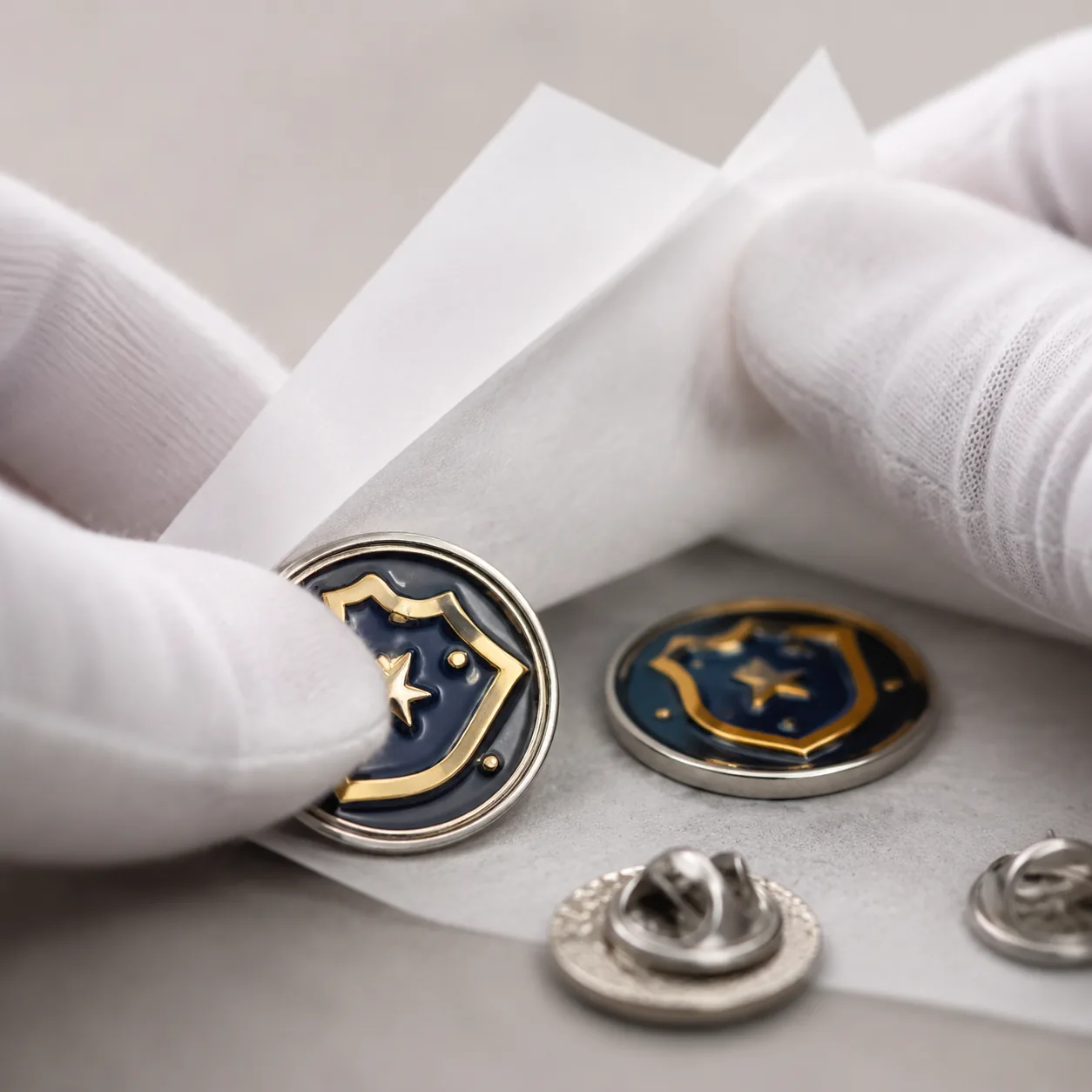
Why edge finish changes both feel and manufacturability
On custom pins, the perimeter often decides whether the finished piece reads as retail-grade or low-cost, even when the front artwork is accurate. Color match, enamel fill and clasp function can all pass, yet the pin still feels weak in hand because of a sharp trim line, uneven side polish, inconsistent bevel, or rough internal cutout. Buyers usually notice that immediately, especially on hard enamel, polished metal borders and collector pieces where the edge is visible from normal viewing angles.
Edge finish is not a styling note added at the end of the RFQ. It affects die design, draft angle, trimming method, deburring time, polishing access, plating distribution, packing scuff resistance and inspection yield. A late switch from smooth to bevel may only require tool modification, but a change from a plain perimeter to rope detail or internal cutouts often means new tooling or a remade mold cavity. In current production planning, minor edge rework typically adds 3 to 6 days; a new die or mold usually adds 7 to 12 days before bulk production resumes.
For 2026 buying, the edge should be specified as a controlled feature with dimensions, tolerances and defect definitions. The right choice depends on finished size, part thickness, base metal, plating system and whether the side profile is intended to disappear or to function as a visible design surface. The four most common options are smooth edge, bevel edge, rope edge and cutout with finished internal edges. All four are valid, but they create different cost, lead-time and reject patterns.
Comparison table: cost, size range and failure risk
| Edge finish | Best-fit applications | Recommended size range | Typical metal and thickness | Stable MOQ tiers | FOB price at 500 pcs | Lead time after sample approval | Typical QC failures |
|---|---|---|---|---|---|---|---|
| Smooth edge | Corporate logo pins, employee badges, retail logo merch, school programs | 18 to 45 mm | Stamped iron or brass at 1.2 to 2.0 mm; zinc alloy at 2.0 mm+ | 100 / 300 / 500 / 1000 pcs | USD 0.28 to 0.85 each FOB | 10 to 14 days | Burrs over 0.05 mm, uneven side polish, inconsistent radius, corner flattening |
| Bevel edge | Formal insignia, donor pins, premium anniversary badges, polished hard enamel pieces | 20 to 50 mm | Brass, iron or zinc alloy at 1.5 to 2.5 mm | 200 / 300 / 500 / 1000 pcs | USD 0.43 to 0.95 each FOB; usually +USD 0.03 to 0.10 vs smooth | 12 to 16 days | Uneven bevel width, crest plating thin spots, waviness, over-buffing at corners |
| Rope edge | Challenge-coin style pins, heritage emblems, club badges, ceremonial items | 25 to 55 mm | Usually zinc alloy or brass at 1.8 to 3.0 mm | 300 / 500 / 1000 pcs | USD 0.55 to 1.10 each FOB; usually +USD 0.05 to 0.15 vs smooth | 12 to 18 days | Softened pattern after polish, repeat mismatch at corners, residue in valleys, seam breaks near posts |
| Cutout plus finished edge | Openwork badges, event medallions, layered designs, architectural or emblematic shapes | 22 to 60 mm | Brass or zinc alloy at 1.5 to 3.0 mm | 300 / 500 / 1000 pcs | USD 0.60 to 1.25 each FOB; usually +USD 0.08 to 0.22 vs smooth | 14 to 21 days | Sharp internal windows, bent bridges, rough inner walls, plating pooling, narrow-section warpage |
As perimeter complexity increases, defects usually shift away from enamel fill and toward tactile, geometric and plating issues. AQL 2.5 for major defects and 4.0 for minor defects remains a workable baseline for bulk inspection. On premium retail, uniformed-service insignia and collector programs, the edge itself should usually be treated as a major appearance feature. Burrs, exposed base metal, distorted rope repeats, asymmetrical bevels and rough internal walls should not be downgraded as minor cosmetic variation.
Smooth and bevel edges: polish control is the real separator
Smooth edge is the most repeatable option when reorder consistency matters more than visual drama. It is usually the safest choice for corporate identity pins, small hard enamel badges and long-running programs that will reorder across multiple production runs. The term smooth by itself is too loose to control quality. A more usable callout is edge radius R0.20 to R0.40 mm, with post-polish burr height not exceeding 0.05 mm and no exposed base metal on the side wall. Without those limits, one factory may ship a soft hand-safe radius while another ships a sharper stamped trim and still classify both as smooth.
Bevel edge adds metal presence without introducing a decorative pattern. On polished nickel, shiny gold or black nickel, the angled face reflects light and makes a 1.5 mm or 1.8 mm pin appear heavier than its actual thickness. For most badges above 20 mm, a bevel width of 0.6 to 1.2 mm at roughly 30 to 45 degrees is practical. On pins below about 18 mm, that bevel often consumes too much front-face area and crowds border lines, text or small enamel islands.
The main trade-off is visibility. A smooth side wall can hide slight polish inconsistency. A bevel cannot, because it becomes a reflective design surface. Any waviness, flat spot, over-buffing or thin plating on the crest is easier to see. Buyers should therefore separate overall part thickness tolerance from edge-feature tolerance. A practical control set is overall thickness +/-0.10 mm for stamped brass or iron, bevel width +/-0.15 mm, and no local flat spot longer than 2.0 mm on a continuous bevel.
Example: a 30 mm hard enamel brass pin with polished nickel plating and two posts commonly lands around USD 0.62 to 0.88 FOB at 500 pieces with a 12 to 14 day lead time after sample approval. Adding a 0.8 mm bevel usually increases unit cost by USD 0.05 to 0.08 and may add 1 to 2 production days, mostly because polishing and side inspection become more demanding.
Rope edge: effective on larger commemorative pins, weak on small logos
Rope edge is best when the product is supposed to feel closer to a challenge coin or ceremonial medal. It works well on heritage marks, club emblems and larger commemorative pieces, but it is not a neutral upgrade. On small wearable logo pins, the rope detail can compete with the front artwork and make a clean mark look crowded. It also introduces more visible variation at corners, around posts and at irregular silhouette changes.
The manufacturing issue is detail retention. Rope relief must be deep enough to survive tumbling, side polish and plating build. In routine volume production, rope pitch below about 0.60 mm tends to soften, and relief depth below about 0.20 mm often loses contrast after finishing. A more reliable working range is rope pitch 0.70 to 1.20 mm, rope width 0.9 to 1.5 mm, relief depth 0.20 to 0.35 mm and total part thickness of at least 1.8 mm. Below that, the pattern often blurs, especially on bright polished finishes.
Finish selection matters. Antique nickel, antique brass and antique copper preserve rope detail better than mirror-polish plating because darkened recesses maintain contrast. Bright gold and shiny nickel can still work, but only if the repeat is clean and polishing is tightly controlled. Buyers should confirm in advance whether rope continuity is required around the full perimeter or whether interruptions near posts, corners or attachment points are acceptable. Those breaks are a frequent source of sample rejection.
In cost terms, rope edge is most stable on 30 to 50 mm zinc alloy or brass pieces at 300 pieces and above. It is a poor fit for thin stamped iron pins under 20 mm, minimalist tech logos or employee-recognition badges where brand clarity matters more than decorative side detail. A 38 mm soft enamel zinc alloy commemorative pin with antique brass rope edge typically quotes at USD 0.78 to 1.08 FOB at 500 pieces, with a lead time of 14 to 18 days.
Cutout edges: internal walls and bridge strength decide yield
Openwork and internal cutouts are the edge option most likely to be revised after first sample review. Artwork may look clean in vector form, but the physical part quickly shows where the design exceeds practical manufacturing limits. Common issues include sharp internal windows, bent bridges, rough inner walls, plating buildup in narrow openings and an obvious quality gap between the outer perimeter and the internal cut edges.
Internal edges need their own design rules. For standard wearable pins, a minimum bridge width of 1.2 mm is a sound baseline. If the design pushes down to 0.8 to 1.0 mm bridges, zinc alloy casting generally holds the shape better than thin stamped iron, but dimensional variation increases and cleanup becomes less consistent. Internal corner radius should be at least 0.30 mm where design allows. Very tight inside corners are harder to deburr and more likely to trap polishing compound or plating residue.
Plating performance is also less uniform on internal walls because current density drops inside narrow recesses. On decorative pin finishes, copper undercoat is commonly 3 to 8 microns, nickel underlayer 1 to 3 microns where used, and the visible gold-tone top finish only about 0.03 to 0.08 micron. On cutout-heavy parts, weak undercoat leveling shows up quickly as roughness, color shift or thin spots inside the windows. That is why sample approval should include front, back and side photos plus 5x to 10x macro shots of the internal edges.
Example: a 35 mm openwork zinc alloy pin with two internal windows, 2.0 mm thickness, antique nickel finish and soft enamel typically quotes at USD 0.72 to 1.05 FOB at 500 pieces. If the same design is forced into 1.0 mm stamped iron to save cost, the nominal price may drop by USD 0.08 to 0.15 each, but reject rates from bent bridges, rough windows and deformation in transit often wipe out that saving.
QC callouts to lock before sample approval
Most edge disputes start with vague wording. A purchase order says bevel edge or rope edge, the supplier delivers something that broadly fits the label, and the sample still misses expectation. The practical fix is to define the edge numerically, attach those dimensions to defect classification and approve against both a retained golden sample and close-up images.
- Define edge geometry numerically: smooth radius R0.20 to R0.40 mm; bevel width 0.6 to 1.2 mm at 30 to 45 degrees; rope pitch 0.70 to 1.20 mm with relief depth 0.20 to 0.35 mm; openwork minimum bridge width 1.2 mm unless approved otherwise.
- Set tactile acceptance: no burrs or sharp points above 0.05 mm; edge must not snag 0.04 mm polybag film or lightly brushed knit fabric during normal handling.
- Separate overall size tolerance from edge-feature tolerance: outer size +/-0.25 mm, decorative edge feature +/-0.15 mm, thickness +/-0.10 mm for stamped parts and +/-0.15 mm for typical zinc alloy castings.
- Specify plating stack where appearance is sensitive: copper undercoat 3 to 8 microns, nickel 1 to 3 microns where applicable, and decorative top plating per finish requirement.
- Classify defects clearly: exposed base metal, plating skip, dent, seam mismatch, asymmetrical bevel, distorted rope repeat, rough internal wall and any bridge deformation.
- Require front, back and side-view sample photos, plus 5x to 10x close-up images for bevel surfaces, rope detail or internal cutouts that drive the design.
- Inspect bulk at AQL 2.5 major and 4.0 minor as a baseline; tighten to AQL 1.5 major for premium retail, collector and formal insignia programs where edge appearance affects sellable value.
These controls are more useful than generic wording such as premium edge or polished side. They also make supplier comparisons more realistic, because two factories can interpret the same style term very differently while both claiming compliance.
How edge finish changes MOQ, lead time and total program cost
Edge finish does not usually change the formal MOQ as much as buyers expect. What it changes is the MOQ tier at which pricing and yield become stable. Many factories will accept 100 pieces on rope-edge or cutout designs, but the unit price is volatile because tooling, slower side finishing and heavier inspection are spread over too few parts. In practice, the cleanest quote tiers are still 300, 500 and 1000 pieces.
For reference, a 30 mm soft enamel stamped iron pin with smooth edge, polished nickel plating and butterfly clutch often lands around USD 0.38 to 0.65 FOB at 500 pieces. The same part with a bevel usually shifts to about USD 0.43 to 0.72. Move to a 2.0 mm zinc alloy build with rope edge or cutouts and the range commonly rises to USD 0.55 to 0.95, with antique finishes, cleaner back-side grinding or stricter side-wall inspection pushing above USD 1.00. Backing cards, individual polybags, barcode labels, retail set packing and export-carton drop-test requirements are usually quoted separately.
Lead time follows perimeter complexity. Smooth-edge stamped pins commonly run 10 to 14 days after sample approval. Bevel and rope edges usually need 12 to 18 days depending on polish load, plating queue and whether side inspection is 100 percent or sampled. Cutout-heavy parts often require 14 to 21 days because deburring, touch-up and inspection are slower. If the finish changes after first sample approval, a minor edge adjustment may add 3 to 6 days, while a die remake can add 7 to 12 days before mass production restarts.
That timing matters more than the nominal unit upcharge. A well-chosen edge may add only a few cents per piece. Choosing the wrong edge late in development can disrupt shipment bookings, card-packing schedules and launch dates. For event-driven or retail programs, the schedule impact is often more expensive than the edge premium itself.
Selecting the right edge for the product goal
Choose smooth edge when the priority is brand fidelity, hand safety and reorder consistency. It is usually the best fit for employee-recognition pins, retail logo badges, school programs and small hard enamel pieces under 20 mm. Choose bevel edge when the design needs more plated-metal presence without adding decorative texture. It suits formal insignia, donor recognition, anniversary badges and premium corporate pins with enough border area to display the angle cleanly.
Choose rope edge only when the design language genuinely benefits from a coin-like, ceremonial or heritage feel and the pin is large enough to carry the repeat. Choose cutout plus finished internal edges when openness is central to the concept and the buyer is prepared to control bridge width, internal deburring and macro plating review closely. If two edge treatments both work visually, select the one with fewer perimeter transitions. Every transition point makes polishing pressure, plating coverage and burr control harder to keep uniform in bulk.
For the next RFQ, lock four items before sampling: edge type with dimensions, base metal and thickness, plating stack and defect limits for burrs and plating skips. Once those are fixed, edge finish stops being a subjective late-stage argument and becomes a manageable production variable with measurable cost and yield consequences.
Have a project? Send your artwork and target quantity and we’ll reply with a detailed quotation within 12 working hours.
Ready to get this made?
Send your sketch, target quantity and ship-date. Detailed quotation in 12 hours.



