Pin, Coin, Keychain or Magnet: Choosing the Right Promo Format
Start With the Use Case, Not the Finish
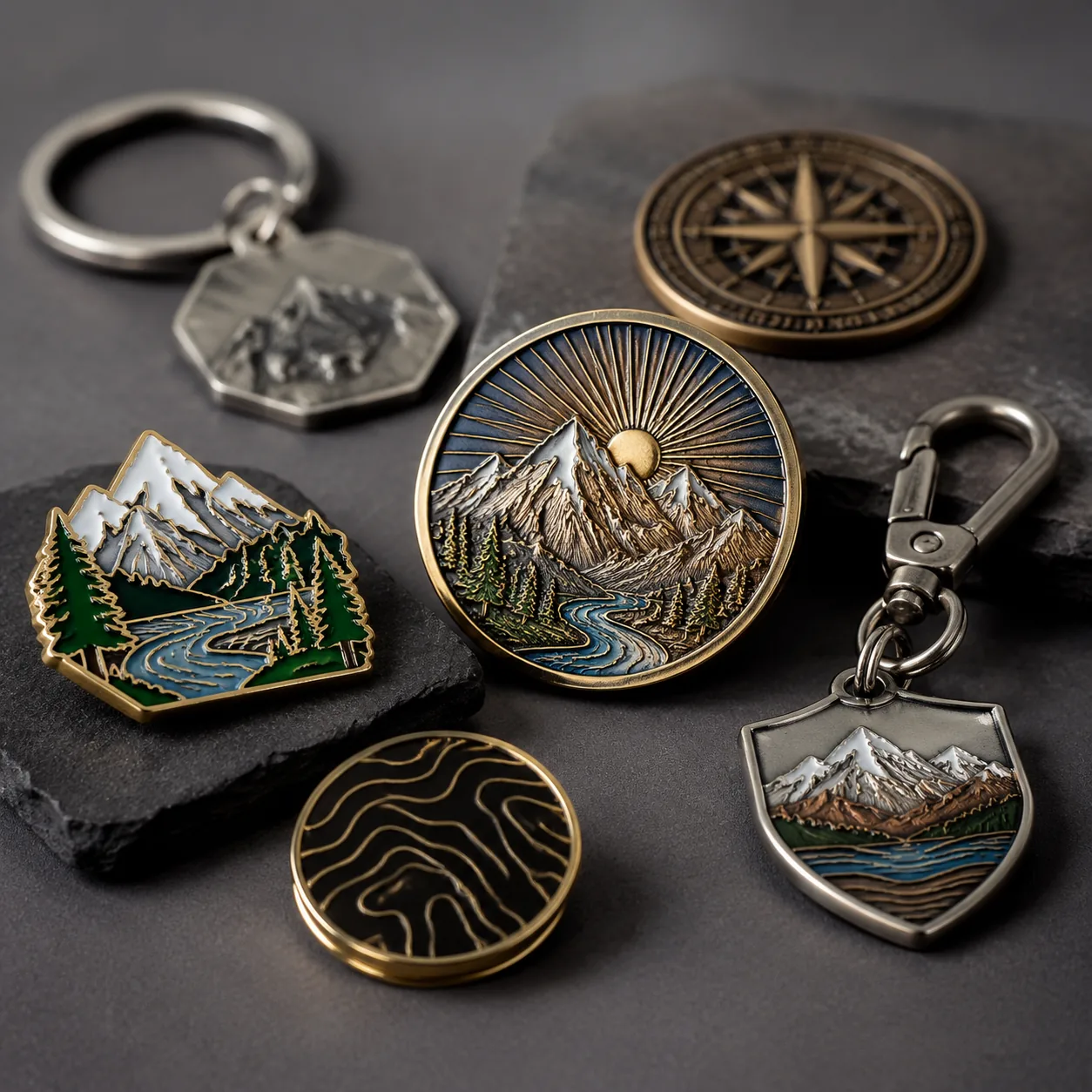
Many RFQs begin with “custom metal giveaway” before the buyer defines how the item will be used. That is where projects get misquoted. A 25-30 mm lapel pin, 45-50 mm challenge coin, 50-60 mm keychain and 60-80 mm magnet can all carry the same logo, but each format solves a different job: worn, carried, displayed or ceremonial.
For a conference welcome kit, a 25-35 mm soft enamel pin with a butterfly clutch or rubber clutch is usually the most efficient option. It is light, cheap to pack, and easy to distribute at registration. For employee recognition or milestone gifting, a 40-50 mm coin at 3.0-4.0 mm thick feels more substantial and tends to stay on desks or in display cases. For membership gifts or retail add-ons, keychains provide the most daily exposure because they move with the user. Magnets work best when the goal is visual presence on refrigerators, lockers, filing cabinets or steel office furniture without a post, ring or pocket wear.
A better first question is not “Which item has the nicest finish?” but “What must the recipient do with it?” If it must be worn, start with weight, post safety and fabric impact. If it must be carried every day, start with ring hardware and abrasion resistance. If it must feel like an award, start with diameter, thickness, edge treatment and relief depth. That sequence prevents expensive rework after tooling is approved.
Match Format to Physical Limits
Each format has a practical size and mass envelope. Pins usually perform best at 20-35 mm wide, 1.2-1.8 mm thick and roughly 5-12 g finished weight with backing. Once a pin moves beyond about 38-40 mm, a single post can rotate or pull on light fabric, so two posts, a brooch bar, or a larger clutch becomes safer. Keychains commonly land at 40-60 mm wide and 2.0-3.0 mm thick, with a 25-30 mm split ring made from 1.2-1.6 mm wire. Jump rings under 1.0 mm wire are cheaper, but they open more easily under repeated tugging.
Magnets should be specified by holding performance, not only by diameter. A 50-70 mm printed or metal magnet with a 0.8-1.5 mm flexible magnet sheet is normally decorative first and functional second. If the buyer expects it to hold a single sheet of 80 gsm paper on painted steel, that should be tested and written into the RFQ. Challenge coins are most practical at 38-50 mm diameter and 3.0-4.0 mm thickness. Below 2.5 mm, they can feel thin and underpriced. Above 4.5 mm, material cost, weight, and air freight rise quickly without always improving perceived value.
| Primary behavior | Best format | Typical production specs | Avoid when |
|---|---|---|---|
| Worn on jacket, cap or lanyard | Soft or hard enamel pin | 20-35 mm, 1.2-1.8 mm thick, butterfly clutch, rubber clutch, safety pin or brooch back | Campaign targets children under 3, very delicate fabric, or users unlikely to wear branded items |
| Carried with keys daily | Metal, PVC or acrylic keychain | 40-60 mm, 2.0-3.0 mm body, 25-30 mm split ring, 1.2-1.6 mm jump ring wire | Artwork has sharp corners, thin openwork or mirror plating that will show abrasion quickly |
| Displayed on steel surface | Fridge, locker or office magnet | 50-80 mm body, 0.8-1.5 mm magnetic sheet or embedded 8-12 mm round magnets | Target users may not have steel surfaces, or the item must hold multiple sheets reliably |
| Kept as award or collector item | Challenge coin or medallion | 38-50 mm diameter, 3.0-4.0 mm thick, 30-55 g, optional edge text or antique finish | Low-budget mass handouts, tight air freight limits or campaigns needing wearable exposure |
Compare MOQ, FOB Price and Tooling Together
Unit price alone is misleading because tooling, assembly labor, and packing complexity change the true economics. At 1,000 pieces, a 25-30 mm soft enamel pin often lands around USD 0.35-0.95 FOB, depending on size, plating, number of colors, backing type and carding. A zinc alloy keychain is commonly USD 0.85-2.40 FOB. A 45-50 mm challenge coin often prices at USD 1.60-4.80 FOB. Printed or soft PVC magnets may sit around USD 0.40-1.60 FOB. The cheapest piece is not always the cheapest campaign if the format is ignored or discarded.
Tooling matters because it is paid once but used to define every piece. A simple die-struck iron or brass pin mold is often USD 45-90. A zinc alloy die-cast keychain mold is commonly USD 80-180 and can exceed USD 220 for deep relief, openwork, or multi-part structures. Challenge coin dies often run USD 90-220 per side, with edge numbering, cutout shapes, or 3D relief increasing the total. Printed flat magnets may require little or no hard tooling, but metal enamel magnets follow pin-like tooling costs.
MOQ tiers are driven by setup loss, finishing, and packing labor. Practical starting quantities are usually 300 pcs for pins and metal keychains, 500 pcs for magnets, and 100-300 pcs for challenge coins. The most economical band is often 500-1,000 pcs. At 1,000 pcs, unit prices commonly fall 15-35% versus 300 pcs because mold cost, polishing, QC, and packing are spread across more units.
| Format | Practical MOQ | Typical FOB at 1,000 pcs | Tooling range | Main cost driver |
|---|---|---|---|---|
| Soft enamel pin | 300 pcs; better at 500+ | USD 0.35-0.95 | USD 45-90 | Size, color count, polishing, plating, backing and carding |
| Hard enamel pin | 300 pcs; better at 500+ | USD 0.65-1.45 | USD 50-110 | Repeated polishing, flatness control and color matching |
| Metal keychain | 300 pcs; better at 500+ | USD 0.85-2.40 | USD 80-180 | Thickness, base metal, ring assembly, epoxy, enamel or 3D casting |
| Printed or PVC magnet | 500 pcs; better at 1,000+ | USD 0.40-1.60 | USD 0-120 | Magnet area, PVC mold, print process, lamination and size |
| Challenge coin | 100 pcs possible; better at 300+ | USD 1.60-4.80 | USD 90-220 per side | Diameter, two-sided relief, edge type, plating, antique finish and packing |
Choose the Process by Artwork Risk
The process should fit the art, not the other way around. Enamel works best with clean vector shapes, separated color fields and raised metal lines. For enamel metal items, a minimum raised metal line of 0.25-0.30 mm is a practical floor. Recessed color channels should usually be at least 0.35-0.40 mm wide so they fill cleanly without overflow or uneven edges. Tiny dots and hairline details can disappear during polishing or filling.
Hard enamel gives a smoother, jewelry-like surface, but it is less forgiving of tiny details because the surface is filled and polished flush. Soft enamel keeps recessed color below the metal line and shows more texture at a lower cost. A useful acceptance target is soft enamel recessed 0.10-0.30 mm below the raised metal, while hard enamel should appear flush with no obvious pits, waves, or sink marks under normal viewing.
If the design includes gradients, shadows, photos, QR codes, or small sponsor marks, printed epoxy is usually safer than enamel. Offset or digital print with epoxy can hold finer detail, with registration tolerance around ±0.15 mm on small items. The trade-off is durability: epoxy can scratch, dent, or yellow faster under UV than plated metal and enamel. For outdoor or high-abrasion keychain use, avoid using epoxy over the main wear surface unless visible wear is acceptable.
Coins are judged differently because relief quality drives perceived value. A 2D coin uses clean raised and recessed layers. A 3D coin models faces, mascots, buildings, or animals with curved relief. On a 3.0 mm coin, relief height around 0.6-1.2 mm is common. Relief below 0.3 mm can look flat after antique plating. If exact Pantone color is essential, use larger enamel zones separated by metal lines or switch to a printed insert instead of forcing tiny color fills into a high-relief coin.
Specify Durability Before Approving Samples
Durability depends on the contact environment. Pins on jackets receive light handling. Keychains face daily abrasion against keys, coins and bags. Coins are handled often but normally not scraped unless used as bottle openers or gaming tokens. Magnets avoid abrasion, but they can fail through weak adhesive, curled flexible sheet, or insufficient pull force.
For decorative plating on zinc alloy, iron or brass, do not specify only “gold,” “nickel,” or “black nickel.” Define thickness. For pins and magnets, 3-5 microns is a practical promotional range. For keychains, coins, or heavier handling, 5-8 microns is safer. Bright gold and rose gold show scratches sooner than antique nickel, antique brass, or matte finishes. Black plating can reveal base metal on sharp edges if the design has aggressive high points.
If the item will be used outdoors, near sweat, in coastal markets, or as a retail product, ask for a corrosion expectation. A 24-hour neutral salt spray test is a reasonable baseline for many promotional metal goods. A 48-hour test adds cost and may narrow finish options, but it is useful for keychains and higher-value coins. For a one-day indoor event pin, specifying 48 hours usually adds cost without meaningful value.
- State plating color and thickness: for example, black nickel 3-5 microns for pins or 5-8 microns for keychains.
- Define enamel acceptance: soft enamel recessed 0.10-0.30 mm, or hard enamel visually flush with no major sink marks in the logo area.
- For keychains, require split rings with no open gap above 0.3 mm after assembly and no burrs on jump rings.
- For magnets, specify magnet sheet thickness or magnet diameter, plus whether it must hold one sheet of 80 gsm paper on painted steel.
- For epoxy-coated items, allow no visible bubbles over 0.5 mm in the main logo area when viewed at 30 cm.
- For retail goods, confirm nickel, lead, cadmium, phthalate, CPSIA, or REACH requirements before sampling, not after mass production.
Control Weight, Freight and Packing Early
Weight is often discovered too late. A 30 mm pin may weigh 6-10 g with backing. A 50 mm zinc alloy coin can weigh 40-55 g before packaging. At 5,000 pieces, choosing coins instead of pins can add more than 150 kg to the shipment. That changes air freight cost, carton handling, event drayage, and how practical the item is to distribute at a registration desk.
Packing can also change both cost and damage rate. Pins on printed backing cards in individual OPP bags usually add USD 0.03-0.10 per piece depending on card size, paper weight, and print coverage. Velvet coin pouches may add USD 0.12-0.35. Acrylic capsules may add USD 0.18-0.45 and increase carton volume. Gift boxes can add USD 0.50-1.50 depending on size, foam insert and printing. For keychains and coins, bulk packing without separation often creates scratches before the buyer opens the cartons.
Carton planning should match the product. For metal coins and keychains, keep cartons below 15-18 kg gross weight to reduce crushing and manual handling risk. Inner boxes of 50-100 pieces simplify inspection and distribution. Pins can often be packed 100-200 pieces per inner box if each piece is bagged or carded. Magnet stacks should be separated if the face finish is glossy, printed, or easily marked.
| Format | Typical finished weight | Common individual packing | Packing caution |
|---|---|---|---|
| 25-30 mm pin | 5-10 g | Backing card plus OPP bag | Card hole position must not bend the pin post or clutch |
| 45-55 mm keychain | 18-45 g | OPP bag or paper card plus bag | Separate pieces so rings do not scratch plated faces |
| 50 mm challenge coin | 35-55 g | OPP bag, velvet pouch, capsule or presentation box | Keep carton weight below 18 kg to reduce edge dents |
| 60 mm magnet | 15-40 g | OPP bag, printed card or retail header card | Magnet stacks can attract, slide and mark printed or plated surfaces |
Build the Timeline Around Approval Risk
Lead time is not only factory production time. It includes proofing, sample approval, mass production, QC, packing, export booking and transit. A typical enamel pin schedule is 2-4 days for digital proof, 5-8 days for mold and pre-production sample, and 10-18 days for mass production after approval. Hard enamel, two-sided designs, special plating, and complex card packing can add 3-7 days.
Metal keychains usually need 15-25 days after sample approval, depending on casting, plating and assembly. Printed soft magnets can be faster, often 10-16 days after artwork approval at moderate quantities. Metal enamel magnets follow pin-like timing. Challenge coins normally need 18-30 days after sample approval, especially with two-sided dies, edge text, antique plating, sequential numbering, capsules, or boxes.
For international orders, add 3-5 days after production for final inspection, carton labeling and shipment booking. Air freight commonly takes 5-10 days airport-to-door depending on customs and destination. Ocean freight may take 25-45 days port-to-port on many Asia-to-North America or Europe lanes, before inland delivery. If the event date is fixed, lock the format first, then use the sample stage to confirm finish, size and color. Changing from pin to coin after tooling normally resets the schedule.
Set Inspection Criteria by Failure Mode
Inspection standards should reflect the item type. For most promotional metal goods, general inspection level II with AQL 2.5 for major defects and 4.0 for minor defects is a practical baseline. Critical defects should be zero tolerance: sharp burrs, broken posts, detached magnets, wrong logo, wrong plating, unsafe small parts, or packaging errors for regulated markets.
Dimensional tolerances should be agreed before production. For die-struck or die-cast metal promotional items, ±0.2 mm on main width or diameter is reasonable for small pieces. Larger cast shapes may need ±0.3 mm. Thickness tolerance of ±0.15 mm is common, though heavy 3D cast coins may need a wider band if visual quality and weight stay within approval. Color should be checked against approved Pantone or a physical sample under consistent lighting, not against a phone photo.
The checklist should be item-specific. Pins need post strength, clutch fit, orientation and enamel coverage checks. Keychains need ring closure, jump ring pull resistance, plating scratches and swivel function. Magnets need adhesive strength, pull force and surface flatness. Coins need edge dents, relief clarity, plating consistency, thickness, diameter and weight consistency.
- Major defects: wrong shape, wrong plating, missing color, broken post, loose key ring, detached magnet or unreadable required text.
- Minor defects: small plating speck outside the logo area, tiny enamel dust, light surface mark not visible at 30 cm, or slight approved color variation.
- Critical checks: no sharp burrs, no exposed needle point beyond intended pin post, no loose magnet, no missing warning label where required.
- Measurement checks: width, height, thickness, weight, ring diameter, post length, magnet thickness, card size and carton quantity.
- Functional checks: clutch retention, ring closure, swivel movement, magnet hold test and capsule or pouch fit where applicable.
Prepare a Comparable RFQ
Before asking factories for pricing, choose one primary behavior: worn, carried, displayed or ceremonial. Then define size range, target weight, process, finish, packing and inspection level. That prevents suppliers from quoting attractive but non-comparable options that hide different tooling, plating, magnet strength or packing assumptions.
A useful RFQ for ZheCraft or any qualified factory should include vector artwork, Pantone references, quantity tiers such as 300, 500, 1,000 and 3,000 pcs, required delivery date, destination port or country, packing preference and whether a pre-production sample is required. State whether the item is for children, outdoor use, retail sale, uniforms, a regulated corporate program, or food-service distribution. Those details can change metal choice, backing, warning labels and compliance testing.
If the format is still uncertain, request a decision quote instead of a single-product quote: one pin option, one keychain option, one magnet option and one coin option using the same artwork and quantity tiers. Compare FOB unit price, tooling, finished weight, lead time, inspection risk and expected recipient behavior. The right format is the one that survives the real use case without adding unnecessary cost, freight weight or quality risk.
Have a project? Send your artwork and target quantity and we’ll reply with a detailed quotation within 12 working hours.
Ready to get this made?
Send your sketch, target quantity and ship-date. Detailed quotation in 12 hours.



