Pin Clutch Failures in Transit: Specs That Stop Missing Backs
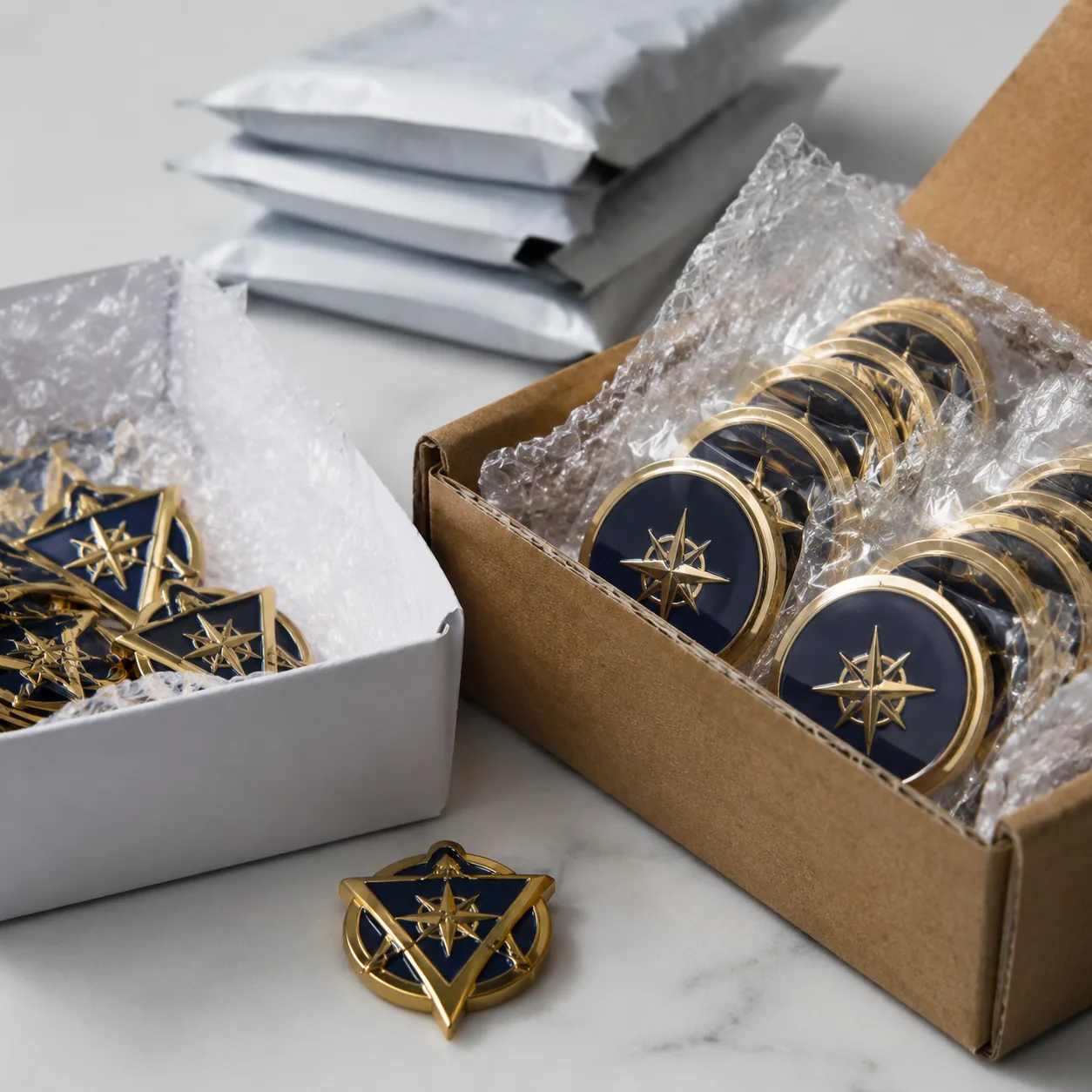
Why pins pass final inspection but still arrive with missing backs
Missing-back claims usually appear after cosmetic inspection is complete and cartons have already shipped. Count is correct, plating passes visual review, and the face matches the approved sample, yet 2% to 8% of units in retail packs or polybags may have loose clutches, detached backs, or posts pulled free of the card. For resale programs, that is not a minor defect. A pin with an exposed sharp post is often unsellable, can fail retail presentation requirements, and creates immediate rework at the distributor or 3PL.
Most transit failures are not caused by one dramatic defect. They come from tolerance stack-up across the full retention system: post diameter after plating, clutch spring force, post perpendicularity, post root strength, backing-card hole size, insert density, and vibration over 25 to 45 days of ocean plus parcel handling. Buyers usually control front-side details such as Pantone match, enamel fill, plating shade, and logo position, but leave the hardware as a generic note like "butterfly back." That omission gives the factory room to substitute whatever is standard on hand.
For distributor, retail, e-commerce, and event programs, the attachment hardware should be specified like any other functional component. The drawing and PO should define clutch type and material, finished post diameter, post length, minimum pull-off force, post angle limit, card or insert dimensions, and inspection frequency. When those items are left open, the supplier will optimize for assembly speed and piece price, not for 45 days of freight vibration and retail handling.
Set post and clutch fit with dimensions, force, and finish allowances
The most common root cause is poor fit between the finished post and the clutch bore or spring. On a nominal 1.0 mm post, a finished diameter shift of only 0.05 to 0.07 mm can materially change retention force. That shift can come from worn heading tools, post taper, over-polishing, inconsistent deburring, or plating build. Bright nickel, imitation gold, and black nickel commonly add about 3 to 8 microns per side; heavier antique finishes can vary more because high points and recesses do not plate evenly.
For standard die-struck or stamped lapel pins up to 35 mm wide and below 12 g, a workable baseline is post diameter after plating of 0.95 to 1.00 mm, post length of 8 to 10 mm, and minimum axial pull-off force of 1.5 kgf, equivalent to about 14.7 N, with the clutch fully seated. For pins weighing 12 to 18 g, raise the minimum to 1.8 kgf, or 17.6 N. For pieces above 18 g, widths above 45 mm, or collector products packed in rigid presentation boxes, 2.0 to 2.5 kgf is a better target. Below roughly 1.3 kgf on a standard butterfly clutch, failures in carded retail packs become much more common.
The hardware name alone is not a usable spec. Terms such as "deluxe clutch" or "military clutch" do not define retention force, material gauge, or spring temper. A standard brass butterfly clutch on a controlled 0.98 mm post often performs better than a poorly fitted locking clutch on an undersize post. A practical drawing note is: "Post dia after plating 0.98 +/- 0.03 mm; post length 9 +/- 1 mm; axial pull-off force >= 1.5 kgf for pins under 18 g; test 10 pcs per lot using calibrated digital force gauge." That wording makes substitutions auditable.
Commercially, tightening the hardware spec is usually inexpensive. At 1,000 pcs FOB, moving from a basic butterfly clutch to a better-controlled brass butterfly or locking clutch typically adds USD 0.03 to 0.08 per unit. At 3,000 to 5,000 pcs, the adder is more often USD 0.02 to 0.06. Standard custom pin MOQs usually remain tied to the main order quantity, but special clutch colors, custom rubber backs, or magnet assemblies often require 500 to 1,000 pcs per hardware type.
Control post geometry and root strength, because the fixed side often fails first
Buyers tend to focus on the removable back, but many retention failures start at the post itself. If the post is tilted, soldered onto a thin rib, or attached with incomplete wetting, the clutch cannot seat squarely. Once seated at an angle, the spring contacts the post unevenly and vibration gradually walks the clutch backward until it detaches. A loose back found inside a sealed bag is often the visible symptom of a post problem, not a clutch problem.
For stamped brass or iron pins with body thickness of about 1.2 to 1.5 mm, specify post perpendicularity within 3 degrees of the back plane as the target and treat more than 5 degrees as a major defect. For soldered posts, require continuous solder wetting around the base with no visible skips under 2x magnification and no rocking when pressed against a flat plate. If antique finishing obscures the joint, ask for first-off macro photos or one destructive sample per style. For cast zinc alloy pins with integral posts, a root diameter of at least 1.8 mm is a reasonable minimum; 2.0 to 2.2 mm is safer on larger or heavier pieces that will be inserted into cards, EVA, or garments repeatedly.
Post placement matters as much as construction. Keep the post center at least 5 mm from the nearest edge where design permits. On wide pieces above 45 mm, use two posts to reduce leverage and prevent rotation. On tall, narrow, or asymmetrical silhouettes, dual posts are often justified below 45 mm because a single central post allows the pin to twist during handling. A 50 mm banner pin with one post may pass pull testing but still fail in transit because repeated rotation unloads and reloads the clutch spring.
Artwork can also create hidden risk. Deep recesses, large cutouts, thin ribs, and irregular back geometry may leave less than 4 mm of stable flat land for the post base. In those cases, changing the back layout before tooling is far cheaper than trying to compensate later with stronger clutches. On the tooling proof, ask the supplier to mark post locations and confirm whether each location sits on a flat supported area, a rib, or a recessed section.
Packaging can defeat good hardware during 30 to 45 days of transit
A pin that passes assembly inspection can still fail in distribution because the pack-out works against retention. Ocean freight from China to North America or Europe often runs 25 to 40 days port to port, and total door-to-door transit can exceed 45 days once consolidation, customs, drayage, and parcel sorting are added. During that period, a free-moving pin repeatedly impacts the pack, while a carded pin in an oversized hole can shift enough for the clutch to creep off the post.
Backing-card hole size is a functional dimension, not a cosmetic detail. For a 1.0 mm finished post, a card hole of 1.00 to 1.05 mm is usually the most stable range. At 1.10 mm and above, loading becomes easier but support drops sharply because the card no longer controls the post tightly. Card stock should generally be 250 to 350 gsm for standard single-pin cards; below about 230 gsm, flex increases and the card can work the clutch loose. For euro-slot retail cards carried in inner packs, 300 gsm SBS or C1S board is a stronger default.
For boxed pins, use EVA or sponge inserts 3 to 5 mm thick with a slit or hole that grips the post without pushing the clutch backward when the box closes. Inserts that are too soft allow wobble; inserts that are too dense can behave like a spring and partially eject the clutch during closure. In bulk polybag packing, require the clutch to be pre-mounted and the pin face to rest against a mini card or chipboard shield instead of loose metal against film. At 1,000 pcs FOB, that inner card often adds only USD 0.01 to 0.03 per unit, which is materially cheaper than repacking at a 3PL.
| Pack-out method | Transit risk | Recommended specification | Typical FOB impact at 1,000 pcs |
|---|---|---|---|
| Loose pin in polybag | High | Pre-mount clutch; add 250-300 gsm mini card; one pin per bag | USD 0.01-0.03 |
| Pin on retail backing card | Medium | Card hole 1.00-1.05 mm for 1.0 mm post; 250-350 gsm card stock | USD 0.03-0.09 |
| Pin in velvet pouch | Medium to high | Do not pack loose; add mini card or tissue wrap to limit movement | USD 0.12-0.25 |
| Pin in paper or plastic gift box | Low to medium | Use 3-5 mm EVA slit insert; verify no clutch pushback on closure | USD 0.18-0.60 |
| Collector set in rigid box | Low | Dual-post layout plus EVA or flocked tray; zero free movement in shake test | USD 0.45-1.20 |
A basic pre-shipment pack test catches many avoidable failures. Ask the factory to assemble 10 finished packed samples, shake each sample for 60 seconds, reopen, and record whether any clutch has backed off, detached, or shifted visibly. This is not a formal ASTM transit simulation, but it is quick, repeatable, and effective at exposing weak card-hole control or insert density problems before the full lot is packed.
Match clutch style to pin weight, use case, and retail value
Not every attachment method suits every program. Rubber clutches are comfortable and less likely to scratch plated surfaces, but retention is usually less consistent than metal butterfly backs, especially in warm conditions or when molding tolerance varies by batch. They can work for low-cost giveaway pins under roughly 8 g, but they are a weak default for e-commerce, subscription packs, or collector merchandise where one replacement often costs more than the hardware savings.
For standard promotional pins under 12 g, a properly fitted metal butterfly clutch remains the best cost-to-performance baseline. For fan merchandise, service awards, limited editions, or any pin retailing above about USD 8 to 10, locking clutches are often justified. Typical FOB price ranges at 1,000 pcs are about USD 0.28 to 0.65 for a 25 to 30 mm stamped iron soft-enamel pin with butterfly clutch, and roughly USD 0.33 to 0.73 with a locking clutch, depending on plating, color count, and packaging. For 3,000 pcs, the same locking upgrade often compresses to only a few cents per unit.
Magnetic backs solve the no-puncture requirement, but they create different engineering and compliance issues. If magnets are specified, define magnet grade and holding force instead of only saying "magnetic back." A practical starting point is N35 or higher, then test on actual fabric thicknesses. A magnet that holds through a thin blouse may fail on denim, fleece, or a padded uniform. Magnet assemblies also raise FOB cost, commonly by USD 0.08 to 0.20 per unit at 1,000 pcs, and may require warning labels depending on channel and market. They are not a direct substitute for a clutch-backed pin.
Retention requirements should follow real use conditions. For event-day wear lasting a few hours, a butterfly clutch with 1.5 kgf minimum pull force may be enough. For individually mailed pins, retail displays, or collector items that will be opened and handled repeatedly, use a higher retention target, tighter pack-out, and often dual posts or locking hardware. The correct spec comes from the actual failure mode, not habit.
Write QC around retention defects, sampling, and traceability
AQL only works when the defect definitions are functional. Many factories inspect enamel fill, plating appearance, count, and logo accuracy adequately, but treat the clutch as incidental hardware. That leads to inconsistent judgments: one inspector calls a loose back minor, another accepts it because the back is still inside the bag. For finished pins, a detached or non-retained back is a functional failure and should be written that way.
If backs are pre-mounted, classify the following as major defects: missing clutch, detached clutch inside a sealed retail pack, pull-off force below the agreed minimum, post bent more than 5 degrees, finished post diameter below lower tolerance, or a clutch that cannot fully seat because of burrs, plating buildup, or deformed wings. Cosmetic variation on the back side may remain minor if function is unaffected. For retail chains, collector products, and repeat programs, many buyers tighten inspection to ANSI/ASQ Z1.4 AQL 1.5 major and 2.5 minor. For lower-risk promotional jobs, AQL 2.5 major and 4.0 minor is still common.
In-process control should not rely only on final inspection. A workable plan is first-off pull testing at each assembly setup, then one pull test every 200 to 300 pcs during clutch mounting, plus final random inspection before packing. For orders above 5,000 pcs, separate the data by shift or by hardware lot so one weak batch does not disappear inside a passing average. If clutches are sourced separately from the pin body, require lot traceability or at minimum one retained hardware sample card from each lot used in production.
- Define minimum pull-off force in kgf or N on both the drawing and the PO
- State whether pull testing is performed before pack-out, after pack-out, or both
- Classify missing back, loose back, or detached back in a sealed pack as a major defect
- Specify post perpendicularity target <= 3 degrees and maximum 5 degrees
- Set card hole size and card gsm anywhere pins are mounted to backing cards
- Require a 24-hour recheck on first-off samples if spring relaxation is a known risk
- Add a 60-second shake test on 10 packed samples before approving mass pack-out
Prevent hardware substitution with PO language, MOQ tiers, and lead-time planning
Quote pressure often drives quiet substitution. The approved sample may use a decent brass butterfly clutch with consistent spring temper, while mass production switches to lighter-gauge iron hardware from a different source to protect price. The apparent saving is small, often only USD 0.01 to 0.02 per piece at 3,000 units, but it disappears immediately if a 3PL must rework cards or an event team needs bags of spare backs on site.
The PO does not need a complex engineering print, but it does need enough detail to make the attachment auditable. At minimum, specify clutch type, material, finish color, post diameter after plating, post length, and minimum pull-off force. If the order is retail-facing or intended to repeat, require one sealed mass-production reference set in addition to the approved pre-production sample. That gives a clear comparison if the shipped configuration does not match the approved one.
Lead times should reflect hardware complexity. Standard custom pins commonly run 7 to 10 days for pre-production samples and 10 to 15 days for bulk production after sample approval. Locking clutches, magnets, custom-colored rubber backs, or special retail inserts typically add 2 to 5 production days if they were not confirmed at quotation stage. FOB price breaks are usually most meaningful at 500, 1,000, 3,000, and 5,000 pcs, so ask the supplier where the hardware adder actually changes rather than assuming the same cents-per-piece across all tiers.
For practical sourcing, many factories can hold the same MOQ for standard and locking clutches when they already stock the hardware, but specialty magnet sets, non-standard finishes, or matched-color rubber backs may carry a separate 500 to 1,000 pc minimum by type. Those details matter when one style is split across several SKUs and the buyer assumes the full order quantity applies to every hardware variant.
Use a spec block that production, QC, and packaging can all execute
The most effective fix is a short attachment note block that leaves little room for interpretation. Example: "Attachment: butterfly clutch, brass shell with spring insert, finish to match plating. Post dia after plating 0.98 +/- 0.03 mm; post length 8-10 mm. Pull-off force >= 1.5 kgf for pins under 18 g and >= 2.0 kgf for pins 18 g and above, tested axially with clutch fully seated. Post perpendicularity target <= 3 degrees, max 5 degrees. Clutch pre-mounted before pack-out. No detached backs inside sealed retail packs. Inspection per ANSI/ASQ Z1.4, AQL 2.5 major / 4.0 minor unless otherwise agreed."
Pair that with a packaging block that protects retention during transit: "Retail card hole 1.00-1.05 mm for 1.0 mm post; card stock 300 gsm SBS. Boxed pack to use 4 mm EVA slit insert. Bulk polybag pack requires 250-300 gsm mini card behind pin face. Ten packed samples must pass 60-second shake test with zero detached backs." Without the packaging note, even a well-fitted clutch can fail because the pack-out creates repeated pushback or free movement.
Before bulk release, ask for three specific approvals: one sample built with production hardware, one photo of the final back layout showing actual post positions, and one pull-test record listing numeric results rather than only pass or fail. Those checkpoints catch most preventable back-loss issues while tooling, hardware sourcing, and assembly are still easy to correct.
The practical lesson is simple: do not buy only the decorated pin face and treat the back as an accessory. Buy a retention system made up of post, clutch, geometry, and pack-out. Once those four elements are specified with real numbers, missing backs stop being a vague transit complaint and become a controllable quality variable.
Have a project? Send your artwork and target quantity and we’ll reply with a detailed quotation within 12 working hours.
Ready to get this made?
Send your sketch, target quantity and ship-date. Detailed quotation in 12 hours.



