Pin Backings for Small Orders: Head-to-Head Buyer Guide
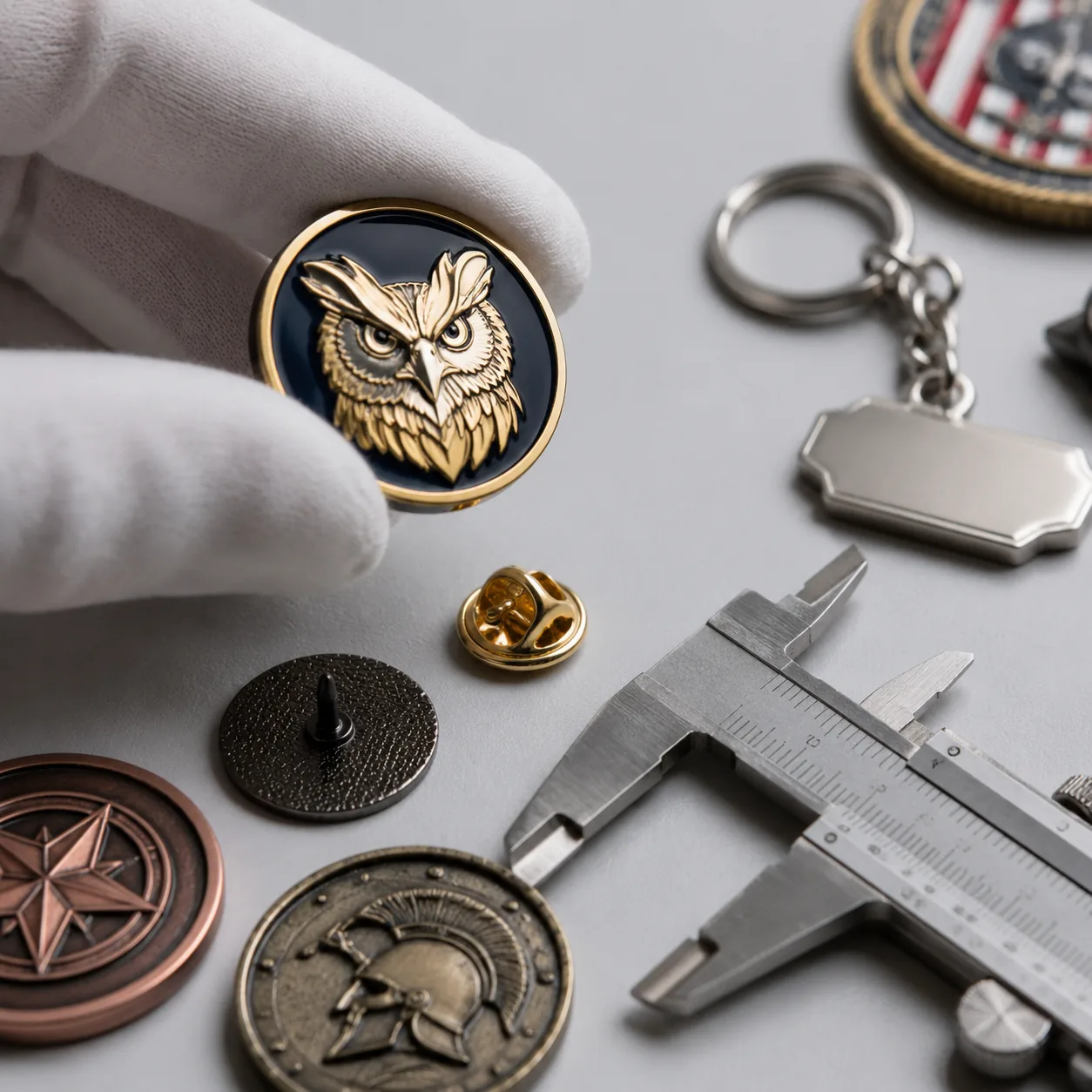
Backing choice affects loss rate, comfort, and rework on 100-1,000 pc pin orders
On small custom pin runs, the backing is not a minor accessory. It determines retention, anti-rotation, wearer comfort, garment damage, assembly time, and complaint rate. On a 100-300 pc order, one wrong hardware choice can erase the savings from negotiating the face price down by a few cents.
The common buying mistake is to specify the front badge carefully, then accept a default stock backing. That is workable only on repeat SKUs with a proven construction. It is risky for first runs, event giveaways, staff uniform pins, collector drops, and assortments that will be worn on very different fabrics.
A better starting point is to match backing choice to four variables: finished pin weight, width, post layout, and wear context. A single-post 25 mm soft enamel iron pin at roughly 4-6 g usually performs acceptably with a butterfly or rubber clutch. Once the piece moves above about 8 g, above 35 mm wide, or uses a thicker die-cast zinc alloy body around 1.8-2.2 mm with raised relief, buyers should review double posts, locking clutches, safety pin hardware, or magnets instead of defaulting to stock hardware.
Fabric matters as much as pin size. A cotton tee, blazer lapel, knit polo, apron, and bag strap put very different loads on the attachment. The useful question is not 'Which backing is best?' but 'Which backing is best for this weight, this fabric, and this wear duration at this order size?'.
2026 FOB add-on costs, MOQ tiers, and working limits by backing type
The ranges below are typical 2026 FOB China add-on costs for a standard 25-30 mm custom pin with one attachment point, excluding mold, sample courier, backing card, and retail packaging. For 100-1,000 pc orders, in-stock hardware and hand assembly often affect price as much as the raw hardware itself.
| Backing type | Typical FOB add-on | Typical MOQ | Recommended pin size / weight | Lead-time impact | Best use case | Main limitation |
|---|---|---|---|---|---|---|
| Butterfly clutch | USD 0.02-0.05/pc | 100 pcs | 20-30 mm; 3-7 g | 0 days if stock | Lowest-cost promo pins, caps, tees, short-duration wear | Spring tension varies; loosens after repeated removal |
| Rubber clutch | USD 0.03-0.07/pc | 100 pcs | 20-30 mm; 3-6 g | 0 days if stock | Comfort-first handouts, mailers, youth programs | Lower retention on heavier pins; softens in heat |
| Deluxe locking clutch | USD 0.08-0.18/pc | 100 pcs | 25-38 mm; 4-10 g | 0-2 days | Retail pins, daily wear, staff programs, collector drops | Higher assembly cost; user must understand release |
| Safety pin back | USD 0.03-0.08/pc | 100-200 pcs | 35-50 mm; 8-20 g | 1-3 days | Brooch-style pieces, flatter wear, larger badges | Bulkier pack-out; less discreet rear appearance |
| Magnetic back | USD 0.18-0.45/pc | 100 pcs | 20-35 mm; 3-8 g on thin fabric | 2-5 days | No-puncture uniforms, delicate garments, showroom use | Weak hold on thick fabrics; loose magnet half can be lost |
| Needle and barrel / brooch pin | USD 0.05-0.12/pc | 200 pcs | 35-60 mm; slim or elongated forms | 2-4 days | Fashion brooches, ribbon shapes, long narrow badges | Alignment-sensitive assembly; tilt if hinge/catch is off center |
Typical production is 10-15 calendar days after artwork approval for 100-500 pcs and 12-18 days for 500-1,000 pcs when using standard stock backings. If the order needs magnetic sets, brooch hardware, or rear hardware plating to match a special finish such as antique copper or dyed black, add about 1-3 days for sourcing, plating match, and inspection.
As a buyer-side rule, switch out of the lowest-cost clutch class when any of these are true: the pin exceeds 35 mm, finished weight exceeds 8 g, the pin will be worn daily, or fabric is thick knit, fleece, webbing, or outerwear.
Butterfly vs. rubber clutch: same budget class, different failure modes
Butterfly clutches remain the default because they are compact, cheap, and fast to assemble. Typical material is nickel-plated brass or steel. For light pins, they are usually sufficient if the post and clutch are dimensionally matched. A common post diameter is 0.8-0.9 mm, and practical exposed post projection after plating is about 2.5-3.5 mm. Below roughly 2.3 mm exposed length, even a good clutch can feel insecure. Above roughly 3.8 mm, the back may snag or cant on lighter garments.
The weakness of butterfly clutches is lot-to-lot variation. Lower-cost stamped steel versions can differ noticeably in spring tension. On a 200 pc run, that inconsistency matters because a bad lot is not diluted across a large quantity. If the quote only says 'butterfly back,' ask whether the clutch is brass or steel and whether it is standard stock or higher-tension stock. Brass clutches usually give more consistent retention on low-MOQ work.
Rubber clutches address a different buyer priority. They are easier on fingers, more comfortable against skin, and less likely to scratch phones, coated notebooks, or laptop sleeves when shipped loose in event packs. They are often the better option for school programs, conference kits, and direct-mail inserts where the pin may be handled casually rather than worn daily.
Their limitation is grip under load and heat. On a 30-35 mm die-cast zinc pin around 7-8 g, a rubber clutch may hold adequately at first but lose grip faster than a brass butterfly after repeated removal. In summer transit, mailbox heat, or a parked vehicle, softer rubber backs can deform and fit more loosely. That makes them a poor choice for daily-use outerwear, backpacks, and heavier cast pieces.
- Choose butterfly clutch for the lowest cost, compact bulk packing, and broad compatibility on light pins under about 7 g.
- Choose rubber clutch when comfort, easy handling, and low scratch risk matter more than maximum retention.
- Do not treat either as a default once the pin exceeds 35 mm, exceeds 8 g, or will be worn daily on jackets, aprons, or bags.
- For fleece, knit polos, caps, or webbing straps, request a fit check on actual fabric instead of approving only from a desk sample.
A simple buyer test is worth doing: request 5-10 loose backings or 3-5 assembled samples and wear them on the real garment for one full day. If the pin rotates, leans outward, or drops during normal movement, the attachment is under-specced even if the front finish looks acceptable.
Locking clutch vs. magnetic back: premium solutions for different problems
Locking clutches are the most practical upgrade when pin loss has a real replacement cost. They are common on collector pins, employee recognition programs, gift-shop items, and branded apparel accessories. On a 100-500 pc order, moving from a USD 0.03 butterfly to a USD 0.12 locking clutch raises total FOB by only about USD 9-45, usually less than one replacement shipment or one round of complaint handling.
Their advantage is controlled release. A locking clutch is much less likely to come off accidentally on jackets, aprons, backpacks, or lanyards that see repeated rubbing. It also improves perceived value at retail. Buyers should still confirm post compatibility, because most locking clutches are designed around a narrow post diameter band, typically around 0.8-1.0 mm. A mismatch can make assembly either too loose or nearly impossible.
Where possible, specify locking clutches together with double posts on wider pins. A stronger clutch reduces loss, but a second post is what usually prevents rotation. For a 30-40 mm retail pin on a blazer or tote bag, double posts spaced about 8-15 mm apart generally improve stability more than upgrading the clutch alone.
Magnetic backs solve a different problem: avoiding fabric puncture. They are useful for uniforms, rental garments, silk blends, fine knits, showroom samples, and photography wardrobes. Small-order systems usually use a two-part set with one magnet fixed to the badge and one loose keeper plate behind the fabric.
In practice, magnets work best on thin to medium fabrics with compressed thickness below about 2.0-2.5 mm. On heavy wool, fleece, padded outerwear, or thick pique polos, holding force drops sharply. That is why magnets should be specified only after a real fabric test, not just from the pin dimensions.
| Decision factor | Locking clutch | Magnetic back |
|---|---|---|
| Fabric damage | Pierces fabric | No puncture |
| Retention in daily wear | High if post spec is correct | Moderate on thin fabrics; poor on thick fabrics |
| Best fabric range | Thin to heavy | Thin to medium only |
| Anti-rotation | Good with double posts | Moderate; depends on magnet area |
| Packing risk | Low once assembled | Loose magnet half can separate or scratch plating |
| Typical use case | Retail, staff pins, collector runs | Delicate uniforms, temporary wear, sample garments |
Magnets also require better pack-out discipline. If bulk packed, loose magnet halves can stick together, chip enamel edges, or scratch plated surfaces. For magnetic orders, individual polybags or card-mounted sets are usually worth the extra cost.
Safety pin and brooch hardware work better on heavy or elongated pieces
Safety pin backs are often the correct answer for larger, flatter, or heavier pieces that would spin on a single post. They spread load over a wider area and usually let the badge sit flatter. Buyers should actively evaluate safety pin hardware once the design reaches about 35 mm+, uses layered construction, or weighs more than about 10 g.
This option is especially practical for brooch-style promo pieces, scarf accessories, sash pins, and blazer wear where visual stability matters more than hiding the rear attachment. On larger die-cast pieces in the 40-50 mm range, a safety pin back can outperform a single locking clutch simply because the load is distributed along a longer axis.
Needle-and-barrel systems, also called brooch pin or C-clasp hardware, are more specialized. They suit long narrow forms such as ribbon shapes, floral brooches, and nameplate-inspired badges around 40-60 mm. The rear appearance is cleaner than using two visible posts with clutches, but assembly tolerances become much more critical.
For these systems, approve functional tolerances instead of plating alone. Reasonable buyer requirements on long metal forms are straightness within 1.0-1.5 mm over 50 mm length, hinge and catch location within +/-0.8 mm of centerline, and no sharp burrs on the needle point or catch housing. If hinge and catch are mounted slightly off-square, the pin will sit crooked when worn.
Pre-shipment evidence should include a rear photo with clasp closed, a side photo showing body flatness, and at least one fabric-wear photo showing whether the badge tilts. On brooch hardware, these checks matter more than on a basic clutch-backed promo pin.
What really changes landed cost on small orders
Small-order buyers often compare only the visible hardware delta. In practice, landed cost also changes with hand assembly time, reject rate, package thickness, and replacement exposure. A backing upgrade from USD 0.03 to USD 0.12 looks large in percentage terms, but on 300 pcs the difference is only USD 27 FOB. That is usually cheaper than one partial remake, one air reshipment, or the labor spent replacing lost pins.
Technical fit drives a large share of complaints. Three dimensions cause most of them: post diameter, exposed post projection after plating, and finished pin weight. For standard clutch systems, 2.5-3.5 mm post projection is a practical target. Shorter than that, retention feels weak. Longer than that, the clutch can cant, protrude, or catch on fabric. On pins above about 30 mm width, anti-rotation usually improves more from adding a second post than from changing clutch type.
Packaging is another hidden cost. Butterfly and rubber backs pack densely in bulk. Locking, safety pin, and magnetic hardware increase pack thickness and reduce pieces per carton. Magnetic and brooch hardware also raise fulfillment labor if each unit must be paired, carded, or bagged. For direct-to-end-user shipments, this labor can exceed the raw hardware upcharge.
A useful costing example: on 500 pcs, moving from butterfly to locking clutch may add roughly USD 35 FOB, while moving from butterfly to magnet plus individual polybag can add USD 120-250 FOB once hardware, slower assembly, and pack-out are included. That is why magnets should be justified by garment protection, not selected casually as a premium option.
QA specs that are worth putting in writing
Even small orders need measurable controls. A practical baseline is: no exposed burrs, no loose or bent posts, visible plating color within approved sample range, enamel fill even to visual standard, and backing fit checked functionally before pack-out. For final inspection, AQL 2.5 for major defects and AQL 4.0 for minor defects is a workable default for non-medical consumer hardware.
For clutch-backed pins, ask the factory to run a functional retention spot check on at least 10 pcs per lot for orders under 1,000 pcs and 20 pcs per lot for 1,000+ pcs, recording any failures by backing type. You do not need a lab pull-force test for every promo run, but you do need confirmation that the clutch seats and releases normally across a random sample.
For brooch and safety pin styles, add checks for hinge motion, clasp closure, point sharpness, and body flatness. For magnetic styles, require confirmation that both magnet halves are paired per unit and that the magnet does not visibly slide on the approved fabric sample during normal movement.
If the item is for retail, ask the inspection report to separate hardware-related defects from cosmetic defects. That distinction helps identify whether the problem comes from plating, post geometry, clutch lot variation, or assembly.
RFQ and sample checklist buyers should send the factory
A short, specific RFQ usually gets better results than a long vague brief. If the backing is not clearly specified, the supplier may substitute the cheapest stock part that fits the post. That is where small-order inconsistency starts.
- Pin face size in mm, metal type, thickness, and target finished weight in grams.
- Required backing type, plus one pre-approved fallback if stock changes.
- Single-post or double-post layout, with target spacing if double post is used.
- Target post diameter and post projection after plating; for clutch systems, usually 2.5-3.5 mm exposed.
- Whether fabric puncture is allowed, limited, or prohibited.
- Actual use fabric: tee, polo, blazer, fleece, cap, apron, bag strap, or knitwear.
- Rear hardware finish requirement: nickel, black nickel, gold-tone, antique brass, dyed black, etc.
- Packing method: bulk, individual polybag, backing card, or retail card plus polybag.
- Inspection standard: AQL target, functional fit check, and photo approval before mass production.
- Ship term and schedule, such as FOB Shenzhen, 15 calendar days after pre-production sample approval.
If retention or comfort is sensitive, request 3-5 assembled pre-production samples. On a small order, that step usually costs far less than a full-run hardware mistake. For repeat orders, keep one approved golden sample and reference its date, PO number, backing type, post diameter, and post length on every reorder.
As a practical buying rule: use butterfly for low-cost light promo pins, rubber for comfort-oriented handouts, locking clutch for staff or retail programs where loss matters, safety pin or brooch hardware for larger heavy pieces, and magnets only when no-hole wear is a firm requirement. Match the attachment to the wearing context first, then optimize cost.
Have a project? Send your artwork and target quantity and we’ll reply with a detailed quotation within 12 working hours.
Ready to get this made?
Send your sketch, target quantity and ship-date. Detailed quotation in 12 hours.



