PCC vs PEO: Which Metal Finish Fits Your Promo Product?
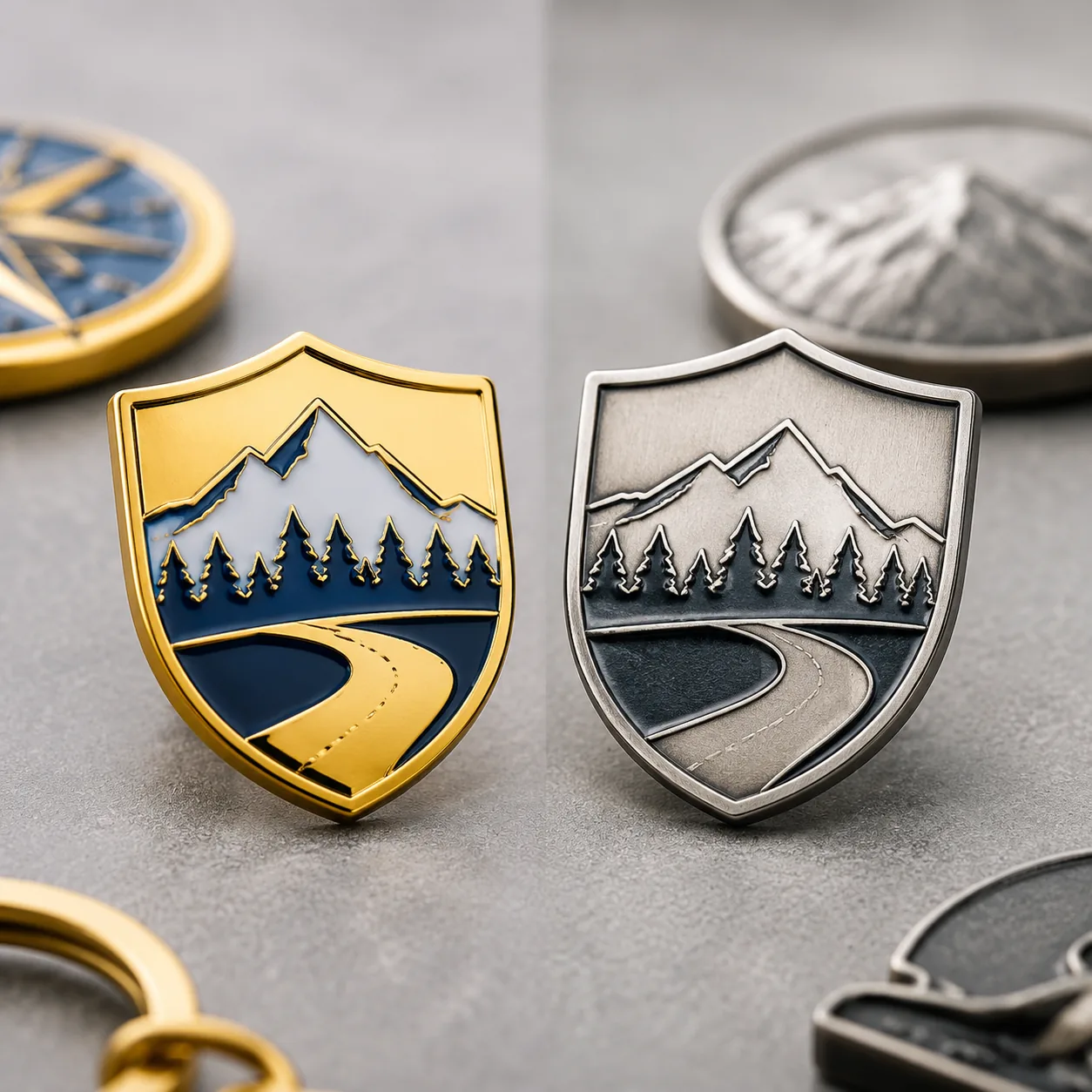
Two Finishes, Different Risk Profiles
Buyers often ask for a finish that looks premium, survives handling, and still fits budget. The issue is that plated finishes and PEO-style surface finishes fail in different ways. Plating can thin on edges, tarnish if the stack is weak, or show base-metal bleed at high spots. PEO-style finishes usually hold up better under abrasion, but they can look less traditional and may soften very fine logo detail.
For custom metal promo products, the right choice depends on geometry, touch frequency, and the environment the item will live in. A conference pin that sits on a jacket is a different job from a keychain that rubs against keys all day, or a challenge coin that is handled, pocketed, and displayed. If you compare them only by shine, you miss the specifications that drive returns, rework, and quote spread.
This comparison is written for procurement teams and distributors who need to decide before sampling. The goal is not to pick a favorite finish. The goal is to choose the one that matches the product, the artwork, and the price band.
- Use plating when you want a classic metallic look, broad supplier availability, and low setup risk.
- Use PEO-style finishing when wear resistance matters more than mirror shine or antique styling.
- Ask for thickness, adhesion, and abrasion data instead of relying on catalog photos.
- Check corners, cutouts, and recessed text before approving a finish for production.
Spec Comparison at a Glance
The fastest way to separate the two is to compare them on the numbers that affect production. The ranges below reflect typical factory results for zinc alloy, brass, or iron parts used in pins, coins, badges, and keychains. Exact performance depends on base metal, pre-treatment, geometry, and whether the item is die-cast, stamped, or etched.
| Spec | Plated Finish | PEO-Style Finish |
|---|---|---|
| Typical surface thickness | 0.1–0.5 microns decorative; 1.0–2.5 microns for heavier wear stacks | 2–20 microns depending on process and substrate |
| Appearance | Mirror, antique, brushed, matte metallic | Satin to ceramic-like; more technical than jewelry-like |
| Wear resistance | Good when the stack is thick and sealed; weak on sharp edges | Usually better for rubbing, pocket wear, and repeated handling |
| Detail retention | Excellent on fine lines, small text, and crisp borders | Good on medium detail; very fine engraving can look softened |
| Corrosion risk | Low to moderate; depends on nickel layer and topcoat | Low when process control is stable and sealing is consistent |
| Typical MOQ | 100–300 pcs for standard SKUs; 500+ for special plating | 300–500 pcs is more common due to setup and process control |
| Lead time | 10–18 days after sample approval | 12–20 days after sample approval |
| FOB price impact | Lowest-cost option for standard nickel, gold, black nickel, and antique looks | Usually 10%–35% higher than basic plating |
| Best fit | Pins, coins, badges, premium giveaways | High-touch badges, functional keychains, outdoor-use promo items |
That price spread is not random. Plated finishes are mature and widely available, so setup is fast and quoting is easy. PEO-style surfaces usually need tighter process windows, cleaner pre-treatment, and more consistent sealing, which adds cost but can reduce failures when the product will be rubbed, clipped, or pocketed every day. If you need a simple rule: plating is easier to buy, while PEO-style finishing is easier to justify when durability is the main risk.
When Plating Wins
Plating remains the default for most promo metal products because it balances appearance, tooling flexibility, and cost. For enamel pins, challenge coins, and lapel badges, a nickel, black nickel, gold, matte silver, or antique brass finish usually gives buyers the most visual control at the lowest risk. It also offers more predictable color and sheen matching across reorder lots when the same bath and topcoat are used.
Choose plating when the artwork has fine linework, multiple recessed levels, or a requirement for mirror shine or antique shading. Plating is also the safer option when low MOQ matters, because a factory can often run a plated sample or short production lot without locking up a dedicated line. Common acceptance targets are straightforward: decorative plating thickness around 0.2–0.5 microns, coverage above 95% on visible faces, and no visible base-metal bleed on raised edges under normal daylight inspection.
Plating is especially strong for items where the finish is there to support the design rather than survive punishment. That includes commemorative coins, retail-style pins, award badges, and gift box inserts. If the buyer wants crisp contrast between metal and enamel, plating also gives the cleanest border definition.
- Best for brand colors that rely on enamel contrast rather than surface texture.
- Best for awards, commemorative coins, and retail-style pins.
- Best when the buyer wants stable cost and a wide finish menu.
- Less ideal if the item will be constantly rubbed against hard objects without a topcoat.
When PEO-Style Finishing Wins
PEO-style finishing makes sense when the product needs a tougher, more engineered surface and the visual brief can accept a less jewelry-like appearance. On badges, functional keychains, and outdoor-use promo pieces, a harder surface can reduce scuffing at edges and preserve the graphic longer under friction. That matters when the end user clips, drops, or pockets the item daily.
The trade-off is design flexibility. Fine antique shading, high mirror polish, and delicate relief transitions are easier with standard plating. PEO-style surfaces also tend to have stricter process control, so the buyer should expect a narrower acceptable color band and a more specific pre-production approval step. If the supplier cannot explain substrate prep, sealing, and abrasion testing in plain terms, treat that as a risk signal.
For spec writing, ask for target thickness, edge coverage, and the intended wear class. A practical factory target is a finish that passes 500–1,000 rub cycles without obvious dulling, plus no peeling at corners after tape pull. For outdoor or high-touch items, many buyers also request salt-spray or sweat exposure references, even if the finish is decorative rather than industrial. If the vendor cannot give a realistic process range, assume the finish is more specialized than the quote suggests.
PEO-style surfaces are strongest when the shape is simple and the use case is honest. A clean, bold logo on a badge or keychain can look deliberate and premium. A tiny filigree crest with micro-text usually should stay with plating.
How Finish Choice Changes Artwork and Tooling
The finish you choose changes how the artwork should be drawn. With plating, raised lines, shallow recesses, and polished borders are usually your friends because they make the metal look intentional and help the eye separate color zones. With PEO-style surfaces, overly thin linework can disappear visually, so the logo often needs bolder shapes, wider spacing, and fewer tiny islands.
Tooling changes the failure profile as well. Sharp corners and deep relief can create thin spots in plating, while excessive micro-detail can make a tougher surface look muddy or over-processed. For mixed promo sets, keep the design language consistent, but do not force the same detail density across pins, coins, and keychains. The best practice is to define one primary finish spec, then adapt line weight and relief depth by item category rather than copying the same artwork blindly.
Concrete drawing targets help reduce sampling loops. For items that will be visually heavy after finishing, a minimum line width of 0.25–0.30 mm is safer. Raised borders should stay consistent so the finish does not pool unevenly at corners. If the item will be handled often, ask the designer to reduce deep texture and increase negative space so the finish can breathe visually.
- Increase minimum line width to 0.25–0.30 mm if the finish is visually heavy.
- Keep raised borders consistent so plating does not pool unevenly on corners.
- Use shallower texture if the part will be handled frequently.
- Request a golden sample that shows edge coverage, not only front-face appearance.
Cost, MOQ, and Lead Time
Buyers often assume the tougher finish is always the expensive one, but the answer depends on the part and order size. Standard plating is usually the lowest-cost path at low to mid MOQs, especially for zinc alloy pins, badges, and coins. PEO-style finishing can become cost-effective when the item is expected to face daily wear, because fewer cosmetic complaints can offset the higher unit price.
As a rough FOB guide from a Yiwu factory, a simple plated pin may land around USD 0.18–0.45 per piece at 1,000 pcs, depending on size, mold complexity, and enamel count. A plated challenge coin may sit around USD 0.70–1.80 at 500 pcs, while a plated badge or keychain can run USD 0.35–1.20 depending on tooling and attachment. PEO-style finishing usually adds about 10%–35% over basic plating, with the premium widening when the part needs extra prep or sealing.
MOQs also shift by finish. Standard plating can often start at 100–300 pcs for straightforward SKUs, while more complex stacks or antique looks may need 500 pcs to stay efficient. PEO-style finishes more often begin at 300–500 pcs because the process control burden is higher. Lead time is commonly 10–18 days after sample approval for plated work and 12–20 days for specialized surfaces, assuming the artwork is finalized and no re-sampling is required.
For procurement teams, the key is to compare landed risk, not just unit price. A slightly higher FOB on a tougher finish can be cheaper than dealing with early wear, reorders, and customer complaints. That is especially true for items sold at events, in retail packs, or through branded merchandise programs where the first impression carries more weight than the last cent saved.
Buyer Checklist Before Approval
The right finish decision becomes easy when you force the supplier to answer specific questions. If the answers are vague, the quote is probably hiding risk in process control rather than offering real value. Use the checklist below before approving artwork or paying a deposit.
- Ask for finish thickness in microns, not just a trade name.
- Confirm whether the part needs a topcoat, anti-tarnish layer, or sealing step.
- Request photos of sharp edges, recessed areas, and backside coverage.
- Check whether the factory can hold color and sheen across a reorder.
- Ask for rub, salt-spray, or tape-pull results if the item is for outdoor or high-touch use.
- Verify MOQ, setup fee, and whether the finish changes sample lead time.
- Confirm whether the finish affects magnet strength, attachment fit, or engraving legibility.
A good supplier should be able to explain where the finish is strong and where it is weak. At ZheCraft, we typically help buyers compare plated and specialized surface options during RFQ review so they do not discover edge wear or color mismatch after sampling. That matters when one SKU must sit inside a broader promo set and still look consistent beside lanyards, patches, or packaging.
What To Do Next
Start by sorting the product into one of three buckets: decorative, handled often, or exposed to friction and weather. If it is decorative, plated finish is usually the fastest and safest choice. If it is handled often or needs tougher surface performance, compare a plated stack against a more durable surface with a real wear spec, not just a pretty sample.
Next, write the finish into your RFQ with thickness, target sheen, topcoat needs, acceptance tests, MOQ, and lead time. Ask for one pre-production sample that shows both front-face appearance and edge coverage, because that is where most finish complaints start. If you want, I can turn this into a buyer-facing RFQ template or a factory comparison sheet for pins, coins, badges, and keychains.
Have a project? Send your artwork and target quantity and we’ll reply with a detailed quotation within 12 working hours.
Ready to get this made?
Send your sketch, target quantity and ship-date. Detailed quotation in 12 hours.



