Patch QC Failures: Factory Specs That Prevent Returns
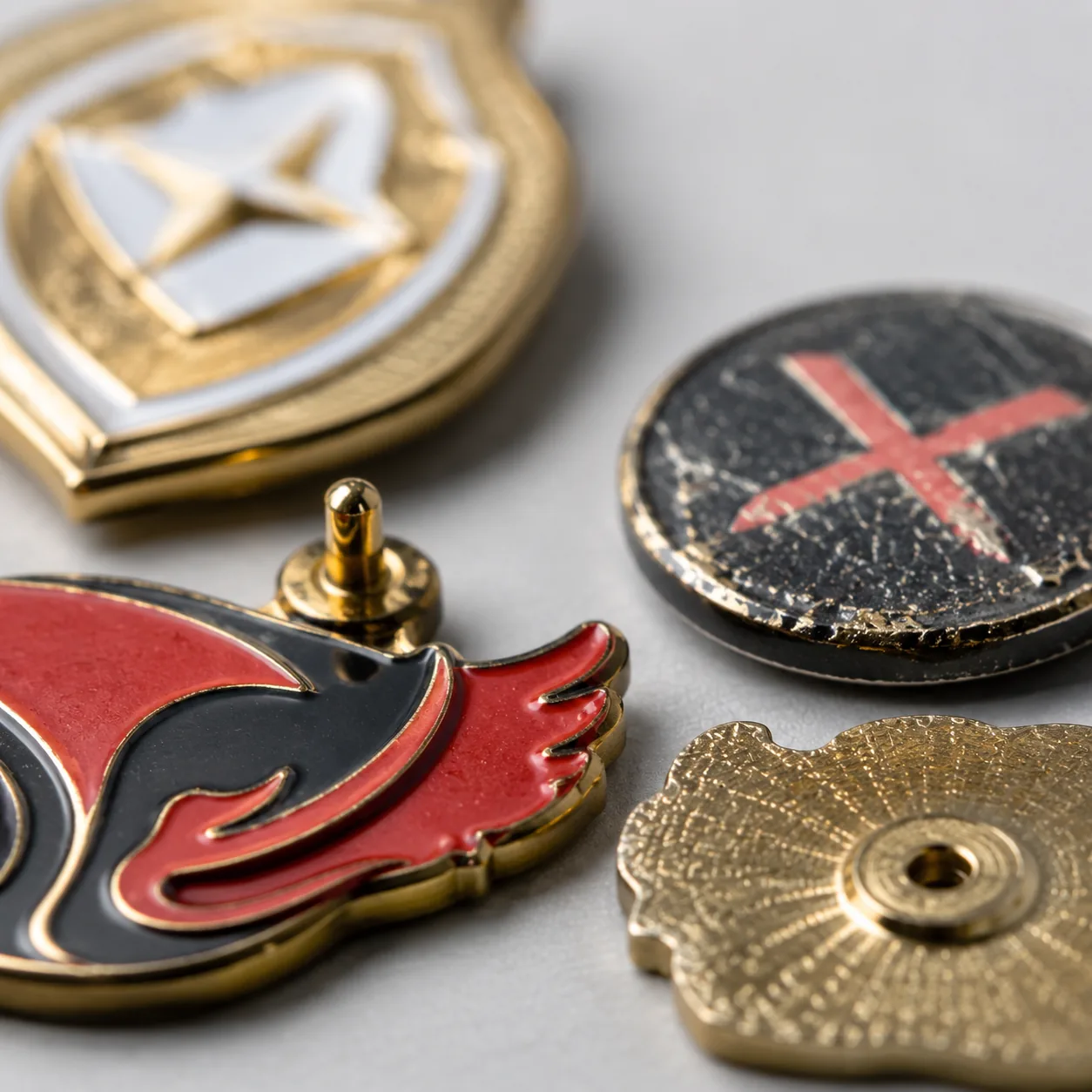
1. Edge Construction: Stop Curling, Fraying, and Wavy Borders
A patch can look acceptable in a supplier photo and still fail when sewn onto a cap crown, sleeve pocket, backpack panel, or retail backing card. Most border defects come from using the wrong edge for the artwork geometry. Merrow thread rolls upward on sharp corners, laser-cut textile edges fuzz when under-sealed, and heat-cut polyester can become glossy, hard, or brittle when the cutting temperature is too high.
For embroidered patches, use merrow only on simple circles, ovals, shields, rectangles, and rounded rectangles. Specify finished size of at least 50 mm across, merrow width of 3.0-4.0 mm, border width tolerance of ±0.3 mm, and finished size tolerance of ±1.0 mm for patches up to 100 mm. If the outline has points, internal cutouts, thin peninsulas, or lettering that forms the outer edge, specify laser cut plus satin stitch instead of merrow. Limit visible edge fuzz to 0.5 mm when viewed from 300 mm under D65 or 5000-6500K white inspection light.
For woven patches under 60 mm, a laser-cut edge with heat-seal backing is usually safer than merrow because merrow can swallow fine border detail. For soft PVC patches, specify a raised rim 0.8-1.2 mm above the base and at least 1.2 mm wide; thinner rims often tear during demolding or cool with a wavy profile. Confirm edge construction at proof stage. Changing from merrow to satin stitch after digitizing, or changing a PVC rim after mold cutting, commonly adds 2-5 working days and may trigger a new setup charge.
| Patch Type | Factory-Ready Edge Spec | Common Reject | Typical MOQ | Typical FOB at 500 pcs |
|---|---|---|---|---|
| Embroidered round/shield | Merrow border, 3.0-4.0 mm wide, ±0.3 mm | Rolled edge on tight corners or undersize patches | 100-300 pcs/design | USD 0.35-0.95/pc |
| Embroidered complex outline | Laser cut plus satin stitch, 2.0-3.0 mm edge | Fuzz above 0.5 mm or weak edge sealing | 100-300 pcs/design | USD 0.45-1.25/pc |
| Woven patch | Laser cut with heat-seal backing | Loose yarns, distorted small text, thin border breaks | 300-500 pcs/design | USD 0.40-1.30/pc |
| Soft PVC patch | Raised rim 0.8-1.2 mm high, 1.2 mm min width | Wavy rim, torn points, pigment bleed | 100-300 pcs/design | USD 0.75-1.95/pc |
2. Artwork Limits for Text, Lines, Icons, and QR Codes
Small lettering is one of the fastest ways to make a custom patch look cheap. Buyers often approve a vector file at 300% screen zoom, then reject the physical sample when 4 mm text becomes thread noise. Embroidery, weaving, sublimation, and PVC molding have different detail limits, so a single logo file should not be copied across all materials without process-specific redrawing.
For embroidered patches, keep capital letters at 6 mm minimum and mixed-case text at 7 mm minimum. Satin stitch strokes should be at least 1.0 mm wide, with open counters inside letters such as A, O, P, and R at 0.8 mm minimum. Fine legal copy, registered marks, URLs, and social handles should move to the backing card or hangtag unless the factory proves readability on a pre-production sample.
Woven patches can hold finer detail, but only with enough contrast and stable yarn. Use 3.5-4.0 mm minimum capital height, 0.35-0.50 mm stroke width, and avoid low-contrast combinations such as navy on black or tan on olive. For PVC patches, raised or recessed letters should be at least 5 mm high. Use 0.6-0.8 mm minimum line width for shallow 2D PVC and 0.8-1.0 mm for deeper 3D levels. Recessed channels below 0.5 mm are difficult to fill cleanly and often trap pigment contamination.
- Approve artwork at 1:1 scale, not enlarged screen view.
- Print a 1:1 PDF and check readability from 300-400 mm.
- Set embroidered capitals at 6 mm minimum and mixed case at 7 mm minimum.
- Set woven capitals at 3.5-4.0 mm minimum with high color contrast.
- Set PVC letters at 5 mm minimum with 0.6-1.0 mm line width.
- Move QR codes, disclaimers, care copy, and social handles to packaging when detail is below process limits.
3. Color Control: Thread, Yarn, PVC Pigment, and Print
Color mismatch often starts with an incomplete specification. A Pantone number alone is not enough because polyester embroidery thread, woven yarn, soft PVC pigment, and printed twill do not share the same color system or surface gloss. Pantone 186 C in a coated paper book will not match red polyester thread exactly, and matte PVC usually reads darker than glossy print even when both are matched to the same nominal reference.
For embroidered and woven patches, match from physical thread or yarn cards and record the approved thread code on the control sheet. A realistic bulk tolerance is Delta E 3-5 against the nearest available stocked thread, not Delta E 1, which is a print-level target and usually unrealistic for embroidery thread. For printed patches, sublimation and heat-transfer processes can target Delta E 2-3 after sample approval if the fabric base is consistent.
For PVC patches, solid pigment matching can usually hold Delta E 2-3 after sample approval. Translucent, glow-in-the-dark, glitter, metallic, fluorescent, and reflective materials should be approved by physical sample only because instruments do not fully capture appearance under different lighting. For orders above 3,000 pieces per design, require one dye lot per major color where available or approve a shade band before mass production. For repeat orders, keep one signed golden sample and one physical color chip at both buyer and factory. Do not approve reorders from phone photos; white balance and compression hide drift that becomes obvious when new stock sits beside old stock.
4. Backing and Adhesion Specs That Survive Handling and Wash
Backing failures are expensive because they often appear after the patch reaches a sewing contractor, distributor, or end user. Iron-on backing is convenient for retail patches, but it is usually the wrong primary attachment method for uniforms, rental garments, tactical gear, children’s apparel, coated jackets, or textured caps. A hand peel test immediately after pressing does not predict wash durability, flexing, or bond strength on water-repellent fabric.
A useful heat-seal spec should define adhesive type, film thickness, press temperature, pressure, dwell time, cooling time, and peel strength. For standard polyester-cotton garments, specify hot-melt film at 80-120 microns, press temperature of 150-165°C, dwell time of 12-18 seconds, medium pressure of about 0.3-0.5 MPa, and minimum peel strength of 8 N per 25 mm after full cooling. For thick embroidery, use a silicone pad so pressure reaches the adhesive layer evenly. For nylon, softshell, waterproof coatings, and PU-coated bags, run a substrate test before approving production because the garment may deform before the adhesive bonds.
Hook-and-loop backing is better for removable patches but adds cost, stiffness, and thickness. Specify hook side, loop side, or both; otherwise factories may quote only one side. Combined hook-and-loop thickness is commonly 1.5-2.5 mm. The hook or loop should be stitched inside the border with at least 2.0 mm seam allowance, and backing misalignment should be limited to ±1.0 mm on patches up to 100 mm.
| Backing | Technical Spec | Best Use | QC Risk | Typical FOB Add-On |
|---|---|---|---|---|
| Plain sew-on | No adhesive; optional thin stabilizer | Uniforms, caps, bags, rental garments | Edge distortion during sewing | USD 0.00-0.03/pc |
| Heat seal | 80-120 micron hot-melt film; 8 N/25 mm peel target | Retail cotton-blend apparel | Peel after wash or incorrect press settings | USD 0.03-0.08/pc |
| Hook and loop | 1.5-2.5 mm combined thickness; ±1.0 mm alignment | Tactical, staff ID, event roles | Wrong hook/loop side or weak perimeter stitching | USD 0.18-0.45/pc |
| Pressure-sensitive adhesive | 0.15-0.25 mm adhesive layer | Temporary display, samples, packaging | Residue or poor bond on fabric | USD 0.08-0.22/pc |
5. PVC Mold Specs: Thickness, Odor, Bubbles, and Compliance
PVC patches fail differently from textile patches. The main defects are thin raised details tearing during demolding, trapped bubbles in large flat fields, pigment bleed between adjacent zones, strong plasticizer odor, and uneven thickness after cooling. Many of these issues are built into the mold before bulk production, so the production drawing matters as much as the artwork proof.
For standard soft PVC patches, specify base thickness of 2.0-2.5 mm. Use 3.0 mm for morale patches above 90 mm wide or for designs requiring deeper 3D relief. Raised details should be at least 0.6 mm wide, preferably 0.8 mm or wider for repeatable long runs. Recessed grooves should be at least 0.5 mm wide so operators can fill colors without contamination and the part can release cleanly. For two-level 2D PVC, keep height differences around 0.5-0.8 mm. For 3D PVC, confirm the highest point, slope transitions, and minimum valley width in the mold proof.
Bubbles are most visible in large single-color panels and transparent PVC. Specify no bubble larger than 0.5 mm in logo-critical areas and no more than two bubbles under 0.5 mm outside the main viewing zone. For odor control, request low-odor PVC compound, ventilated curing, and 24-48 hours of airing before packing. A practical acceptance standard is no sharp odor after the patch is removed from its polybag and aired for 2 hours. If the product must meet REACH, CPSIA, Prop 65, phthalate-free, or EN71 requirements, state the exact standard before quotation because compliant compound and third-party testing affect both FOB price and lead time.
6. Dimensional Tolerances and Garment Fit
Patch size is not only cosmetic. A 2 mm oversize patch can block sewing clearance on a sleeve pocket, sit off-center on a cap front, or fail to fit a molded gift-box recess. Textile shrinkage, heat cutting, embroidery tension, adhesive lamination, and PVC cooling all create dimensional drift. If the purchase order says only “same as artwork,” the factory has no measurable acceptance target.
For embroidered and woven patches up to 100 mm wide, specify finished size tolerance of ±1.0 mm. For textile patches from 100-180 mm, use ±1.5 mm. For back patches above 180 mm, agree ±2.0 mm unless the sewing panel is tight. Border width tolerance should normally be ±0.3 mm for satin or merrow borders. For PVC patches, ±0.5-0.8 mm is achievable on most shapes, but long points, thin tails, and flexible protrusions need separate checks because they bend during packing.
If the patch must align with a garment, send the garment measurement instead of only the logo file. Better still, provide one physical garment, a full-scale sewing template, or a CAD panel drawing with seam allowance marked. For caps, confirm crown type, panel width, seam position, and whether the patch will be flat, pre-curved, or sewn over a seam. A patch that is correct on a table can still look wrong if it is too stiff for the garment curve.
7. AQL Inspection Plan for Bulk Patch Orders
Many patch orders fail because the inspection instruction says “check quality” without defining quality. Inspectors may count cartons and catch obvious stains but miss wrong backing, mirrored artwork, poor hook orientation, weak border stitching, peeling heat seal, or mixed SKUs. A proper inspection plan classifies defects before production starts and connects each defect class to an acceptance limit.
For most B2B promotional patch orders, use ANSI/ASQ Z1.4 or ISO 2859-1 normal inspection with AQL 0 for critical defects, AQL 2.5 for major defects, and AQL 4.0 for minor defects. Critical defects include sharp foreign objects, wrong logo, wrong country marking, contamination affecting safety, or banned materials when a compliance standard is specified. Major defects include unreadable text, wrong backing, color outside the approved shade range, size outside tolerance, loose border stitching, exposed adhesive, weak hook-and-loop stitching, or heat-seal peel strength below the agreed value.
Minor defects must still be defined. Acceptable examples may include one thread tail under 3 mm, slight edge fuzz under 0.5 mm outside the main logo, or a tiny color speck outside the primary viewing area. Set inspection viewing at 300 mm under white light for 5-10 seconds per piece. Magnifying every stitch creates disputes that do not reflect real use, while no viewing standard lets genuine defects pass.
- Use AQL 0 for critical, AQL 2.5 for major, and AQL 4.0 for minor defects unless the item is safety-sensitive.
- Measure 5-10 pieces per carton for size, border width, backing position, and SKU accuracy.
- Check heat-seal peel only after full cooling, not while adhesive is still warm.
- Pull-test hook-and-loop stitching on at least 10 random pieces per lot.
- Compare bulk pieces against the signed golden sample, not only the digital proof.
- Photograph carton labels, inner bags, mixed-SKU packing, and inspection samples before shipment.
8. MOQ, Lead Time, Packing, and PO Release Controls
Packing problems are easy to prevent and costly after arrival. Large embroidered patches crease when compressed too tightly, PVC patches can take a temporary bend if packed while warm, and similar colorways are easily mixed when several SKUs share one carton. For small patches under 80 mm, bulk packing of 50 or 100 pieces per inner polybag is usually acceptable. For retail, specify one patch per OPP bag with a printed backing card; 300-400 gsm card is typical for peg-hook display. For PVC patches above 90 mm, keep pieces flat in layers and limit cartons to about 12-15 kg gross weight.
Carton marks should include PO number, SKU, design name, colorway, quantity, gross weight, net weight, carton dimensions, and carton sequence such as 1 of 8. For mixed-SKU orders, require separate inner bags and a packing list showing exact counts per carton. This prevents warehouse disputes more reliably than a vague instruction to “pack well.”
For budget planning, common MOQs are 100-300 pieces per design for embroidered and PVC patches, and 300-500 pieces per design for woven patches. Cleaner pricing usually starts at 500 pieces, with stronger breaks at 1,000, 3,000, and 5,000 pieces. Typical sample lead time is 5-8 working days after artwork confirmation. Mass production is usually 10-18 working days after sample approval for embroidery and woven patches, and 12-22 working days for PVC depending on mold complexity and color count. Add 2-5 working days for new PVC molds, complex woven detail, compliance testing, or special packaging. Air freight to major markets often takes 4-8 days after QC release; sea freight requires earlier planning.
Before releasing the PO, convert the artwork into a one-page production control sheet covering patch type, finished size, edge construction, backing, color references, text minimums, tolerances, inspection level, packing method, carton marks, and compliance requirements. Send the supplier final vector artwork, actual-size PDF, intended garment or surface, quantity by SKU, backing requirement, packing style, and any required test standard before asking for a final quote. If the design is close to the process limit, request a factory redline before sampling so the first sample tests a manufacturable construction, not an optimistic artwork file.
Have a project? Send your artwork and target quantity and we’ll reply with a detailed quotation within 12 working hours.
Ready to get this made?
Send your sketch, target quantity and ship-date. Detailed quotation in 12 hours.



