Patch Edge Specs: Merrowed, Heat-Cut and Overlocked Borders
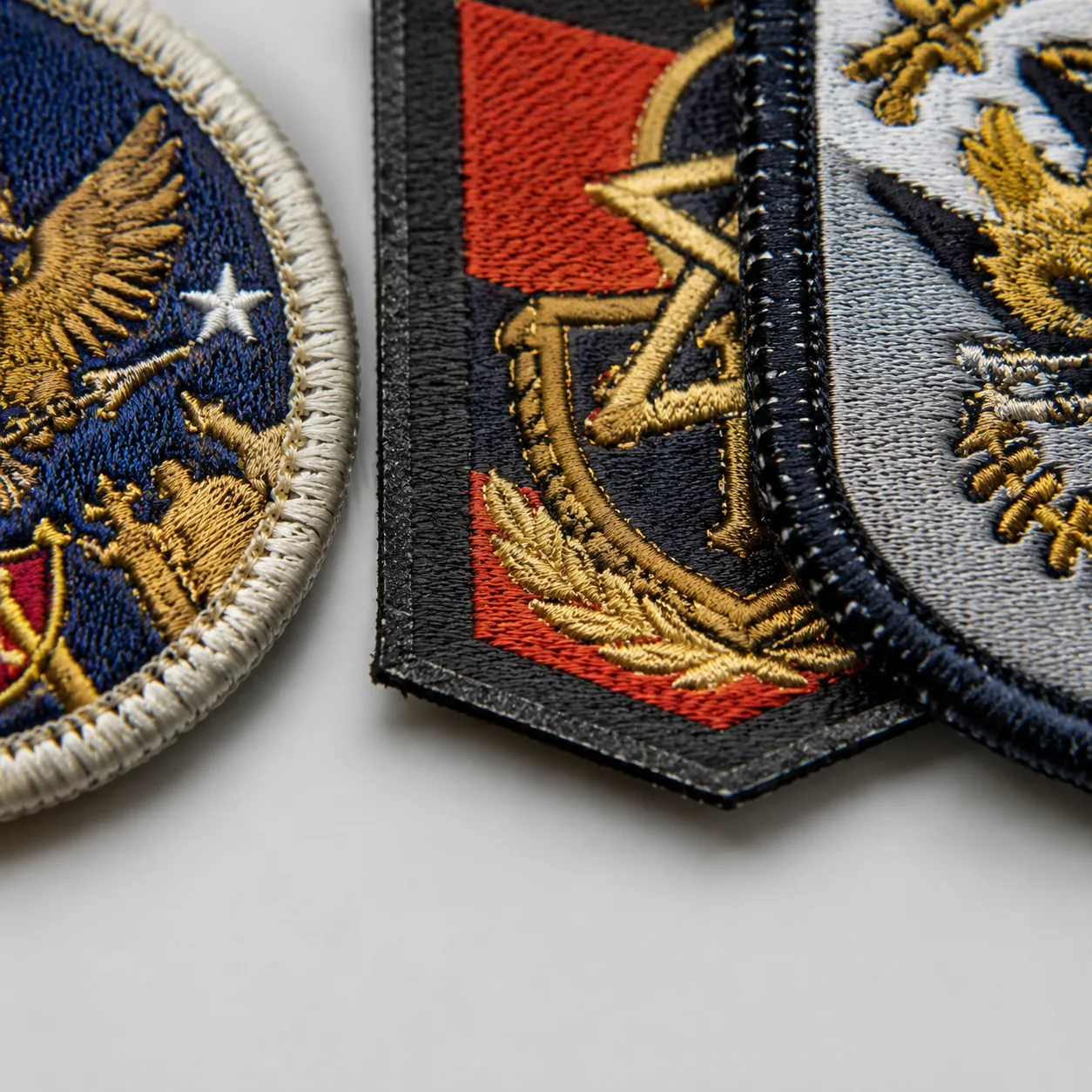
Why patch edges fail after artwork approval
Most patch rejects do not come from the center logo. They come from the perimeter: merrow loops open after washing, heat-cut corners curl, adhesive squeezes out at the edge, small text disappears under the border, or sewing operators cannot follow an irregular outline. These issues are preventable when edge construction is specified before sampling, not corrected after the first bulk lot.
For uniform, retail apparel, club, tactical and event-merchandise buyers, the edge is both a design and manufacturing decision. It affects abrasion resistance, garment sewing speed, heat-press reliability, carton deformation and customer perception. A raised merrowed edge can make a 75 mm uniform badge look premium, but the same border can be too bulky on a cap side panel or thin 160 gsm jersey.
At ZheCraft, edge type is locked in the same approval sheet as finished size, artwork, thread chart, backing, packing and inspection level. Changing from heat-cut to merrowed after sampling often requires re-digitizing embroidery, adding fabric allowance around the design, and rechecking text clearance. For woven patches, changing the edge can also require a new cutting path or revised adhesive film.
Select the edge before finalizing the outline
Merrowed, heat-cut, laser-cut, satin-stitched and overlocked borders are not interchangeable. A 75 mm round scout-style patch is efficient with a merrowed edge. A 65 mm mascot with ears, claws and narrow internal cutouts is usually better with laser cutting or a satin-stitched border. If the buyer approves a detailed silhouette first and requests merrowing later, the factory may need to simplify protrusions, widen gaps or move artwork inward.
The first decision is whether the patch needs a raised protective rim or a flat profile. Merrowed and overlocked edges protect the perimeter but add thickness. Heat-cut and laser-cut edges preserve shape detail and reduce bulk but rely on fabric stability and backing. Satin stitching is a middle option: cleaner than a raw cut edge, less bulky than merrowing, but slower to sew and more sensitive to puckering.
| Edge type | Best applications | Typical edge width | Normal tolerance | Avoid when |
|---|---|---|---|---|
| Merrowed border | Round, oval, shield and simple uniform patches | 3.0-4.5 mm visible rim; 0.8-1.3 mm raised height | +/-0.5 mm border width; +/-1.0 mm finished size | Sharp inside corners, protrusions under 4 mm, patches under 35 mm |
| Heat-cut edge | Printed patches, woven patches, simple embroidered shapes | 0-1.0 mm visible fabric lip | +/-0.7 mm outline on stable materials | Loose twill without backing, premium raised-edge requirements |
| Laser-cut edge | Detailed woven patches, reflective patches, tight repeatable outlines | 0-0.8 mm visible lip | +/-0.5 mm outline for woven; +/-0.7 mm for embroidered | Materials that scorch, yellow, melt unevenly or produce odor |
| Satin-stitched border | Custom silhouettes needing a stitched finish | 2.0-3.5 mm stitch band | +/-0.5 mm stitch width | Very low-cost giveaways or shapes with many tiny teeth |
| Overlocked edge | Large utility badges, workwear labels, tactical-style patches | 3.0-5.0 mm wrapped edge | +/-0.7 mm edge width | Thin garments where edge stiffness telegraphs through fabric |
Merrowed borders: durable but shape-limited
A merrowed border is made on an overlock machine that wraps thread around the patch perimeter. It creates a rounded rim that resists fraying and protects the base fabric during sewing, washing and abrasion. For standard embroidered patches, common border threads are 120D/2 or 150D/2 polyester; rayon is less common for workwear because it has lower wet-rub and wash durability.
The practical minimum size for a clean merrowed edge is about 35 mm diameter, but 50-100 mm is the efficient production range. The outside profile should avoid concave corners tighter than a 3 mm radius and projections narrower than 4 mm. Small flags, animal ears, lightning bolts and script lettering often need shape simplification before merrowing. If the design includes perimeter text, keep at least 2.0 mm clear space from the inner edge of the merrow; 2.5-3.0 mm is safer for letters below 5 mm high.
For a 75 mm round embroidered patch, a common production spec is 3.5 mm merrowed border, black 120D/2 polyester thread, seam join at bottom center, overall diameter tolerance +/-1.0 mm, border width tolerance +/-0.5 mm, and no exposed base cloth at the rim. The seam join should be tight and trimmed, not bulky enough to interfere with sewing. On retail-facing patches, the join location should be consistent across the lot, especially for sets sold in clear packaging.
Merrowing is efficient on simple shapes but can increase rejects on complex outlines. If the operator has to slow down around many curves, unit cost rises and border variation becomes more visible. For irregular patches, compare a merrowed sample with a satin or laser-cut sample before committing to mass production.
Heat-cut and laser-cut edges: flat profiles with material risk
Heat-cut edges use a heated die, hot knife or thermal cutting tool to cut and seal synthetic fabric. Laser-cut edges use a programmed beam and are more precise for curves, holes and repeated small details. Both are common on woven patches, sublimation printed patches and low-profile embroidered patches where the buyer wants a flatter edge than merrowing.
The main risk is edge stability. Polyester twill with suitable backing usually seals well. Loose twill, cotton-rich fabrics and some recycled blends may fuzz, discolor or leave an uneven lip. White and pale fabrics show yellowing more easily than dark fabrics. For visual inspection, check scorch marks under consistent 300-500 lux lighting, not only under bright photography lamps that exaggerate minor discoloration or dim warehouse lamps that hide it.
For reliable cutting, keep minimum outside projections at 2.5-3.0 mm for woven patches and 3.5-4.0 mm for embroidered patches. Internal holes are possible, but holes under 5 mm can trap adhesive film, collect soot or look ragged after handling. For woven patches, normal laser outline tolerance is +/-0.5 mm; for heat-cut embroidered patches, +/-0.7-1.0 mm is more realistic because embroidery thickness and backing change how the edge seals.
Laser cutting is best when the outline has many repeated curves and the artwork needs tight registration. Heat cutting is better for simpler shapes where cost matters more than contour precision. For safety-critical or uniform programs, ask for edge-rub and wash testing because a clean sample photo does not prove the edge will stay stable after bulk handling.
Satin-stitched and overlocked edges: middle options
A satin-stitched border is digitized into the embroidery program, usually at 2.0-3.5 mm width with stitch spacing around 0.35-0.45 mm for polyester thread. It follows custom shapes better than merrowing and gives a cleaner finish than a plain heat-cut edge. It is often used on mascots, brand icons, shields with angled corners and patches where the edge color must match an exact design element.
The trade-off is machine time. On a 75 mm embroidered patch, a satin border can add 10-25 percent to stitching time compared with a simple heat-cut edge. If the fabric is thin or the border density is too high, the patch may pucker or curl. A backing layer can stabilize the edge, but it also changes hand feel and thickness. For patches applied to lightweight apparel, approve a real garment test rather than judging the loose patch alone.
Overlocked edges are a heavier wrapped-edge construction used on larger utility badges, workwear patches and tactical-style applications. They can be specified at 3.0-5.0 mm, with more bulk than satin stitching and a flatter look than some raised merrow borders. They perform well where abrasion resistance matters, but they may feel stiff on thin shirts or cap panels. If the patch must bend around a sleeve, cap crown or pocket flap, request side-view photos and a flex check before production.
Backing and adhesive specs control edge performance
The same edge behaves differently with sew-on, iron-on, hook-and-loop and pressure-sensitive adhesive backing. Sew-on patches tolerate a slightly softer edge because perimeter stitching fixes the patch to the garment. Iron-on patches need stable edge sealing and adhesive coverage close to the perimeter; otherwise corners lift after laundering or flexing. Hook-backed patches need edge stiffness control because thick borders can catch on the loop field during removal.
For standard iron-on apparel patches, specify adhesive film thickness at 80-120 microns. Heavier embroidered patches often need 120-160 microns to compensate for uneven stitch height. Where glue squeeze-out is unacceptable, the adhesive can stop 0.5-1.0 mm inside a heat-cut edge. For workwear, near-full adhesive coverage may be preferable because edge hold matters more than a perfectly clean underside.
Typical heat-press conditions are 150-165 degrees Celsius for 12-18 seconds at medium pressure, followed by cooling before peel or handling. These settings must be validated on the actual garment fabric. Nylon, coated polyester, softshell, elastic blends and water-repellent finishes can distort, gloss, delaminate or resist adhesion. For uniform programs, test after 24 hours because adhesive bond strength can change after cooling and dwell time.
Hook-and-loop backing usually adds 1.5-2.0 mm thickness. A fully assembled embroidered patch with hook backing and a raised merrowed edge can reach 3.0-4.5 mm overall thickness. If the buyer needs a low-profile sleeve or cap badge, a woven patch with laser-cut edge and thinner hook backing is usually cleaner than a dense embroidered patch with a heavy border.
- Confirm backing before approving the border sample; do not treat backing as a late packing option.
- For iron-on patches, request peel testing after 24 hours and after one 40 degrees Celsius wash if laundering matters.
- For hook-backed patches, check whether the edge catches, curls or separates during repeated removal.
- For sew-on patches, keep at least 2.0 mm of stable edge area for the sewing operator.
- For adhesive event patches, avoid heavy merrowed borders because edge weight can lift the perimeter.
MOQ, lead time and FOB price ranges for RFQs
Patch pricing depends on size, stitch count, embroidery coverage, fabric, backing, edge type, packing and inspection requirements. For a 75 mm embroidered patch with about 75 percent embroidery coverage, polyester thread and individual polybag packing, typical FOB China pricing is USD 0.38-0.85 per piece at 1,000 pieces. A woven patch of similar size is often USD 0.28-0.65 per piece. PVC patches are higher, commonly USD 0.75-1.80 per piece, because molds, color fills and thickness drive cost.
Edge type changes cost through labor, cutting time, reject rate and machine capacity. A simple heat-cut woven patch is usually the lowest-cost construction. Satin borders add embroidery time. Complex laser outlines add programming and cutting time but can reduce manual trimming. Merrowing is economical for round and shield shapes in volume, but not for silhouettes that force slow handling or create high edge reject rates.
Practical MOQ at ZheCraft is usually 100 pieces for sampling and small promotional runs, 300 pieces for stable unit pricing, and 1,000 pieces or more for distributor-level FOB pricing. Pre-production samples normally take 5-8 days after artwork approval. Mass production for 300-3,000 pieces is commonly 10-18 days after sample approval. Add 3-6 days for special thread, custom-dyed fabric, retail carding, mixed edge trials or additional wash testing.
| Specification scenario | Suggested MOQ | Sample lead time | Mass lead time | Typical FOB range |
|---|---|---|---|---|
| 75 mm embroidered, merrowed, sew-on, polybag | 300 pcs | 5-7 days | 10-15 days | USD 0.42-0.95 per pc |
| 75 mm woven, laser-cut, iron-on backing | 300 pcs | 6-8 days | 12-18 days | USD 0.32-0.75 per pc |
| 90 mm embroidered, satin border, hook backing | 300 pcs | 6-9 days | 14-20 days | USD 0.70-1.45 per pc |
| 60 mm printed patch, heat-cut, adhesive backing | 500 pcs | 5-7 days | 10-14 days | USD 0.25-0.60 per pc |
| 100 mm PVC patch, raised molded border, hook backing | 100 pcs | 7-10 days | 15-25 days | USD 1.10-2.40 per pc |
QC criteria to write into the purchase order
Edge inspection should not rely on a front-view sample photo. For most B2B patch orders, AQL 2.5 for major defects and AQL 4.0 for minor defects under general inspection level II is a practical baseline. Retail brand programs, public safety uniforms and large contract reorders may require tightened inspection, functional testing or retained samples from every production batch.
Major edge defects include open seams, missing merrow loops over 3 mm, exposed base cloth at the rim, burnt fabric visible at normal viewing distance, wrong border color, adhesive exposed beyond the edge, sharp hardened glue lumps, delamination, and outline deviation beyond tolerance. Minor defects include slight thread fuzz under 2 mm, small trimming tails that do not unravel, and shade variation within the approved standard. Keep a signed golden sample and a measurement drawing showing finished width, height, border width, backing and acceptable join location.
A low-cost durability screen catches many failures before shipment. For merrowed and overlocked patches, rub the border by hand for 20 cycles and check for loose loops or unraveling. For iron-on patches, apply to the approved fabric, wait 24 hours, bend the edge 10 times and inspect lifting. For wash-use programs, test at 40 degrees Celsius and inspect after air drying; tumble drying should be added if the end user will use it.
- Measure width and height using the agreed AQL sampling plan; for a medium lot, 13 samples is a useful quick check only if contractually accepted.
- Check border width at top, bottom, left and right, not only at the easiest flat section.
- Pull loose threads gently; any unraveling border should be classified as a major defect.
- Compare edge color under consistent neutral light instead of switching between window light and warm warehouse lamps.
- Inspect carton pressure because over-compressed packing can bend hook-backed or thick merrowed patches.
RFQ wording that prevents edge disputes
A clear RFQ removes interpretation. Instead of asking for a custom embroidered patch with only a logo attached, state finished size, construction, edge type, backing, color references, packing, inspection level and target use. The supplier can then quote the intended product rather than the cheapest version that roughly resembles the artwork.
A complete example is: 75 mm round embroidered patch, 100 percent polyester twill base, approximately 75 percent embroidery coverage, 3.5 mm black merrowed border, sew-on backing, overall diameter tolerance +/-1.0 mm, border width tolerance +/-0.5 mm, seam join at bottom center, individual polybag, AQL 2.5 major and AQL 4.0 minor, 1,000 pieces, FOB Ningbo or Shanghai. If the patch is for uniforms, add garment fabric, wash requirement and whether the patch will be sewn before or after garment laundering.
If the artwork may suit more than one construction, request two samples before bulk approval: one durable option and one cost-optimized option. For example, compare a merrowed embroidered patch against a laser-cut woven patch, or a satin-stitched mascot against a heat-cut version. The extra 3-5 sample days are usually cheaper than resolving edge curling, sewing complaints or inconsistent silhouettes after mass production.
- Send vector artwork with the finished size marked in millimeters.
- State whether the patch will be sewn, heat pressed, attached to hook-and-loop or used as a temporary giveaway.
- Specify edge type, border width, edge color, backing and acceptable tolerances.
- Request front, back and side-view photos of the sample edge before approval.
- Approve one golden sample and keep it unchanged for reorders.
- For mixed patch sets, use the same edge logic across sizes unless the shape or garment use requires a change.
Have a project? Send your artwork and target quantity and we’ll reply with a detailed quotation within 12 working hours.
Ready to get this made?
Send your sketch, target quantity and ship-date. Detailed quotation in 12 hours.



