Patch Edge and Backing Specs That Prevent Peeling
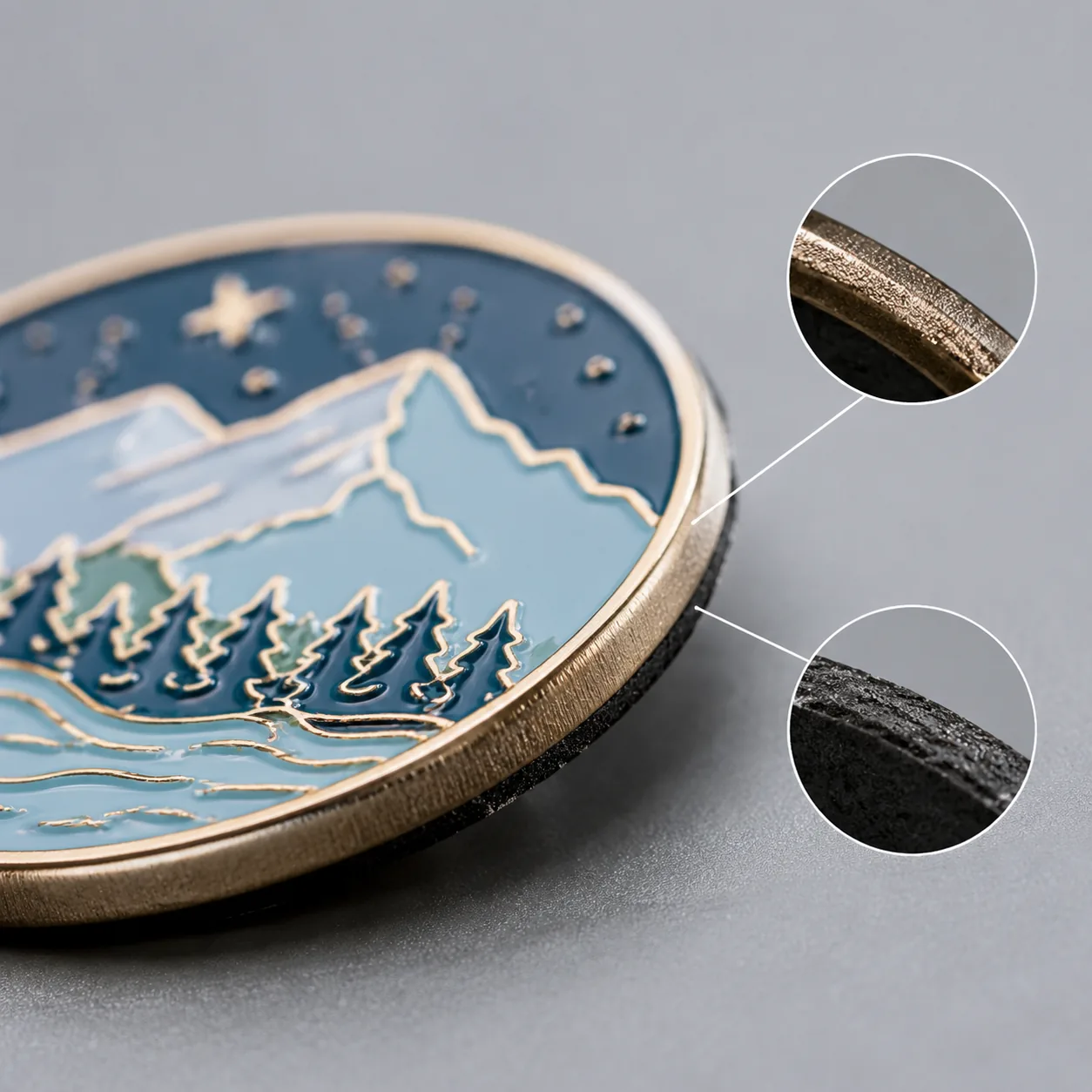
Why approved patch samples still fail in use
A patch can pass desk approval and still fail after two weeks on a uniform, backpack, cap or event jacket. The common complaints are predictable: frayed edges, curled corners, hook-and-loop lifting, adhesive bleeding through the face fabric, stiff patches pulling on lightweight garments, or borders that look uneven after washing. These are rarely random defects. They usually come from purchase orders that approve the artwork but leave the edge, backing and performance standard undefined.
For B2B programs, the face artwork is only half the product. The edge construction and backing system determine whether the patch survives sewing, heat pressing, washing, abrasion and repeated removal from a loop panel. A reliable specification should lock the border type, backing type, adhesive grade, stitch density, thickness, dimensional tolerance and inspection method before sampling. Changing any one of these after approval can alter appearance, hand feel, production time and FOB cost.
This guide focuses on embroidered, woven and soft PVC patches from 50 mm to 120 mm wide, which covers most corporate, club, event and uniform orders. Typical factory MOQ is 100 pcs per design for embroidered and woven patches, 300 pcs for custom-molded PVC, and 500 pcs for more stable unit pricing. Standard production after artwork and sample approval is 10 to 18 days for embroidered or woven patches and 15 to 25 days for PVC patches, excluding international freight and peak-season delays.
Specify the edge before the backing
The edge is the first failure point because it takes abrasion every time the patch is handled, washed, sewn or pulled from a Velcro panel. For embroidered patches, the main options are merrowed border, satin stitch border, heat-cut edge and laser-cut edge. For woven patches, heat-cut and laser-cut edges are more common because the base is thinner and the artwork often needs sharper small-text detail. For PVC patches, the outer rim is molded into the part and must be designed with enough width to resist bending.
A merrowed border is a raised overlock edge, normally 2.5 mm to 4.0 mm wide and about 0.8 mm to 1.5 mm high. It works best on circles, ovals, rectangles, shields and simple badges. It is durable and forgiving in bulk production, but it cannot follow tight internal corners, thin protrusions or sharp mascot outlines. If the design has points, narrow tails or text that reaches the edge, a satin stitch or laser-cut edge gives better control.
Satin stitch borders are better for custom shapes because the machine can follow irregular outlines. A practical stitch width is 1.8 mm to 3.0 mm with a cut or sew tolerance of ±0.5 mm. For high-density embroidery, specify polyester thread and a stitch density around 8 to 12 stitches per 10 mm on the border, adjusted by thread size and fabric weight. Too low a density leaves gaps; too high a density can pucker the base fabric.
PVC patches need a molded outer rim rather than a textile border. For a 60 mm to 90 mm PVC patch, a raised rim of 1.2 mm to 2.0 mm is usually enough. Below 1.0 mm, the edge can feel weak and may deform in packing. Above 2.5 mm, the patch can look bulky on sleeves, caps and retail cards. Standard PVC thickness is 2.0 mm to 3.0 mm for most morale patches and 3.5 mm to 4.0 mm only when the product is intended for bags or outerwear.
| Edge type | Best use | Factory-ready spec | Main risk |
|---|---|---|---|
| Merrowed border | Simple embroidered circles, ovals, shields and rectangles | 2.5-4.0 mm border; polyester thread; border height 0.8-1.5 mm | Cannot follow sharp corners or complex outlines |
| Satin stitch border | Custom-shape embroidered patches | 1.8-3.0 mm stitch width; ±0.5 mm edge tolerance; no skipped stitch over 10 mm | May show waviness on very thin protrusions |
| Heat-cut edge | Woven patches and flat embroidered labels | Sealed cut edge; ±0.5 mm size tolerance; no exposed yarn over 1 mm | Less premium look than merrowed border |
| Laser-cut edge | Detailed woven patches and irregular shapes | ±0.3 mm cut tolerance; minimum fabric bridge 1.5 mm | Can slightly darken light fabric edges |
| Molded PVC edge | Rubber-style morale and outdoor patches | 1.2-2.0 mm raised rim; 2.0-3.0 mm body thickness | Higher mold cost and slower sampling |
Match backing to the real attachment method
The main backing choices are sew-on, iron-on, hook-and-loop, adhesive sticker and no backing. Sew-on is the most reliable option for uniforms, workwear, sports clubs and garments expected to go through repeated wash cycles. It is also the lowest-cost construction. As a reference, a 75 mm embroidered sew-on patch at 500 pcs commonly falls around USD 0.35 to 0.95 FOB, depending on embroidery coverage, thread colors, border type and base material.
Iron-on backing uses a heat-activated adhesive film, usually 0.10 mm to 0.18 mm thick. It is convenient for retail craft patches and low-wash promotional apparel, but it should not be treated as a universal attachment method. Many cotton and polyester blends can be pressed at 150°C to 165°C for 12 to 18 seconds under medium pressure of about 0.3 MPa to 0.5 MPa. Coated nylon, waterproof polyester, flame-resistant garments, elastic sportswear and heat-sensitive bags often cannot tolerate those conditions.
Hook-and-loop backing is the right choice for removable patches on tactical bags, uniform panels, staff roles and event credentials. The added thickness is usually 1.5 mm to 2.5 mm, and the FOB cost increase is commonly USD 0.08 to 0.25 per patch at 500 pcs. For soft fashion garments, it is often the wrong choice because the hook side can scratch nearby fabric and the stacked patch can sit too high.
Adhesive sticker backing is only for temporary placement on folders, notebooks, packaging, event giveaways or retail cards. It should not be specified for washable garments. Sticker adhesive is usually pressure-sensitive and may leave residue, lose tack in heat, or lift from textured fabric within hours. If the end use is unclear, specify sew-on or iron-on plus sewing rather than relying on sticker backing.
- Use sew-on backing for workwear, school uniforms, sports clubs and long-wash-cycle programs.
- Use iron-on backing for craft retail, low-wash promotions and consumer application on compatible fabrics.
- Use hook-and-loop backing for removable role patches, tactical bags, staff badges and interchangeable designs.
- Use adhesive sticker backing only for temporary use on packaging, notebooks, folders or event giveaways.
- Avoid thick PVC plus hook-and-loop on lightweight T-shirts because the patch will sag and pull the fabric.
- Treat iron-on as positioning assistance, not the sole attachment, when the garment must survive more than 10 wash cycles.
Define Velcro construction in measurable terms
Many RFQs say only “Velcro backing,” which is not enough for repeatable production. Velcro is a brand name often used generically for hook-and-loop tape, and the PO must state whether the patch receives hook side, loop side or both sides supplied as a pair. For morale patches and uniform panels, the patch usually has hook backing and the garment has loop fabric. Some corporate buyers reverse this to prevent hook tape from scratching garments during storage.
For woven and embroidered patches, the hook tape should normally be cut 1.0 mm to 2.0 mm inside the finished patch edge so it does not show from the front. On a 75 mm circular patch, a 72 mm to 73 mm hook backing is typical. For patches over 100 mm, allow up to 1.5 mm backing alignment shift if it is not visible from the face. On small patches below 60 mm, keep shift under 1.0 mm because a misaligned backing is easier to see and can affect peel behavior.
The attachment method also matters. Sewn hook backing gives better peel resistance than heat-applied hook, especially on heavy PVC or patches removed daily. For embroidered and woven patches, use a stitch margin of 1.5 mm to 2.5 mm from the backing edge and require no skipped stitch longer than 10 mm. For PVC patches, stitching is preferred when the design has enough flat edge area. If the hook is heat-pressed to PVC, request a production peel check because adhesive compatibility varies by PVC compound and tape supplier.
A practical peel requirement is no hook-and-loop separation from the patch back after a 180-degree peel test at 8 N to 12 N for standard textile patches. For heavy PVC patches above 20 g, test at 12 N to 18 N. The acceptance point should be written clearly: no backing lift longer than 5 mm after the test and no torn base fabric. Without a measurable requirement, inspection teams can only judge the defect by appearance.
| Velcro detail | Recommended specification | Inspection point |
|---|---|---|
| Hook backing size | 1.0-2.0 mm inset from finished patch edge | No hook visible from the front at normal viewing distance |
| Hook tape thickness | 0.8-1.2 mm nylon or polyester tape | No hard folds, bubbles or loose corners |
| Sewn hook margin | 1.5-2.5 mm from hook edge | No skipped stitch over 10 mm continuous length |
| Peel resistance | 8-12 N standard; 12-18 N for heavy PVC over 20 g | No backing lift longer than 5 mm after test |
| Pair supply | Hook on patch plus loose loop mate if required | Loop mate count equals patch count plus agreed spare rate |
Control thickness, stiffness and garment compatibility
A patch can be strong and still be wrong if it is too stiff for the application. Embroidered patches usually finish at 1.0 mm to 2.0 mm thick without hook-and-loop and 2.0 mm to 3.5 mm with hook backing. Woven patches are thinner, usually 0.6 mm to 1.2 mm without backing, making them better for shirts, caps, detailed logos and retail programs where a low profile matters.
PVC patches are heavier and less flexible. A 75 mm PVC patch at 3.0 mm thickness can weigh about 18 g to 30 g depending on shape, relief coverage and whether hook backing is added. That weight is acceptable on backpacks, tactical panels and outerwear, but it can pull on thin polo shirts, event vests or lightweight cotton tees. If the patch will be worn on apparel, request a sample weight in grams and test it on the actual garment before approving bulk.
Curved surfaces need tighter limits. For caps, keep the patch under 70 mm wide when possible and avoid rigid PVC above 2.5 mm thick. For woven or embroidered cap patches, a pre-sewing thickness of 0.8 mm to 1.6 mm is easier for the cap factory to handle. Large stiff patches can bridge over the crown curve, leaving raised side edges even when the sewing is technically correct.
Dimensional tolerance should also be set by patch type. A reasonable bulk standard is ±0.5 mm for woven patches, ±1.0 mm for embroidered patches and ±0.5 mm to ±0.8 mm for molded PVC patches. For multi-part programs, such as matching sleeve patches and chest patches, specify whether tolerance applies to width, height, border position and backing position. If the patch must fit a recessed area, molded panel or retail card window, use the tighter end of the tolerance range.
Set adhesive, heat-press and bleed limits
Iron-on failures usually come from applying one press setting to every garment. A common operating window is 150°C to 165°C, 12 to 18 seconds, medium pressure around 0.3 MPa to 0.5 MPa, with a cool peel or warm peel depending on the adhesive film. This works for many cotton and polyester blends, but nylon bags, coated polyester, waterproof fabrics and elastic knits may need lower-temperature adhesive or no iron-on backing at all.
The RFQ should identify the adhesive as standard hot-melt film, low-temperature film or high-wash film, then state the target fabric. Standard film is cost-effective for retail and promotions. Low-temperature film is useful when the surface cannot tolerate high heat, though wash strength may be lower. High-wash film costs more but is better when the patch is used on uniforms or apparel expected to see repeated laundering. As a practical FOB reference, iron-on backing can add USD 0.05 to 0.15 per 75 mm patch at 500 pcs, depending on film grade.
Adhesive bleed-through is common on thin woven patches, white twill and light-color designs. To reduce it, use film around 0.10 mm to 0.12 mm for lightweight patches and avoid excessive dwell time during pressing. During sample approval, press the patch onto white cotton and black polyester test fabrics. Reject samples with visible glue spots larger than 0.5 mm on the face, glue overflow beyond 0.8 mm at the edge, or a glossy adhesive halo visible from 50 cm.
- Record heat-press temperature, time, pressure and peel method on the approval sheet.
- Test iron-on samples on the real garment fabric before bulk production whenever possible.
- Do not approve iron-on only for rainwear, coated nylon bags, flame-resistant clothing or elastic sportswear.
- Set glue overflow at maximum 0.8 mm beyond the patch edge and visible glue spots at maximum 0.5 mm.
- For washable uniforms, require sewing even when iron-on backing is added for positioning.
- Ask the factory to mark uncertain applications as “positioning only; sewing recommended.”
Apply artwork rules that protect the edge
Patch artwork must leave enough safe area for the selected edge. For embroidered patches with merrowed borders, keep important text and logo elements at least 3.0 mm from the finished edge. For satin stitch borders or heat-cut woven patches, 2.0 mm is usually workable, but 2.5 mm gives better consistency in bulk. If the artwork has a printed proof only, request a production mockup showing finished size, border width, backing inset and cut line before sampling.
Small lettering should be matched to the production method. Woven patches can usually hold 3.0 mm to 4.0 mm letter height when the font is simple and contrast is high. Embroidery usually needs 5.0 mm or larger for readable text, especially on twill or felt. PVC raised text should generally be at least 4.0 mm high with stroke width above 0.8 mm. Smaller raised PVC letters may fill in during molding or become difficult to color cleanly.
Avoid thin bridges and unsupported protrusions when hook-and-loop backing is used. Any textile bridge below 2.0 mm wide can curl, lift or twist during removal from a loop panel. For PVC patches, keep narrow protrusions at least 2.5 mm wide and avoid unsupported tips longer than 8 mm. Mascot whiskers, lightning-bolt points and small flag corners often need to be thickened slightly for production even when they look correct in vector art.
Color control should be physical, not only digital. For brand-critical orders, specify Pantone TCX or coated/uncoated Pantone references as appropriate, but approve a thread card, woven yarn sample, PVC color chip or production sample. Monitors do not show thread sheen, woven density or PVC translucency accurately. For repeat orders, keep one signed golden sample and require bulk production to match it within the approved visual range.
Inspect with AQL, packing rules and cost context
Patch inspection should combine visual checks, dimensional checks and simple performance tests. For normal B2B promotional orders, AQL 2.5 for major defects and 4.0 for minor defects is reasonable. For uniform, tactical or retail programs with higher return risk, use AQL 1.5 major and 2.5 minor. Critical defects, such as exposed sharp wire, contaminated backing or unsafe foreign material, should have zero acceptance.
Major defects include wrong backing, wrong border type, visible logo distortion, wrong color family, open seams, loose hook corners over 5 mm, oil stains, PVC mold marks on the visible face and patches outside the agreed size tolerance. Minor defects include single loose threads under 5 mm, slight thread shade variation within the approved range, small edge waviness and backing alignment shift under the agreed limit. Defect photos should be agreed before production so the factory and inspection team classify issues the same way.
Packing also affects quality. Embroidered and woven patches should be packed flat in inner polybags of 50 pcs or 100 pcs, then in export cartons under 15 kg gross weight. PVC patches should not be compressed under heavy cartons; for soft PVC above 3.0 mm thick, use inner bags of 25 pcs to 50 pcs to reduce edge marks and rim deformation. If the patches are retail-facing, specify whether individual polybags, barcode stickers, header cards or country-of-origin labels are required before the quotation is finalized.
| Check item | Tolerance or acceptance level | Defect class |
|---|---|---|
| Finished size | Woven ±0.5 mm; embroidered ±1.0 mm; PVC ±0.5-0.8 mm | Major if outside tolerance |
| Backing alignment | Shift under 1.0 mm for small patches; under 1.5 mm for patches over 100 mm | Minor or major depending on visibility |
| Loose threads | No loose thread over 5 mm; no unraveling edge | Major if edge opens |
| Velcro peel | No lift over 5 mm after agreed peel test | Major |
| Glue overflow | Maximum 0.8 mm beyond edge; no visible face spot over 0.5 mm | Major if visible from front |
| Color approval | Within approved thread, yarn, PVC chip or golden sample range | Major if brand color changes visibly |
Cost should be evaluated against the failure risk, not only the lowest unit price. As a practical FOB reference, a 75 mm embroidered patch at 500 pcs may run USD 0.35 to 0.95 for sew-on, USD 0.42 to 1.10 with iron-on and USD 0.55 to 1.35 with hook backing. Woven patches of the same size often sit around USD 0.30 to 0.85. PVC patches may range from USD 0.75 to 1.80 plus mold cost, commonly USD 40 to 120 for simple 2D designs and more for larger 3D relief molds.
Before requesting quotes, define the use case, finished size, edge, backing, thickness target, color standard, tolerance and AQL level in one RFQ. Approve a physical pre-production sample, then test it on the real fabric or surface: sew it, press it, remove it from Velcro 20 times, bend it around the intended curve and wash it if the final product will be washed. If it passes, lock that sample as the production standard and require bulk goods to match the written tolerances, not just the digital artwork.
Have a project? Send your artwork and target quantity and we’ll reply with a detailed quotation within 12 working hours.
Ready to get this made?
Send your sketch, target quantity and ship-date. Detailed quotation in 12 hours.



