Patch Border Specs: Merrowed, Laser-Cut or Heat-Cut Edges
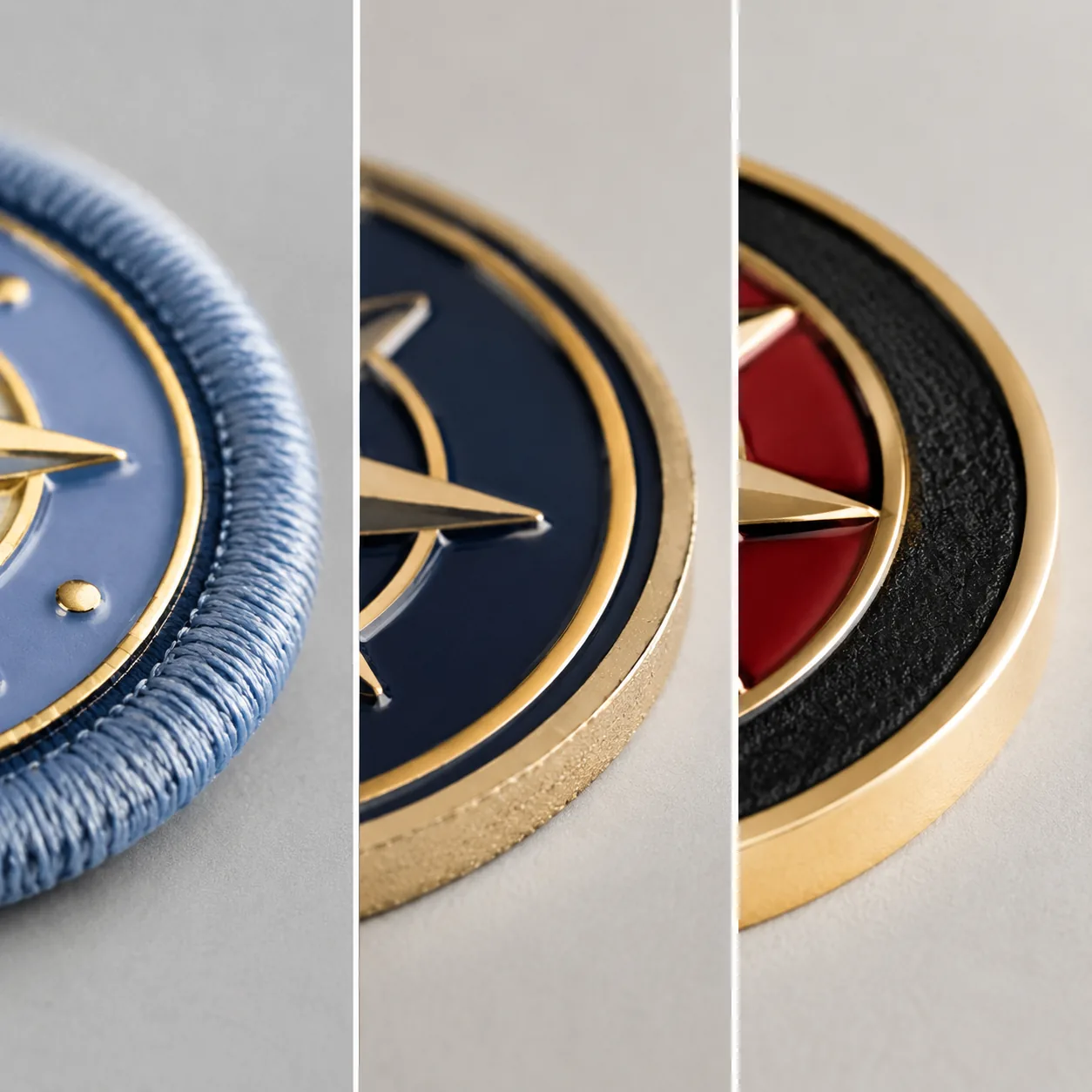
Why patch edges fail after artwork approval
Many patch disputes start after the buyer has already approved artwork, thread colors and backing. Bulk production arrives with fuzzy edges, curled corners, scorch marks, exposed Velcro or a bulky stitched rim that changes the silhouette. The face embroidery may match the sample, but the border makes the patch look lower grade on uniforms, caps, backpacks or retail cards. In most cases the factory did not ignore the design; the purchase order simply did not define the edge construction tightly enough.
A patch border is a structural specification, not only a visual frame. It affects outside size, abrasion resistance, sewing behavior, heat-press contact, stiffness, packing thickness and the way a patch sits on curved garments. A 75 mm patch with a 3.0 mm merrowed edge can measure and feel very different from a 75 mm woven patch with a 0.5 mm laser-sealed edge. If the quoted size is not defined as outside size or face size, both buyer and supplier can be technically correct while still disagreeing at inspection.
A complete RFQ should state border type, border width, edge color, outside-size tolerance, minimum bridge width, backing inset, loose-thread limit and AQL acceptance level. These lines prevent more rework than another round of Pantone matching because they give production and QC the same measurable standard. For ZheCraft patch orders, the cleanest approvals usually come from buyers who treat the edge as a separate component with its own drawing notes.
Choose the edge by shape, use and backing
The main textile edge options are merrowed, laser-cut and heat-cut. Merrowed borders are overlocked around the perimeter with polyester thread, normally 2.5 to 4.0 mm wide. They are strong and familiar on uniform patches, but they add bulk and round off detail. Laser-cut borders are cut after embroidery or weaving; the beam seals synthetic fabric and leaves a narrow visible edge, usually 0.3 to 0.8 mm. They are best when the outline is irregular, detailed or retail-facing. Heat-cut borders use a heated die, blade or wire. They suit simpler polyester twill shapes and cost-sensitive runs where a sealed edge is required but ultra-fine contour accuracy is not.
PVC patches follow different rules. The edge is molded, not stitched or cut, so the buyer specifies rim width, rim height, mold draft and flash allowance. A typical soft PVC raised rim is 1.0 to 2.0 mm wide and 0.5 to 1.2 mm higher than the base. Textile patch tolerances should not be copied directly to PVC tooling because shrinkage, mold parting lines and trimming flash are controlled differently.
| Edge type | Best application | Typical edge spec | Shape limit | Main production risk |
|---|---|---|---|---|
| Merrowed border | Round, oval, shield and square uniform patches | 2.5-4.0 mm thread border; ±0.5 mm border-width tolerance | Poor for sharp inside corners under 90° or thin protrusions under 2.5 mm | Bulky rim changes final outside size and can crowd artwork |
| Laser-cut border | Woven patches, detailed logos and irregular silhouettes | 0.3-0.8 mm sealed edge; ±0.5 mm outside-size tolerance on woven goods | Good for complex outlines if bridges remain at least 1.5-2.0 mm | Brown scorch or melted shine on pale polyester if power is too high |
| Heat-cut border | Simple polyester twill patches and budget promotional runs | 0.5-1.2 mm sealed edge; ±0.8-1.0 mm outside-size tolerance | Moderate; not ideal for tiny teeth, serrations or tight inside holes | Variable edge width on curves and slightly harder hand feel |
| Molded PVC rim | Outdoor morale patches, bag patches and rubber labels | 1.0-2.0 mm raised rim; flash under 0.3 mm unless otherwise approved | Good if artwork allows mold draft and minimum line thickness | Flash, sink marks or over-thick rim if details are too small |
Merrowed border specifications that prevent disputes
A merrowed border is created by wrapping thread around the outside of the prepared patch. For most 50 to 100 mm embroidered patches, a 3.0 mm border is the commercial standard. A workable specification is 3.0 mm ±0.5 mm, using polyester embroidery thread in an approved color. Heavier thread can create a tactical look, but it increases thickness and may make small patches look crowded. On patches below 40 mm, a 3.0 mm border can consume more than 15% of the total diameter, leaving little space for the actual logo.
Merrowed edges work best on closed shapes with smooth curves: circles, ovals, shields, tabs and rectangles with rounded corners. Specify an outside corner radius of at least 2.0 mm, preferably 3.0 mm for patches above 60 mm. Sharp corners will often become rounded during overlocking, so stars, lightning bolts, animal legs and script logos are better handled with laser cutting or a simplified outline.
Size language is critical. Most factories quote patch size as the maximum outside dimension including the border. If the buyer requests a 75 mm round patch, that normally means 75 mm finished outside diameter, not 75 mm embroidery face plus border. If the face must be 75 mm and the merrowed rim is 3.0 mm, the finished patch will be about 81 mm. That difference can make the patch fail on a Velcro panel, retail card or cap front.
- State whether size is finished outside size or embroidered-face size.
- Specify border width, such as 3.0 mm ±0.5 mm, and confirm edge thread color by Pantone or approved thread chart.
- Keep important artwork at least 1.5 mm inside the merrowed border; use 2.0 mm for small text.
- Set loose-thread limits: no loose end over 2 mm on the front and no unraveling at the seam join.
- Use a minimum outside corner radius of 2.0-3.0 mm; avoid merrowed borders on jagged or narrow silhouettes.
- For hook-and-loop backing, inset the backing 0.5-1.0 mm from the finished edge so it does not show or scratch.
Laser-cut and heat-cut specs for detailed outlines
Laser cutting gives the cleanest textile outline when the patch is woven, printed or finely embroidered. For woven patches from 40 to 120 mm, a realistic outside-size tolerance is ±0.5 mm when the cut line is supplied as vector artwork. For embroidered twill patches, thread height and fabric movement make ±0.8 mm more practical unless the outline is simple. The cut line should sit on a separate artwork layer and should represent the finished outside shape, not a rough visual guide.
Minimum bridge width matters more than many buyers expect. For textile patches, avoid fabric bridges narrower than 1.5 mm after cutting; 2.0 mm is safer for patches that will be sewn, washed or handled in retail bins. Inside holes below 3.0 mm often trap lint, adhesive residue or melted fibers and become inconsistent in bulk. If the artwork has many hairline gaps, it is usually better to simplify the silhouette or convert the item to a woven label, printed patch or PVC part.
Heat cutting is not just a cheaper substitute for laser cutting. It is efficient for repeated simple shapes, especially polyester twill patches with sew-on or iron-on backing. However, it is less suitable for pale fabric that cannot tolerate slight yellowing, premium retail patches where consumers inspect every edge, or outlines with fine teeth and tight inside curves. Heat-cut samples should be approved under the same lighting and distance used for bulk inspection.
| Spec item | Laser-cut recommendation | Heat-cut recommendation |
|---|---|---|
| Finished outside-size tolerance | ±0.5 mm for woven; ±0.8 mm for embroidered | ±0.8-1.0 mm on most polyester twill shapes |
| Minimum bridge after cutting | 1.5 mm absolute; 2.0 mm preferred for washable patches | 2.0 mm preferred; avoid fragile bridges |
| Minimum inside hole | 3.0 mm practical minimum | 4.0 mm practical minimum or avoid cutting |
| Visible sealed edge | 0.3-0.8 mm | 0.5-1.2 mm |
| Scorch allowance | No brown mark visible at 30 cm under D65 light | Slight edge darkening only if approved on the signed sample |
| Best backing fit | Sew-on, iron-on, thin adhesive, inset Velcro | Sew-on, iron-on and simple Velcro shapes |
Cost, MOQ and lead-time impact
Border selection changes the production route. Merrowed edges add an overlocking operation but remain efficient for standard shapes. Laser cutting requires programming, jig positioning and test cuts, especially when the artwork has inside holes or mixed materials. Heat cutting is economical when the same simple outline repeats across a larger run. Backing, packing and inspection level can add as much time as the border itself.
For B2B patch sourcing, practical MOQs are commonly 100 pieces per design for trial orders, 300 pieces for more stable unit pricing and 500 to 1,000 pieces for promotional pricing. Sampling usually takes 5 to 10 calendar days after artwork approval. Bulk production for 100 to 1,000 pieces is normally 10 to 21 days after sample approval. Complex laser-cut shapes, multiple backings, retail header cards, barcode labeling or third-party inspection can add 3 to 7 days.
FOB China pricing depends on size, thread coverage, stitch density, backing, packing and defect standard. For planning, a 75 mm embroidered merrowed sew-on patch may run USD 0.45 to 1.35 depending on quantity and coverage. A 75 mm woven laser-cut patch may run USD 0.55 to 1.20. Iron-on film commonly adds USD 0.04 to 0.10 per piece. Hook-and-loop backing adds about USD 0.18 to 0.45 depending on hook quality, coverage and whether one or both sides are supplied.
| 75 mm patch construction | MOQ tier | Typical FOB China range | Sample lead time | Bulk lead time |
|---|---|---|---|---|
| Embroidered, merrowed, sew-on | 100-299 pcs | USD 0.70-1.35 | 5-8 days | 10-15 days |
| Embroidered, merrowed, iron-on | 300-999 pcs | USD 0.50-1.05 | 5-8 days | 12-16 days |
| Woven, laser-cut, sew-on | 300-999 pcs | USD 0.55-1.20 | 6-9 days | 12-18 days |
| Embroidered, laser-cut, Velcro backing | 300-999 pcs | USD 0.85-1.65 | 6-10 days | 14-21 days |
| Simple heat-cut twill patch, sew-on | 500-1,999 pcs | USD 0.38-0.85 | 5-8 days | 10-16 days |
Backing compatibility with each border
The edge and backing should be engineered together. Sew-on patches are the most forgiving because the garment factory can stitch through the patch face or near the border. If the patch will be sewn around the perimeter, keep small text, fine outlines and important design elements at least 1.5 mm away from the border. For thick merrowed patches, the sewing line should not climb onto the raised rim unless that look is intentional.
Iron-on backing uses hot-melt adhesive film, commonly 0.12 to 0.18 mm thick. A practical starting condition is 150-165°C for 12-18 seconds under medium pressure, but the real setting depends on the garment fabric. Nylon, fleece, coated canvas and stretch fabric require separate testing. A thick merrowed rim can prevent even pressure in the center of the patch unless the heat press uses a compliant pad. For laser-cut patches, the flat edge usually improves heat-press contact, but excess adhesive can squeeze beyond the sealed edge if the film is not trimmed cleanly.
Pressure-sensitive adhesive should be treated as temporary positioning unless the supplier has validated a specific permanent-use tape. It helps align patches before sewing or packaging, but it is not a substitute for stitching or heat bonding on washable garments. Velcro backing requires an inset. Hook or loop should sit 0.5 to 1.0 mm inside the finished patch edge to prevent visible creep, sharp corners and scratchy exposure. For patches under 60 mm or patches used on caps and curved sleeves, full-coverage Velcro may make the piece too stiff; partial or inset coverage is often more comfortable.
- For sew-on patches, specify no adhesive if the patch must stay soft and needle-friendly.
- For iron-on patches, request a peel test on the real garment fabric when possible.
- For pressure-sensitive adhesive, define it as temporary positioning unless permanent performance is tested.
- For Velcro, state hook side, loop side or both sides clearly in the PO.
- For curved applications, avoid overly stiff full-coverage backing on small patches.
- For children’s apparel, check edge softness and prevent exposed hook, hard corners or sharp melted edges.
Inspection criteria for border defects
Patch inspection should include border-specific checks, not only color and size. A common baseline is AQL 2.5 for major defects and AQL 4.0 for minor defects. Retail, military, safety or licensed-brand orders may require tighter limits, such as AQL 1.5 for majors. Major defects include wrong border type, wrong edge color, open merrow seams, detached backing, severe scorch, outside size beyond tolerance and visible Velcro from the front.
Measure patches on a flat table after they relax for at least 2 hours from packing compression. For a 75 mm patch, a reasonable outside-dimension tolerance is ±1.0 mm for embroidered merrowed goods and ±0.5 mm for woven laser-cut goods. Thickness should be checked when patches must fit mailers, retail cards or badge holders. Common embroidered sew-on patches measure about 1.2 to 2.2 mm thick. With hook-and-loop backing, total thickness often rises to 2.5 to 4.0 mm.
Simple performance checks catch many border failures before shipment. Rub the edge 20 cycles against medium cotton canvas and inspect for fraying, lifted yarns or backing separation. For iron-on patches, run at least one wash simulation before bulk approval when the patch is garment-facing: 30 minutes at 40°C, air dry, then inspect for edge lift, adhesive bleed and curling. For pale laser-cut fabric, inspect at 30 cm under D65 light and reject brown scorch unless the signed sample clearly approved that appearance.
| Defect | Classification | Acceptance rule |
|---|---|---|
| Wrong border type or edge color | Major | Reject affected pieces; verify against approved sample and PO |
| Finished size outside tolerance | Major | Reject if beyond stated tolerance, such as ±1.0 mm for merrowed or ±0.5 mm for woven laser-cut |
| Loose front thread | Minor or major | Minor if under 2 mm; major if visible at 30 cm, unraveling or crossing artwork |
| Laser scorch on pale fabric | Major | Reject if brown marks are visible at 30 cm under D65 light |
| Edge fraying after light rub | Major | Reject if yarns lift, edge opens or backing separates |
| Velcro visible beyond patch edge | Minor or major | Minor if under 0.5 mm and not sharp; major if visible from front, uneven or scratchy |
RFQ wording that gets a production-ready sample
Before requesting prices, decide whether the patch edge is meant to protect, decorate or disappear. Uniform and workwear patches usually prioritize durability, wash resistance and backing compatibility. Retail collector patches usually prioritize contour accuracy, clean edge color and consistent presentation on backing cards. Promotional patches may accept wider tolerances if the savings are meaningful and the edge is not a design feature.
Send vector artwork with the outside cut line on a separate layer. Label the line as finished outside size, and specify whether any internal holes are real cuts or printed/embroidered details. Include patch size, border type, border width, backing, edge color, quantity tiers, packing method, AQL level and target garment or substrate. If the patch is assembled with coins, pins, keychains, lanyards or gift boxes, include the final packing size and maximum allowed thickness so the border does not create a downstream packaging problem.
A factory-ready RFQ line is specific enough to quote and inspect: 75 mm woven patch, finished outside size, laser-cut edge, outside tolerance ±0.5 mm, sealed edge under 0.8 mm, no visible scorch at 30 cm under D65 light, loop Velcro backing inset 0.8 mm, individual opp bags, AQL 2.5 major and 4.0 minor, quote 500 and 1,000 pieces FOB China. That level of detail gives the supplier a measurable target for sampling, pricing and bulk QC, and it gives the buyer a clear basis for accepting or rejecting the finished shipment.
Have a project? Send your artwork and target quantity and we’ll reply with a detailed quotation within 12 working hours.
Ready to get this made?
Send your sketch, target quantity and ship-date. Detailed quotation in 12 hours.



