Patch Border Specs: Merrowed, Heat-Cut or Satin Stitch
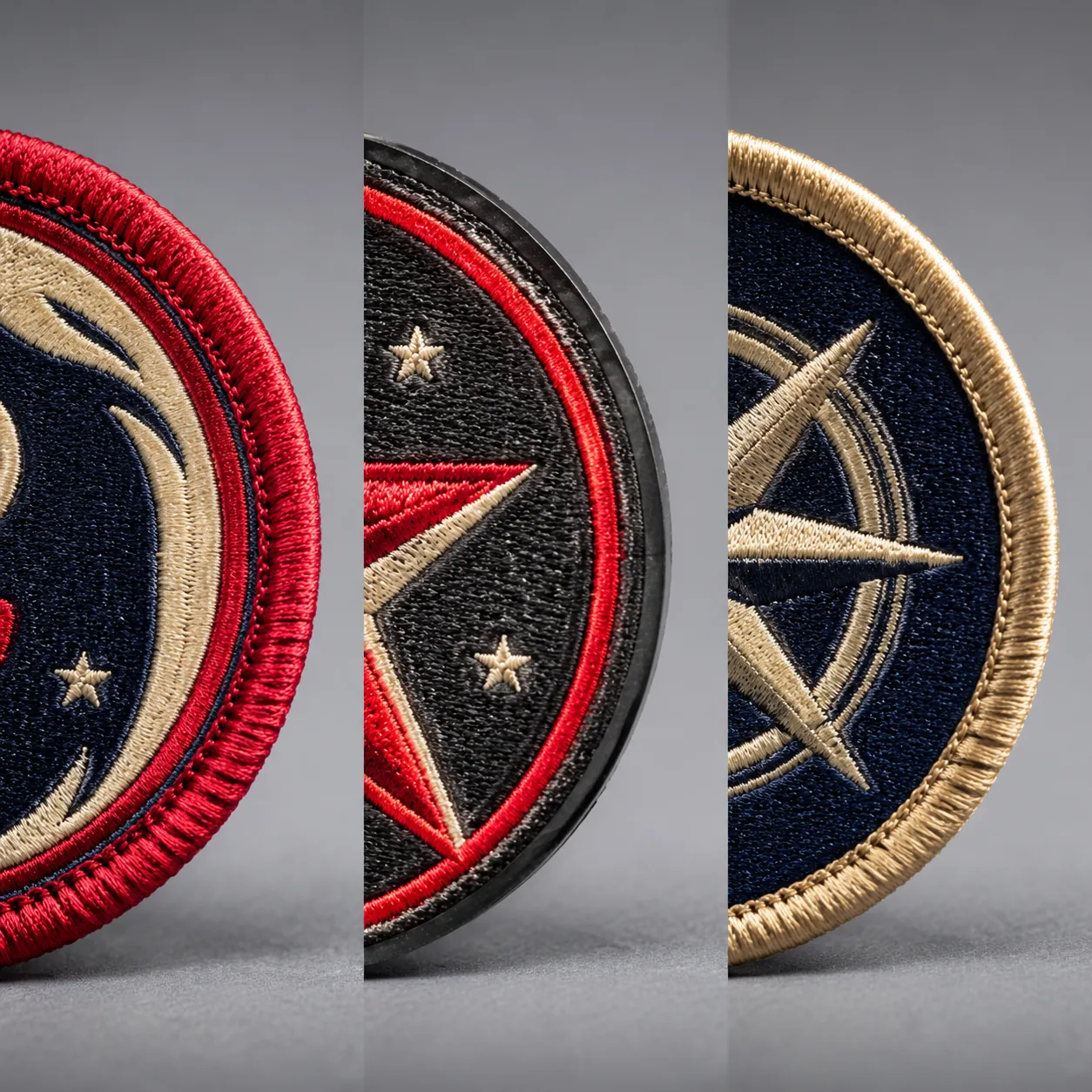
Start with the edge, not only the logo
Many patch failures are edge failures. The logo may be correctly embroidered or woven, but the finished piece is rejected because the merrowed border covers small text, a heat-cut outline frays after abrasion, or a stiff backing makes an irregular shape curl. For uniforms, event merchandise, club kits and retail patches, the border specification determines how clean the patch looks after sewing, pressing, washing and handling.
Most custom patch artwork can be produced with three border systems: merrowed overlock, heat-cut edge, or satin stitch edge. Each system has different limits for minimum radius, border width, stitch density, backing inset and finished-size tolerance. These details should be confirmed before digitizing. Changing from merrowed to satin after sampling is not a trim adjustment; it usually requires a new stitch file, a revised cut path and another sample approval.
For normal embroidered or woven patch orders, practical MOQ is 100 pieces per design for a small trial, 300 pieces for stable production pricing, and 500 to 1,000 pieces for distributor-level pricing. Digital proofing normally takes 1 to 2 working days. A physical pre-production sample takes 5 to 8 working days after artwork confirmation. Mass production is typically 10 to 18 days for 300 to 3,000 pieces, and 18 to 28 days for 5,000 to 10,000 pieces depending on backing, packing and inspection level.
Merrowed border: strongest for simple badges
A merrowed border is the raised overlock edge commonly used on police patches, scout badges, club emblems and workwear patches. It wraps thread around the patch edge, protecting the base fabric from abrasion. Typical finished border width is 2.5 to 3.5 mm, with thread height about 0.8 to 1.2 mm above the patch face. A 3 mm border is the default for 60 to 100 mm patches because it gives visible protection without consuming too much artwork area.
Merrow works best on circles, ovals, shields, rectangles with rounded corners and simple badge shapes above 50 mm wide. For clean production, keep outside corner radius at 3 mm or more, avoid narrow necks under 8 mm, and keep readable text, QR codes and fine emblem details at least 4 mm inside the finished edge. On small patches under 50 mm, a thick merrow can overpower the design; a 2.5 mm satin edge is often cleaner.
The main advantage is durability. For embroidered patches, factories commonly use polyester merrow thread such as 120D/2 or similar, over a polyester-cotton twill base of roughly 180 to 220 gsm. For workwear or bag use, specify sew-on application or iron-on plus perimeter sewing. A heat-seal backing alone is convenient, but it is not a substitute for stitching when the patch will be flexed, washed or scraped repeatedly.
- Use merrowed borders for round, oval, shield and simple rectangle patches.
- Avoid merrowed borders for starbursts, animal silhouettes, script logos and small internal cutouts.
- Specify 3 mm border width unless the patch is under 60 mm, where 2.5 mm may be better.
- Keep text and fine details at least 4 mm inside the finished edge.
- Use polyester thread for abrasion resistance; cotton-look thread is mainly decorative.
- Confirm the finished size includes the raised border, not only the visible artwork.
Heat-cut edge: flexible shape, lower abrasion protection
A heat-cut edge is made by cutting polyester fabric with a hot knife, die or laser after embroidery or weaving. It is the right choice when the outline follows a mascot, aircraft, product silhouette, bottle, leaf, letterform or complex badge contour. Finished edge tolerance is usually ±0.8 mm for simple shapes and ±1.2 mm for detailed silhouettes. Very small spikes, holes and internal notches may need to be simplified for repeatable production.
Heat cutting seals polyester fibers, but it does not wrap the edge like merrow. For embroidered patches, the cut edge should normally be supported by a stitched outline. A safe construction is a 1.5 to 2.5 mm satin outline placed 0.5 to 0.8 mm inside the cut path. Without this, twill can show at the perimeter and the edge can look thin, especially after sewing onto a garment.
The weak point is long-term wear. Heat-cut patches used on caps, jackets and event apparel are usually fine if the perimeter is stitched during application. For backpacks, work trousers or outdoor uniforms, specify a full stitched perimeter and advise the sewing contractor to stitch 1.5 to 2 mm from the edge. Avoid fragile necks under 6 mm on soft patches and under 8 mm when hook backing is used, because the hook tape makes the edge stiffer.
Satin stitch edge: clean premium control
A satin stitch edge is a flat embroidered border that follows the patch shape. It is less bulky than merrow and more finished than a bare heat-cut edge. It is often the best choice for retail merchandise, fashion labels, small logo patches and designs that need a custom outline without the heavy classic-badge look.
Common satin border width is 2 to 4 mm. Use 2 to 2.5 mm for patches under 60 mm, 3 mm for most 70 to 100 mm designs, and 3.5 to 4 mm for large patches above 120 mm or for shapes that need more edge stability. Polyester embroidery thread is commonly sewn at about 0.35 to 0.45 mm stitch spacing. If density is too loose, base fabric shows through; if it is too tight, the edge can pucker, cup or curl after heat pressing.
Satin borders can follow curves and moderate points, but they still need manufacturable geometry. Avoid points under 2 mm, internal gaps under 3 mm and sudden border-width changes. For woven patches, a satin border may be embroidered after weaving. This gives a raised premium edge and better abrasion protection, but it adds one process step and usually 1 to 3 production days.
| Border type | Best use | Practical specification | Shape limits | FOB price effect |
|---|---|---|---|---|
| Merrowed overlock | Uniforms, clubs, workwear, classic badges | 2.5 to 3.5 mm raised overlock; polyester thread | Simple outside shapes; radius ≥3 mm; no narrow cutouts | Base price or +USD 0.02 to 0.06/pc |
| Heat-cut edge | Mascots, custom silhouettes, event patches | Cut path with 1.5 to 2.5 mm inner satin support | Good for irregular outlines; avoid necks under 6 to 8 mm | +USD 0.03 to 0.08/pc |
| Satin stitch edge | Retail patches, fashion labels, detailed brand shapes | 2 to 4 mm flat embroidered border; 0.35 to 0.45 mm stitch spacing | Good curves; avoid points under 2 mm and gaps under 3 mm | +USD 0.04 to 0.12/pc |
| No visible border | Minimal woven labels, temporary giveaways | 0 to 1 mm margin with sealed polyester edge | Low-abrasion use only; higher fray risk | May reduce cost by USD 0.01 to 0.04/pc |
Size, backing and tolerances that affect the edge
Border performance changes with patch size and backing. A 45 mm iron-on logo behaves differently from a 110 mm jacket patch with hook backing. For most embroidered promotional patches, finished thickness is about 1.2 to 1.8 mm without backing, 1.6 to 2.3 mm with heat-seal backing, and 2.5 to 3.5 mm with hook-and-loop. Woven patches are usually thinner, often 0.6 to 1.0 mm before backing.
Heat-seal film should be specified clearly. Common adhesive film thickness is 80 to 120 microns for lightweight patches and 120 to 160 microns for heavier embroidered patches. The adhesive should stop 0.5 to 1 mm inside the finished edge to prevent glue squeeze-out during pressing. Hook backing should be cut about 0.5 mm smaller than the patch face so hook tape does not scratch skin or protrude beyond the border.
Finished-size tolerance should be realistic and measurable. For patches under 100 mm, specify ±1 mm on width and height. For patches above 100 mm, ±1.5 mm is more practical. Border-width tolerance is commonly ±0.3 mm for satin and ±0.5 mm for merrowed overlock. Color should be approved against a physical thread card or sample under D65 light because thread lots can vary more visibly than printed ink.
| Specification item | Recommended range | Why it matters |
|---|---|---|
| Finished size tolerance | ±1 mm under 100 mm; ±1.5 mm above 100 mm | Keeps reorder sets consistent and prevents visible size drift |
| Border width tolerance | ±0.3 mm satin; ±0.5 mm merrow | Controls artwork crowding and edge symmetry |
| Embroidery coverage | 50% to 75% standard; up to 100% for premium look | Higher coverage improves color depth but increases stiffness and cost |
| Heat-seal film | 80 to 120 microns light patches; 120 to 160 microns heavy patches | Affects bonding, edge squeeze-out and final thickness |
| Iron-on adhesive inset | 0.5 to 1 mm inside finished edge | Reduces glue overflow and dirty borders |
| Hook backing inset | 0.5 mm smaller than patch outline | Prevents scratchy hook material from protruding |
Cost, MOQ and lead-time expectations
For a 75 mm embroidered patch with up to 75% coverage, up to 8 thread colors and standard sew-on or iron-on backing, realistic FOB China pricing is often USD 0.38 to 0.85 per piece at 500 pieces. At 300 pieces, the same patch may land around USD 0.48 to 1.05 because setup and handling are spread across fewer units. At 1,000 pieces, a straightforward design may fall to USD 0.30 to 0.68. Complex satin borders, metallic thread, hook backing or individual retail cards can push the price higher.
Woven patches of similar size often range from USD 0.32 to 0.75 at 500 pieces because fine detail is created by weaving rather than high stitch-count embroidery. Chenille and PVC patches are separate processes and should not be priced against the same border rules. PVC normally has mold charges and layered color limitations; chenille has loop height and felt-edge issues instead of satin stitch density.
Sample charges are commonly USD 25 to 80 per design for embroidered or woven patches, with credit-back negotiable on larger orders. MOQ can be 100 pieces for a trial, but 300 pieces is usually the first economical tier. For RFQs, request 300, 500, 1,000 and 3,000 piece pricing. This exposes real production breaks and prevents comparing a low placeholder quote against a fully reviewed construction.
QC inspection points for patch borders
Border inspection should happen before packing, not after patches are sealed in polybags. For normal B2B orders, a practical standard is AQL general inspection level II with critical 0, major 2.5 and minor 4.0, unless the buyer has stricter brand rules. Critical defects include wrong logo, wrong border type, wrong backing, sharp melted residue that can cut skin, or adhesive contamination on the front face.
Major border defects include open seams over 3 mm, skipped satin stitches longer than 2 mm, fraying visible from 50 cm, exposed backing, distorted outline, wrong finished shape, or size outside tolerance. Minor defects include thread tails under 3 mm, slight border waviness not visible when flat, or shade variation within the signed sample range. Retail packs need tighter cosmetic review because the buyer handles each patch individually.
For an internal buyer-side check on a 500-piece order, inspect at least 50 to 80 pieces even if the formal AQL sample size differs. Measure at least 10 pieces across width and height, pull lightly at the edge seam, and bend patches around a 50 mm cylinder to check curling. For iron-on backing, test press on similar fabric at 150 to 165°C for 12 to 18 seconds, wait 24 hours, then wash once before approving apparel use.
- Confirm finished size includes the border and backing, not only the artwork area.
- Check border thread color against the approved sample under neutral D65 lighting.
- Look for glue squeeze-out, hard melted beads and hook backing protrusion.
- Reject open seams, skipped stitches, exposed base fabric and distorted corners beyond tolerance.
- Keep one signed golden sample and one bulk sample for reorder comparison.
- Record press temperature, time and pressure for any iron-on approval test.
RFQ artwork rules that prevent rework
A complete patch RFQ should include two outlines: the visible artwork outline and the finished sewing or cutting outline. If the buyer sends only a flat logo, the factory must decide where the border goes, and that decision may shrink text, change the brand shape or create an edge that cannot be repeated in mass production. Send vector artwork when possible and mark finished size in millimeters, such as 80 mm wide by proportional height.
For embroidered patches, minimum readable letter height is usually 5 mm for block letters and 6 to 7 mm for serif or script letters. For woven patches, 3 mm letters can be possible if the border does not crowd the text. Fine lines should be at least 0.8 mm for embroidery and 0.4 mm for woven work. QR codes should be tested at actual size; many fail because the border reduces quiet-zone space.
Do not approve a flat digital mockup without asking how the edge is built. The screen proof may show a perfect contour that is too sharp to cut or too narrow to stitch. A useful spec sheet should state finished size, border type, backing, thread or color count, expected use, packing method, inspection standard and target quantity tiers. For simple uniform badges, start with a 3 mm merrowed border. For mascots, brand shapes and retail patches, request heat-cut or satin stitch edging with a clear cut path and backing inset. For washed or high-abrasion use, approve a physical sample only after press, wash and edge-pull testing.
Have a project? Send your artwork and target quantity and we’ll reply with a detailed quotation within 12 working hours.
Ready to get this made?
Send your sketch, target quantity and ship-date. Detailed quotation in 12 hours.



