Patch Border Specs: Merrow, Heat-Cut and Stitched Edges
Spec Line 1: Define Patch Build and Edge Construction
A patch border is not a styling detail only. It controls the finished size, sewing behavior, durability and whether the factory can follow the approved artwork at scale. A weak spec such as “custom embroidered patch with border” leaves too much open: the supplier may choose a merrow edge, a satin stitched edge or a heat-cut edge, each with different shape limits and cost.
Write the border line as a manufacturing instruction: patch type, finished size, edge method, border width, backing and tolerance. For example: “Embroidered polyester twill patch, 80 mm W x 65 mm H measured after finishing, 3.0 mm black merrow border, plain sew-on backing, finished size tolerance ±1.0 mm.” That sentence gives the factory enough information to digitize, sample and inspect the patch consistently.
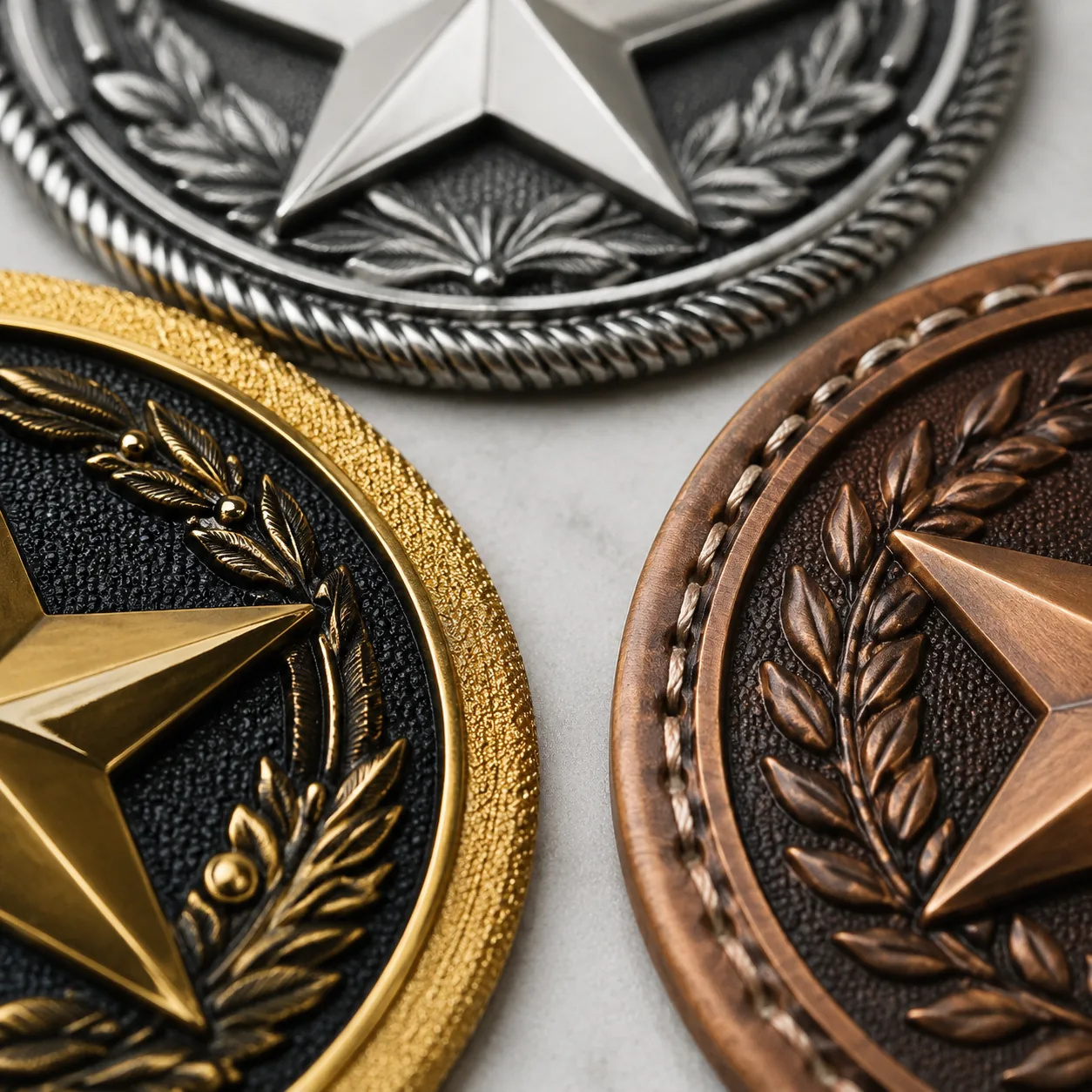
Merrowed edges are overlocked around the outside perimeter and form a raised rope-like edge, normally 2.5 to 3.5 mm wide. Heat-cut and laser-cut edges are trimmed after embroidery or weaving, usually with a 0.3 to 1.0 mm fabric allowance. Satin stitched edges are embroidered as a flat border, usually 1.5 to 3.0 mm wide, and are better for irregular outlines.
At ZheCraft, we confirm the edge method before quoting because it affects digitizing time, machine setup and reject risk. A round 80 mm badge with a 3 mm merrow edge is routine. A 72 mm mascot with narrow ears, 2 mm corner radii and deep cutouts should usually move to heat-cut or laser-cut finishing, because merrow stitching cannot turn cleanly around those features.
Spec Line 2: Match Border Method to Geometry
Choose one primary border method and one approved fallback. This is especially useful for distributors quoting from early artwork, where the final silhouette may still change. The edge method should follow the geometry, not only the buyer’s preference. Merrow is durable and traditional, but it adds bulk and works best on simple closed shapes. Heat-cut and laser-cut edges preserve irregular silhouettes better.
| Border method | Best use | Normal border width | Shape limits | Typical FOB range, 1000 pcs |
|---|---|---|---|---|
| Merrowed edge | Circles, rectangles, shields, ovals, simple badges | 2.5 to 3.5 mm | Avoid internal angles under 90° and outside radii below 4 mm | USD 0.42 to 1.20 per 75 mm patch |
| Heat-cut edge | Irregular logos, mascot silhouettes, promotional patches | 0.5 to 1.0 mm fabric allowance | Works on most polyester twill shapes; pale edges can show slight darkening | USD 0.38 to 1.05 per 75 mm patch |
| Laser-cut edge | Woven patches, fine silhouettes, small retail labels | 0.3 to 0.8 mm allowance | Best on polyester twill or woven fabric; not ideal for thick felt | USD 0.45 to 1.25 per 75 mm patch |
| Satin stitched edge | Flat border on detailed embroidered shapes | 1.5 to 3.0 mm satin stitch | Requires enough border width for needle coverage and clean turns | USD 0.40 to 1.15 per 75 mm patch |
For patches under 35 mm, avoid heavy merrow edges unless the shape is very simple. The border can visually overpower the artwork and reduce readable space. For patches over 120 mm, check whether the border will curl after backing is applied; larger patches need better base stability, especially with iron-on adhesive or plastic backing.
Spec Line 3: State Finished Size, Shape and Tolerance
Patch size should be specified as maximum width by maximum height, measured at the furthest finished points including the border. Do not specify only “about 3 inches” or measure the artwork area before edging. A clean spec reads: “90 mm H x 70 mm W finished shield, measured after merrow finishing, tolerance ±1.0 mm.” If the patch must fit a cap front, sleeve panel or pocket, include the placement limit.
For most embroidered patches under 100 mm, a practical finished-size tolerance is ±1.0 mm. For 100 to 180 mm patches, use ±1.5 mm. For woven patches, ±0.5 to ±0.8 mm is often achievable because the surface is more uniform and less affected by embroidery pull. PVC patches should be specified separately as molded products, normally with tooling tolerance around ±0.3 to ±0.5 mm depending on size.
Shape tolerance is important on shields, badges with a vertical axis and matched left-right sets. A 1.5 mm asymmetry on a 90 mm uniform badge is visible when sewn on a sleeve. For these orders, add: “Centerline symmetry within 1.0 mm; inspect against approved dieline.” For pairs or mirror-image patches, specify whether the tolerance applies to each patch alone or to the pair as worn.
If the patch has cutouts or protrusions, define minimum manufacturable features. As a working rule, keep embroidered protrusions at least 3.0 mm wide after trimming, heat-cut bridges at least 2.0 mm wide and laser-cut woven details at least 1.0 to 1.5 mm wide. Anything smaller can distort, fray or break during handling.
Spec Line 4: Control Border Width, Density and Pull
Border width affects both appearance and edge strength. A merrow border below 2.5 mm often exposes base fabric on curves. A satin stitched border below 1.5 mm may look uneven because the needle does not have enough coverage area. Wide borders can also create problems: a 4 mm merrow edge on a 45 mm patch reduces the usable artwork area and makes the patch feel bulky.
For embroidered patches, normal satin border spacing is about 0.35 to 0.45 mm between stitches when using standard 120D/2 polyester embroidery thread. High-density borders can look premium, but too much thread creates pull, puckering and edge curl. Low density saves machine time but leaves visible twill gaps, especially on dark borders over light base fabric.
- Specify border width in millimeters, not as “thin,” “standard” or “premium.”
- Use 2.5 to 3.5 mm for merrowed borders on simple geometric shapes.
- Use 1.5 to 3.0 mm satin stitched borders for irregular embroidered outlines.
- Keep small text at least 2.5 mm from a merrow edge and 1.5 mm from a heat-cut edge.
- Avoid border color changes on tight corners unless the patch is large enough to hide thread transitions.
Clarify whether an outer colored line in the artwork is the border or a printed graphic inside the border. A 3 mm black merrow edge around a navy logo is not the same as a 1 mm black outline plus a 2.5 mm navy merrow edge. This small distinction prevents sample rejection and unnecessary redigitizing.
Spec Line 5: Link Backing to Sewing Margin
Backing changes how a patch edge behaves. Plain sew-on patches are the safest choice for uniforms, bags and outdoor gear because final attachment is controlled by stitching. Iron-on backing is convenient for clubs and retail patches, but it adds stiffness and can lift at sharp points after repeated washing. Hook backing is removable, but it increases thickness and cost.
Typical adhesive film thickness for iron-on backing is 0.10 to 0.18 mm. Sticker adhesive is usually 0.08 to 0.15 mm and should be treated as temporary, not a permanent apparel attachment. Plastic backing adds about 0.2 to 0.4 mm and improves shape stability, but it can feel rigid on soft garments. Hook backing adds roughly 1.5 to 2.5 mm total thickness depending on hook quality and lamination.
For sew-on use, protect important artwork from the garment stitching path. Leave a clean sewing margin of 2 to 3 mm for uniforms and light bags. For heavy canvas, tactical gear or leather goods, allow 3 to 4 mm because operators may use thicker thread and larger needles. Without this margin, the patch may pass inspection but fail at garment assembly because letters or faces are stitched through.
| Backing type | Added thickness | Good for | Risk to specify |
|---|---|---|---|
| Plain sew-on | 0 to 0.2 mm | Uniforms, caps, bags, workwear | Requires garment sewing; no retail convenience |
| Iron-on | 0.10 to 0.18 mm | Clubs, retail packs, short-term apparel | Can lift on sharp corners or high-wash garments |
| Sticker adhesive | 0.08 to 0.15 mm | Temporary event use, packaging decoration | Not a permanent apparel attachment |
| Hook backing | 1.5 to 2.5 mm | Tactical patches, removable name tags | Higher cost and thicker hand feel |
| Plastic backing | 0.2 to 0.4 mm | Shape stability, retail patches | Can feel rigid on soft garments |
Spec Line 6: Specify Materials, Thread and Color Control
The material line should name the base fabric, thread type and color reference. Standard embroidered patches usually use polyester twill with polyester embroidery thread because the combination is cost-effective, stable and wash resistant. Felt gives a softer heritage look but has looser edges and is less suitable for heat-cut details. Woven polyester is better when small text or fine lines are more important than raised embroidery texture.
Thread color should be controlled by thread code and a physical sample, not only by Pantone. Pantone TCX or Pantone C references help communicate the target, but thread has sheen and directionality. A navy thread can appear lighter under D65 daylight and darker under warm office LEDs. Metallic thread is stiffer and more abrasive, so use it for accents rather than large filled areas.
For legibility, embroidered uppercase letters should normally be at least 5 mm high, with strokes around 0.8 to 1.0 mm. Woven patches can hold smaller text, often 2.5 to 3.0 mm high, if the font is simple and the contrast is strong. Avoid placing 3 mm text next to a bulky merrow edge; the border will visually crowd the lettering.
- Use polyester twill for standard embroidered patches and woven polyester for fine text.
- Specify polyester embroidery thread for normal promotional, workwear and uniform use.
- Request metallic thread only for accents, not broad fills, to reduce stiffness and uneven coverage.
- Set color approval under one light condition, such as D65 daylight or a defined office LED source.
- Lock the thread code after sample approval, not only the Pantone reference.
Spec Line 7: Quote MOQ, Sampling and Lead Time by Tier
MOQ depends on patch size, edge method, backing, color count and packaging. A realistic MOQ for simple embroidered patches is often 100 pcs per design, but price becomes more stable at 300, 500 and 1000 pcs because digitizing and setup are spread across more units. Woven patches, hook-backed patches and retail-packed patches may still start at 100 pcs, but the sample and setup share is higher.
For planning, allow 2 to 4 days for artwork cleanup and stitch file preparation, 5 to 9 days for a physical pre-production sample and 10 to 18 days for mass production after sample approval. Orders above 10,000 pcs, mixed-size sets or retail cards with barcodes can push production to 20 to 30 days. Air freight normally adds 3 to 7 days after packing; sea freight should be planned separately.
FOB pricing for a standard 75 mm embroidered patch with plain backing commonly falls around USD 0.35 to 0.80 at 1000 pcs, depending on embroidery coverage, border method and shape complexity. Add roughly USD 0.03 to 0.08 for iron-on backing, USD 0.05 to 0.12 for plastic backing and USD 0.18 to 0.45 for hook backing. Retail cards, polybags and barcode labels add cost and lead time.
| Quantity tier | Best for | Typical sample approach | Normal production lead time |
|---|---|---|---|
| 100 to 299 pcs | Club orders, test campaigns, replacement badges | Physical sample recommended if shape, colors or backing are new | 10 to 15 days after approval |
| 300 to 999 pcs | Small events, team uniforms, distributor trials | Physical sample recommended for first order | 12 to 18 days after approval |
| 1000 to 4999 pcs | Corporate events, retail patch drops, campaigns | Seal a golden sample before bulk production | 14 to 22 days after approval |
| 5000 pcs and above | National campaigns, uniform programs | Pilot lot or first-article inspection recommended | 18 to 30 days after approval |
Spec Line 8: Inspect Borders with AQL and Defect Rules
The quality line should define how borders are inspected. “Good quality” is not enforceable. For most patch orders, AQL 2.5 for major defects and AQL 4.0 for minor defects is a practical starting point. Critical defects should be zero tolerance, including wrong logo, wrong backing, mold, oil contamination, unsafe metal fragments or mixed customer designs.
Major border defects include open seams, unraveling merrow stitches, wrong border color, heat-burn marks visible at 50 cm, loose backing, size outside tolerance and distortion that prevents normal sewing. Minor defects include thread tails under 3 mm, slight fuzzing not visible at normal viewing distance and small stitch density variation that does not affect the approved appearance. For retail patches, tighten the cosmetic standard because customers inspect the item close to the package.
Before issuing a purchase order, send a one-page border spec covering finished size, border method, border width, backing, thread references, tolerance, sample requirement, MOQ tier, price basis and inspection level. Ask the factory to flag risky corners, small text, narrow protrusions and backing conflicts before sampling. Correcting a dieline before the first sample is far cheaper than sorting 3000 finished patches after garment sewing.
- Approve a physical sample for any first-time design, new border method or new backing.
- Keep one sealed golden sample with the buyer and one with the factory before mass production.
- Measure finished size at the furthest points, including the border, not only the artwork area.
- Check 10 to 20 random pieces before shipment photos are accepted as final proof.
- For repeat orders, reference the previous order number, thread codes, backing type and border width.
Have a project? Send your artwork and target quantity and we’ll reply with a detailed quotation within 12 working hours.
Ready to get this made?
Send your sketch, target quantity and ship-date. Detailed quotation in 12 hours.



