Patch Backings Compared: Sew-On, Iron-On, Hook-and-Loop or Adhesive
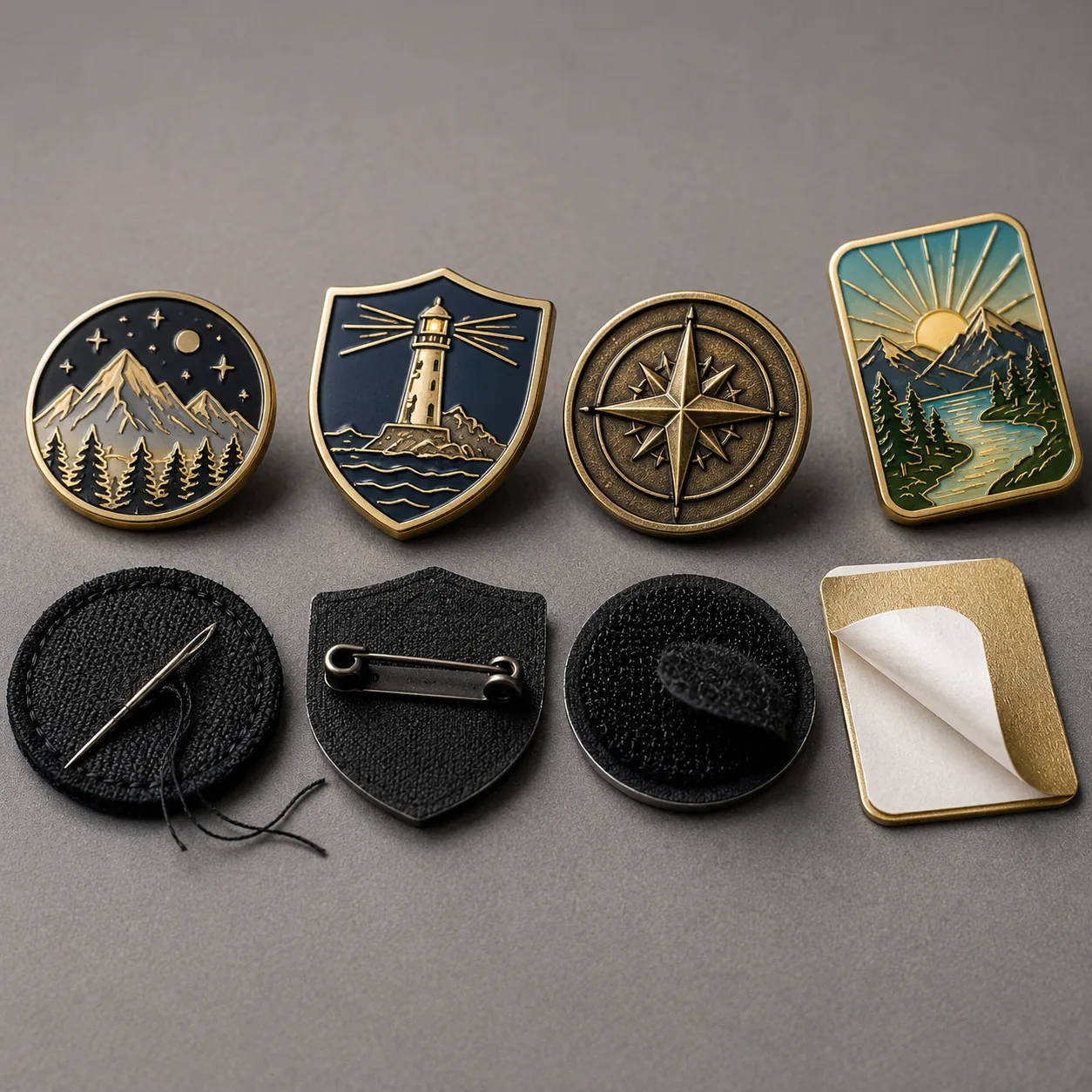
Why patch backing fails before the patch does
Most patch complaints are not caused by embroidery density, woven detail or PVC color matching. They happen after delivery: iron-on corners lift after the first wash, hook-and-loop patches curl on sleeves, adhesive patches leave residue on packaging, or sew-on patches arrive with no clean border for stitching. On a 5,000-piece uniform order, the rework cost of a wrong backing can exceed the patch cost.
Backing should be defined at RFQ stage, before sample approval. Treat it as a functional component with its own material, thickness, tolerance, test method and application conditions. The same 80 mm embroidered patch can pass inspection as a sew-on badge and fail quickly if converted to heat-seal film without checking fabric, wash temperature and press conditions.
This comparison covers four common backings for embroidered and woven patches: sew-on, heat-seal iron-on, hook-and-loop, and pressure-sensitive adhesive. PVC patches use the same selection logic, but their molded thickness, sewing channel and bonding behavior are different enough that they should be sampled separately.
Specification and cost comparison
| Backing type | Best use | Typical added thickness | Material spec to request | MOQ impact | FOB cost impact, 75-90 mm patch | Lead-time impact | Main failure risk |
|---|---|---|---|---|---|---|---|
| Sew-on border only | Uniforms, caps, denim, bags, long-term workwear | 0.0-0.2 mm beyond base patch | Merrowed edge or laser-cut edge with 2.0-3.0 mm stitchable border; shape tolerance ±1.0 mm up to 100 mm | No extra backing MOQ; normal embroidered or woven patch MOQ 100-300 pcs/design | +USD 0.00-0.03/pc | No added time; sample 7-12 days, bulk 12-20 days | Artwork leaves no needle path; edge frays if cut too close |
| Iron-on heat seal | Retail patches, school badges, event merchandise, light jackets | 0.10-0.18 mm film | PA or PES hot-melt film, 90-120 gsm; press 150-165°C for 12-18 seconds at 2.5-4.0 bar | +0 MOQ for standard film above patch MOQ | +USD 0.03-0.08/pc | Adds 1-2 days for lamination, cooling and peel check | Peels on coated, stretch or low-surface-energy fabrics; weak bond if applied with home iron |
| Hook-and-loop | Tactical patches, name tapes, staff roles, medical/security identifiers | 1.8-2.6 mm for hook plus loop set | Nylon or polyester hook tape sewn to patch; loop supplied loose or shape-cut if required | Practical MOQ 300 pcs; color-matched tape often 500-1,000 pcs | +USD 0.12-0.35/pc for hook only; +USD 0.22-0.55/pc with loop | Adds 2-4 days; custom-dyed tape can add 5-10 days | Curling on narrow shapes; weak peel; hook damages delicate garment fabric |
| Pressure-sensitive adhesive | Temporary giveaways, packaging decoration, sample kits, photo props | 0.08-0.15 mm adhesive plus release liner | Acrylic PSA preferred; 80-120 gsm release paper; rubber PSA only for short-term use | No extra MOQ for standard adhesive; specialty tape 500-1,000 pcs | +USD 0.04-0.12/pc | Adds 1-2 days; die-cut liner or kiss-cut sheets add 2-4 days | Not washable; adhesive transfer, edge lift or poor bond on textured/coated surfaces |
The ranges above assume 500-5,000 embroidered or woven patches, 75-90 mm wide, bulk packed, FOB Ningbo or Shanghai. Very small patches under 40 mm often carry a higher backing cost per piece because manual alignment and trimming take nearly the same time. Patches over 120 mm need extra attention to curl, carton pressure and edge lift, especially with iron-on film and hook tape.
For quoting, ask suppliers to separate the patch price from the backing surcharge. It makes value engineering easier: for example, an 80 mm embroidered sew-on patch at 1,000 pcs may quote at USD 0.62-0.95/pc FOB depending on thread coverage and border. Adding iron-on may move it to USD 0.65-1.03/pc, while hook plus loop can push it to USD 0.84-1.45/pc.
Sew-on vs iron-on: permanent stitch or heat-activated convenience
Sew-on remains the safest choice where patches must survive repeated laundering, abrasion and outdoor use. A production-ready sew-on patch should have a clean 2.0-3.0 mm needle path around the edge. For merrowed borders, that path sits just inside the raised edge. For laser-cut woven patches, it must be designed into the artwork. If embroidery runs to the edge with no margin, the garment factory has to stitch through the design, which can break threads and create visible distortion.
Iron-on backing is convenient but less universal. It is a thermoplastic film, usually polyamide (PA) or polyester (PES), laminated to the patch back. During application, the film melts into the fabric surface under heat and pressure, then gains strength after cooling. A practical factory setting is 150-165°C, 12-18 seconds dwell, medium pressure around 2.5-4.0 bar, then full cooling before peel. For thicker patches or dense twill bases, a second press from the garment reverse side can improve penetration, but only if the fabric tolerates heat.
Home irons are the weak point. They rarely give stable pressure, and their temperature cycles are inconsistent. Iron-on patches applied at home may work on cotton canvas, denim and uncoated polyester-cotton blends, but they are risky on waterproof jackets, stretch knits, fleece, silicone finishes and low-energy synthetic coatings. If the end user will wash the garment more than five times, specify sew-on or instruct users to sew around the edge after heat application.
For B2B uniform programs, choose sew-on unless the application site has validated heat presses and fabric data. For retail souvenir patches, iron-on is often the better commercial choice because it gives the customer an easy first-use method and still allows reinforcement stitching later.
Iron-on vs adhesive: heat bond and pressure tack are not interchangeable
Iron-on film and pressure-sensitive adhesive are often confused because both can arrive with a glossy back surface. They are different systems. Iron-on film is dry and non-tacky at room temperature, then melts under heat. Pressure-sensitive adhesive (PSA) is tacky at room temperature and protected by a release liner until use.
On compatible fabric, iron-on normally gives a stronger textile bond than PSA because the molten film penetrates fibers. PSA sits closer to the surface and depends on surface energy, pressure and dwell time. It is useful for temporary badges, packaging decoration, displays, sample cards and positioning a patch before sewing. It should not be described as washable unless the exact fabric, adhesive and wash process have passed testing.
A practical adhesive spec is acrylic PSA, 0.08-0.12 mm adhesive layer, 80-120 gsm release paper, application above 15°C, and no laundry guarantee. Acrylic PSA has better aging and lower odor than rubber-based PSA. Rubber adhesive can feel stickier on first touch and may bond better to some rough paperboard, but it is more likely to yellow, smell or leave residue under heat. For premium retail patches, acrylic is the safer default.
If the patch must stick to plastic packaging, test the exact pouch, carton coating or display board. Matte lamination, UV varnish, recycled paper fibers and anti-static plastic films all change adhesion. A sample that sticks well to plain paper may fail on a coated mailer after 24 hours in a warm warehouse.
Hook-and-loop: removable function adds thickness, cost and inspection points
Hook-and-loop backing, often called Velcro in casual purchasing, changes the product from a fixed badge to a removable component. That functionality is valuable for tactical patches, name tapes, emergency service identifiers, event staff roles and morale patches. It also changes the physical build. A 90 mm embroidered patch that is 2.0-2.8 mm thick can become 4.0-5.5 mm thick after hook tape, sewing thread and optional loop tape are included.
The added thickness affects carton quantity, mailer selection and how the patch sits on a sleeve or bag. Standard black hook tape is normally the lowest-cost option and fastest to source. Coyote, olive drab, navy and white are common but may vary by supplier lot. Pantone matching is approximate because nylon and polyester tape reflect light differently from embroidery thread. Custom-dyed hook or loop should be quoted with 500-1,000 pcs MOQ and 5-10 extra days unless the supplier already stocks the color and width.
Specify whether the order requires hook only or hook plus loop. Many buyers order hook only assuming the garment has loop panels; then the receiving team discovers that the uniforms are blank. If loop is supplied, confirm whether it should be rectangular, shape-cut to match the patch, or supplied as yardage. Shape-cut loop looks cleaner in retail kits but adds cutting cost and can increase tolerance issues on irregular outlines.
Curl is the main mechanical risk. Hook tape is stiffer than the embroidery or woven base. Rectangles, shields and circles are stable; long name tapes and thin arcs are more likely to lift at the ends. For shapes narrower than 25 mm or longer than 120 mm, request full-area hook, perimeter stitching and a flatness check after 24 hours under normal carton pressure. If the patch must stay permanently on one garment, sew-on is usually more reliable and cheaper.
Inspection standards: tolerances, AQL and practical tests
Backing inspection should match real use, not just visual appearance. For sew-on patches, inspect border width, edge security, thread trimming and shape. For iron-on and adhesive, test peel behavior after cooling or dwell time. For hook-and-loop, inspect tape offset, skipped stitches, corner curl and open-close durability.
A practical bulk inspection plan is AQL 2.5 for major defects and AQL 4.0 for minor cosmetic defects, general inspection level II. For critical uniform or safety programs, tighten major defects to AQL 1.5. Dimensional tolerance should normally be ±1.0 mm for patches up to 100 mm and ±1.5 mm for larger shapes. Backing alignment should stay within ±1.5 mm from the patch edge; on dark bordered hook-and-loop patches, even a 2.0 mm tape offset can be visible and should be treated as a major defect if it affects use.
Thickness should be measured with a consistent method because embroidery compresses. For comparison samples, use a flat anvil thickness gauge with light pressure and record total patch thickness at three points. If patches are packed tightly, run a carton pressure check: store packed samples for 24-48 hours, then inspect for blocking, liner transfer, bent corners and hook imprinting on neighboring patches.
- Sew-on: confirm 2.0-3.0 mm stitchable border, no loose edge yarn, no glue contamination on the sewing path, and no embroidery collapse when stitched through a test fabric.
- Iron-on: press at approved temperature, time and pressure; cool fully for at least 10 minutes; then perform a peel check. For wash use, test after 24 hours, not while the adhesive is still warm.
- Hook-and-loop: run at least 20 open-close cycles, check perimeter stitches, measure tape offset, and confirm corners remain flat after resting overnight.
- Adhesive: apply to the intended surface for 24 hours at 20-25°C, then check peel, residue, corner lift and release-liner removal.
- All backings: confirm total thickness, backing alignment, packing pressure, and whether patches block together after storage in cartons.
Wash testing should be specified for apparel use. A basic validation is 5 wash cycles at 40°C, air dry, then inspect for peeling, fraying, shrinkage, color bleed and edge deformation. For industrial workwear, request 10-20 cycles or higher-temperature testing if the laundry process requires it. Do not rely on a generic wash claim without fabric type, detergent, temperature and drying method.
MOQ, lead time and buying scenarios
MOQ is usually driven by patch construction and setup, not backing, when standard materials are used. Typical practical MOQs are 100-300 pcs per design for embroidered or woven patches, 300 pcs for PVC patches, and 500-1,000 pcs when custom-dyed hook-and-loop, unusual adhesive tape or specialty backing color is required. Multi-design programs can share standard backing film or black hook tape, but they cannot always share custom-colored tape unless width, color and material match.
Lead time should include backing tests, not just sewing or weaving. A normal pre-production sample takes 7-12 days after artwork approval. Bulk production for 500-5,000 pcs usually takes 12-20 days. Add 1-2 days for iron-on or adhesive lamination and basic peel checks, 2-4 days for hook-and-loop sewing, and 2-4 more days if the buyer requires wash testing, individual barcodes or retail carding. Before Chinese New Year or major holiday peaks, add buffer rather than compressing backing tests.
For corporate uniforms and workwear, choose sew-on unless the label must be removable. Send a pre-production patch to the garment factory so they can confirm sewing speed, needle position and thread color before mass application. For festivals, fan merchandise and school patches, iron-on is often the best balance of user convenience and cost, but include printed instructions with temperature, time, pressure, cool-down and fabric warnings.
For tactical, medical, security and temporary event staff patches, hook-and-loop is usually worth the cost. Confirm hook only versus hook plus loop before issuing the PO. For mailers, sample kits, trade show handouts and decorative packaging, adhesive backing is suitable only as a temporary solution and should be tested on the exact surface.
RFQ checklist before approving the backing
Write the backing into the RFQ as a functional specification, not a one-word option. Include patch type, size, thickness target, fabric or application surface, expected wash cycles, removal requirement and packing method. If a garment factory, event team or retailer will apply the patches, confirm their equipment before selecting iron-on or hook-and-loop.
- Send final patch dimensions and shape, with the backing area marked on the artwork.
- State the end use: uniform, retail souvenir, temporary event badge, tactical patch, packaging decoration or giveaway.
- For sew-on, specify required stitchable border width and whether the border is merrowed, satin-stitched or laser-cut.
- For iron-on, specify press temperature, dwell time, pressure and target fabric if known.
- For hook-and-loop, confirm hook only or hook plus loop, tape color, tape width, and whether loop must be shape-cut.
- For adhesive, send the exact application surface or request a small test batch before mass production.
- Approve one pre-production sample with backing attached and use it as the golden sample for bulk inspection.
If the application is uncertain, quote the same patch with two or three backing options and compare total thickness, FOB cost, MOQ and test results. The correct backing is not automatically the strongest or most expensive option. It is the one that matches how the patch will actually be applied, worn, washed, removed, packed and stored.
Have a project? Send your artwork and target quantity and we’ll reply with a detailed quotation within 12 working hours.
Ready to get this made?
Send your sketch, target quantity and ship-date. Detailed quotation in 12 hours.



