Patch Backing Specs That Prevent Peeling, Curling and Sew Rework
1. Specify the Garment Surface Before the Patch
Most patch failures are not caused by bad embroidery or poor artwork conversion. They start when the backing is selected without knowing the garment surface, press method, and end-use conditions. A patch that photographs correctly can still peel from PU-coated nylon, curl on a curved cap panel, or force sewing rework because the border leaves no clean stitch path.
Put the substrate and application method in the first line of the RFQ. Cotton twill uniforms normally accept sew-on, heat-seal, or hook-and-loop constructions. Polyester caps, especially structured six-panel caps, are safer with sew-on or hook-and-loop because the curved panel reduces platen contact and edge pressure. Waterproof nylon, PU-coated bags, DWR softshells, silicone-finished fabrics, and low-melt shells should not be assumed compatible with standard hot-melt film. They need mechanical sewing or a validated TPU adhesive tested on the actual material.
Concrete spec lines prevent guesswork. For example: embroidered patch, 80 x 50 mm, 100% polyester twill base, merrowed border, for cotton/poly workwear jacket, sew-on only, buyer will machine apply, no heat activation. Or: woven patch, 60 mm round, heat-seal backing, for 320 gsm cotton hoodie, buyer heat press at 150°C for 15 seconds at 3 bar, domestic wash target 5 cycles at 40°C, no edge lift over 2 mm. Those details let the factory select the backing, border, and packing before sampling instead of correcting the order after production.
2. Match Backing Type to the Failure Risk
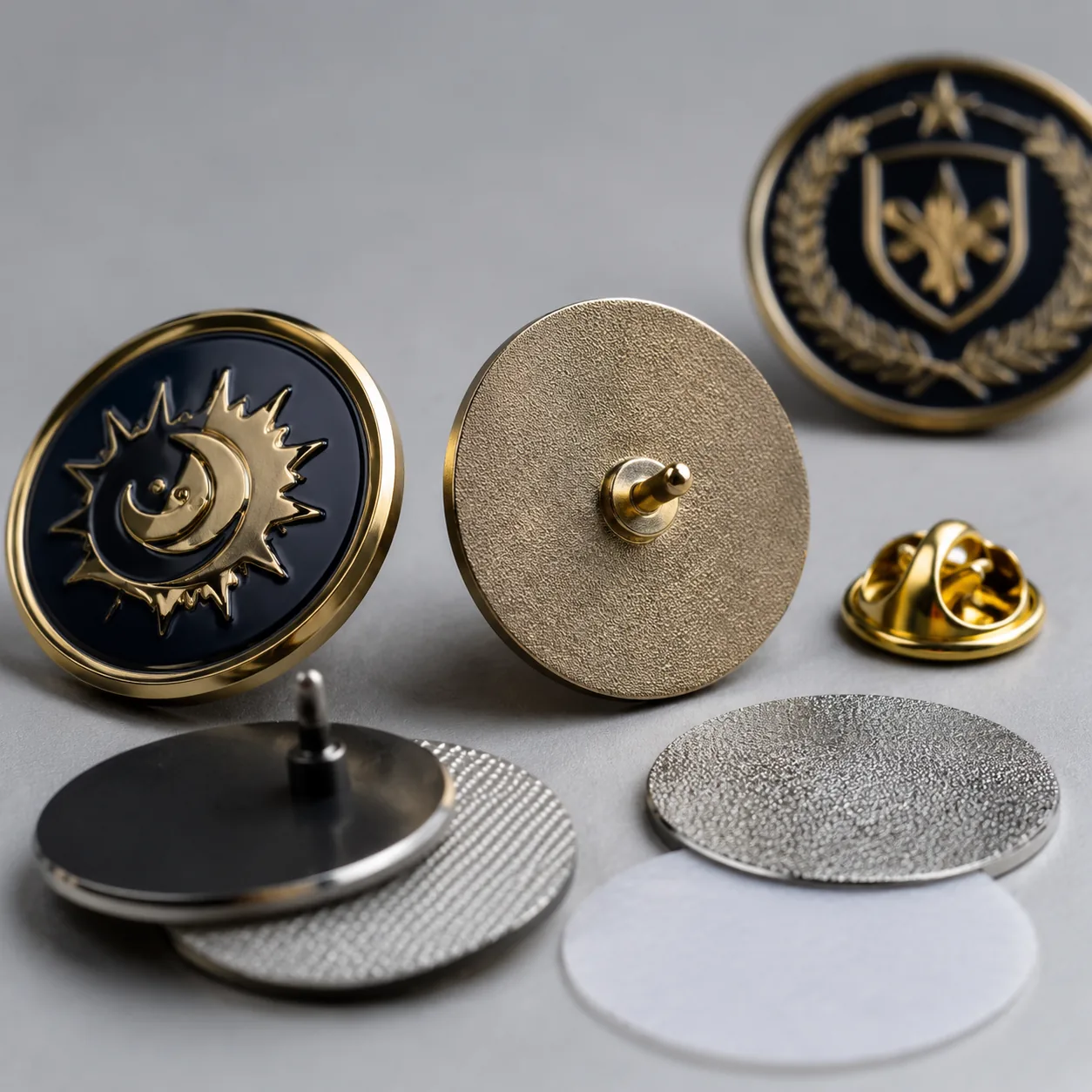
Backing affects thickness, drape, storage stability, carton volume, and the way the patch fails under use. Sew-on has the lowest hidden risk because the stitch carries the load and the backing only stabilizes the patch. Heat-seal is convenient for retail, teamwear, and small-batch decoration, but it depends on a calibrated press, dwell time, pressure, and fabric chemistry. Hook-and-loop is correct for removable IDs, tactical patches, staff badges, and morale patches, but it adds bulk and is usually wrong for lightweight polos. Peel-and-stick is for temporary placement, packaging, trade shows, or one-day events; it should not be sold as washable.
| Backing type | Typical added thickness | Best use | Avoid when | Typical FOB add-on |
|---|---|---|---|---|
| No backing / sew-on stabilizer | 0.0-0.2 mm | Uniforms, caps, bags, heavy wear, industrial laundering | Buyer needs no-sew application | $0.00-$0.03/pc |
| Heat-seal EVA or polyester film | 0.15-0.35 mm | Cotton, denim, fleece, hoodies, flat panels | PU coating, silicone finish, curved caps, unknown synthetics | $0.03-$0.08/pc |
| TPU heat-seal film | 0.10-0.25 mm | Stretch knits, soft-touch garments, some synthetics after testing | High-temperature press limits below 125°C or oily coatings | $0.06-$0.12/pc |
| Hook-and-loop, hook side only | 1.5-2.2 mm | Tactical, removable ID, morale patches, bags | Thin fashion garments, low-profile retail labels | $0.08-$0.25/pc |
| Hook plus matching loop piece | 3.0-4.5 mm combined | Uniform programs where loop is supplied loose or sewn later | Buyer assumes loop is included but did not quote it | $0.16-$0.45/pc |
| Peel-and-stick adhesive | 0.10-0.25 mm | Temporary events, sample boards, packaging, displays | Washing, rain, abrasion, textured fabric | $0.04-$0.12/pc |
| Safety pin or plastic button loop | 3-8 mm projection | Temporary name badges and event staff badges | Children's wear, premium apparel, metal-detector environments | $0.05-$0.18/pc |
Use a simple selection rule. If the patch must survive laundering, specify sew-on or a validated heat-seal system. If it must be removable, specify hook-and-loop and state whether the loop side is included. If it is temporary, adhesive is acceptable only after a substrate test. This avoids return claims that are really backing-selection errors.
3. Define Adhesive Film, Press Window, and Wash Target
An iron-on specification that only says “heat-seal backing” is too loose. Factories may use a general EVA or polyester hot-melt that bonds well to cotton but poorly to coated polyester. A stronger spec names the film family or defines the activation window and performance target. EVA and polyester films are common on promotional embroidered and woven patches. TPU film is usually more flexible and can perform better on stretch or soft-touch garments, but it costs more and needs tighter press control.
Typical production windows are 145-155°C for 12-18 seconds at 2.5-4.0 bar on cotton, cotton/poly twill, fleece, and denim. Heat-sensitive synthetics often require 130-145°C for 10-15 seconds, but lower temperature must be validated because bond strength may drop. Caps need a curved platen; a flat press on a curved crown creates weak contact at the edges. Household irons should not be described as equivalent to a calibrated heat press because pressure is inconsistent and edge dwell is poor.
Define the wash target before approval. A practical baseline for promotional apparel is no adhesive bleed visible beyond 0.5 mm, no edge lift over 2 mm after 24-hour conditioning, and no edge lift over 2 mm after one 40°C domestic wash and line dry on the nominated fabric. For workwear, schoolwear, or retail replenishment programs, test 5 wash cycles at 40°C or 60°C depending on the garment care label. Industrial laundry, tumble drying, or dry cleaning must be specified separately because many standard films will fail those conditions.
4. Engineer the Edge: Border, Cut, and Curl Control
Peeling and curling usually begin at the border. Merrowed borders are strong and forgiving for round, oval, shield, and rectangle patches, with a typical wrap width of 2.5-4.0 mm. They are less suitable for sharp internal corners or complex die-cut shapes. Laser-cut or hot-cut borders allow tighter artwork, but the edge must be sealed cleanly to prevent fray on woven and embroidered constructions.
For embroidered patches, thread coverage and backing stiffness should balance each other. Full-coverage embroidery is often 85-95% stitch coverage; lighter coverage can expose twill and make the edge lift after heat pressing or washing. Avoid placing small text, metallic thread, or raised satin stitches directly on the sew path. For woven patches, specify sealed edge, hot-cut tolerance, and no yarn fray longer than 2 mm. For PVC patches, curl is commonly caused by an unbalanced construction: a thin 1.5 mm PVC body combined with heavy hook backing can bow when stacked warm or compressed in cartons.
A usable edge specification is: merrowed border 3.0 mm ±0.5 mm, border color Pantone matched to approved sample, no loose thread over 2 mm, adhesive flash under 0.5 mm, edge lift after heat test under 1 mm at any point before wash. For complex die-cut patches, set minimum neck width at 3 mm for embroidery and woven, or 2 mm for soft PVC. Narrower bridges may look acceptable in vector art but distort during sewing, cutting, or handling.
5. Lock Dimensions, Thickness, Alignment, and Detail Limits
Specify patch size as maximum width by maximum height, not only as a nominal diameter or artwork scale. The maximum outline controls backing placement, border width, packing, and garment placement. For embroidered and woven patches under 100 mm, normal overall size tolerance is ±1.0 mm. For 100-150 mm patches, use ±1.5 mm unless the factory confirms tighter control. Molded PVC bodies can usually hold ±0.3-0.5 mm in the molded area, but trimming, hook backing, or loop pieces may still vary by ±1.0 mm.
Thickness matters for comfort, shipping, and perceived quality. Embroidered patches are commonly 1.2-2.0 mm without hook backing and 2.8-4.0 mm with hook. Woven patches are thinner, usually 0.6-1.2 mm, so they suit fashion labels and small detail. Chenille is bulky at 3.0-6.0 mm and is poor for fine text. PVC patches are often 1.5-3.0 mm, with 2.0 mm a common balance for morale patches and retail accessories.
| Patch construction | Size tolerance under 100 mm | Typical thickness without backing | Minimum readable detail | Common MOQ |
|---|---|---|---|---|
| Embroidered patch | ±1.0 mm | 1.2-2.0 mm | 1.2-1.5 mm satin lines; text preferably 5 mm high or larger | 100 pcs/design |
| Woven patch | ±1.0 mm | 0.6-1.2 mm | 0.5-0.8 mm lines; text 3-4 mm high if contrast is strong | 100-200 pcs/design |
| Soft PVC patch | ±0.3-0.5 mm molded body | 1.5-3.0 mm | 0.8-1.0 mm raised lines; recessed gaps at least 0.6 mm | 100 pcs/design; mold charge often separate |
| Chenille patch | ±1.5-2.0 mm | 3.0-6.0 mm | Not suitable for small text or fine outlines | 100 pcs/design |
| Printed sublimation patch | ±1.0 mm | 0.4-1.0 mm | Photo detail possible; edge and color fastness drive quality | 100-200 pcs/design |
Backing placement should also have numbers. Hook backing should be inset 1.0-1.5 mm from the border so hooks do not show from the front. For exact-shape hook backing, an offset tolerance of ±1.0 mm is acceptable for standard morale patches; use ±0.7 mm only for premium retail items and expect extra inspection cost. Heat-seal film normally covers the full back, but visible adhesive overflow should be under 0.5 mm. For sew-on patches, leave a 2.0-3.0 mm clean stitch path inside the edge.
6. Prevent Sew Rework and Hook-and-Loop Quoting Errors
Sewing contractors need a clear path for the needle. If the artwork places raised PVC, metallic thread, dense embroidery, or tiny lettering at the edge, operators slow down, break needles, or shift the seam inward and cover details. A clean border or sewing allowance of 2.0-3.0 mm is the cheapest way to reduce rework. For caps and curved panels, confirm whether the patch will be pre-curved, steamed, or simply sewn flat; stiff patches over 90 mm wide can bridge the curve and pucker the panel.
Hook-and-loop orders need both sides defined. “Hook backing” normally means the hook side is sewn or laminated to the patch only. The loop side is not automatically included. The PO should say: hook side on patch, black hook, matching loop piece supplied loose, same shape or simplified oval/rectangle as approved, loop color black/olive/white/custom dyed, packed together per set. If the loop side must be sewn to garments by the factory, that is a separate operation with separate tolerance and labor cost.
A simplified loop shape is often stronger than an exact outline. Sharp corners and narrow points on loop pieces can peel, curl, or catch during handling. For irregular patch shapes, specify a simplified backing shape inset 1.0-1.5 mm from the outline, with no exposed hook visible from the front. Custom-dyed hook-and-loop usually raises MOQ and lead time; stock black, white, coyote, and olive are faster and cheaper.
7. Test Backing Quality With AQL and Physical Methods
Approvals should not rely on flat-lay photos. Backing performance is measurable. For heat-seal patches, press the approved sample onto the buyer’s nominated fabric, condition it for 24 hours, then check peel, edge lift, adhesive bleed, and hand feel. Do not judge the bond immediately while the adhesive is still warm. If the garment has DWR, PU, silicone, or anti-microbial finishes, test that exact lot of fabric where possible.
For sew-on and hook-and-loop patches, run pull or separation checks. A practical working target is no separation under 20 N for patches under 70 mm and 30 N for patches 70 mm and larger, unless the product is tactical, safety, or industrial workwear and requires a higher standard. For peel-and-stick patches, define the application as temporary and test dwell on the real substrate after 24 hours; dust, fabric texture, matte coating, and moisture can reduce adhesion sharply.
Use AQL inspection with defect categories written into the order. A reasonable export baseline is General Inspection Level II, critical 0, major 2.5, minor 4.0. Critical defects include wrong backing type, sharp or unsafe pin hardware, missing loop pieces where specified, mold contamination on PVC, and banned materials. Major defects include backing offset beyond tolerance, missing adhesive film, edge fray over 3 mm, heat film blistering, adhesive bleed over 0.5 mm, wrong size outside tolerance, and shade visibly outside the approved sample under D65 light. Minor defects include loose thread under 2 mm, small packing scuffs, or slight backside cosmetic marks that do not affect use.
- Confirm backing against the actual garment substrate, coating, and care label.
- State heat-press temperature, dwell time, pressure, and whether a curved platen is required.
- Approve a physical pre-production sample using the exact bulk backing and border method.
- Test adhesion on the buyer’s nominated fabric, not only on factory test cloth.
- Define hook side, loop side, color, shape, and whether loop pieces are supplied loose or sewn.
- Set size, thickness, backing inset, adhesive overflow, and edge-fray tolerances in millimeters.
- Use AQL levels and defect definitions before shipment inspection, not after a claim.
8. MOQ, Lead Time, Packing, and FOB Budget Ranges
MOQ depends on construction, materials, and whether the backing is stock or custom. Standard embroidered patches often start at 100 pcs/design, with better pricing at 300, 500, and 1,000 pcs. Woven patches commonly start at 100-200 pcs/design because loom setup and color matching are less efficient at very small runs. PVC patches often start at 100 pcs/design, but a mold charge of about $30-$120 is common depending on size, depth, and color count. Custom-dyed hook-and-loop, special TPU film, flame-retardant materials, or low-temperature films may require 300-500 pcs/design.
Typical lead time is 2-3 days for artwork digitizing or woven layout, 5-7 days for a physical embroidered or woven sample, then 10-18 days for mass production after approval. PVC usually needs 7-10 days for mold and sample, then 12-20 days for bulk. Add 3-7 days if the buyer requires a fabric adhesion test, loop-side matching, custom dyeing, barcode labeling, or retail card packing. Rush orders are realistic only when thread, base fabric, backing, and hook-and-loop are in stock and the buyer limits sample revisions.
FOB pricing varies by size, stitch density, color count, and backing. As working ranges at 500 pcs, a 70 mm embroidered sew-on patch is often $0.35-$0.85/pc; woven is $0.30-$0.75/pc; sublimation printed is $0.25-$0.65/pc; soft PVC is $0.65-$1.60/pc plus any mold charge; chenille is commonly $0.90-$2.50/pc depending on size and felt base. Add $0.03-$0.08 for standard heat-seal film, $0.06-$0.12 for TPU heat film, $0.08-$0.25 for hook backing, and $0.16-$0.45 when matching loop pieces are included.
Packing should match the backing. Heat-seal patches should be kept flat, separated from high heat, and packed with release paper if adhesive tack is exposed. Hook-backed patches can snag thread or fabric, so use OPP bags or stack hook-to-loop where sets are supplied. Standard bulk packing is often 50-100 pcs/polybag and 1,000-2,000 pcs/carton depending on size. Individual OPP bags add about $0.02-$0.05/pc; header cards, UPC labels, and retail instruction cards should be quoted separately. The strongest RFQ includes artwork, size, substrate, backing, press window, loop inclusion, tolerances, AQL, packing, quantity tiers, and required delivery date. If the garment surface is uncertain, approve two backing samples before issuing the PO; the delay is cheaper than replacing a shipment of peeling patches.
Have a project? Send your artwork and target quantity and we’ll reply with a detailed quotation within 12 working hours.
Ready to get this made?
Send your sketch, target quantity and ship-date. Detailed quotation in 12 hours.



