Patch Backing Specs: Sew-On, Iron-On, Velcro and Adhesive
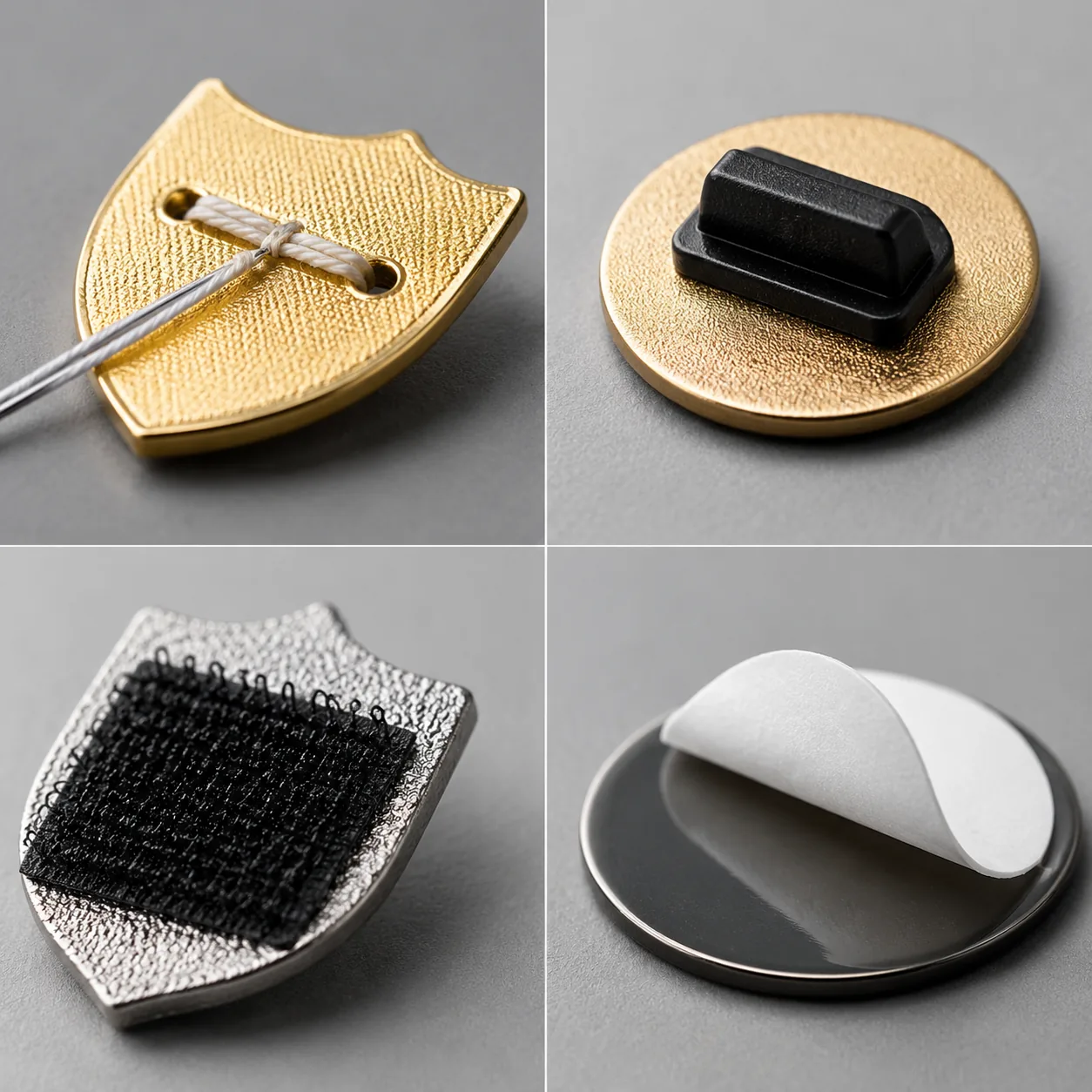
Start With the Garment, Not the Patch
The most common patch failure is not bad embroidery or poor molding. It is the wrong backing for the fabric, heat exposure, and user behavior. A 75 mm embroidered logo that performs well as a sew-on patch on denim may peel in the first wash if it is supplied with low-grade iron-on film for a polyester shell jacket.
Before requesting price, define the patch type, base fabric, attachment method, and expected service life. For reference, embroidered patches are usually 1.2 to 2.5 mm thick before backing, woven patches are about 0.8 to 1.8 mm, and soft PVC patches are often 2.0 to 4.0 mm including raised detail. A stable outline tolerance is ±1.0 mm for woven and embroidered patches under 100 mm, and ±0.5 mm is realistic for molded PVC when the mold is controlled.
The garment surface matters more than the artwork. Cotton twill, denim, and canvas are forgiving. Nylon, TPU-coated fabric, fleece, leather, and stretch blends are not. If the patch will be washed, dry-cleaned, exposed to rain, or applied by consumers instead of a sewing line, the backing specification should be written separately from the visual artwork approval.
| Backing type | Best use | Typical thickness added | Typical MOQ | Indicative FOB impact | Main risk |
|---|---|---|---|---|---|
| Sew-on only | Uniforms, denim, bags, hats | 0.0 to 0.2 mm | 100 pcs/design | Base price | Higher application labor at buyer side |
| Iron-on hot-melt film | Retail merch, cotton garments, simple promos | 150 to 250 μm | 100 pcs/design | + $0.03 to $0.10/pc | Peeling on coated or stretchy fabrics |
| Hook backing only | Uniforms with existing loop panels | 1.0 to 1.8 mm | 100 pcs/design | + $0.12 to $0.45/pc | Corner lift and bulk |
| Hook-and-loop set | Tactical kits, clubs, detachable badges | 1.8 to 3.2 mm | 100 pcs/design | + $0.25 to $0.80/pc | Higher cost and carton volume |
| Pressure-sensitive adhesive | Event badges, packaging, stationery | 100 to 250 μm | 200 pcs/design | + $0.04 to $0.18/pc | Weak bond on fabric and heat exposure |
| Raw sew-on edge | Factory garment assembly | 0.0 mm | 100 pcs/design | Lowest | Fraying if edge is not specified well |
Compare Backings by Failure Mode
There is no universal best backing. Sew-on is the strongest in service, but it is slower to install. Iron-on is clean and retail-friendly, but it depends on heat, pressure, dwell time, and fabric chemistry. Hook-and-loop is ideal for uniforms and tactical gear, but it adds bulk and can feel stiff at the edge.
A useful way to choose is by failure mode. If the buyer cares most about wash durability, choose sew-on or sew-on plus hot-melt reinforcement. If the buyer cares about easy consumer application, choose iron-on and limit the fabric list. If the patch must be removable daily, choose hook-and-loop. If the patch is only for short events or packaging, use pressure-sensitive adhesive and define it as temporary.
For a concrete example: a 90 mm club patch on a polyester softshell jacket should not rely on iron-on alone. The safer spec is hook-and-loop on the patch, stitched perimeter, and a loop panel sewn to the garment. That gives repeatable removal, avoids heat damage, and prevents the patch from delaminating when the jacket is flexed or laundered.
For a budget example: a 60 mm woven logo for a cotton tote can be sew-on only, laser-cut, with no backing film. That keeps thickness down, reduces cost, and avoids the user having to manage heat application at all.
Iron-On Specs: Temperature, Pressure, and Wash Limits
Iron-on backing is often quoted too casually. A proper RFQ should state the adhesive film type, activation temperature, dwell time, pressure, and the test fabric. For most embroidered and woven patches, a hot-melt film of 150 to 250 μm is common. Typical heat-press settings are 150 to 165°C for 12 to 18 seconds under medium pressure, followed by cooling under light compression for 10 to 15 seconds.
Do not assume one formula works on every garment. Iron-on performs best on cotton, denim, canvas, and cotton-poly blends. It is risky on waterproof coatings, silicone-treated nylon, fleece, rib knits, spandex blends, leather, and synthetics that deform above 140°C. If the garment supplier cannot confirm the fabric finish, request 10 to 20 sample applications before bulk approval.
A practical wash check is better than a vague promise. For consumer merch, condition the pressed sample for 24 hours, then run three wash cycles at 40°C with air dry. Require no edge lift greater than 3 mm at any point and no visible bubbling in the adhesive zone. For higher-duty apparel, use five wash cycles and allow no more than 5% of the perimeter to show partial lift.
If the patch is going on a work uniform, write the press method into the PO. Example: 155°C, 15 seconds, medium pressure, peel liner only after cooling, then post-press from the reverse side if the garment permits it. That level of detail avoids disputes when a supplier uses a household iron instead of a calibrated press.
Sew-On and Hook-and-Loop Need Different Detail Control
Sew-on patches are the safest option when the patch must survive long-term use. The important specs are border type, edge margin, stitch path, and backing stiffness. Merrowed borders work well on circles, ovals, shields, and simple rectangles, with a border width of 2.5 to 4.0 mm. They are not ideal for sharp inside corners or intricate silhouettes.
For irregular shapes, laser-cut or die-cut edges with heat sealing are cleaner, but they need enough artwork margin. A good rule is at least 1.5 mm from the artwork to the cut edge for woven patches and 2.0 mm for embroidered patches. If thread runs too close to the edge, the patch can fray after sewing or show fuzz after washing.
Hook-and-loop backing needs control of both thickness and stitch line. For embroidered or woven patches, the hook sheet is normally cut 0.5 to 1.0 mm inside the patch edge so it does not scratch skin or catch adjacent fabric. Perimeter stitching usually leaves a 2.5 to 3.5 mm seam margin. On sharp-corner shapes, a corner radius of at least 1.5 mm reduces lift and makes the patch easier to remove.
PVC patches with hook backing deserve special attention because they are heavier. An 80 x 50 mm PVC badge at 3.0 mm thickness may weigh 18 to 28 g, versus about 6 to 12 g for a similarly sized embroidered patch. For that reason, molded recesses for stitching or full-surface lamination plus perimeter sewing are better than relying on hook backing alone when the patch will be pulled off daily.
If the application is tactical, school, or workwear, specify whether you want hook only or a matched hook-and-loop set. Many buyers only need hook on the patch because the garment already has loop panels. Ordering both sides increases cost and carton volume without improving performance.
Adhesive Backing Is Temporary, Not Laundry-Grade
Pressure-sensitive adhesive backing is useful because it is fast, but it should be treated as temporary. It fits conference badges, gift-box decoration, scrapbook items, notebooks, sample boards, and one-day event identification. It does not belong on washable garments, textured fleece, oily leather, powder-coated bags, or outdoor gear exposed to heat and rain.
Common adhesive films add 100 to 250 μm and are supplied with a release liner. On smooth paperboard, plastic folders, and clean metal, a small woven patch under 60 mm can hold acceptably. On larger patches above 90 mm, or on PVC patches heavier than 20 g, adhesive-only attachment becomes unreliable unless the item is flat and handled gently.
If adhesive is still required, test the real substrate. A useful incoming check is application at 20 to 25°C, a 30-minute wait, then a 180-degree hand peel from one corner. For packaging or display use, require no visible lift after 24 hours at room temperature. For export cartons or hot-container storage, a 45°C aging check for 24 hours is a sensible screen because low-grade adhesive can soften and creep.
A simple example: a 45 mm woven logo on a presentation box can use adhesive backing if the box stays indoors and is not flexed. The same patch on a fleece sleeve is a bad specification, even if the supplier quotes the same part number.
QC Checks Buyers Should Put in the PO
Patch QC should cover appearance, dimension, and attachment function. For normal promotional orders, General Inspection Level II with AQL 2.5 for major defects and AQL 4.0 for minor defects is a practical baseline. Set critical defects, such as wrong logo, wrong backing, sharp contamination, exposed needle fragments, or missing hook components, at AQL 0.
Tolerance should be written explicitly. For woven and embroidered patches under 100 mm, use ±1.0 mm for width and height. For larger pieces, ±1.5 mm is realistic. For molded PVC, ±0.5 mm on outline size is usually achievable, and thickness tolerance of ±0.3 mm is reasonable for most soft-PVC builds. If the patch includes a molded frame or raised icon, specify which dimension controls acceptance.
Tell the inspector what to check, not just what to count. Confirm backing type on the approved pre-production sample, inspect liner removal, glue coverage, hook stitch quality, edge finish, and corner shape, and verify that the approved fabric is the same as the production substrate. A patch that passes on paper may still fail on coated nylon.
- Confirm the backing type on the signed pre-production sample, not only in the quotation.
- Check 20 random pieces for liner removal, adhesive coverage, hook stitching, and edge finish.
- For iron-on patches, press five samples on the buyer-approved fabric and inspect after 24 hours.
- For hook-and-loop patches, run 20 attach-remove cycles during sample approval and 10 cycles during shipment inspection.
- For adhesive patches, test on the final application surface, not on glass or clean paper.
- Add needle detection where the patch is used on children’s apparel or regulated garments.
MOQ, FOB Price, and Lead Time Planning
Most patch factories accept 100 pieces per design for embroidered, woven, and PVC patches, but the economics change sharply below 300 pieces. For a 75 mm embroidered patch with normal backing, typical FOB pricing is about $0.35 to $0.90 at 500 pieces, depending on stitch density, thread count, border type, and backing. At 100 pieces, the same patch often rises to $0.80 to $1.80 because digitizing and setup are spread across fewer units.
Woven patches usually price slightly above embroidered patches when the artwork is fine and compact, often $0.45 to $1.20 FOB at 500 pieces for a 70 to 80 mm patch. Soft PVC is more expensive because of mold work and material volume; a 75 mm PVC patch is commonly $0.90 to $2.20 FOB at 500 pieces, excluding glow-in-the-dark, transparent, or multilayer effects. Hook-and-loop can add $0.12 to $0.80 per piece depending on whether the patch includes hook only or a matched set.
Sampling lead time is typically 5 to 8 days for embroidered or woven patches after artwork approval, and 7 to 12 days for PVC patches because the mold must be made and checked. Bulk production is usually 10 to 18 days for embroidered or woven orders and 15 to 25 days for PVC orders, depending on volume and season. Add 2 to 4 days if the order needs polybags, backing cards, barcodes, or mixed-SKU sorting.
For a realistic procurement plan, request three price tiers: 100 pcs, 300 pcs, and 500 pcs per design. That makes setup cost visible and shows where unit price starts to flatten. If the order is seasonal or tied to an event date, lock the sample approval deadline first, then the mass-production start date, then the shipping window. Otherwise, a low unit price can cost more through schedule risk than it saves on the PO.
Build the RFQ Around Use, Not Just Artwork
The strongest RFQs list the application surface, wear life, wash requirement, attachment method, patch size, edge type, quantity per design, packaging, target delivery date, and test method. If you have the final garment, bag, or panel fabric, send a swatch or one finished sample piece to the factory before approving the backing. That is the fastest way to avoid choosing iron-on or adhesive for a surface that will not hold it.
A clean order example is: 80 mm embroidered patch, merrowed edge, sew-on only, to be applied to cotton twill uniforms, AQL 2.5 major and 4.0 minor, size tolerance ±1.0 mm, sample in 7 days, bulk in 14 days, FOB quoted at 100/300/500 pcs. That level of detail gives the supplier a real target and gives inspection a clear pass-fail standard.
For higher-risk projects, approve two things separately: the visual sample and the attachment performance. A patch can look perfect on a bench and still fail on a coated jacket or flexible bag. Lock the backing material, press settings, stitch method, tolerance, and inspection level in the PO so the factory and QC team are checking the same standard.
Have a project? Send your artwork and target quantity and we’ll reply with a detailed quotation within 12 working hours.
Ready to get this made?
Send your sketch, target quantity and ship-date. Detailed quotation in 12 hours.



