Patch Backing Specs: Sew-On, Iron-On, Hook-and-Loop or Adhesive
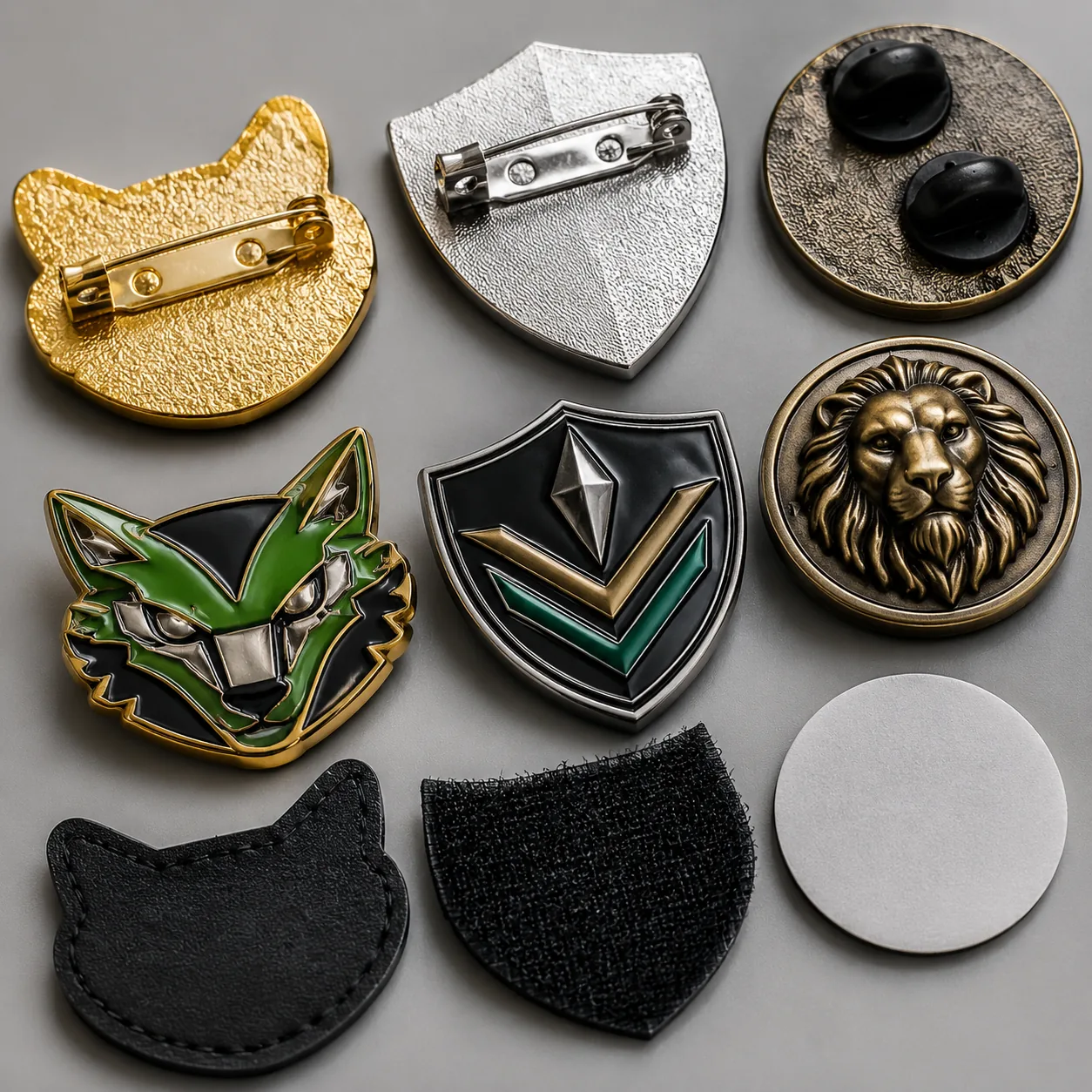
Why Patch Backing Fails After Delivery
Most patch claims are not caused by the front artwork. They appear later, when an embroidered patch curls after washing, an iron-on badge peels from a cap, hook tape scratches a jacket lining, or an adhesive patch releases before an event ends. Backing is a functional specification. It affects application method, garment compatibility, packing thickness, wash durability and rejection risk.
For B2B orders, the wrong backing creates downstream cost. A distributor may need to repack patches with sewing instructions. A school buyer may discover that household irons cannot apply dense patches evenly. A uniform buyer may reject hook-backed patches if the hook side damages adjacent fabric in bulk cartons. The RFQ should define backing type, rear material, adhesive film thickness, border construction, wash target, dimensional tolerance and inspection method.
Backing should be confirmed during artwork engineering, before sampling. It changes border stiffness, finished thickness, carton compression and sometimes the minimum readable text size. For most custom embroidered and woven patches, practical MOQ starts at 100 pieces for a trial run, 300 to 500 pieces for stable production pricing, and 1,000 pieces or more for better FOB cost. PVC patches with new molds usually become economical from 300 to 500 pieces, depending on size and color count.
| Backing type | Best use | Typical added thickness | FOB add-on range | Main risk |
|---|---|---|---|---|
| Sew-on | Uniforms, workwear, jackets, bags | 0.0 to 0.2 mm | USD 0.00 to 0.03 per pc | Requires sewing labor |
| Iron-on | Retail patches, schools, light apparel | 80 to 150 microns | USD 0.03 to 0.09 per pc | Peeling on unsuitable fabric |
| Hook-and-loop | Tactical, staff, reusable roles | 1.8 to 2.8 mm combined | USD 0.12 to 0.38 per pc | Bulk, scratching, alignment error |
| Adhesive sticker | Events, packaging, temporary use | 100 to 180 microns with liner | USD 0.04 to 0.12 per pc | Not wash durable |
Select Backing by Application, Not Preference
Sew-on backing is the most durable choice for uniforms, workwear, outdoor clubs and garments that will be laundered repeatedly. The patch has no heat adhesive layer. It is attached by stitching through the border or body, so it is less sensitive to fabric coatings, heat limits or garment texture. It takes more labor, but it gives the lowest long-term failure rate on washed apparel.
Iron-on backing is suitable for retail patches, school merchandise, short campaigns and buyers who need simple application without sewing. It uses a thermoplastic adhesive film that melts into the garment surface under heat and pressure. Standard settings are usually 150 to 170 degrees Celsius, 2.5 to 4.0 bar, and 12 to 18 seconds, followed by flat cooling. It should not be assumed safe for nylon shells, waterproof jackets, PU coatings, leather, high-stretch sportswear or heat-sensitive synthetics.
Hook-and-loop backing is best for tactical patches, staff badges, morale patches, temporary role identifiers and reusable department labels. Buyers must specify hook only, loop only, or hook plus loose loop. Adhesive backing is different: it should be treated as temporary, suitable for conference badges, packaging decoration, folders, gift boxes or one-day promotions. It is not a substitute for sewing or heat bonding on washable garments.
- Use sew-on for garments expected to pass more than 10 wash cycles.
- Use iron-on only after testing the real garment fabric and application tool.
- Use hook-and-loop when the wearer must remove or swap the patch regularly.
- Use adhesive only for dry, smooth, non-wash surfaces.
- Avoid choosing backing solely by lowest unit price; rejected garments cost more than backing upgrades.
Sew-On Backing Specs for Durable Uniforms
For sew-on patches, do not specify only “plain back.” Define the rear surface. Embroidered patches commonly use a 180 to 220 gsm polyester twill base, sometimes with a light stabilizer to keep the shape flat. Felt backs are used where a softer hand is preferred, but felt can collect lint and may not be ideal for workwear. Woven patches usually use the woven base itself, with edge sealing only where fray control is required.
Border choice affects both appearance and sewing efficiency. A merrowed border needs a finished border width of about 2.5 to 3.0 mm and works best on circles, rectangles, shields and other simple outlines. Laser-cut or hot-cut borders can run narrower, about 1.5 to 2.0 mm, and suit complex silhouettes, but they require tighter edge control. On light colors, a cut border can expose more base fabric if the cutting path is not accurate.
Uniform programs should include a stitch-safe margin of at least 2.0 mm from critical artwork to the outer edge. For small text, keep letters at least 4.0 to 5.0 mm high for embroidered patches and about 2.0 to 2.5 mm high for woven patches, depending on font. Dimensional tolerance should normally be plus or minus 1.0 mm for patches under 80 mm and plus or minus 1.5 mm for patches from 80 to 150 mm.
Inspection should cover edge fray, loose threads, rear stains, shape distortion and needle clearance. A common export standard is AQL 2.5 for major defects and AQL 4.0 for minor defects. Major defects include wrong backing, wrong size outside tolerance, unreadable text, open border stitching, severe stains or visible fabric damage. Minor defects include short thread tails under 3 mm, small rear-side marks not visible in normal use, or slight shade variation within the approved sample range.
Iron-On Backing Specs That Reduce Peeling
Iron-on backing fails for three main reasons: the adhesive film is too light for the patch, the user applies too little heat or pressure, or the garment surface cannot accept heat bonding. A factory heat press gives more consistent results than a household iron. If the patch is sold to consumers, provide application instructions and test the patch on a realistic fabric, not only on clean cotton.
For standard embroidered or woven patches, specify a thermoplastic adhesive film of 80 to 120 microns. For heavier patches above 90 mm wide, dense embroidery over 75 percent coverage, chenille areas or thick merrowed borders, 120 to 150 microns is often safer. The trade-off is stiffness: thicker adhesive improves bond strength but can make the patch feel rigid and can show a raised edge on thin garments.
A practical factory setting is 150 to 170 degrees Celsius, 2.5 to 4.0 bar pressure, and 12 to 18 seconds. The patch should cool flat for at least 30 seconds before handling, because the adhesive continues to set as it cools. For nylon, coated polyester, leather, rainwear and heat-sensitive synthetics, sew-on or hook-and-loop is safer. If the buyer still wants iron-on, run a scorch test and a 24-hour peel check before approving mass production.
| Test item | Suggested requirement | Reject if |
|---|---|---|
| Peel after pressing | Corner lift under 2 mm after 24 hours | Corner lifts more than 3 mm by hand |
| Wash test | 3 cycles at 30 degrees Celsius for promo use; 10 cycles for uniform use | Adhesive bubbles, patch curls or edge opens |
| Heat compatibility | No scorch, gloss or shrinkage at 160 degrees Celsius | Fabric shines, shrinks or coating cracks |
| Edge stiffness | Patch bends around a 50 mm radius without cracking | Backing cracks or separates from border |
| Adhesive coverage | Film covers full rear surface within 1.0 mm of edge | Bare zones, bubbles or contamination visible |
Hook-and-Loop Specs: Side, Inset and Bulk
Hook-and-loop is often quoted casually as “Velcro,” but the specification must state which side is supplied. For uniforms, the garment often already has loop panels, so the patch usually needs hook backing only. For retail packs, club kits or event badges, buyers may need hook on the patch plus a loose loop piece that can be sewn to a bag or jacket. If both sides are supplied, confirm whether the loop piece is the same size as the patch or cut smaller for easier sewing.
Combined hook-and-loop thickness is typically 1.8 to 2.8 mm, depending on grade. This added bulk affects sleeve comfort, mailer thickness and carton count. For patches under 70 mm, the hook tape is usually cut 1.0 to 1.5 mm inside the finished edge so black or white backing does not show from the front. For larger patches, a segmented or recessed hook layout can reduce stiffness on curved sleeves or caps.
Alignment tolerance should be plus or minus 1.0 mm for patches under 100 mm and plus or minus 1.5 mm for larger patches. Stitching should not crush the front border or create visible puckering. Hook engagement should feel secure after at least 20 attach-remove cycles in a basic handling test. If the patch will be used on tactical gear, ask for a firmer hook grade; if it will be used near soft garments, consider lower-profile hook to reduce abrasion.
Hook-and-loop also changes cost. At 500 pieces, a 75 mm embroidered patch may cost USD 0.42 to 0.90 FOB with sew-on backing, USD 0.48 to 1.00 with iron-on, and USD 0.60 to 1.20 with hook only. Supplying hook plus loose loop can add another USD 0.08 to 0.22 per piece depending on size, tape grade and whether the loop piece is packed separately.
- State “hook only,” “loop only,” or “hook plus loose loop” in the RFQ.
- Specify hook-and-loop color: black, white or color-matched where available.
- Set tape inset at 1.0 to 1.5 mm from the finished patch edge.
- Confirm alignment tolerance before approving the sample.
- Pack hook-backed patches so they do not catch threads, paper cards or polybag seams.
Adhesive Backing for Temporary and Packaging Use
Pressure-sensitive adhesive backing is useful when the patch functions like a sticker rather than a garment component. It works for trade shows, product packaging, folders, gift boxes, sample cards and short-term event identification. It should not be sold as washable apparel backing. Even strong adhesive performs poorly when fabric moves, sheds fibers, absorbs moisture or bends around a cap crown.
A typical adhesive layer is 100 to 180 microns including the release liner. Standard adhesive performs best on smooth, clean, dry surfaces such as coated paper, plastic boxes, metal tins and rigid display boards. It performs poorly on cotton fleece, rough canvas, dusty cartons, silicone-coated surfaces, oily leather, curved fabric panels and textured luggage. For any critical program, test after 24 hours because many adhesive failures appear after the patch has been flexed or after air slowly enters the edge.
Specify removable or permanent adhesive. Removable adhesive is safer for event badges and temporary labels, but bond strength is weaker. Permanent adhesive grips better on packaging, but it may leave residue or damage printed surfaces during removal. For resale, label adhesive-backed patches as temporary use only unless the supplier has completed surface-specific bond testing.
| Surface | Adhesive suitability | Buyer note |
|---|---|---|
| Coated paper card | Good | Press firmly for 5 seconds after placement |
| Smooth plastic box | Good | Clean dust and oil before application |
| Powder-coated metal tin | Fair to good | Test for edge lift after 24 hours |
| Cotton fabric | Poor | Use sew-on or iron-on instead |
| Curved cap panel | Weak | Patch stiffness causes edge lift |
| Leather or PU | Unreliable | Adhesive may stain, release or leave residue |
MOQ, Lead Time, Pricing and Final QC
Backing choice affects price less than artwork complexity, but it still matters on large programs. At 500 pieces, a simple 75 mm embroidered patch usually ranges from USD 0.42 to 0.90 FOB with sew-on backing, USD 0.48 to 1.00 with iron-on, USD 0.60 to 1.20 with hook-and-loop, and USD 0.50 to 1.08 with adhesive backing. Dense embroidery, metallic thread, glow thread, small text, chenille, special shapes, retail cards and individual barcode labels can push prices higher.
Woven patches are often similar or slightly lower for flat designs with fine detail, commonly USD 0.35 to 0.80 FOB at 500 pieces for a 70 to 80 mm patch. PVC patches follow a different cost structure because the mold and color fills dominate pricing. A 75 mm soft PVC patch with hook backing often ranges from USD 0.85 to 1.80 FOB at 500 pieces, depending on mold complexity, color count, thickness and whether the reverse side is flat or textured.
Typical timing is 2 to 3 days for artwork engineering, 5 to 8 days for physical sampling after artwork approval, and 10 to 18 days for mass production after sample approval for 500 to 5,000 pieces. Add 2 to 4 days for custom retail cards, barcode labels, mixed-size packing or carton-level sorting. For 5,000 pieces or more, plan 18 to 28 days of production, especially if multiple backings or SKUs share similar artwork.
| Order size | Commercial tier | Sample time | Mass production time | Best use |
|---|---|---|---|---|
| 100 pcs | Trial MOQ | 5 to 8 days | 8 to 12 days | Internal team, design validation |
| 300 to 500 pcs | Standard promo tier | 5 to 8 days | 10 to 15 days | Events, resale, club orders |
| 1,000 to 3,000 pcs | Efficient production tier | 5 to 8 days | 12 to 18 days | Brand campaigns, uniform rollout |
| 5,000 pcs plus | Bulk program | 7 to 10 days | 18 to 28 days | Retail or national distribution |
Final QC should test the backing as a performance feature, not only inspect the front artwork. For sew-on patches, check border security, edge fray, rear cleanliness and size tolerance. For iron-on patches, check adhesive coverage, film bubbles, corner lift and heat bonding on a reference fabric. For hook-and-loop patches, check side supplied, tape alignment, stitch security, visible backing edge and engagement. For adhesive patches, check liner release, residue, adhesive transfer and edge curl after 24 hours at room temperature.
- Approve a physical sample with the exact backing, border and rear material.
- Keep one signed golden sample at the factory and one with the buyer.
- Test iron-on patches on the target garment before mass production.
- Inspect 20 to 32 random pieces per SKU for small lots, or use formal AQL sampling for larger lots.
- Require carton labels to show backing type when multiple versions share the same front artwork.
- Ask for 500 and 1,000 piece pricing so the buyer can compare the real MOQ break.
A clear RFQ line prevents most backing mistakes: 80 mm embroidered patch, merrowed border, sew-on backing, 180 to 220 gsm polyester twill base, plus or minus 1.0 mm size tolerance, AQL 2.5 major and 4.0 minor, 500 and 1,000 piece pricing, physical sample required before mass production. For hook-and-loop, add hook only or hook plus loose loop, tape color and inset requirement. For iron-on, add adhesive film thickness, heat press setting and wash-test target.
Have a project? Send your artwork and target quantity and we’ll reply with a detailed quotation within 12 working hours.
Ready to get this made?
Send your sketch, target quantity and ship-date. Detailed quotation in 12 hours.



