Patch Backing Specs: Sew-On, Iron-On, Hook-and-Loop, Adhesive
1. Choose the Backing by Garment, Use, and Service Life
A patch specification should not say only “with backing.” It should identify the attachment method, the patch body, the garment or substrate, the expected service life, and any wash, flex, or outdoor exposure. A 75 mm embroidered chest patch for cotton polos, a 90 mm soft PVC morale patch for a tactical bag, and a 60 mm woven brand label for retail packaging need different backing choices even if the front artwork is identical.
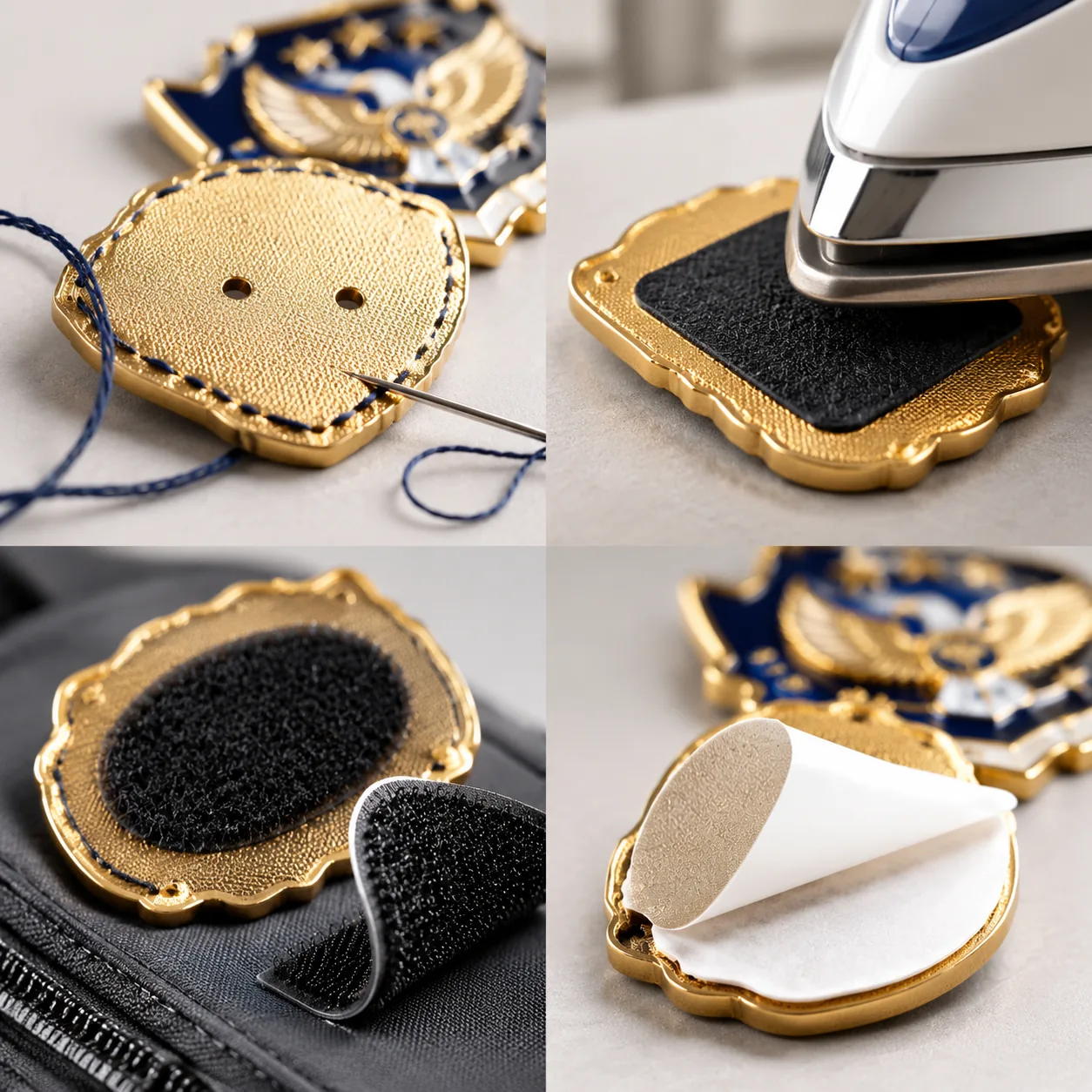
For permanent apparel, sew-on is still the lowest-risk option because the bond is mechanical rather than adhesive. Iron-on can reduce sewing labor on cotton and polyester uniforms, but only when the buyer controls heat-press temperature, pressure, dwell time, and cooling. Hook-and-loop is best for removable name patches, tactical patches, clubs, and interchangeable ID panels. Pressure-sensitive adhesive is suitable for samples, event badges, packaging, and display cards; it should not be sold as a washable garment attachment.
| Backing method | Best use | Typical MOQ tier | FOB price adder | Typical lead time impact | Avoid when |
|---|---|---|---|---|---|
| Sew-on | Uniforms, caps, workwear, bags | 100-299 pcs sample run; 300+ pcs production | $0.00-$0.03/pc | No added time | End user has no sewing process |
| Iron-on | Cotton or polyester apparel with heat press | 100+ pcs; 500+ pcs for custom film tests | $0.03-$0.09/pc | Adds 0-2 days | Nylon shells, DWR coatings, PU coatings, heat-sensitive fabrics |
| Hook-and-loop | Tactical patches, name patches, clubs | 100+ pcs; 300+ pcs with mating loop supplied | $0.08-$0.28/pc | Adds 1-3 days | Thin fashion garments or low-profile retail labels |
| Adhesive | Event badges, samples, packaging | 300+ pcs; 1,000+ pcs for custom die-cut liners | $0.04-$0.14/pc | Adds 1-2 days | Laundry, outdoor wear, children’s clothing, dusty fabric |
2. Match Backing to Patch Body, Edge, and Thickness
Backing performance starts with the patch construction. Embroidered patches usually use twill around 0.35-0.45 mm thick before stitching and finish at about 1.2-2.2 mm depending on thread coverage and foam. They accept sew-on, iron-on, hook-and-loop, and adhesive backs well. Woven patches are thinner, normally 0.45-0.80 mm finished, so they are comfortable on apparel but can distort if a heavy full hook layer is added to a large or narrow shape.
Soft PVC patches are different because the backing is bonded to molded material, often 2.0-4.0 mm thick. Sew channels, recessed backs, and hook-and-loop lamination should be designed before tooling. Adding a sew groove after the mold is approved can reduce artwork area or force a new mold. For 2D PVC, allow at least 0.4-0.6 mm height separation between raised and recessed areas; for 3D PVC, keep the backing area flat enough to bond hook material without air pockets.
Edge style matters. Merrowed borders work well on regular embroidered shapes above 50 mm, especially circles, shields, rectangles, and ovals. Laser-cut or heat-cut edges are better for woven patches, small text labels, and irregular profiles. If an iron-on film is used, the film should stop 0.5-1.0 mm inside the outer edge where possible to reduce glue squeeze-out. For hook-and-loop, the hook or loop layer should follow the patch shape within ±1.0 mm, with no backing visible from the front at normal viewing distance.
3. Specify Sew-On Channels, Borders, and Tolerances
For sew-on patches, define the stitch zone instead of leaving the sewing line to guess. A practical sew border is 2.0-3.0 mm on woven patches and 3.0-4.5 mm on embroidered patches. For soft PVC, a recessed sewing groove should be 2.5-3.5 mm wide and at least 0.5 mm lower than the raised design surface so the needle does not ride on the artwork.
The needle path should avoid fine lettering, metallic thread, glow thread, QR details, and raised PVC elements. On patches under 40 mm, do not combine a wide decorative border with a separate sew channel; it makes the artwork too small and the patch visually heavy. For curved embroidered and woven edges, use finished-size tolerance of ±1.0 mm under 100 mm and ±1.5 mm above 100 mm. For molded PVC, tooling can usually hold ±0.5-0.8 mm, but thin tails, stars, and long narrow shapes may still vary more.
- State “sew-on backing, no heat film” when the garment factory will sew through the full patch body.
- Keep the stitch zone at least 2.0 mm from small letters, QR codes, and narrow border art.
- Use matching bobbin thread if the patch back may be visible on thin or mesh fabric.
- Avoid chest-worn PVC above 4.0 mm thick unless the garment fabric is heavy enough to carry it.
- Run a sewing test on the actual garment for stretch fabric, waterproof fabric, or orders above 1,000 pcs.
- For uniforms, specify no skipped stitches, no loose thread over 3 mm, and no puckering at AQL major level.
4. Define Iron-On Film, Pressing Window, and Wash Risk
Iron-on backing should be specified by film chemistry and application window, not only by “heat seal.” Common hot-melt films for patches are EVA, PES, and TPU blends, usually 80-150 microns thick. For cotton and standard polyester, a common starting point is 150-165°C for 12-18 seconds at medium pressure, about 0.3-0.5 MPa. The release method must also be stated: hot peel, warm peel, or cool peel.
The factory can usually bond film to the patch. The real risk is whether the buyer can bond the patch to the garment after storage, pressing, washing, flexing, and wear. Coated nylon, water-repellent jackets, fleece with long pile, silicone-treated sportswear, laminated softshell, and highly elastic fabrics are poor candidates for standard iron-on. If the patch must survive repeated industrial laundry or field wear, sew-on or sew-plus-heat is safer than heat film alone.
| Film option | Typical thickness | Pressing range | Wash expectation | Use case | Risk control |
|---|---|---|---|---|---|
| EVA hot melt | 90-130 microns | 145-160°C, 12-15 sec | Light to moderate | Promo patches, cotton tees | Low cost, but weaker after repeated hot wash |
| PES hot melt | 100-150 microns | 155-170°C, 15-20 sec | Better wash resistance | Uniforms, polyester blends | Check fabric heat limit before approval |
| TPU hot melt | 80-120 microns | 135-155°C, 10-15 sec | Flexible, moderate | Soft garments, stretch-friendly hand feel | Confirm recovery after flexing |
| Sew plus heat film | 80-130 microns plus stitching | Press then sew or sew then press | Highest reliability | Workwear, school uniforms, service apparel | More labor but reduces edge lift |
For approval, press five to ten patches onto the real garment fabric and wash them before mass production. A practical small test is 3 wash cycles at 40°C for promotional apparel and 5-10 cycles for uniforms. Failures to record include edge lift over 2 mm, bubbling, glue bleed, fabric shine, scorching, and patch distortion. If any of these appear, change the film, lower the temperature, add sewing, or move away from iron-on.
5. Control Hook-and-Loop Side, Coverage, and Peel Strength
Hook-and-loop backing requires two decisions: which side is on the patch and whether the mating side is supplied. For most tactical, club, police, fire, and interchangeable name patches, the hook side goes on the patch and the loop side is sewn to the garment or bag. If the patch will touch delicate lining or knit fabric during handling, loop on the patch is safer, but it will not grip standard loop panels unless the system is reversed.
A normal hook-and-loop layer adds about 0.7-1.5 mm thickness and increases stiffness. On a 75 mm embroidered patch, that is usually acceptable. On a 120 mm back patch, a full hook layer can make the patch curl or bridge over curved fabric. For large patches, partial hook strips can reduce cost, weight, and rigidity, but they also increase the chance of edge lifting. For duty or outdoor use, full-back coverage is usually better unless the patch is very large.
Quality checks should be simple and measurable. Require no delamination between patch and hook backing during hand peel. For a medium patch, test a 24-hour vertical hang with a 300-500 g weight on a clean loop panel. For heavy PVC patches, use 800-1,000 g or reduce patch size if the panel is weak. For production inspection, classify wrong hook/loop side, missing mating piece, delamination, and backing misalignment over 1.0 mm as major defects.
6. Limit Adhesive Backing to Temporary or Packaging Uses
Pressure-sensitive adhesive is useful, but it is often oversold. It works for trade shows, temporary name labels, retail cards, product mockups, and packaging decoration. It should not be promised as washable, permanent apparel backing. A typical adhesive layer is 80-160 microns thick with white paper or clear PET release liner. High-tack adhesive costs more and can still fail on dusty, oily, textured, cold, or fabric surfaces.
If the patch will be applied to packaging, specify the substrate: coated paper, kraft carton, PET bag, acrylic display, painted metal, or corrugated board. Adhesives that hold well on smooth coated paper may not perform on low-energy plastics such as PE or PP. For outdoor events, humidity and temperature cycling are the weak points. A patch stored in a container at 45-55°C can lose tack or cause liner curl before the event if the adhesive is not selected for heat aging.
Adhesive-backed patches should be packed flat, not compressed in tight bundles. Ask for release liners to extend 1.0-2.0 mm beyond the patch edge where the shape allows so workers can peel them quickly. For die-cut liners, allow ±1.0 mm liner alignment tolerance unless the package design requires tighter registration. Use adhesive backing only when the buyer confirms the bond is temporary, display-only, or packaging-based.
7. Add Backing Checks to QC, Packing, and RFQs
Backing defects are easy to miss when inspection focuses only on front artwork. Add backing type, backing side, alignment, glue overflow, delamination, liner condition, finished thickness, edge curl, and heat-film coverage to the QC sheet. For normal promotional orders, AQL 2.5 for major defects and AQL 4.0 for minor defects is practical. For uniform programs, retail packs, or regulated service apparel, buyers often tighten major defects to AQL 1.5.
Define defect levels before production. Wrong backing, wrong hook/loop side, missing mating piece, adhesive liner missing, visible backing from the front, delamination, and heat damage should be major defects. Minor defects can include small thread tails under 3 mm, light backing offset within tolerance, or slight liner scuffing that does not affect use. Finished carton weight should stay under 12-15 kg gross to avoid compressed merrowed edges, PVC deformation, or creased adhesive liners.
| QC item | Recommended tolerance or test | Major defect example | Minor defect example |
|---|---|---|---|
| Finished size | ±1.0 mm under 100 mm; ±1.5 mm above 100 mm | Patch outside tolerance affecting fit | Small variation within approved limit |
| PVC size | ±0.5-0.8 mm depending on shape | Molded shape visibly wrong | Slight flash trimmed cleanly |
| Backing alignment | ±1.0 mm, not visible from front | Hook or film exposed beyond edge | Offset within tolerance |
| Iron-on bond | No film lift before application | Film peeling from patch | Small non-functional film wrinkle |
| Hook-and-loop | No delamination on hand peel | Wrong side supplied | Slight edge fuzz |
| Adhesive liner | Clean liner, peelable edge preferred | Missing liner or dry adhesive | Light liner mark |
RFQs should include patch type, finished size, edge style, backing method, application surface, wash or outdoor expectation, packing method, MOQ target, and inspection level. Typical sample lead time is 5-8 days for embroidered or woven patches, 7-10 days for PVC with existing mold style, and 10-14 days for new PVC tooling. After sample approval, mass production is commonly 10-18 days for 300-3,000 embroidered or woven patches, 14-24 days for PVC, and 20-30 days for complex retail packing or multiple backing SKUs.
Commercially, small trial runs carry higher unit cost because film setup, hook cutting, adhesive lamination, and packing labor do not scale down cleanly. A realistic FOB range for a 75 mm embroidered patch is about $0.45-$0.95/pc at 300 pcs, $0.28-$0.60/pc at 1,000 pcs, and $0.18-$0.42/pc at 5,000 pcs, depending on embroidery coverage, colors, edge, and backing. PVC and oversized woven patches can fall outside these ranges, so quote from a complete backing spec rather than a front-art image alone.
Have a project? Send your artwork and target quantity and we’ll reply with a detailed quotation within 12 working hours.
Ready to get this made?
Send your sketch, target quantity and ship-date. Detailed quotation in 12 hours.



