Patch Backing Specs: Sew-On, Iron-On, Hook and Adhesive
Why backing fails before the logo does
Most patch failures are not artwork failures. They happen after the patch reaches a uniform, backpack, cap, event badge or retail sleeve: iron-on corners lift after washing, hook tape peels from the rear, adhesive stains fabric, or a pin fitting rotates and pulls a thin garment. For B2B buyers, backing is a functional specification, not a finishing detail.
A quote request that only includes artwork, size and quantity usually defaults to a basic sew-on patch. That may be fine for a garment factory, but it is wrong if the end user expects heat application, removable tactical use, peel-and-stick placement, or pin-on wear. Backing affects rear thickness, border construction, carton packing, testing method and sometimes the patch base material.
Before sampling, confirm five points: the receiving fabric or surface, whether the patch is permanent or removable, whether application uses a heat press or household iron, the wash requirement, and whether the final product is apparel, bags, caps, packaging or hard goods. Those answers prevent the common mismatch of a good-looking sample that fails in the field.
Backing options and working specifications
Sew-on backing is the most stable choice for uniforms, workwear, denim, caps and bags. The rear layer is usually twill, felt or non-woven fabric, with a merrowed, satin-stitched or laser-cut edge. Typical finished thickness is 1.2 to 2.2 mm for embroidered patches, 0.6 to 1.0 mm for woven patches, 2.0 to 5.0 mm for chenille, and 1.8 to 3.0 mm for soft PVC.
Iron-on backing uses a hot-melt adhesive film laminated to the rear face. For embroidered and woven patches, common EVA or polyamide film thickness is 120 to 180 microns. A practical heat-press window is 150 to 170°C for 12 to 20 seconds at medium pressure. It is convenient for retail and clubs, but it should be tested carefully on polyester, stretch fabric, coated nylon, water-repellent fabric, leather and garments requiring industrial laundering.
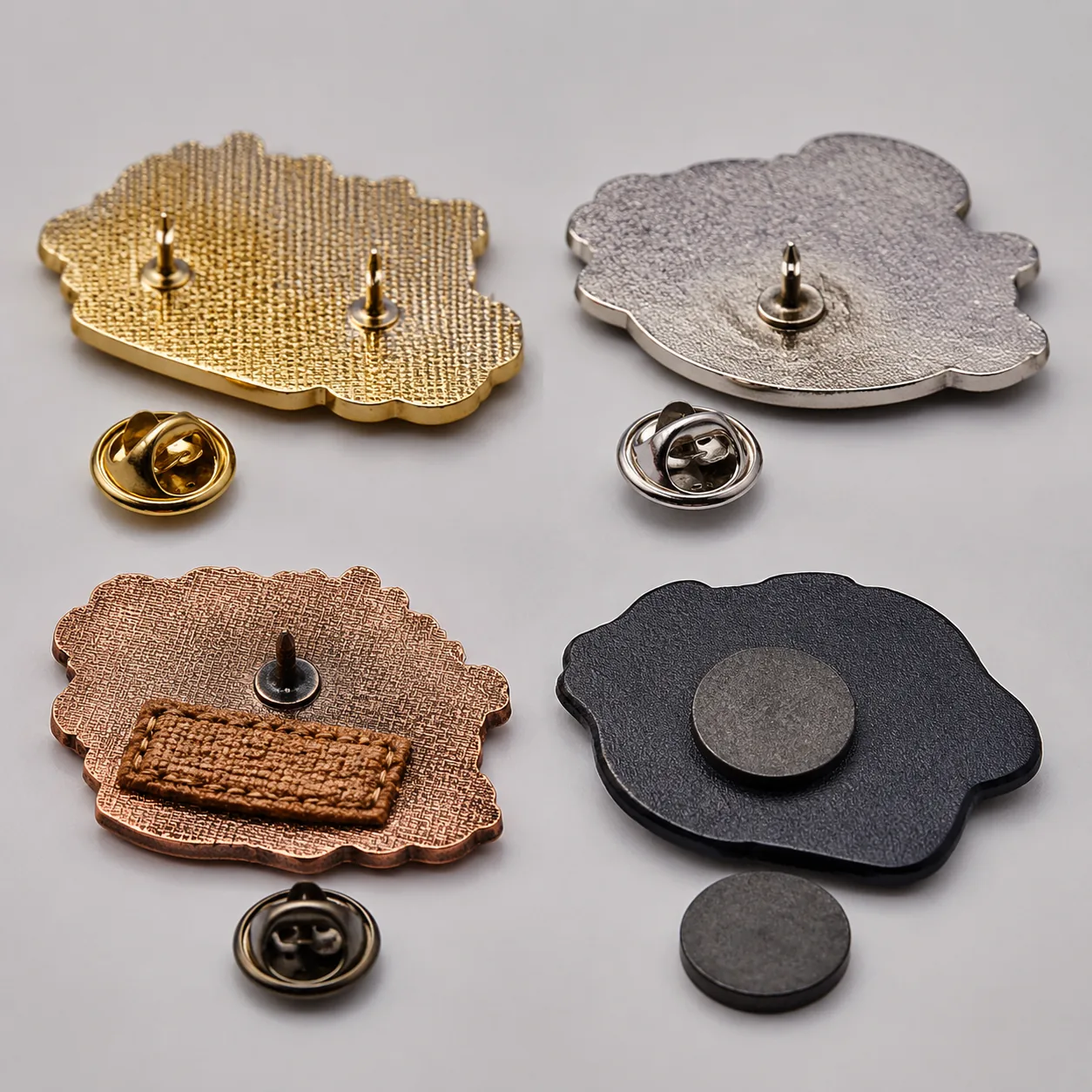
Hook backing uses nylon or polyester hook tape stitched or heat-laminated to the rear. Standard hook tape is 1.6 to 2.0 mm thick, so the finished patch becomes noticeably stiffer. Adhesive backing uses pressure-sensitive glue with release paper and is best for packaging, notebooks, plastic cards, displays and short-term event use. Pin or brooch backing is removable, but hardware position and pull strength must be controlled.
| Backing type | Typical rear material | Best use | Avoid when |
|---|---|---|---|
| Sew-on | Twill, felt or non-woven rear layer | Permanent apparel, caps, bags, workwear | End user cannot sew or needs removable patches |
| Iron-on | 120 to 180 micron hot-melt film | Retail patches, clubs, light cotton garments | Coated nylon, leather, stretch fabric, high-wash uniforms |
| Hook | 1.6 to 2.0 mm nylon or polyester hook tape | Tactical patches, reusable badges, role identifiers | Patches under 35 mm or very thin fashion garments |
| Adhesive | 100 to 150 micron acrylic PSA with liner | Packaging, notebooks, plastic cards, temporary events | Washed garments, flocked fabric, hot outdoor storage |
| Pin or brooch | Steel or brass pin with safety catch | Visitor badges, souvenirs, removable apparel use | Children’s products, thin fabric, patches above 80 mm without support |
Size, border and thickness rules
Backing performance changes with patch geometry. A 50 mm round embroidered patch with iron-on film is easy to apply; a 120 mm shield with sharp points is more likely to lift at corners if heat, pressure or fabric contact is uneven. For iron-on patches, use corner radii of at least 2.0 mm and avoid narrow extensions below 5.0 mm because adhesive coverage and heat transfer become inconsistent.
For sew-on patches, the border is often more important than the rear layer. A merrowed border suits simple circles, rectangles, shields and ovals, but it normally needs a 3.0 mm minimum finished edge width. Complex silhouettes should use satin stitching or laser cutting. Practical cutting tolerance is ±0.5 mm for woven and laser-cut patches, ±0.8 to ±1.0 mm for embroidered patches, and ±0.3 mm for molded PVC dimensions controlled by tooling.
Hook backing has a minimum practical size. Below 35 mm, hook tape can dominate the patch and make edges bulky. Above 100 mm, especially for name tapes and morale patches, specify full-area hook coverage or at least 80% rear coverage. Small hook islands reduce cost but allow corners to flap during movement.
- Specify finished size in millimeters, including border, not only artwork scale.
- State maximum thickness if patches must fit cap seams, retail sleeves or rigid trays.
- Use at least 2.0 mm corner radius for iron-on designs where artwork allows.
- Avoid adhesive backing on ribbed, flocked, oily, waterproof or heavily textured surfaces.
- For hook patches over 100 mm wide, confirm full-area or minimum 80% hook coverage.
- For pin patches over 70 mm, request two pins or one pin plus anti-rotation support.
Heat-press and adhesive data to write into the PO
Do not write only “iron-on backing” in the purchase order. Write the application window and test substrate. For cotton twill, a useful starting point is 160°C, 15 seconds, medium pressure, followed by 5 seconds from the reverse side if the garment construction allows it. For polyester blends, trial 145 to 155°C first to reduce shine marks, dye migration and fabric deformation.
Peel strength should be defined realistically. For embroidered patches on approved cotton fabric, a 180-degree peel target of 8 to 12 N per 25 mm after 24 hours of cooling is a practical benchmark. For promotional goods, minor edge lift below 2.0 mm after three domestic wash cycles at 30°C may be acceptable. For uniforms or retail goods sold as durable, require 5 to 10 wash cycles and no progressive corner lift.
Pressure-sensitive adhesive behaves differently. It needs a clean surface, firm compression and dwell time, not heat activation. A 100 to 150 micron acrylic adhesive layer can work on coated paper, ABS, PVC cards, smooth metal and glass. On fabric, lint contamination and surface texture make peel strength inconsistent. If the customer wants sticker-like patches for clothing at a one-day event, label them as temporary rather than washable.
| Spec item | Practical buyer value | Factory note |
|---|---|---|
| Iron-on film thickness | 120 to 180 microns | Thicker film may bond better but increases stiffness |
| Heat-press setting | 150 to 170°C, 12 to 20 seconds | Validate on the actual garment fabric |
| Peel target on cotton | 8 to 12 N per 25 mm | Measure after 24 hours of cooling |
| Wash check | 3 cycles at 30°C for promo, 5 to 10 for uniforms | Industrial laundry needs a separate test plan |
| PSA thickness | 100 to 150 microns | Use acrylic adhesive for smoother hard surfaces |
| Storage condition | Below 30°C, dry cartons | Hot containers can soften glue and cause blocking |
MOQ, FOB price and lead-time impact
Backing changes unit cost, sampling time and production risk. For a 70 mm embroidered patch at 500 pieces, a basic sew-on version commonly falls around FOB USD 0.38 to 0.75 depending on embroidery coverage, thread count, border and packing. Iron-on film usually adds USD 0.04 to 0.10 per piece. Hook backing adds USD 0.12 to 0.30 because the tape is material-heavy and requires additional stitching or lamination.
For woven patches around 60 to 70 mm, 500-piece FOB pricing often lands around USD 0.30 to 0.65 before special packing. Iron-on adds USD 0.04 to 0.09 and hook adds USD 0.10 to 0.25. Soft PVC patches are higher: a 70 mm 2D design at 500 pieces commonly ranges from USD 0.80 to 1.80, with hook backing adding USD 0.10 to 0.22. These are planning ranges, not quotes; mold fees, Pantone colors, glow material, metallic thread, Velcro brand requirements and individual packaging all move the price.
MOQ also changes by construction. Simple embroidered or woven designs can often start at 100 pieces, but 300 to 500 pieces per design is the more efficient export tier. PVC usually makes sense from 300 pieces because mold and color setup costs are higher. Normal sampling is 5 to 8 days for embroidered or woven patches, 7 to 10 days for PVC, and mass production is usually 10 to 18 days after sample approval for 300 to 3,000 pieces.
| Backing | Typical MOQ | Added FOB cost | Sample lead time | Mass lead time |
|---|---|---|---|---|
| Sew-on | 100 to 300 pcs | Base cost | 5 to 8 days | 10 to 15 days |
| Iron-on | 100 to 300 pcs | +USD 0.04 to 0.10 | 5 to 8 days | 10 to 16 days |
| Hook | 300 pcs recommended | +USD 0.10 to 0.30 | 6 to 9 days | 12 to 18 days |
| Adhesive | 300 pcs recommended | +USD 0.05 to 0.14 | 6 to 9 days | 12 to 18 days |
| Pin or brooch | 300 pcs recommended | +USD 0.08 to 0.25 | 6 to 9 days | 12 to 18 days |
Inspection tolerances and AQL controls
Patch QC should cover appearance, dimensions, backing performance, hardware safety and packing. For export orders, a common inspection plan is General Inspection Level II with AQL 0 for critical defects, 2.5 for major defects and 4.0 for minor defects unless the buyer requires stricter limits. Critical defects include exposed sharp pin points, wrong backing type, detached hardware, severe contamination, mold odor, or mixed designs in the same retail pack.
Agree tolerances before sampling. For most embroidered patches, ±1.0 mm on overall size is workable. For woven and laser-cut patches, ±0.5 mm is usually achievable. Thickness tolerance is typically ±0.3 mm for embroidered and woven patches. PVC patches can often hold ±0.2 mm thickness if the mold and curing process are controlled. Hook alignment should normally stay within ±1.0 mm from the patch edge.
Backing checks should match the construction. For iron-on patches, inspect glue overflow, missing adhesive, wrinkled film, blocked pieces and corner lift. For adhesive patches, test tack after 24 hours, not only immediately after placement. For hook backing, check stitch security, hook coverage and whether hook edges scratch neighboring patches in bulk packing. For pin patches, perform a 5 to 7 kgf pull check on the pin base for adult promotional use and confirm the catch closes without rough burrs.
- Approve one golden sample showing front, back, edge, thickness and packing.
- Request first-batch rear photos before the full mass-production run continues.
- Test iron-on patches on the actual garment fabric, not only loose cotton cloth.
- Check both hook tape and mating loop panel if the supplier provides both parts.
- Test adhesive patches after 24 hours of dwell time because initial tack can mislead.
- Reject exposed pin points, loose catches, off-center hardware and sharp burrs.
Packaging that protects the backing
Packing should follow the backing type. Sew-on patches can usually be bulk packed in 50 or 100-piece polybags, then inner cartons, as long as borders are not crushed. Iron-on and adhesive patches need the release liner kept flat. Tight rubber-banded bundles can crease the liner and create weak points in the adhesive film.
Hook-backed patches should not be packed face-to-back against delicate woven, chenille or high-stitch embroidery surfaces unless a separator is used. Hook tape can snag threads and create visible fuzz before the goods reach the buyer. Individual OPP bags typically add USD 0.02 to 0.05 per piece, but they reduce abrasion and simplify retail or event distribution.
Carton weight also matters. For small embroidered patches, export cartons at 10 to 15 kg gross weight are usually safe. For PVC, chenille or hook-backed patches, keeping cartons below 12 kg reduces crushing and makes inspection easier. A practical export packing target is no loose pieces, broken hardware or adhesive blocking after a 60 cm carton drop on one corner, three edges and six faces.
Spec sheet before quotation
Start with the application, not the cheapest backing. If the patch is permanent on apparel and the buyer controls sewing, choose sew-on. If retail users must apply it at home, iron-on may work, but the label should state fabric limits and heat settings. If the patch must be removable, choose hook backing and define hook coverage, loop panel requirements and maximum finished thickness. If it is for packaging or a one-day event, adhesive backing can be acceptable when described as temporary.
A useful backing specification sheet includes finished size, patch type, backing type, border type, applied fabric or surface, wash expectation, target thickness, packing method, quantity by design, inspection level and delivery date. If the receiving fabric is unusual, send a swatch or clear surface photo with the artwork. The supplier can then sample the correct rear construction instead of quoting a backing that will not survive the end use.
The safest approval route is a pre-production sample made with the exact backing and packing. Do not approve only a front photo. Approve rear construction, edge finish, thickness, bonding result, hardware position and carton packing. Those details decide whether the patch performs after delivery, and they are far cheaper to correct before mass production than after goods reach uniforms, retail shelves or event kits.
Have a project? Send your artwork and target quantity and we’ll reply with a detailed quotation within 12 working hours.
Ready to get this made?
Send your sketch, target quantity and ship-date. Detailed quotation in 12 hours.



