Patch Backing Specs: Sew-On, Heat-Seal, Hook-and-Loop or Adhesive
Start with the Failure Mode, Not the Artwork
Most patch complaints are not caused by the visible face. Embroidery density, woven detail and PVC color can all pass approval, while the backing fails after the first real use. Common failures include heat-seal film peeling after washing, hook-and-loop corners curling, pressure-sensitive adhesive leaving residue, or a thick merrowed border making the patch difficult to sew onto a cap panel.
For uniforms, retail merch, event staff kits, outdoor clubs and promotional launch packs, backing should be specified as a functional component. A useful RFQ defines the backing type, patch size, edge style, finished thickness, fabric or surface material, wash exposure, peel requirement, packing method and inspection standard. Without these details, two suppliers can quote the same artwork with different glue films, hook tape weights and application assumptions.
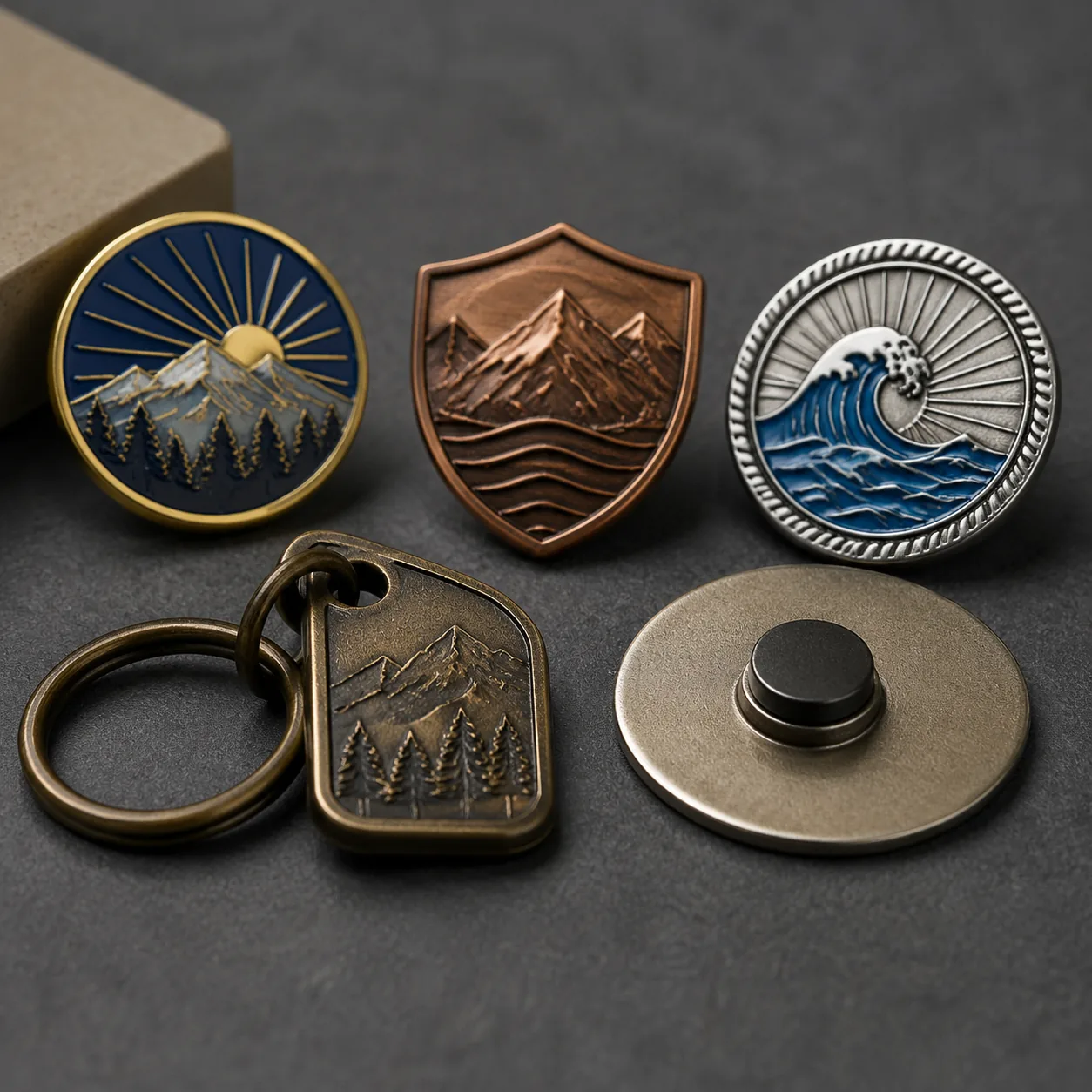
At ZheCraft, we produce embroidered, woven and PVC patches in Yiwu and often combine them with pins, lanyards, coins or keychains in one set. The safest buying method is to choose the backing based on the item it attaches to and how long it must remain there. The specifications below are written so procurement teams can copy them directly into an RFQ or purchase order.
Backing Options by Use Case
Sew-on backing is the most durable default for uniforms, bags, denim jackets, caps and workwear. It normally has no adhesive film, only the production stabilizer on the reverse. Embroidered sew-on patches commonly finish at 1.6 to 2.4 mm thick with a merrowed border, or 1.2 to 1.8 mm with a laser-cut satin-stitch edge. Woven patches are thinner, usually 0.6 to 1.2 mm, making them better for shirts, caps and retail labels where flexibility matters.
Heat-seal backing, often called iron-on, uses thermoplastic adhesive film that melts into the garment under heat and pressure. It can work well on cotton, polyester-cotton blends and canvas totes, but it is risky on waterproof coatings, silicone finishes, high-stretch sportswear, down jackets, fleece pile and heat-sensitive synthetics. A controlled heat press is far more reliable than a handheld iron because it controls pressure, dwell time and platen temperature.
Hook-and-loop backing is best when patches need to be removed or swapped, such as tactical roles, staff access levels, club ranks, name badges and luggage ID. Pressure-sensitive adhesive backing is for temporary use on packaging, folders, display boards or photo props. It should not be sold as a washable garment solution. Magnetic assemblies are possible for premium badges where pins are not allowed, but they require sample testing because garment thickness sharply reduces holding force.
| Backing type | Best use | Typical added FOB cost | Practical MOQ | Main risk |
|---|---|---|---|---|
| Sew-on | Uniforms, bags, caps, denim, workwear | $0.00 to $0.03 per patch | 100 to 300 pcs workable; 500 pcs better | Requires sewing labor after delivery |
| Heat-seal | Cotton shirts, canvas totes, casual apparel | $0.02 to $0.08 per patch | 300 pcs+ for stable film sourcing | Peeling if fabric, heat, pressure or time are wrong |
| Hook-and-loop | Removable name, rank, tactical and club patches | $0.08 to $0.28 per patch | 300 to 500 pcs+ | Corner curl, stiffness and added thickness |
| Self-adhesive | Packaging, paper, plastic displays, event boards | $0.03 to $0.12 per patch | 300 pcs+ | Residue, weak hold on fabric and poor wash resistance |
| Magnetic assembly | Small premium badges where pins are not allowed | $0.25 to $0.80 per set | 500 pcs+ | Weight, rotation and weak hold on thick fabric |
Sew-On Backing: Specify Stitchability
For sew-on patches, the key specification is not simply “no glue.” Buyers should control edge construction, needle clearance, backside cleanliness and finished thickness. A merrowed border is durable and hides sewing variation, but it adds about 2.5 to 4.0 mm of rounded edge width and cannot follow sharp internal corners or complex silhouettes. A laser-cut edge with satin stitching is better for irregular shapes, but excessive stitch density can create a stiff, wavy edge.
The reverse side should allow a standard industrial needle to pass without adhesive build-up. Apparel factories commonly use 75/11 or 90/14 needles depending on garment weight. If embroidery coverage exceeds 80% of the face, the patch body becomes dense and sewing becomes harder. For shirts and light jackets, keep finished patch thickness under 2.5 mm. For bags, denim and outerwear, under 3.0 mm is usually acceptable.
Use measurable tolerances. For patches under 80 mm wide, specify finished width and height tolerance of ±1.0 mm. For patches from 80 to 150 mm, use ±1.5 mm. Edge skew should be under 2 degrees. Loose thread tails over 3 mm should be trimmed before packing. Oil stains, missing stitches, broken borders over 5 mm and exposed stabilizer on the front face should be treated as major defects.
Heat-Seal Backing: Film, Pressure and Wash Limits
Heat-seal backing is attractive because it reduces sewing labor, but it is the easiest option to overpromise. A good adhesive film is not universal. The film must match the garment surface, and the application window must be written clearly. For many cotton and polyester-cotton garments, a practical starting setting is 150 to 165°C, 12 to 18 seconds and medium pressure around 3 to 5 bar on a flat heat press. Curved cap panels and seams need separate testing because pressure is uneven.
For standard embroidered and woven patches, specify hot-melt adhesive film thickness of 80 to 150 microns. A 60-micron film is more flexible and cheaper but has less ability to flow into textured fabric. A film above 180 microns can improve grip on canvas but may create a stiff handfeel, visible glue squeeze-out or a raised edge after pressing. Ask the supplier to record the film type and supplier code on the sample approval sheet for repeat orders.
Wash claims should be conservative and tested on the real garment. For promotional apparel washed occasionally, a reasonable requirement is no edge lift over 2 mm after 5 domestic wash cycles at 30°C and air dry. For uniforms, request a pre-production test panel and consider adding perimeter stitching even when heat-seal is used. Do not rely on heat-seal alone for rainwear, silicone-coated fabric, heavy fleece, high-stretch sportswear or garments that will be tumble-dried at high heat.
- State garment fabric composition, coating and stretch percentage, not only the patch artwork.
- Specify press settings: 150 to 165°C, 12 to 18 seconds and 3 to 5 bar unless test data supports a different window.
- Require finished patch thickness and adhesive film thickness in microns on the sample approval sheet.
- Test on the actual garment, tote or cap material rather than spare cotton cloth from the factory.
- For repeat orders, keep the same adhesive film supplier and film code wherever possible.
- For uniforms or workwear, add perimeter stitching if wash durability matters more than labor savings.
Hook-and-Loop Backing: Control Curl and Alignment
Hook-and-loop backing is usually quoted with hook tape sewn to the patch and loop tape supplied separately for sewing onto the garment. The full assembly is thicker than many buyers expect. A woven patch with hook backing may finish around 1.5 to 2.2 mm thick. An embroidered patch with merrowed border and hook backing can reach 2.6 to 3.8 mm, which may feel too bulky for retail apparel but acceptable for tactical bags or outerwear.
The most common complaint is corner curl. It is caused by stiff hook tape, embroidery shrinkage, poor lamination balance, or stitching placed too close to the patch edge. For rectangular or shield patches above 90 mm, specify hook backing inset of 1.5 to 2.5 mm from the finished edge, with the hook tape stitch line 2.0 to 3.0 mm from the tape edge. For small patches under 50 mm, full-edge hook coverage is workable but can feel rigid.
Alignment also affects perceived quality. Use ±1.0 mm hook alignment tolerance for patches under 100 mm and ±1.5 mm for larger patches. For black or navy patches, confirm hook color before sampling. Black hook tape is usually available, but custom colors, low-profile hook, flame-retardant hook or specialty loop shapes may raise MOQ to 500 to 1,000 pcs and add 3 to 7 sourcing days.
| Spec item | Recommended range | Reason |
|---|---|---|
| Hook tape weight | 180 to 280 gsm for most promo patches | Balances grip, flexibility and cost |
| Hook inset from edge | 1.5 to 2.5 mm on medium patches | Reduces visible misalignment and corner curl |
| Loop side size | Same shape or rectangle with 1 to 2 mm margin | Gives garment factories easier sewing allowance |
| Finished thickness target | Under 3.0 mm for apparel; under 4.0 mm for bags | Avoids unwanted bulk |
| Alignment tolerance | ±1.0 mm under 100 mm; ±1.5 mm above 100 mm | Prevents tilted backing on retail goods |
| Corner lift after handling | No lift above 2 mm after 20 peel cycles | Screens out weak stitching or stiff tape |
Self-Adhesive and Magnetic Backings: Use with Limits
Self-adhesive patch backing uses a pressure-sensitive adhesive sheet with release liner. It is useful for temporary branding on folders, retail boxes, event check-in boards, acrylic displays and photo props. It is not a washable apparel backing. If a supplier describes pressure-sensitive adhesive as permanent on fabric, ask for peel data on the exact fabric and a wash test before accepting the claim.
Specify the bonding surface: coated paper, uncoated kraft, PP plastic, painted metal, acrylic, wood or fabric. Adhesive performance changes sharply on low-surface-energy plastics and textured textiles. For display use, a practical test is 180-degree peel after 24 hours dwell at 23°C and 50% RH, with no full release from the stated surface. For packaging, confirm whether adhesive residue is acceptable after removal.
Magnetic patch assemblies are a niche option when fabric must not be pierced. They perform better on small woven or embroidered badges under 60 mm than on heavy embroidered patches. On jacket fabric above 1.5 mm thick, holding force can drop enough for the badge to rotate or slide. Use two or more magnets for rectangular badges and test with the real garment. The added FOB cost is higher because magnets, steel plates and manual assembly are involved.
Cost, MOQ and Lead-Time Benchmarks
Backing changes both material cost and handling time. A 50 to 80 mm embroidered sew-on patch at 500 pcs may quote around $0.25 to $0.70 FOB Ningbo or Shanghai, depending on embroidery coverage, thread count, edge type and color count. A comparable woven patch may quote around $0.22 to $0.60. Heat-seal film typically adds $0.02 to $0.08 per patch, hook-and-loop adds $0.08 to $0.28, self-adhesive adds $0.03 to $0.12, and magnetic assemblies add $0.25 to $0.80 per set.
MOQ depends on backing supply, cutting labor and setup efficiency. Standard sew-on embroidered or woven patches are often workable at 100 to 300 pcs, although 500 pcs usually gives better pricing. Heat-seal and self-adhesive backings are more stable from 300 pcs upward. Hook-and-loop, custom hook colors, unusual adhesive films, specialty loop shapes and magnetic assemblies are better planned at 500 pcs or more. For price comparison, ask for 300, 500, 1,000 and 3,000 pcs tiers.
A straightforward patch order normally needs 3 to 8 days for sampling and 10 to 22 days for mass production after sample approval. Add 2 to 5 days when the buyer requires a physical pre-production sample before bulk start. Add 3 to 7 days for unusual backing materials, custom loop-side shapes, color-matched hook tape or mixed-size assortments. For launch kits that combine patches with pins, lanyards or coins, lock the slowest item first so packing is not delayed by one late component.
| Order type | Sample time | Mass production time | FOB guidance at 500 pcs |
|---|---|---|---|
| 50 to 80 mm embroidered sew-on patch | 3 to 6 days | 10 to 15 days | $0.25 to $0.70 |
| 50 to 80 mm woven sew-on patch | 4 to 7 days | 12 to 18 days | $0.22 to $0.60 |
| Heat-seal embroidered patch | 4 to 7 days | 12 to 18 days | Base price plus $0.02 to $0.08 |
| Hook-and-loop embroidered patch | 5 to 8 days | 14 to 22 days | Base price plus $0.08 to $0.28 |
| Self-adhesive woven patch | 5 to 8 days | 12 to 20 days | Base price plus $0.03 to $0.12 |
| Magnetic badge assembly under 60 mm | 6 to 10 days | 16 to 25 days | Base price plus $0.25 to $0.80 |
Inspection Tests Before Shipment
Patch inspection should cover more than color, size and loose threads. Backing failures often appear only after pressing, peeling, bending or washing. For bulk orders, use ANSI/ASQ Z1.4 or ISO 2859-1 sampling with general inspection level II, AQL 2.5 for major defects and AQL 4.0 for minor defects unless the brand has stricter rules.
For sew-on patches, major defects include wrong backing, wrong edge type, oil stains, missing stitches, loose border sections over 5 mm and size outside tolerance. For heat-seal patches, inspect adhesive coverage, release liner condition, edge contamination and peel behavior after pressing. Reject missing glue areas larger than 3 mm at the edge. For hook-and-loop patches, check hook alignment, skipped stitching, corner lift, tape color and whether loop-side quantity matches the purchase order.
A practical pre-shipment test does not need a full lab. Pull the backing edge manually on 20 random samples; there should be no easy separation of hook tape, adhesive sheet or hot-melt film. For heat-seal patches, press 5 samples onto buyer-specified fabric, cool for 30 minutes, bend the fabric 20 times and inspect for edge lift above 2 mm. Washable claims should be tested before mass production, not after cartons are packed.
- Confirm finished width, height and thickness against the approved sample.
- Check backing type, backing color and coverage in every inspected carton.
- Apply ±1.0 mm size tolerance under 80 mm and ±1.5 mm from 80 to 150 mm unless artwork requires tighter control.
- Reject loose thread tails over 3 mm, border breaks over 5 mm and visible glue squeeze-out on the face.
- Reject hook-and-loop alignment beyond ±1.0 to ±1.5 mm depending on patch size.
- Record carton count, inner bag quantity, mixed-size assortments and spare loop-side quantities before shipment.
RFQ Wording That Produces Comparable Quotes
Before requesting prices, define where the patch will live: garment, cap, bag, packaging, display board or removable uniform panel. Send the supplier the artwork, finished size, edge style, backing type, fabric or surface material, wash expectation, quantity tiers, packing method and inspection standard. If the patch will be heat-applied, provide the actual garment fabric or at least its composition, coating and stretch percentage.
For most B2B orders, the safe default is sew-on backing for long-term use, heat-seal only after fabric testing, hook-and-loop for removable roles or ranks, and self-adhesive only for temporary non-wash applications. If the order is part of a larger promotional kit, align patch thickness, backing color, bagging and carton labeling with the pins, coins, keychains or lanyards in the same shipment.
A strong RFQ line is: 70 mm embroidered patch, merrowed edge, sew-on backing, finished thickness under 2.5 mm, size tolerance ±1.0 mm, edge skew under 2 degrees, loose threads under 3 mm, packed 100 pcs per polybag, inspection to general level II with AQL 2.5 major and 4.0 minor, quote 300, 500, 1,000 and 3,000 pcs FOB Ningbo or Shanghai. For heat-seal, add 80 to 150 micron hot-melt film and press setting of 150 to 165°C for 12 to 18 seconds at 3 to 5 bar. For hook-and-loop, add hook inset of 1.5 to 2.5 mm and alignment tolerance of ±1.0 mm under 100 mm. This level of detail makes quotes comparable and reduces backing failures after delivery.
Have a project? Send your artwork and target quantity and we’ll reply with a detailed quotation within 12 working hours.
Ready to get this made?
Send your sketch, target quantity and ship-date. Detailed quotation in 12 hours.



