Patch Backing Options: Sew-On, Heat-Seal, Hook-and-Loop and Adhesive Specs
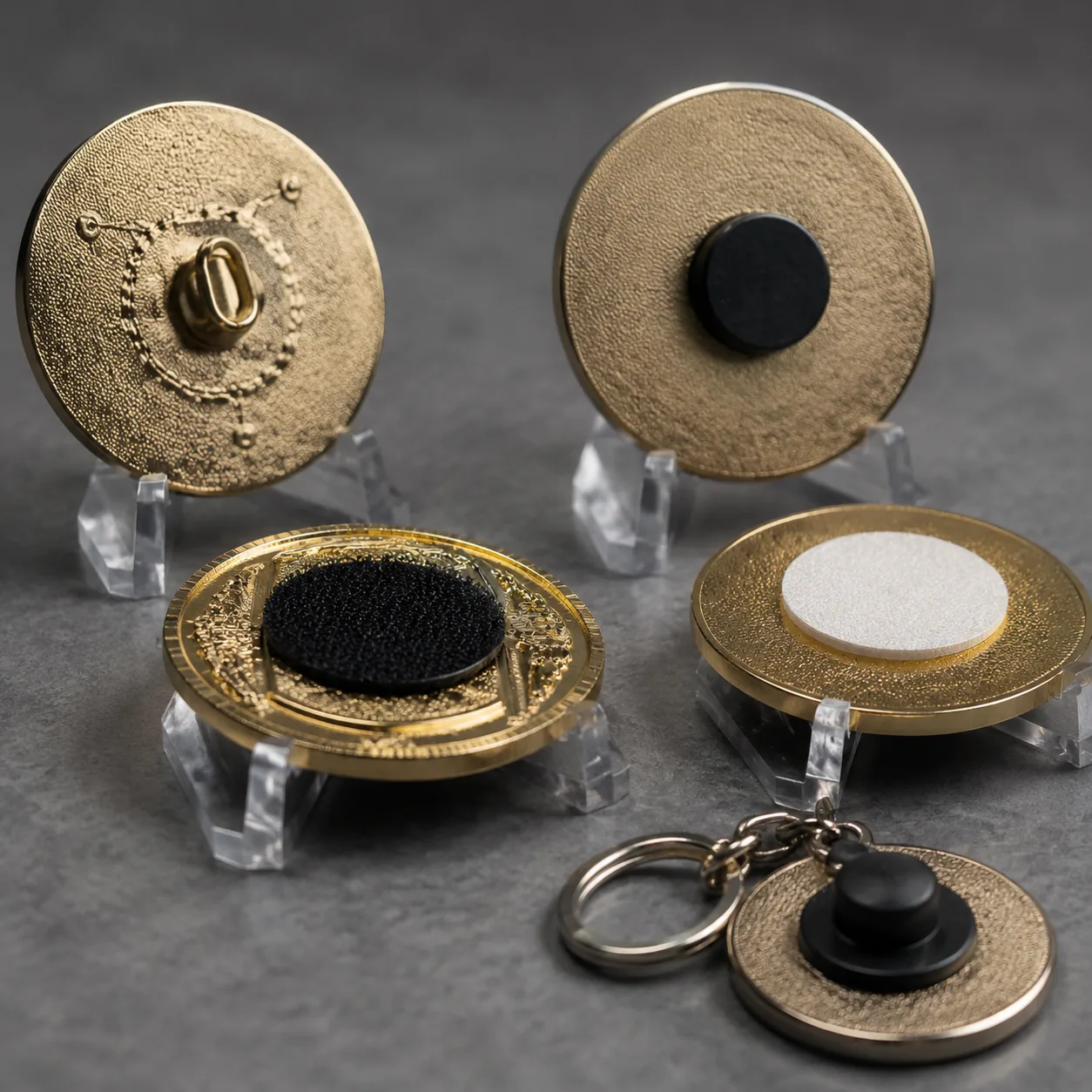
Why Patch Backing Fails After Artwork Approval
A patch can match the approved artwork photo and still fail after one week on uniforms, backpacks or retail cards. The issue is usually not the embroidery or PVC molding; it is the backing specification. Buyers often approve front size, thread colors and logo file, then leave the rear construction as a loose note such as iron-on, Velcro or sticky back. Those terms are not enough for production control.
Backing determines how the patch attaches, how thick it becomes, whether it survives washing, how it stacks in cartons and what inspectors should reject. A 75 mm embroidered staff patch for a work jacket needs a different rear construction from a 50 mm giveaway patch mounted to a paper card. Once the wrong backing is laminated or stitched, the factory cannot correct the failure at final packing.
A useful RFQ should define patch type, finished size, border, backing material, application method, target use, packed thickness limit and inspection standard. For heat-seal or adhesive constructions, also state the surface to be bonded, the expected temperature exposure and the peel-test method. For hook-and-loop, specify whether the order includes hook only or hook plus matching loop panels.
| Backing type | Best use | Thickness added | MOQ guidance | FOB add-on, USD/pc |
|---|---|---|---|---|
| Plain sew-on | Uniforms, caps, jackets, backpacks | 0.0-0.2 mm | 100-300 pcs | 0.00-0.03 |
| Heat-seal film | Retail patches, school badges, light cotton/poly garments | 0.15-0.35 mm | 300-500 pcs | 0.03-0.10 |
| Hook-and-loop | Tactical, club, name, role and removable patches | 1.2-2.0 mm | 300-500 pcs | 0.12-0.35 |
| Pressure-sensitive adhesive | Backing cards, event kits, temporary display | 0.10-0.25 mm | 500 pcs | 0.04-0.12 |
| Magnetic insert | Novelty use on thin non-washable garments | 1.5-3.0 mm | 500-1000 pcs | 0.25-0.70 |
Select Backing by Use Case, Not Unit Price
The first decision is whether the patch is decorative, functional or removable. Decorative patches for event giveaways can accept lower attachment strength because many users keep them as souvenirs. Uniform patches, school badges, emergency service patches and club patches need attachment strength that survives pulling, laundering and repeated handling. The cheapest backing often becomes expensive when it causes returns or rework.
The main attachment surfaces are cotton twill, polyester blends, caps, nylon webbing, backpacks, softshell jackets, PVC sheets and retail cards. Heat-seal film bonds well to clean cotton and many polyester blends, but it is high-risk on DWR-coated jackets, silicone-treated fabric, high-stretch knits and thick seams. Pressure-sensitive adhesive is suitable for temporary presentation, not as a permanent garment attachment.
Use a simple rule for procurement: if the patch must survive laundry, choose sew-on, heat-seal plus perimeter stitching, or hook-and-loop. If the patch is used for a one-day campaign, sample book or retail display card, adhesive can be acceptable. If the wearer must remove or swap names, ranks, teams or job roles, hook-and-loop is usually worth the added thickness and cost.
- State the final surface: cotton twill, polyester, nylon, softshell, PVC, paper card or coated packaging.
- Define use life: one-day event, 10 washes, 25 washes, seasonal uniform or long-term tactical use.
- Set a finished thickness limit when patches are carded, mailed flat or packed with pins, coins or lanyards.
- Ask for real substrate testing when using heat-seal on coated fabric or adhesive on plastic cards.
- Avoid approving backing from photos only; request a physical sample if attachment strength matters.
Sew-On Backing: Lowest Risk for Washable Goods
Sew-on backing is the safest option when the buyer cannot control the final fabric. The patch back is left plain or lightly stabilized with a thin nonwoven or gauze layer, and the garment factory or end user stitches the patch onto the product. Embroidered patches commonly finish at 1.5-2.8 mm thick depending on thread density, felt or twill base and border. Woven patches are thinner, usually 0.6-1.2 mm. Chenille patches may exceed 3.0 mm before backing.
The trade-off is installation labor. Loose patches require sewing equipment or local decoration. If a garment factory applies them, the purchase order should show stitch position, thread color and placement tolerance. A practical construction is a lockstitch or zigzag stitch 2-3 mm inside the merrowed, satin or laser-cut edge, with patch placement held to plus or minus 1 mm when a jig is used and plus or minus 2 mm for manual placement.
For sew-on orders, inspect edge stability instead of peel strength. Merrowed borders work well for circles, rectangles, shields and simple shapes above about 50 mm wide; typical border width is 3-4 mm. Satin stitch borders suit custom silhouettes but need clean density control to avoid waving. Laser-cut edges suit woven labels and complex shapes, but exposed yarns must be heat sealed or they can fray during handling and washing.
Size tolerance should be realistic. For embroidered patches, plus or minus 1.5 mm is common for 50-100 mm pieces because thread tension and border density move the edge. Woven patches can normally hold plus or minus 1.0 mm. PVC patches can be tighter, often plus or minus 0.8 mm, because the mold controls the outline. Reject criteria should focus on visible front defects, loose threads over 3 mm, wrong backing, distorted borders and stains.
| Patch type | Typical finished thickness | Text minimum | Normal size tolerance | Preferred washable backing |
|---|---|---|---|---|
| Embroidered | 1.5-2.8 mm | 4.0 mm letter height | +/- 1.5 mm | Sew-on or heat-seal plus stitching |
| Woven | 0.6-1.2 mm | 2.5 mm letter height | +/- 1.0 mm | Sew-on or heat-seal |
| PVC | 2.0-4.0 mm | 3.0 mm raised text height | +/- 0.8 mm | Hook-and-loop or molded sew groove |
| Chenille | 3.0-6.0 mm | Large block lettering | +/- 2.0 mm | Sew-on only for durable wear |
Heat-Seal Backing: Convenient but Fabric-Sensitive
Heat-seal backing, often called iron-on backing, uses a hot-melt adhesive film laminated to the rear of the patch. A common heat-press window is 150-170 degrees Celsius for 12-18 seconds under medium, even pressure. Heavier patches may need a second press from the garment reverse side. Household irons are less consistent than pneumatic or swing-away heat presses, so retail instructions should be conservative and should include cooling before handling.
For B2B uniform or school orders, heat-seal should be treated as semi-permanent unless the patch is also stitched after pressing. On clean cotton twill and many polyester blends, a good film can pass basic hand-peel checks after cooling. On coated nylon, waterproof softshell, silicone-treated fabric and stretch garments, failure risk rises sharply. If the garment has a DWR coating, request fabric swatches before sample approval and test after laundering.
The factory-side spec should include adhesive film thickness, release liner type, press conditions and a simple peel result. Standard promotional embroidered patches often use 0.15-0.25 mm hot-melt film. For embroidered patches above 90 mm or PVC patches above 3 mm thick, 0.25-0.35 mm film may improve coverage but also increases stiffness and can cause glue overflow at the edge. Visible overflow wider than 0.5 mm should be classified as a major defect on front-facing retail goods.
Peel testing does not need to be complicated for routine orders. After pressing and cooling flat for 30-60 seconds, corners should not lift more than 5 mm under firm hand peel. For higher-risk uniform programs, specify a 180-degree peel target such as 8-12 N per 25 mm after 24 hours of conditioning on the approved fabric. If the buyer requires 25 wash cycles, test the patch on the real garment, not on a substitute fabric panel.
| Spec item | Recommended wording | Inspection point |
|---|---|---|
| Temperature | 150-170 degrees Celsius trial range | Avoids under-bonding or fabric scorching |
| Press time | 12-18 seconds after platen temperature recovery | Controls adhesive flow into fabric fibers |
| Pressure | Medium, even pressure across full patch | Prevents weak corners and air pockets |
| Cooling | Cool flat 30-60 seconds before peel check | Hot glue can look bonded before it sets |
| Peel result | No corner lift over 5 mm by hand peel | Fast QC check before packing |
| Glue overflow | Reject visible overflow over 0.5 mm | Protects appearance and prevents tacky edges |
Hook-and-Loop Backing: Removable and Easy to Audit
Hook-and-loop backing is the correct choice when patches must be removable, replaceable or repositioned. The patch normally carries the hook side; the garment, cap or bag carries the loop side. This construction is common for tactical gear, motorsport teams, clubs, staff role badges and emergency service patches because users can change names, ranks and functions without replacing the garment.
Cost increases because the factory adds material, cutting, stitching and sometimes a matching loop panel. At 500-1000 pieces, a 75 mm embroidered patch may add 0.12-0.25 USD for hook only versus plain sew-on. Hook plus separate loop can add 0.20-0.45 USD depending on size and packing. For PVC patches, hook backing often adds 0.20-0.35 USD because the rear surface requires stronger bonding or sewing through a molded channel.
Thickness must be planned early. Hook-and-loop adds about 1.2-2.0 mm before considering the patch itself. A PVC patch with hook can reach 3.0-5.0 mm total, which may be too bulky for flat retail cards, paper envelopes or mixed promo kits. If the order ships with coins, pins, lanyards or keychains, confirm carton height after carding because a 1 mm increase per piece can affect freight volume.
Specify hook color, usually black, white or color-matched when available. The hook layer should be cut 0.5-1.0 mm inside the visible edge so it does not protrude and scratch skin or fabric. For shield shapes and irregular outlines, ask the factory to check hook inset, stitch security and corner lifting on 100 percent of pieces during line inspection, not only during final random sampling.
- Use hook backing when users must swap names, ranks, teams, countries, shifts or event roles.
- Specify hook only or hook plus matching loop; do not assume the loop panel is included.
- Set hook inset at 0.5-1.0 mm from the visible edge with no protruding sharp corners.
- Request black, white or color-matched hook early because non-standard colors can add lead time.
- Avoid hook-and-loop for luxury carded packaging when added thickness creates carton bulge.
Pressure Adhesive and Magnetic Backing: Limited-Use Options
Pressure-sensitive adhesive backing is often misunderstood. It can hold a patch to paper cards, sample boards, smooth plastic sheets or event badges, but it should not be sold as a permanent garment solution. It works best for retail presentation, trade-show kits, sample books and temporary giveaways where the patch needs to stay flat in packaging until the customer removes it.
Adhesive backing usually includes release paper and adds 0.10-0.25 mm thickness. It performs best on clean, dry, smooth surfaces and poorly on textured fabric, dusty cartons, silicone coatings and curved objects. In hot containers or summer warehouses, low-grade adhesive can creep, leaving residue or allowing patches to slide inside polybags. For export orders, a practical storage check is 48 hours at 45 degrees Celsius in a closed carton sample, followed by inspection for edge lift, sliding and residue transfer.
For adhesive-backed carding, define the paper or plastic surface. Coated art card, kraft card and matte recycled board do not behave the same. A light tack adhesive may be enough for paper cards but fail on glossy PP sleeves. If the patch will be removed by the consumer, the adhesive should release without tearing the card face unless destruction is intended.
Magnetic inserts are a niche option for non-washable novelty use on thin garments or display boards. They add bulk, increase cost and can create safety concerns if small magnets detach. Do not use magnetic backing for children’s products, washable garments, medical environments or air shipments without confirming destination rules and packaging controls.
PVC, Woven and Embroidered Patches Need Different Rules
Backing behavior changes by patch material. Embroidered patches have thread texture and a fabric base, giving adhesives more mechanical grip. Woven patches are thinner and better for small text but can curl if lamination tension is uneven. PVC patches are smooth, heavier and less porous, so bonding depends more on surface preparation, glue selection and mechanical attachment.
For PVC patches that will be worn, hook-and-loop or a molded sew channel is usually more reliable than heat-seal. A molded sewing groove of about 1.5-2.0 mm wide gives decorators a stable path without tearing the edge. Keep high 3D relief away from the stitch line because the presser foot can distort the patch during garment application. If the patch is above 100 mm wide or thicker than 4 mm, confirm weight and flex before choosing adhesive or heat-seal.
For woven patches under 40 mm, heat-seal or adhesive backing can make handling and carding easier, but the buyer must define whether the final product is washable or decorative. Thin woven patches can bow when film is applied too hot or under uneven tension. During QC, place samples flat on a glass plate; edge lift over 2 mm on a small patch should be reviewed because it can worsen after packing.
For embroidered patches, dense thread coverage improves appearance but increases stiffness. If a large patch must bend around a cap crown or sleeve, reduce unnecessary fill areas or select a softer twill base. For merrowed borders, confirm that the border does not cover small lettering or cut into the logo. For laser-cut embroidery, require heat sealing and reject loose yarns longer than 3 mm.
QC, MOQ, Price and Lead-Time Targets
Backing defects are easy to miss when inspection focuses only on the front logo. A patch can pass color and size checks while having glue overflow, weak hook stitching, curled adhesive liner or wrong backing type. The purchase order should define major and minor defects before final inspection. For most export patch orders, AQL 2.5 for major defects and AQL 4.0 for minor defects is practical. Critical defects should have 0 acceptance for wrong backing, mold, contamination, sharp metal parts, unsafe magnets or mixed SKUs in the wrong bags.
Finished size should be measured after backing is applied, not before. Heat film, hook panels and release liners can change edge behavior and stacking thickness. Use calipers for size, border width, backing inset and total thickness. For small runs below 300 pieces, 100 percent visual inspection is often faster and safer than sampling because the quantity is too low to absorb hidden backing problems.
Typical MOQ depends on process. Plain embroidered sew-on patches can start at 100-300 pieces per design. Heat-seal usually makes sense at 300-500 pieces because lamination setup must be controlled. Hook-and-loop is usually 300-500 pieces, with higher MOQs for custom hook colors. PVC patches often start at 300-500 pieces per mold, and 500-1000 pieces if special magnetic or multi-part backing is needed.
For a standard 75 mm embroidered patch at 500 pieces, realistic FOB ranges are 0.45-0.95 USD for plain sew-on, 0.50-1.05 USD for heat-seal and 0.65-1.30 USD for hook backing. Woven patches of the same size may be 5-15 percent lower for simple artwork. PVC patches commonly range from 0.80-1.80 USD depending on mold size, colors, thickness and 2D or 3D relief. PVC mold fees are usually separate; embroidery digitizing and woven loom setup may be included or charged as a small fixed fee.
Sampling normally takes 5-8 days after artwork approval for embroidered or woven patches and 7-10 days for PVC patches. Mass production is commonly 10-18 days for 300-3000 pieces and 18-28 days for larger multi-SKU programs. Heat-seal or adhesive backing may add 1 process day. Hook-and-loop can add 2-4 days depending on shape, material color and whether matching loop pieces are cut, bagged and labeled separately.
- Confirm backing type against the signed sample before mass packing.
- Measure finished size, border width, hook inset and total thickness after backing is applied.
- Reject visible glue overflow wider than 0.5 mm on retail-facing edges.
- Perform hand-peel checks after cooling for heat-seal, adhesive and hook panels.
- Check carton stacking for curled patches, crushed borders and release-paper transfer.
- Keep one golden sample with the buyer and one with the factory for reorders.
The safest next step is to request two samples when the application is uncertain: one with the lowest-cost acceptable backing and one with the more durable construction. Test both on the real garment, card or package, then approve the backing with measurable limits. The sample cost is minor compared with replacing a shipment that looked correct in the bag but failed when customers tried to use it.
Have a project? Send your artwork and target quantity and we’ll reply with a detailed quotation within 12 working hours.
Ready to get this made?
Send your sketch, target quantity and ship-date. Detailed quotation in 12 hours.



