Patch Backing Decisions: Sew-On, Iron-On, Hook-and-Loop, or Adhesive
Start With the Failure Mode
Patch backing should be selected from the failure you cannot accept, not from the cheapest quote line. A 75 mm embroidered logo can pass color approval on a sample card and still fail in use: heat film can lift after two washes, a merrowed edge can curl across a cap seam, hook tape can scratch skin if it extends beyond the patch, and pressure-sensitive adhesive can leave residue on a laptop shell or event uniform.
Define service life before construction. Retail apparel usually cannot tolerate heat shine, edge lift, color bleed, or peeling after normal laundering. Security, police, and military programs usually cannot tolerate weak removability, loop panels detaching in the field, or hook backing that clogs with lint. Promotional programs usually cannot tolerate slow application labor, high unit cost, or complicated instructions for end users.
- Choose sew-on for repeated laundering, dry cleaning, abrasion, outdoor wear, industrial uniforms, and garments expected to last more than 25 wash cycles.
- Choose iron-on when fast application matters and the target fabric can tolerate 150–165°C, 12–18 seconds, and 3–4 bar heat-press pressure.
- Choose hook-and-loop when patches must be removed, swapped, inspected, or repositioned during service.
- Choose pressure-sensitive adhesive for packaging, sample cards, event badges, retail displays, and other non-wash uses lasting 1–7 days.
- Choose no backing when a cut-and-sew factory will stitch the patch into the garment during production.
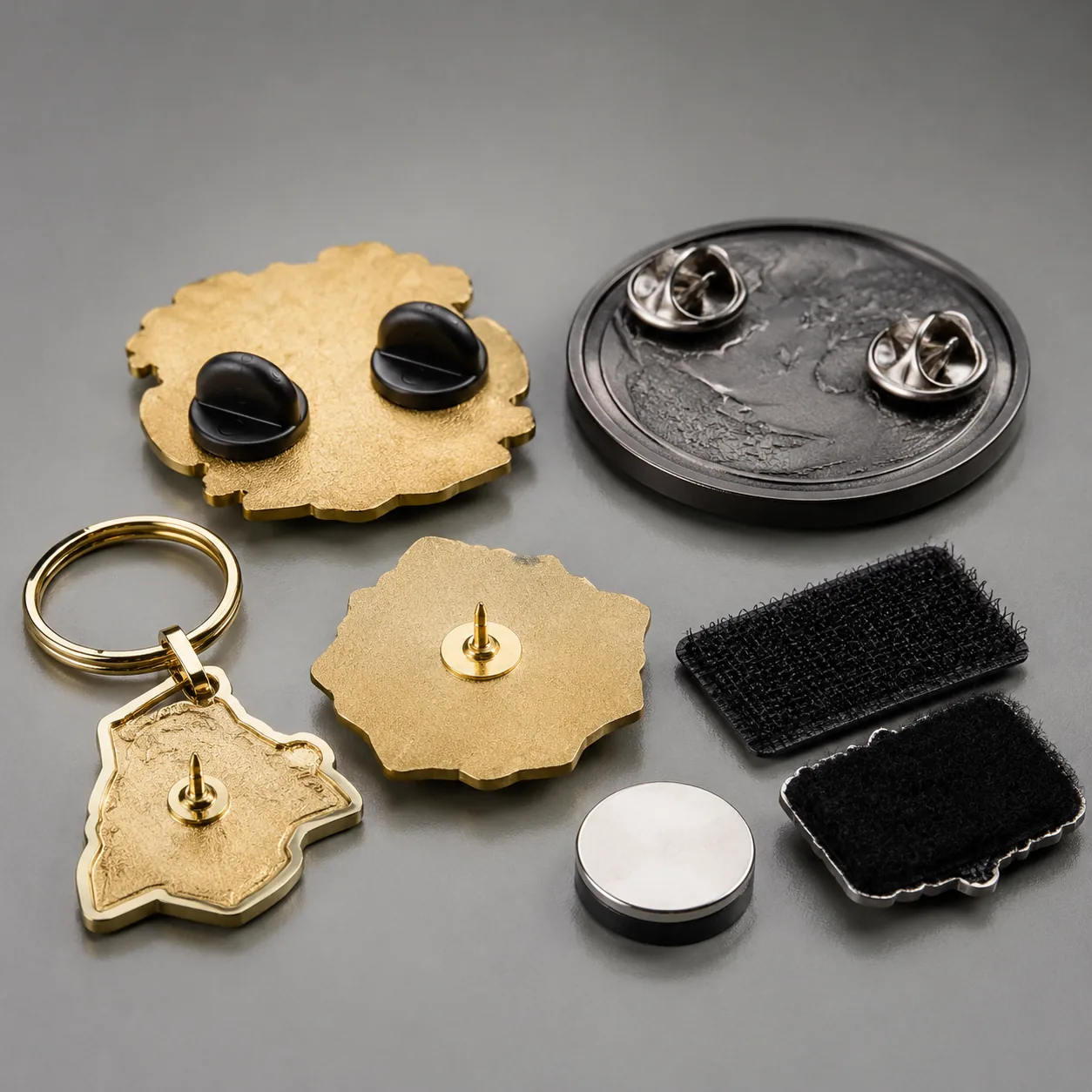
- Choose pin or brooch backing for temporary identification where garment puncture, sagging, and hardware feel are acceptable.
Permanent, Temporary, or Removable
The first commercial decision is permanence. Sew-on construction is mechanically fixed by thread and normally gives the longest service life. For a 70–90 mm embroidered patch on twill, specify a 2.5–3.5 mm stitch-in margin, keep letters and critical artwork at least 3 mm inside the finished edge, and set placement tolerance separately from patch size tolerance. A clean narrow border may look better on the proof, but it gives the operator less sewing room and raises the risk of covering artwork.
Iron-on backing uses a heat-activated adhesive film, commonly 80–150 microns for embroidered and woven patches. Heavier films of 160–200 microns can improve bond on thick twill but add stiffness and can seep at the edge if overheated. Heat seal works best on cotton twill, denim, canvas, and polyester-cotton uniforms applied with a calibrated pneumatic press. It is less reliable on silicone finishes, waterproof coatings, PU-coated bags, down jackets, rib knits, stretch sportswear, and nylon shells.
Hook-and-loop is removable but thicker and more expensive. A typical embroidered patch with hook backing and a separate loop mate adds 2.5–4.0 mm total thickness depending on yarn height, hook density, and tape weight. It is suitable for tactical jackets, uniforms, clubs, and morale patches, but it can look bulky on lightweight shirts, children’s apparel, tote bags, and curved cap panels.
| Backing choice | Best use | Typical added cost FOB | Service expectation | Main trade-off |
|---|---|---|---|---|
| Sew-on or no backing | Uniforms, retail garments, bags | $0.00–$0.03 per patch | Highest if stitched correctly | Requires sewing labor and placement control |
| Iron-on heat seal | DIY merchandise, promotional apparel | $0.03–$0.10 per patch | Medium to high on compatible fabric | Can peel on coated or heat-sensitive fabrics |
| Hook-and-loop set | Police, security, military, clubs | $0.12–$0.40 per patch | High removability; moderate bulk | Higher cost and thicker edge |
| Pressure-sensitive adhesive | Events, packaging, display boards | $0.04–$0.14 per patch | Temporary, normally 1–7 days on fabric | Not washable; substrate-sensitive |
| Safety-pin or brooch | Temporary badges and name patches | $0.05–$0.18 per patch | Reusable with careful handling | Can sag or damage delicate fabric |
Match Backing to Fabric Heat Limits
Do not quote iron-on patches as final until the garment material is known. A common heat-seal setting is 150–165°C for 12–18 seconds under 3–4 bar pressure, followed by 10–20 seconds of flat cooling before handling. Some thick films need 170°C or a second press, but higher temperature can shine polyester, scorch cotton blends, flatten fleece pile, distort foam-backed caps, or shrink nylon shells.
Cotton twill, denim, canvas, and medium-weight polyester-cotton uniforms are the safest substrates. Nylon jackets, waterproof outerwear, PU leather, wool blends, fleece, rib knit, elastic sportswear, and coated bags need testing on the actual material. Use a swatch at least 150 x 150 mm, not a generic cotton panel, so the heat press represents seam bulk, coating, stretch, fabric texture, and real heat recovery.
Application ownership changes the specification. If consumers apply loose iron-on patches with a home iron, temperature and pressure are uncontrolled; the claim should be “recommended settings,” not guaranteed industrial bonding. If a garment factory applies the patches, the purchase order should state temperature, dwell time, pressure, cooling time, peel direction, and wash-test requirement. For premium retail, heat-seal film is often combined with a perimeter sew line to prevent edge lift after laundering.
Decide Edge Construction Early
Backing depends on the edge. Merrowed borders suit circles, ovals, shields, rectangles, and other simple outlines. They normally require a 2.5–3.0 mm border and produce a raised edge. Finished size tolerance for embroidered merrowed patches is commonly ±2 mm because thread tension and border thickness affect the outline. Place small type outside the merrow zone or move it at least 3 mm inward.
Laser-cut and heat-cut edges are better for complex silhouettes, internal angles, thin outlines, and woven artwork with small detail. Stable woven patches can often hold ±1 mm visual tolerance on simple shapes, but protruding points under 2 mm wide can curl, feel sharp, or become stiff when heat-seal film is added. For irregular shapes, confirm the minimum bridge width, minimum inside radius, and whether the backing film follows the cut line or is inset 0.5–1.0 mm to reduce glue bleed.
PVC patches are molded rather than embroidered. Standard PVC thickness is usually 2.0–4.0 mm, with 2.5–3.0 mm common for morale patches. PVC can use recessed sew channels, hook backing, adhesive backing, or molded pin fittings. It is durable outdoors, but heavier than woven or embroidered patches. A PVC patch over 120 mm wide should have a broad sew channel, sufficient hook area, or both to prevent sagging.
MOQ, Lead Time, and FOB Price
Backing is rarely the largest material cost, but it changes landed cost through packing, carton volume, application labor, and reject risk. For a 75 mm embroidered patch at 500–1,000 pieces, a realistic FOB range is $0.35–$0.95 depending on stitch coverage, thread count, border, color count, and backing. Woven patches of similar size often run $0.45–$1.15 because loom setup and fine-detail control differ. Chenille patches are usually $1.20–$3.50 for jacket-size designs because of yarn volume, felt backing, and larger dimensions.
PVC patches are commonly $0.80–$2.40 for 70–90 mm designs, excluding unusual molds, glow pigment, 3D relief, or many color layers. Mold fees are often $50–$150 and may be waived or amortized at higher quantities. Hook-and-loop can add a high percentage to low-cost patches, especially when both hook and loop are supplied and packed as matched sets. Iron-on and adhesive films cost less, but they still require bond testing.
Efficient MOQ depends on construction. Simple embroidered and woven patches can start at 100 pieces, with better price breaks at 300, 500, 1,000, and 3,000 pieces. PVC MOQ is usually 100–300 pieces depending on size and color count. Sample lead time is commonly 5–8 days for embroidered or woven patches, 7–10 days for PVC, and 8–12 days for mixed-material styles. Mass production after approved sample is typically 10–18 days for embroidery and woven patches, or 15–25 days for PVC, complex shapes, and mixed backing orders.
| Order scenario | Recommended backing | Efficient MOQ | Sample lead time | Mass lead time after approval | Typical FOB range |
|---|---|---|---|---|---|
| Retail jacket patch, repeated washing | Sew-on or sew-on plus light stabilizer | 300 pieces | 5–8 days | 10–16 days | $0.45–$1.20 |
| DIY fan merchandise | Iron-on with optional sew guideline | 300 pieces | 5–8 days | 12–18 days | $0.40–$1.10 |
| Security name patch | Hook backing with loop mate | 100–300 pieces | 6–9 days | 12–20 days | $0.65–$1.60 |
| Conference badge patch | Adhesive or safety pin | 300 pieces | 5–7 days | 10–15 days | $0.35–$0.95 |
| Outdoor PVC morale patch | Hook backing or recessed sew channel | 100–300 pieces | 7–10 days | 15–25 days | $0.90–$2.40 |
Test the Backing Under Stress
Patch approvals often focus on thread color, border shape, and logo detail. Backing failures usually appear only after stress. For iron-on patches, test on the target fabric and check bond strength after at least 24 hours of cooling because some films continue to stabilize. A practical apparel requirement is no edge lift over 2 mm after hand flexing and one wash at 30–40°C. Retail or uniform programs should require 5–10 wash cycles and, where relevant, tumble drying before release.
For hook-and-loop, inspect stitch security, hook coverage, alignment, and hand feel. The hook tape should usually sit 0.5–1.5 mm inside the patch edge so it does not scratch skin or catch adjacent fabric. If the patch has an irregular outline, confirm whether the hook is die-cut to match or applied as a simplified rectangle or oval. Simplified hook lowers cost but can leave unsupported points that curl.
For adhesive patches, test the exact surface: coated paperboard, acrylic display, laptop shell, helmet, garment tag, or plastic packaging. Pressure-sensitive adhesive can perform well on smooth, clean, non-porous surfaces and poorly on dusty fabric, textured powder coating, silicone, oily plastic, or low-energy PE and PP. For event apparel, specify the wear duration in days and state that the patch is not washable unless a validated test proves otherwise.
- Iron-on: approve film thickness, temperature, dwell time, pressure, cooling time, target fabric, peel direction, and wash test.
- Sew-on: approve border width, sew margin, attachment thread color, stitch density, needle size, and placement tolerance.
- Hook-and-loop: approve hook shape, loop mate size, edge offset, tape color, total thickness, peel strength, and packing method.
- Adhesive: approve substrate, surface cleaning method, wear duration in days, residue limit, liner type, and storage condition.
- PVC: approve total thickness, sew channel width, backing position, edge smoothness, color layers, shore hardness, and unit weight.
Inspection Criteria for the PO
A purchase order should define measurable backing defects before mass production. For patch orders, a common inspection plan is AQL 2.5 for major defects and AQL 4.0 for minor defects unless the buyer requires stricter control. Critical defects should be zero-tolerance where safety, brand misuse, or sharp hardware is involved. Major defects include wrong backing type, weak heat-seal film, missing hook panel, exposed glue, wrong loop mate, sharp PVC edge, incorrect pin direction, or backing misalignment that prevents application.
Minor defects include slight thread fuzz, small film wrinkles that do not affect bonding, hook offset inside the approved tolerance, or backing discoloration not visible from the front. For embroidered and woven patches, finished size tolerance is often ±2 mm unless tighter tolerance is approved during sampling. For laser-cut woven patches, ±1 mm is often achievable on stable outlines. For molded PVC, outline tolerance of ±0.5–1.0 mm is realistic, but raised layer height, color fill, and small recessed detail need separate approval.
Packing should match the backing. Iron-on and adhesive patches should not be packed loose in a way that bends corners, contaminates glue, or sticks liners together. Hook-and-loop sets should be paired consistently, often one patch with one loop mate in an OPP bag for uniforms or team distribution. Bulk packing can reduce unit cost by $0.01–$0.04 per piece, but it increases sorting labor and the risk of mismatched quantities at the buyer’s warehouse.
RFQ Details That Prevent Rework
Do not ask suppliers to quote only by size and artwork. Backing affects material, application risk, inspection, packing, carton volume, and end-user complaints. A complete RFQ should state where the patch will be used, who applies it, how long it must last, and whether removability is required. If one program includes several patch types, separate them by use case rather than forcing one backing across all items.
For example, staff uniforms may need sew-on woven name patches, event giveaways may use iron-on embroidered patches, and VIP security badges may require hook-and-loop PVC. These can be quoted as one coordinated order while keeping construction specifications separate. That helps control Pantone matching across the program without hiding different performance requirements.
- Send artwork at final size with Pantone references, border type, minimum text height, and required edge construction.
- State the patch type: embroidered, woven, chenille, PVC, leather, rubber, or mixed material.
- Name the backing choice and the reason: permanent, removable, temporary, retail, uniform, DIY, or event use.
- Provide garment or surface material, especially for iron-on and adhesive patches, and include swatches where possible.
- Define sample tests, AQL level, size tolerance, packing method, carton labeling, and delivery date.
- Request price breaks at 100, 300, 500, 1,000, and 3,000 pieces if demand is uncertain.
Have a project? Send your artwork and target quantity and we’ll reply with a detailed quotation within 12 working hours.
Ready to get this made?
Send your sketch, target quantity and ship-date. Detailed quotation in 12 hours.



