Ordering Custom Staff Name Badges Without Rework
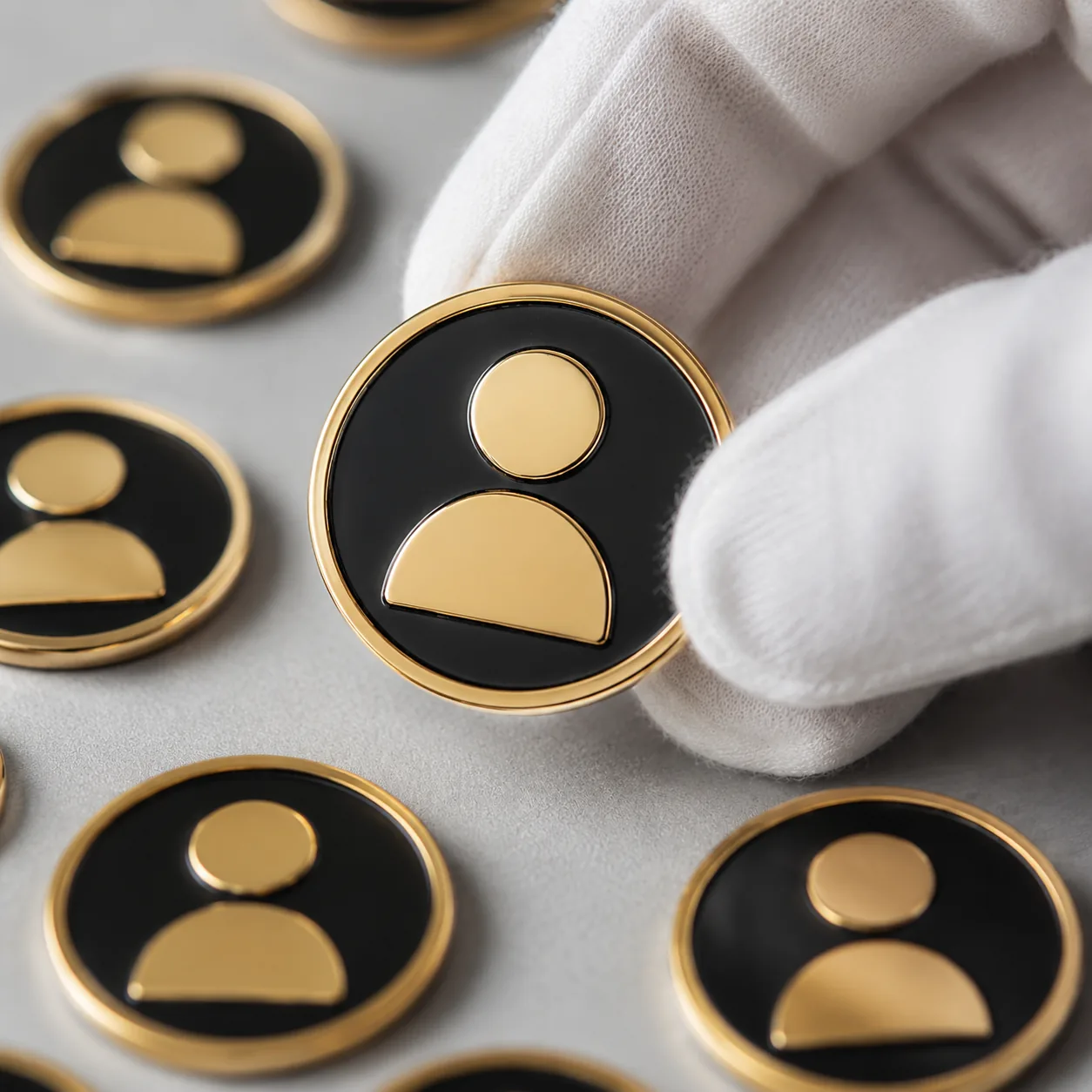
The Order Risk: 640 Badges Before Opening Day
A hotel procurement team needs 640 staff name badges before a soft opening in 21 days. Uniforms are already in production, but the badge artwork, employee list, and attachment choice are not frozen. The badges must show the hotel logo, employee name, and department color. Housekeeping shirts are lightweight polyester-cotton, front desk jackets are thicker suiting fabric, and management blazers cannot have visible pin holes.
This is not the same job as a promotional enamel pin. A staff badge must sit level, remain readable at 1.5 meters, survive daily removal, and support future employee turnover. A weak magnet makes the badge rotate. A heavy zinc alloy body pulls thin shirts forward. A poorly controlled name list creates wrong-name rejects that cannot be repaired after plating or engraving.
Treat the badge as a small wearable hardware system: body, finish, attachment, personalization, packing, and reorder file. For a first hotel order, the safest route is to approve the physical construction before processing every staff name. That keeps the project moving while HR finishes final hiring.
Freeze Wearing Conditions Before Artwork
The first specification is not logo shape. It is where the badge will be worn, how often staff remove it, and whether the uniform can accept a pin. For shirts under 180 gsm, a badge above 25 g often sags unless the magnet footprint is long enough. For jackets and blazers, pins hold securely but can leave holes. For food service and medical uniforms, detachable butterfly clutches may be rejected because loose parts create contamination risk.
A practical hotel badge is usually 60-75 mm wide and 20-28 mm high. For daily wear, keep total weight near 14-24 g. If the design exceeds 75 mm wide or uses a cast zinc alloy body, use a long magnetic bar or two attachment points to reduce rotation. Test the badge on the actual uniform fabric before mold approval; testing on denim or paper tells you very little about a polyester shirt.
| Uniform condition | Safer badge specification | Avoid |
|---|---|---|
| Thin shirt, 120-180 gsm | Aluminum or brass, 60-70 mm wide, 1.0-1.5 mm thick, 45-55 mm magnetic bar | Zinc alloy bodies above 25 g; they pull the fabric forward |
| Suit jacket or blazer | Brass or stainless steel, 65-75 mm wide, 1.2-1.8 mm thick, dual magnet or long magnet | Sharp pin posts on rented garments or premium wool |
| Apron or work vest | Zinc alloy or brass, 60-80 mm wide, 1.8-2.5 mm thick, safety pin or bar pin | Weak magnets if staff bend, carry trays, or move equipment |
| Medical or food service uniform | Light metal badge with enclosed magnet or lockable safety pin | Loose butterfly clutches and small detachable parts |
| Event or training staff | Badge plate with slot, clip, or lanyard adapter, 70-90 mm wide | Heavy cast badges on soft lanyards; they twist forward |
Select a Body Built for Turnover
The badge body should match the staff turnover model. A one-piece metal badge with laser-engraved names is clean and durable, but it is inefficient if 15-25 percent of employees change each year. A removable name strip or replaceable printed insert costs more at the first order, yet it can reduce reorder cost and lead time for HR.
Common body materials are brass, stainless steel, aluminum, and zinc alloy. Brass gives crisp stamping, reliable plating, and a premium feel. Aluminum is lighter and economical, but it limits deep relief and heavy plating effects. Stainless steel is durable and corrosion resistant, but complex filled colors are less flexible. Zinc alloy supports 3D logos and sculpted edges, but the weight must be controlled for shirt wear.
For the 640-piece hotel order, a balanced specification is a 68 x 24 mm badge, 1.2 mm brass or 1.5 mm aluminum, 2.0 mm corner radius, and a recessed name area around 48 x 9 mm. Raised logo relief should be at least 0.25 mm so it remains visible after plating or coating. Engraved name strokes should not fall below 0.18 mm, and printed small text should be kept above 0.25 mm line width to avoid weak letters.
- Specify finished badge size, not only artwork size; common staff widths are 60, 65, 70, and 75 mm.
- Keep name letter height at 3.0-4.5 mm for readability at normal service distance.
- Use a minimum 1.5 mm edge radius; 2.0-2.5 mm feels safer on thin uniform fabric.
- For removable strips, hold strip width and channel tolerance to +/-0.10 to +/-0.15 mm so inserts slide without rattling.
- Send names in a spreadsheet with badge number, name, department, title, language version, and exact capitalization.
Choose Personalization Without Slowing Production
Personalization is where many badge orders lose days. The factory can make 640 badge bodies while HR completes final hiring, but only if the buyer separates body approval from name approval. Freeze the badge construction first, then release a locked name spreadsheet. Do not send names through email threads, screenshots, or marked-up PDFs.
Fiber laser engraving is best for permanent metal badges. On gold, nickel, or black nickel finishes, contrast depends on the plating stack and base metal, so one pre-production sample should include the longest expected name. UV printing allows full-color names, department bars, and bilingual lines, but the surface needs clear coating or careful individual packing to prevent abrasion. Removable name strips are usually best for hotels, retail chains, and clinics with recurring staff changes.
| Personalization method | Typical MOQ and add-on cost | Best use | Main control point |
|---|---|---|---|
| Fiber laser engraving | MOQ 100 pcs; USD 0.08-0.25 per badge FOB | Permanent staff badges on metal surfaces | Approve contrast on the actual plating before mass engraving |
| UV printed names | MOQ 100 pcs; USD 0.12-0.35 per badge plus setup | Full-color departments, bilingual names, temporary campaigns | Use clear coating or individual sleeves to reduce scratches |
| Removable printed name strip | MOQ 300 frames; strips from 100 pcs; USD 0.15-0.45 per system | Hotels, retail, clinics, and high-turnover teams | Control channel tolerance and replacement strip dimensions |
| Domed epoxy name area | MOQ 300 pcs; USD 0.20-0.50 per badge | Glossy promotional look or lower-touch use | Avoid outdoor UV exposure where domes can yellow |
| Blank writable insert | MOQ 300 pcs; lowest body cost, variable insert cost | Training days and temporary contractors | Specify pen type; low-grade markers smear |
Approve Finish by Contrast, Not Rendering
Small badges fail when the finish looks premium but reads poorly. A polished gold badge with polished engraving can disappear under warm lobby lighting. Satin gold, brushed nickel, antique nickel, matte black, or enamel-filled logos often provide better contrast than mirror plating. For a hotel, the finish should match the brand while allowing staff names to be read quickly by guests.
For plated brass or zinc alloy, a normal indoor specification is nickel underplating at 3-5 microns and gold flash at 0.08-0.12 microns. For premium daily-wear badges, specify 0.15-0.25 microns gold to improve wear resistance. If nickel-free plating is required, state it before quotation because the plating stack, color tone, compliance documents, and price change.
Aluminum badges can be anodized or printed. Anodizing is light and corrosion resistant, but Pantone matching is approximate, often within Delta E 3-5 rather than a perfect match. Enamel or printed department colors can usually be controlled closer, around Delta E 2-4, depending on the process and surface finish. For edges, specify no burr above 0.05 mm and no sharp corner that catches fabric.
- Request one physical finish sample for orders above 500 pcs or any new plating color.
- Specify brushing direction, such as horizontal brushing across the 68 mm width.
- Define Pantone references for logo and department colors, with an agreed visual tolerance under standard light.
- Avoid black nickel with very small black text unless engraving exposes a bright base or receives color fill.
- Keep all badges in one plating batch when possible; mixed batches can show tone differences under warm light.
Lock Attachment Before Tooling
The attachment is part of the badge engineering, not an accessory to decide later. A single butterfly clutch works for a small 25 mm lapel pin, but a 70 mm name badge needs anti-rotation support. A single post allows the badge to spin when the wearer walks, bends, or puts on a jacket.
For premium hotel wear, a long magnetic bar is usually the cleanest option. Common backs are 45 x 13 mm or 55 x 13 mm with two neodymium magnets in a plastic or metal holder. For thicker jackets, stronger magnet assemblies improve hold, but they must be tested for comfort because high pull force can pinch thin fabric and make removal awkward.
For industrial uniforms, safety pins and locking bar pins can outperform magnets. In aviation, hospitals, laboratories, and some security environments, magnets may be restricted by internal policy. Confirm site rules before approving magnetic backs, especially when badges will be worn near medical equipment, access cards, or sensitive instruments.
| Attachment | Typical structure | FOB add-on range | Buyer note |
|---|---|---|---|
| Single butterfly clutch | One 8-10 mm post with clutch | USD 0.03-0.08 | Lowest cost, but poor anti-rotation for wide badges |
| Two clutch posts | Two 8-10 mm posts, 25-40 mm spacing | USD 0.06-0.15 | Secure, but creates two garment holes |
| Long magnetic bar | 45-55 mm bar with two magnets | USD 0.18-0.45 | Best general option for shirts, jackets, and blazers after fabric testing |
| Dual round magnets | Two 12-15 mm magnets | USD 0.20-0.50 | Strong anti-rotation; thicker back profile |
| Safety pin or bar pin | 25-38 mm pin assembly | USD 0.06-0.18 | Reliable for workwear, less premium appearance |
| Clip adapter | Spring clip or lanyard clip | USD 0.10-0.30 | Useful for events, but can tilt on soft fabric |
Sample, Inspect, and Pack for HR Issue
The sample stage should prove the badge system, not every employee name. For this 640-piece hotel order, approve one badge with the longest name, one with the shortest name, one department color, and one blank replacement strip if the design uses inserts. This catches alignment, engraving contrast, strip fit, and magnet hold before the full name file is processed.
Realistic sample timing is 7-10 days after artwork approval for a new stamped brass body or zinc alloy mold. A flat aluminum badge with print or laser engraving can sometimes sample in 5-7 days. Mass production for 500-1,000 pieces is commonly 12-18 days after sample approval and final name list. Personalized checking adds 1-3 days, and air freight to many markets adds another 3-7 days after export handover.
Inspection should use AQL Level II unless the buyer has a stricter internal standard. For personalized badges, set critical defects at 0, major defects at 2.5, and minor defects at 4.0. Critical defects include wrong name, missing magnet, wrong attachment, exposed sharp pin, unsafe burr, or a department color assigned to the wrong person. Major defects include unreadable engraving, plating peel, visible scratches on the front face, or name position outside tolerance.
- Check finished size tolerance at +/-0.20 mm for stamped, cut, or machined badge bodies.
- Check name position at +/-0.30 mm from the approved artwork centerline.
- Use a 3M tape test on printed or coated areas; no visible lifting should appear after one firm pull.
- Test magnet hold on the actual uniform with walking, bending, sitting, and jacket removal.
- Inspect every personalized badge against the locked spreadsheet before packing, not only against artwork files.
Packing should support HR distribution. Pack badges in name order or department order, with labels that match the spreadsheet. Use individual OPP bags, paper sleeves, or backing cards to prevent plated surfaces from rubbing. If magnets are strong, separate backs or use cards so badges do not snap together in transit. Inner boxes of 50-100 badges are practical; export cartons should stay below 12-15 kg to reduce deformation and handling damage.
Confirm MOQ, Pricing, and Reorder Control
FOB pricing depends on material, size, finish, attachment, and personalization. At 500 pieces, a 65-70 mm aluminum printed badge is often USD 0.85-1.60 FOB. A brass plated badge with magnetic back and laser names usually falls around USD 1.80-3.20. A zinc alloy 3D badge with premium plating, enamel logo, and removable name strip can run USD 2.50-4.80. Very low quantities are possible, but setup and data handling make the unit price rise quickly.
| Order element | Practical specification | Effect on cost or timing |
|---|---|---|
| MOQ | 300 pcs for a custom metal body; 100 pcs for replacement strips when the frame exists | Lower MOQ is possible, but setup cost is spread over fewer badges |
| Tooling | USD 45-120 for simple stamped or cut badge; USD 80-250 for 3D zinc alloy mold | Reusable for reorders if logo, size, and structure stay unchanged |
| Sample time | 5-10 days depending on material, mold, and finish | Full staff name list is not needed for the first system sample |
| Mass production | 12-18 days for 500-1,000 pcs after sample and name approval | Personalized checking normally adds 1-3 days |
| Freight | 3-7 days by air after export handover to many markets | Magnets and metal weight affect freight class and cost |
| Packing | Individual sleeve plus department inner boxes | Small cost increase, but reduces scratches and HR sorting time |
Before issuing the purchase order, send one technical pack instead of scattered messages. It should include the drawing, finished size, material, finish, attachment, name spreadsheet format, packing sequence, AQL level, delivery deadline, and reorder rule. If the opening date is fixed, confirm the latest sample approval date as well as the final ship date.
Ask for two prices: the first full order and the reorder cost for replacement name strips or individual badges. Also ask how the mold, cutting file, artwork version, plating color, and magnet specification will be identified for future orders. ZheCraft can manage the badge body, attachments, personalization, inspection, and packing in one Yiwu workflow, but the best first inquiry still needs four facts: uniform fabric type, target badge size, quantity by department, and whether names must be permanent or replaceable.
Have a project? Send your artwork and target quantity and we’ll reply with a detailed quotation within 12 working hours.
Ready to get this made?
Send your sketch, target quantity and ship-date. Detailed quotation in 12 hours.



