Ordering 100 Custom Pins in 2026 Without Paying 500-Piece Prices
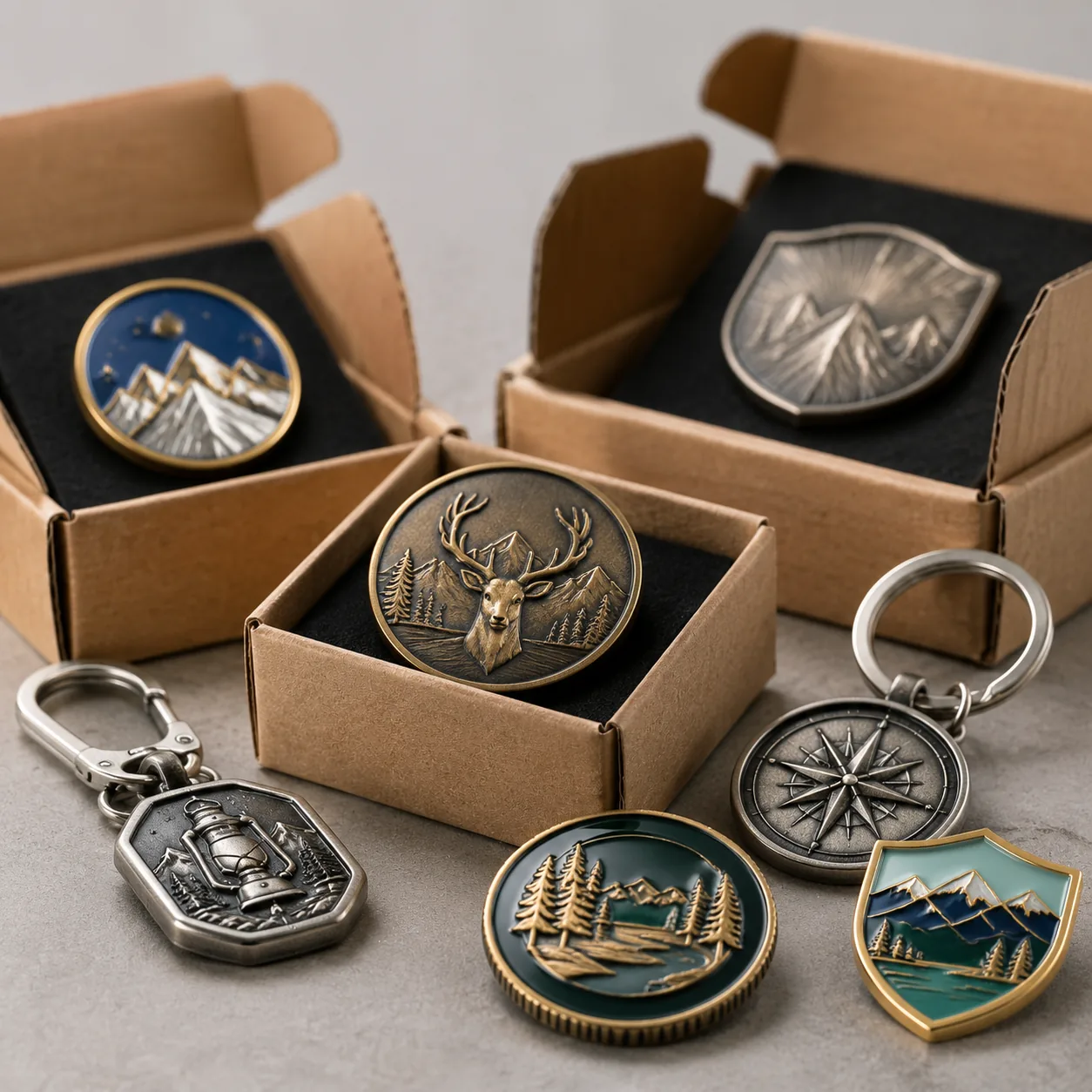
Treat 100 pieces as a pilot SKU, not a one-off rush job
A 100-piece custom pin order is usually a test batch: a launch giveaway, creator merch drop, staff recognition item, conference handout or onboarding insert that may later reorder at 300 to 500 pieces. The pricing problem is straightforward. Pin factories can produce 100 pieces, but die setup, plating preparation, color filling, polishing, counting, QC and hand packing are still largely fixed-labor steps. At 500 pieces those costs dilute; at 100 they do not.
For a mainstream 2026 project in China—roughly 30 mm to 40 mm, 2D construction, one plating finish, standard clutch—FOB unit pricing at 100 pieces typically lands around USD 1.00 to 2.60 each depending on material, shape complexity and packaging. One-time tooling is commonly USD 45 to 95 for stamped iron and USD 80 to 150 for die-cast zinc alloy with irregular outlines or inner cutouts. A physical pre-production sample usually adds USD 35 to 80 plus courier and takes about 5 to 8 working days after proof approval.
That does not make 100 pieces uneconomic. What usually inflates cost is poor specification control: changing the size after die approval, adding a second plating finish midstream, switching from bulk bagging to carded retail packing after assembly starts, or approving artwork with details too fine for the process. The efficient way to buy 100 pins is to lock one repeatable specification, quote 100, 300 and 500 pieces at the same time, and treat the first order as the master record for a lower-cost reorder.
Pick a construction that survives low MOQ economics
At 100 pieces, the best cost-to-result balance is usually 2D soft enamel or imitation hard enamel with one plating finish and moderate detail. Stamped iron remains the best value for regular outlines, straight edges and logo-style shapes; finished thickness is commonly 1.2 mm to 1.5 mm. Die-cast zinc alloy costs more but handles irregular silhouettes, rounded contours, inner cutouts and deeper relief better; finished thickness is commonly 1.5 mm to 2.0 mm. Brass is possible, but at this quantity it is usually reserved for premium badge programs rather than budget-conscious merch.
Design tolerance matters more than buyers expect. A practical production rule is 0.25 mm minimum for raised metal lines, 0.60 mm minimum for enamel fill areas, and 0.20 mm to 0.30 mm minimum for negative gaps. Text below about 1.2 mm cap height becomes inconsistent, especially with antique plating or dark fills that reduce contrast. If the artwork contains gradients, microtype, facial features smaller than 0.6 mm, or photographic texture, an offset-printed badge with epoxy dome is often the more reliable and cheaper route than forcing those details into tiny enamel cells.
Most low-MOQ overruns come from decorative extras rather than from the base pin. Glitter fill, glow enamel, translucent colors over sandblasted texture, screen-printed highlights, dual plating, spinner parts and cut-through windows are all feasible, but each adds setup, approval checkpoints and more manual handling. On a 100-piece order, adding one premium process can add USD 0.12 to 0.40 per piece—sometimes more than the incremental cost of increasing the order from 100 to 150 pieces.
- Keep finished size in the 30 mm to 40 mm range unless visual impact requires a larger statement piece
- Use one plating finish only: bright gold, bright nickel, black nickel, antique brass or dyed black are standard low-risk choices
- Hold raised line width to at least 0.25 mm and enamel islands to at least 0.60 mm
- Limit first-run color count to 4 to 6 fills unless the artwork truly depends on more
- Use 1 post for pins up to about 32 mm and 2 posts for wider, taller or asymmetric shapes to reduce spinning on the garment
Quote three volume tiers and break every cost bucket apart
Requesting one all-in number for 100 pieces hides the real economics. Ask every supplier to quote the same specification at 100, 300 and 500 pieces, with tooling separated from unit production. That immediately shows whether the supplier has a rational low-MOQ model or is simply loading the 100-piece tier with an arbitrary penalty. In many cases, the 300-piece quote approximates the true factory production baseline, while the delta between 100 and 300 shows how much setup recovery is being carried by the smaller batch.
At minimum, split the quote into tooling, pin unit cost, attachment hardware, individual packaging, export carton packing and sample charge. Then confirm whether die storage is included, whether repeat orders can reuse the same die for 12 to 24 months, and whether there is any die-maintenance charge on reorder. Seemingly small changes—moving from 32 mm to 38 mm, changing outer shape, or adding a second cutout—often require new tooling even if the artwork looks similar.
Sampling should be a risk-control decision, not an automatic line item. For a simple 35 mm logo pin with standard line widths and no unusual packaging, a digital proof plus reference photos may be enough. A physical sample is more justified when the design includes irregular geometry, premium imitation hard enamel, exact brand color matching, custom retail card alignment, or a gift box that must fit tightly. If the sample does not remove a real approval risk, it mainly adds time and courier cost.
| Configuration | 100 pcs FOB | 300 pcs FOB | 500 pcs FOB | Typical use case |
|---|---|---|---|---|
| 30 mm stamped iron soft enamel, 4 colors, 1 post, butterfly clutch, bulk polybag | USD 1.00-1.45 each | USD 0.68-0.98 each | USD 0.52-0.82 each | Event logos, staff pins, speaker kits |
| 35 mm zinc alloy soft enamel, irregular shape, 5 colors, 2 posts, bulk polybag | USD 1.35-2.05 each | USD 0.95-1.40 each | USD 0.76-1.15 each | Mascots, shaped merch, creator drops |
| 35 mm imitation hard enamel, polished face, 4 colors, 2 posts | USD 1.80-2.60 each | USD 1.20-1.80 each | USD 0.98-1.48 each | Retail-ready appearance, collectible feel |
| Printed backing card, 300-350 gsm, single-pin mount | Add USD 0.15-0.36 each | Add USD 0.10-0.24 each | Add USD 0.08-0.20 each | Branded handout, SKU control, ecommerce insert |
| Kraft box, velvet pouch or rigid gift box, hand-packed | Add USD 0.32-0.90 each | Add USD 0.26-0.72 each | Add USD 0.22-0.65 each | Awards, donor gifts, executive presentation |
Stop the hidden cost leaks: revisions, packaging creep and freight mismatch
The fastest way to lose money on a 100-piece run is to revise after approval. Increasing size from 30 mm to 38 mm after tooling approval may require a new die, new post spacing and revised packaging artwork. Changing plating from bright nickel to antique silver changes visual contrast and may alter how fine details read. Moving from bulk packing to card-and-bag retail presentation after assembly starts adds manual operations that cannot be efficiently spread over only 100 units. On small runs, such changes can raise landed cost by 10% to 25%.
Packaging is often the second-largest distortion. A mounted card, OPP bag, suffocation warning, barcode label and hand insertion into an outer mailer can cost more than upgrading the metal thickness or adding a second post. If the pins are going into conference tote bags, employee kits or internal welcome packs, counted bulk bags of 10 or simple individual polybags are often the commercially smarter choice. Retail-style presentation should be used only when it changes conversion, gifting value or inventory control.
Freight should be quoted only after pack-out is fixed. One hundred bulk-packed pins often ship by express courier with a chargeable weight under 8 to 12 kg, depending on packaging and carton density. Typical express transit is about 4 to 7 days door-to-door after dispatch. But once you add oversized backing cards, rigid boxes or layered inserts, volumetric weight can become the actual cost driver. For low-MOQ pin orders, a packaging decision that adds 4 kg of billable courier weight can erase the savings negotiated on the unit price.
As a concrete example, 100 pieces of a 35 mm zinc-alloy pin in bulk may fit in a small export carton and move economically by courier. The same 100 pins in rigid gift boxes with foam inserts can multiply carton cube by three to five times, triggering a materially higher courier rate even though the metal content is unchanged. Always confirm freight from final carton dimensions, carton count and gross weight—not from assumptions made at RFQ stage.
Write measurable QC rules before production starts
A 100-piece pilot does not need luxury-jewelry inspection, but it does need objective pass-fail criteria. For promotional pins, many importers use AQL 2.5 for major defects and AQL 4.0 for minor defects, tied to an approved digital proof or sealed sample. That approval should show finished size, thickness, plating finish, Pantone references or equivalent color callouts, post location, card orientation and pack-out method. Without a documented visual standard, cosmetic disputes become subjective and expensive.
Useful tolerances are simple. Overall size tolerance is commonly ±0.30 mm to ±0.50 mm, thickness tolerance ±0.10 mm to ±0.15 mm, and post-location tolerance ±0.50 mm. For front appearance, specify no exposed base metal on visible plated surfaces, no deep scratches visible at normal arm's-length viewing distance, and no major plating burn or blistering. For enamel, allow minor level variation on soft enamel, but reject missing fill, severe underfill, overflow across borders or major color contamination visible under standard indoor light at about 50 to 70 cm.
Plating expectations also need to be realistic. Promotional pin finishes such as bright gold-tone, nickel, black nickel and antique brass are decorative deposits, not heavy engineering coatings. Decorative plating on this category is often around 0.03 to 0.10 micron equivalent depending on finish and process. That is appropriate for normal promotional use, but it is not designed for aggressive abrasion or long-term humid storage. If the pins are collectible merchandise or expected to be worn repeatedly, asking for an anti-tarnish topcoat and sealed OPP packing often delivers more real value than arguing over tiny cosmetic variation.
- Approve one final production sheet covering size, thickness, metal, colors, plating, posts, card size and pack-out
- State inspection standard in writing, such as AQL 2.5 major and AQL 4.0 minor
- Define the viewing condition: front-side appearance at arm's length under standard indoor lighting
- Require count verification and request 1% to 3% spare pieces when factory yield allows
- Ask for in-line production photos before final packing if no third-party inspection is planned
Use packaging only when it changes sales, gifting or compliance
For most 100-piece programs, the best packaging balance is a printed backing card on 300 to 350 gsm coated stock, usually around 55 x 85 mm to 70 x 100 mm depending on pin size and branding needs. That gives enough room for logo, event name, care note, SKU, barcode block and country-of-origin marking while still keeping the pack compact for courier movement. If the pin is for retail or ecommerce, specify euro-slot requirement, barcode quiet zone, legal copy, batch coding and any warning text before print files are released.
Rigid boxes, EVA inserts and velvet pouches can make sense for donor gifts, service awards or executive commemoratives, but they should be quoted as a full packaging system. The box, insert die-cutting, hand placement, protective outer bag and larger freight cube can push packaging cost to two or three times the cost of card-and-bag packing. For creator merch, campus stores and event distribution, that same budget often produces more buyer value when spent on better metal finish, a larger pin size or imitation hard enamel.
Attachment selection should be coordinated with both use and packing. Butterfly clutches are the standard low-cost option and card easily. Rubber clutches are comfortable in use but can compress in hot transit if packed tightly. Deluxe locking backs improve security but add hardware cost and slower assembly. Magnetic backs help where fabric damage is a concern, but they raise cost, add weight and require careful carton planning so units do not attract each other and mark the cards during shipment. If magnets are specified, carton method should be approved before production, not improvised at dispatch.
Build the reorder path before the first batch ships
The biggest savings from a 100-piece order usually appear on the second order. To capture them, create a one-page specification sheet tied to an internal SKU before mass production begins. Include finished size in millimeters, base metal, thickness, plating finish, enamel color count, Pantone references where applicable, post quantity and exact placement, clutch type, backing-card dimensions, individual packing method, export carton quantity and approved proof date. That sheet prevents the common problem of a reorder drifting into a slightly different product that triggers fresh tooling or a new sample cycle.
Also confirm what the supplier archives under the job number: vector artwork, die number, approved proof, plating reference, card artwork, QC photos and final carton specification. When those records are stored under one item code, repeat orders can often skip several admin steps and move directly to proof confirmation and production scheduling. On a stable SKU, that can shorten reorder lead time by about 3 to 5 working days.
For a production-friendly pin in 2026, normal timing is usually 1 to 2 working days for digital proofing, 5 to 8 working days for a physical sample if requested, and 10 to 15 working days for mass production after final approval. More complex imitation hard enamel, multi-part packaging or gift-box assembly can extend production to roughly 15 to 20 working days. If the in-hands date is fixed, simplifying the design or packaging is usually a better budget decision than paying to compress the factory schedule.
A practical buying sequence for 100 custom pins in 2026
Start with one disciplined specification, not multiple optional versions. Choose one size, one base metal, one plating finish, one attachment and one packaging method. Then request pricing at 100, 300 and 500 pieces on exactly those assumptions, with tooling and packaging listed separately. That makes supplier comparisons meaningful and exposes whether the 100-piece quote is grounded in process reality.
Next, issue a concise approval sheet before tooling starts. Include dimensions, thickness, color count, Pantone references, post placement, card size, packing detail, tolerance and AQL target. On low-volume custom pins, that single document often saves more money than negotiating a few cents off the piece price because it removes the ambiguity that causes remakes, hand sorting, delayed signoff and emergency freight.
Finally, judge the supplier on repeatability rather than on the first invoice alone. A factory that provides a clear proof, realistic tolerances, stable plating, accurate count, disciplined pack-out and clean reorder records on 100 pieces is the one most likely to deliver lower unit cost and faster lead times when you scale to 300 or 500. If a supplier cannot execute the pilot cleanly, ordering more later will not fix the underlying process weakness.
Have a project? Send your artwork and target quantity and we’ll reply with a detailed quotation within 12 working hours.
Ready to get this made?
Send your sketch, target quantity and ship-date. Detailed quotation in 12 hours.



