Offset Printed vs Enamel Pins for Detailed Logos
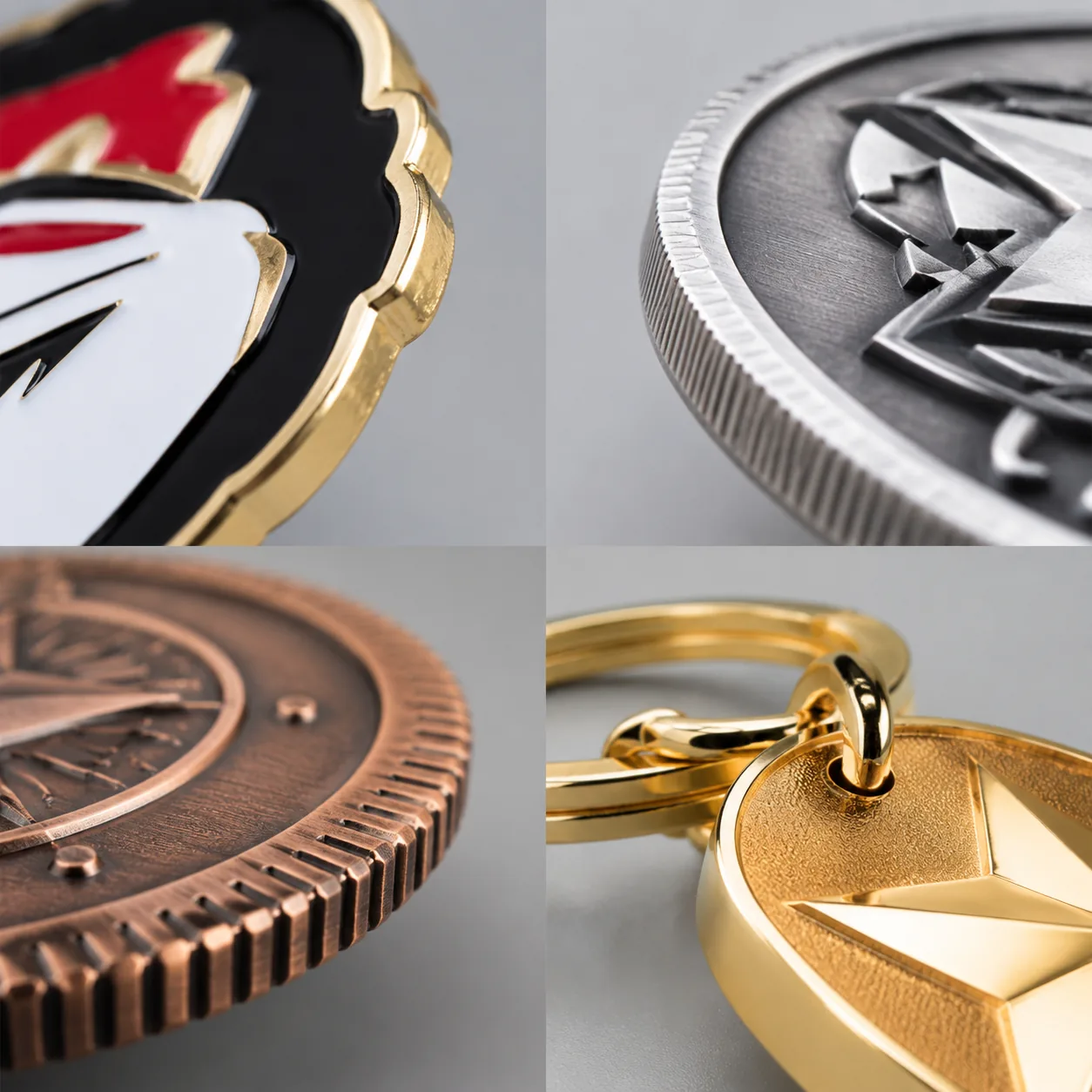
Start With the Smallest Detail, Not the Pin Style
Many buyers request a 25 mm hard enamel pin because it sounds premium. The problem appears when the supplied logo contains 0.10-0.15 mm hairlines, 1.0 mm sponsor names, gradients, drop shadows, halftones, or a full-color mascot. A stamped enamel pin is not a miniature paper print. It is built from recessed color areas separated by raised metal walls. If those walls are too narrow, the die cannot hold the feature cleanly, plating rounds the edge, enamel can flood into the next cell, and polishing can remove the definition the buyer expected.
Offset printed pins solve the opposite problem. The artwork is printed on a flat plated or coated metal surface, then normally sealed with a clear epoxy dome. This construction can reproduce process color, small type, fine linework, QR-like graphics, map details, shaded emblems, and photographic effects that cannot be separated into metal-bordered enamel cells. The trade-off is tactile: printed pins do not have the raised-metal relief of soft enamel or the polished jewelry feel of hard enamel. Unprotected print is also more exposed to scratches.
A reliable sourcing decision starts with measurable artwork limits, not a style preference. Confirm the minimum line width, smallest readable text height, number of colors, gradient requirement, surface feel, target wear life, backing strength, packing method, and inspection level before approving a proof. At ZheCraft, we review vector artwork before quoting and mark any feature below practical production limits. That prevents buyers from approving a clean PDF that fails during tooling, plating, filling, polishing, epoxy curing, packing, or final inspection.
Technical Specification Comparison for 20-35 mm Pins
The ranges below apply to common B2B promotional pins made from iron, brass, or zinc alloy with butterfly clutch or rubber clutch backing, standard individual polybag packing, and FOB China pricing. They are realistic RFQ-screening figures, not fixed quotes. Final cost depends on exchange rate, plating finish, mold complexity, color count, epoxy quality, backing type, packaging, inspection level, and reject allowance.
| Specification | Offset Printed Pin | Soft Enamel Pin | Hard Enamel Pin |
|---|---|---|---|
| Best use | Detailed logos, gradients, photos, small type, QR-like graphics | Bold artwork with clear color zones and raised metal borders | Premium brand pins with simplified artwork and smooth surface |
| Minimum practical line width | 0.10-0.15 mm printed line with high contrast | 0.20 mm possible; 0.25 mm preferred for metal walls | 0.25-0.30 mm because polishing softens edges |
| Minimum readable text height | 1.2-1.5 mm for simple sans-serif text | 2.0-2.5 mm depending on stroke weight | 2.5-3.0 mm for stable readability after polishing |
| Color system | CMYK process print; Pantone simulation; gradients possible | Solid enamel colors; typically 1-8 colors | Solid enamel colors; typically 1-6 colors |
| Surface feel | Flat print under 0.8-1.2 mm epoxy dome | Recessed enamel with raised metal texture | Polished enamel and metal on one smooth plane |
| Base thickness | 1.2-1.5 mm for most 20-35 mm pins | 1.2-1.6 mm iron or zinc alloy | 1.4-1.8 mm zinc alloy or brass for better polishing |
| Plating thickness target | 0.05-0.10 microns economy; 0.10-0.20 microns for better wear | 0.05-0.15 microns standard; 0.20 microns for high-touch orders | 0.10-0.20 microns recommended because polishing exposes defects |
| MOQ tiers | 100 pcs trial; 300 pcs practical; 1,000 pcs freight-efficient | 100 pcs possible; 300 pcs practical; 1,000 pcs better unit cost | 100 pcs possible; 300 pcs practical; 1,000 pcs preferred for premium sorting |
| Typical FOB price, 25 mm, 500 pcs | USD 0.55-0.95 with epoxy and one clutch | USD 0.65-1.10 with up to 4 colors | USD 0.85-1.45 with up to 4 colors |
| Typical FOB price, 35 mm, 500 pcs | USD 0.80-1.35 with epoxy | USD 0.90-1.60 with up to 4 colors | USD 1.15-1.95 with up to 4 colors |
| Sample lead time | 5-7 days after artwork approval | 7-10 days after artwork approval | 8-12 days after artwork approval |
| Mass lead time | 10-16 days for 500-3,000 pcs | 14-22 days for 500-5,000 pcs | 16-26 days for 500-5,000 pcs |
| Primary QC risk | Scratched print, dust, bubbles, cloudy epoxy, registration shift | Low fill, overflow, color bleeding, plating pits | Detail loss, polishing marks, color mismatch, higher reject rate |
There is no universal winner. Offset print wins when logo complexity must remain intact. Enamel wins when the buyer values metal relief, longer wear, and a more premium hand-feel. The correct choice is the one that protects the artwork requirement and the delivery schedule at the same time.
Artwork Detail: Where Each Process Fails
Offset printing is usually the safer choice when critical strokes fall below 0.20 mm. Because the image is carried by ink on a flat surface, it can preserve skyline lines, mascot facial details, small sponsor names, map borders, and shaded badges. For example, a 28 mm event pin with a gradient sky, 1.4 mm sponsor text, and a thin city silhouette should normally be quoted as offset print with epoxy, not hard enamel. Trying to stamp that artwork into enamel will either enlarge the text, delete details, or create muddy metal islands.
Soft enamel needs raised metal between adjacent color areas. For stable mass production, a 0.25 mm metal wall is safer than a theoretical 0.20 mm minimum, especially on black nickel, antique finishes, or pins under 25 mm. Narrow negative spaces inside letters such as A, R, O, and e are common failure points. The mold may reproduce them, but plating and enamel fill reduce the visible separation. A pin can technically follow the approved line art while looking crowded, heavy, or soft at normal viewing distance.
Hard enamel is stricter because the color is overfilled and polished flat. Polishing creates the smooth surface buyers like, but it also rounds metal edges and reduces fine detail. On a 25 mm hard enamel pin, text below 2.5 mm high is risky unless the font is simple, stroke weight is heavy, and contrast is strong. If brand approval depends on tiny letterforms, a detailed mascot expression, or a sponsor lockup, printed construction is usually the more honest recommendation.
Color Control: CMYK Detail or Pantone Solids
Offset printed pins support CMYK artwork, gradients, shadows, skin tones, and photographic detail. They are useful when the approved marketing file already depends on blended color. The limitation is Pantone precision. CMYK can simulate many coated Pantone colors, but bright orange, neon green, deep navy, metallic gold, and some corporate reds may shift after printing at small scale and sealing under epoxy. The correct approval standard is a signed physical sample or calibrated printed proof, not a phone screenshot or monitor view.
Enamel pins use individually mixed solid colors matched to Pantone references. For a logo with two or three brand colors and clean geometry, enamel often gives better repeat consistency than CMYK print. A practical tolerance is a close visual match under D65 or daylight-equivalent lighting. For stricter corporate programs, Delta E targets can be written into the specification. Delta E 2.0-3.0 is realistic for many controlled solid colors; demanding lower values on tiny enamel areas can increase sorting cost and still be affected by gloss, metal reflection, and fill depth.
For repeat orders, the strongest control is an approved golden sample plus retained color chips. PDF files and monitor colors are not production standards. If a campaign will run across several countries or reorder cycles, state whether the priority is Pantone solid coated matching, CMYK appearance, or repeat consistency against the last approved sample. That one instruction prevents disputes when a reorder is technically inside tolerance but looks different from the marketing team's memory of the first batch.
Durability, Epoxy, and Wear Expectations
Hard enamel is usually the best option for daily-wear lapel pins, staff awards, airline or hotel uniforms, and long-running brand programs. The enamel is polished flush with the metal, so the surface is easier to clean and less likely to collect dirt. Soft enamel is durable for promotional use, but the recessed texture can catch fabric fibers or dust when worn on backpacks, lanyards, outdoor volunteer vests, or work jackets. For routine factory checks, specify 300-500 cycles of light dry-cloth rub, tape adhesion testing for printed surfaces, and visual inspection at 30 cm.
Offset printed pins should almost always include clear epoxy. A typical dome height is 0.8-1.2 mm at the center, with controlled edge flow so the epoxy does not spill over the plated rim. Epoxy protects the ink from packing abrasion, fingernails, and clutch contact during handling. Without epoxy, dark printed areas can show scratches before distribution, especially when pins are bulk packed or stacked tightly in export cartons.
Epoxy has limits. It can yellow after long UV exposure, trap micro-bubbles if curing is rushed, or feel less premium than polished metal. It is usually acceptable for conferences, fundraising campaigns, retail blind bags, school events, tourist merchandise, and short-term promotions. For executive recognition, luxury retail, long-service awards, or uniform programs expected to last several years, hard enamel or tightly sorted soft enamel is normally worth the extra cost.
Pricing, MOQ, and Lead Time by Quantity Tier
For a simple 25 mm design at 500 pcs, offset print and soft enamel can be close in price. Printed pins avoid multiple manual enamel-fill steps, but they still require base metal production, plating, print setup, epoxy, backing attachment, inspection, and packing. The savings become clearer when the artwork has many colors because CMYK print does not add cost in the same way as eight enamel colors, glitter fills, transparent colors, or extra manual cleaning.
At 100 pcs, mold and setup cost dominate, so unit prices are high and differences between constructions are less meaningful. A 25 mm pin may quote around USD 1.20-2.80 FOB depending on construction and packing. At 300 pcs, soft enamel becomes practical and offset print gains an advantage for full-color art. At 1,000 pcs, a 25 mm order may fall roughly into USD 0.45-0.80 for offset print, USD 0.55-0.95 for soft enamel, and USD 0.75-1.25 for hard enamel, assuming standard clutch, polybag, and no retail card.
Lead time should be counted from final artwork approval, not from the first RFQ email. A realistic schedule is 1-2 days for artwork check and digital proof, 5-12 days for pre-production sample, then 10-26 days for mass production after sample approval. If the event date is inside three weeks, hard enamel is risky unless the design is simple, the supplier has open capacity, and the buyer accepts air freight plus limited rework time. Offset print with epoxy or simplified soft enamel usually carries less schedule risk.
Inspection Standards and AQL Focus
Printed and enamel pins should not be inspected with the same checklist. For offset printed pins, key checks include print registration within plus or minus 0.15 mm, no visible ink scratches at 30 cm, no cloudy epoxy, no dust trapped in the main logo area, and no bubbles above 0.3 mm in critical areas. Small bubbles outside the logo may be classified as minor defects if they are not visible during normal use.
For enamel pins, inspection should focus on fill height, exposed borders, plating quality, color accuracy, polishing marks, and attachment strength. Size tolerance of plus or minus 0.3 mm and thickness tolerance of plus or minus 0.2 mm are practical for most promotional pins. For attachments, specify no detachment under 5 kgf for 10 seconds when the pin will be worn on uniforms, bags, or event lanyards. For magnetic backs or deluxe clutches, confirm the backing type before testing because failure modes differ.
Many promotional buyers use AQL 2.5 for major defects and AQL 4.0 for minor defects. Retail, licensed merchandise, and staff-award programs often justify AQL 1.5 major and 2.5 minor, but that tighter level should be stated before pricing because it requires more sorting and a higher reject allowance. Zero-defect language without paid inspection is not realistic for metal pins involving manual filling, polishing, plating, assembly, epoxy curing, and packing.
- Measure the smallest required text height in millimeters before choosing construction.
- Flag any line below 0.20 mm and any enamel wall below 0.25 mm as a production risk.
- Confirm whether gradients must remain gradients or may be converted to solid Pantone colors.
- Approve one physical pre-production sample for orders above 1,000 pcs or any licensed artwork.
- Specify plating color, plating thickness target, epoxy requirement, backing type, and packaging method in the PO.
- Define AQL level, viewing distance, major defects, minor defects, and golden sample control before mass production.
RFQ Guidance: Write the Specification Before Sampling
A strong RFQ should include vector artwork, target size, quantity, construction preference, plating finish, attachment, packaging, delivery deadline, and the smallest detail that must remain readable. If the design is borderline, ask for two quotes: offset printed with epoxy and enamel with simplified artwork. Comparing those two physical samples gives the buyer a decision based on appearance, cost, and risk instead of a theoretical debate about which process is better.
Do not choose offset print when the buyer expects raised metal borders, heavy badge depth, or a jewelry-like finish. Do not choose soft enamel when the artwork depends on gradients, small sponsor logos, thin outlines, or photographic detail. Do not choose hard enamel when timing is short, budget is tight, or tiny text is mandatory. Forcing the wrong process usually creates sample delays, artwork revisions, rejected proofs, and approval friction.
For a safe purchase order, write the final specification clearly: construction method, size tolerance plus or minus 0.3 mm, thickness tolerance plus or minus 0.2 mm, minimum readable text requirement, plating thickness target, epoxy requirement, backing pull test, AQL level, packaging method, and approved golden sample. If the logo must preserve detailed artwork, offset print with epoxy is often the cleanest solution. If the pin must feel premium and withstand long wear, enamel usually earns the extra cost.
Have a project? Send your artwork and target quantity and we’ll reply with a detailed quotation within 12 working hours.
Ready to get this made?
Send your sketch, target quantity and ship-date. Detailed quotation in 12 hours.



