Offset Printed vs Enamel Pins for Detailed Logos
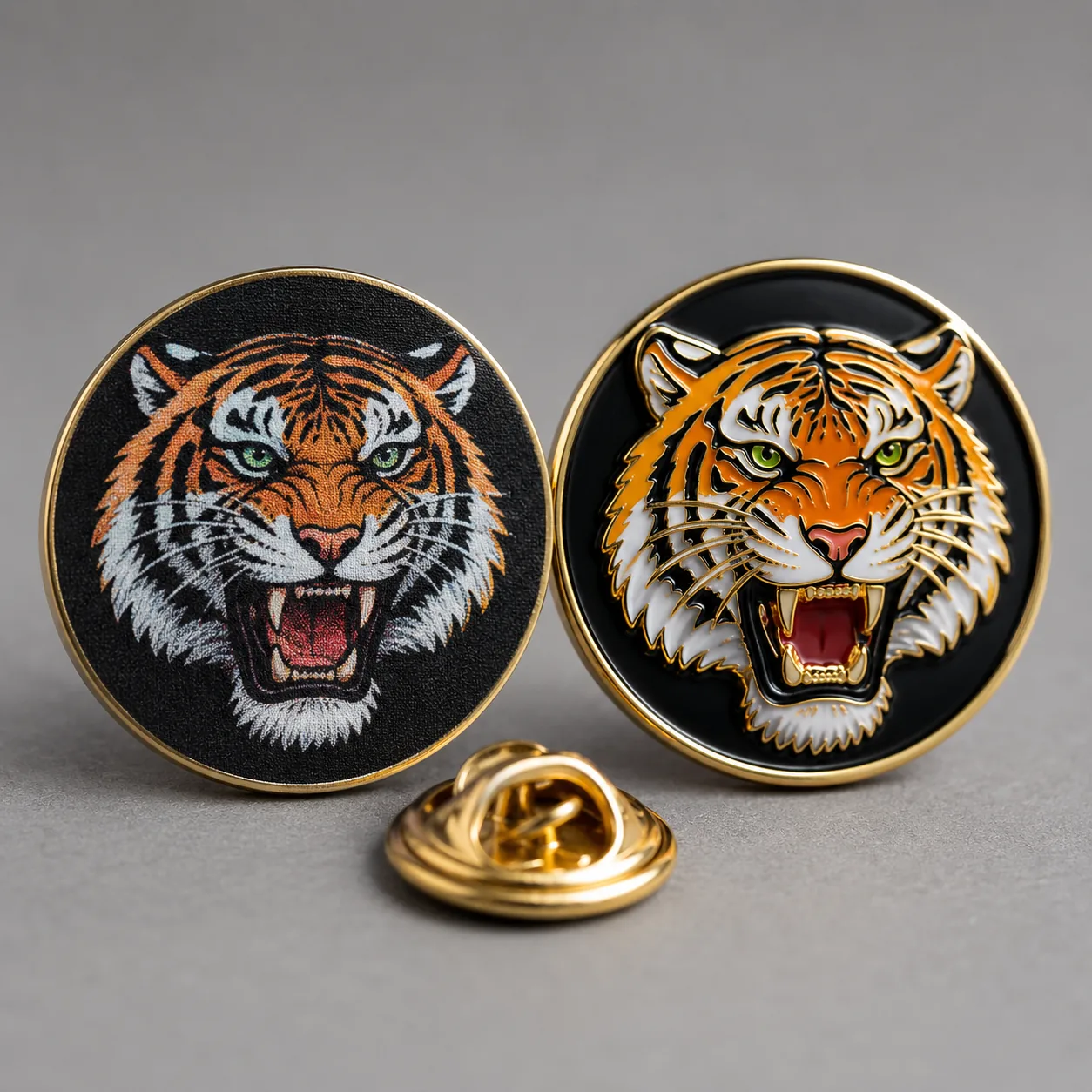
When Enamel Cannot Hold the Logo Detail
A common RFQ for a 25 mm lapel pin includes a five-color logo, 0.25 mm legal text, a gradient shadow, a QR-style mark, and a request for hard enamel because it is considered the premium option. The conflict is technical, not aesthetic. Enamel pins need raised metal walls between color fields. At lapel-pin scale, those walls occupy the same space needed for small letters, hairline gaps, transparent shadows, and tight icon geometry.
Offset printed pins solve that problem by printing the image on a plated metal base, then sealing it with clear epoxy or a flat clear coat. Enamel pins solve a different problem: they convert simplified artwork into a dimensional metal item with tactile value. Neither process is automatically better. The right choice depends on which design features must survive reduction to 18–40 mm and which defects the buyer can accept.
The ranges below reflect typical custom pin production in zinc alloy, iron, or brass, mainly for 25–35 mm pins at 300–5,000 pieces. Prices are indicative USD FOB China for standard butterfly clutch packing. Final cost varies with metal thickness, plating, backing card, epoxy type, mold complexity, seasonal capacity, exchange rate, and inspection requirements.
Sourcing Specification Comparison
Use the table before requesting quotes. It prevents the common mistake of comparing an accurate printed sample with an enamel quote that has already simplified the artwork. For a fair comparison, hold constant the finished size, plating, attachment, packing, backing card, sample approval process, and inspection level.
| Spec | Offset Printed Pin | Soft or Hard Enamel Pin |
|---|---|---|
| Best artwork fit | Gradients, photographs, sponsor logos, seals, map graphics, QR-like marks, and high-contrast text down to 0.30–0.40 mm | Bold logos, mascots, crests, icons, separated spot colors, raised outlines, and collectible merchandise |
| Economical size range | 18–50 mm possible; 25–35 mm most cost-efficient | 15–60 mm possible; 20–40 mm most cost-efficient |
| Minimum readable text | 0.40 mm preferred; 0.30 mm only for dark-on-light print with no epoxy glare over the text | 0.80 mm preferred; 0.60 mm only after stroke thickening and wider metal bridges |
| Minimum line width | 0.12–0.18 mm printable line; keep critical artwork at least 0.30 mm from the cut edge | 0.30 mm raised metal for soft enamel; 0.35 mm safer for hard enamel after polishing |
| Color method | CMYK process with Pantone simulation; gradients possible; neon, reflex blue, and deep navy may shift | Pantone-matched enamel pigments; each solid color normally needs metal separation |
| Surface feel | Flat print with 0.60–1.20 mm epoxy dome or thin clear coat; glossy unless matte epoxy is specified | Soft enamel has recessed color; hard enamel is polished nearly flush with the metal |
| Typical thickness | 1.20–1.80 mm metal base; 2.00–2.80 mm total with epoxy dome | 1.20–2.00 mm base; 1.50 mm common for 25–30 mm pins |
| Decorative plating | Nickel, gold, black nickel, copper, or antique finish commonly 0.08–0.15 microns | Same range; hard enamel polishing needs tighter control to avoid exposed edges |
| MOQ tiers | 100 pcs possible; 300 pcs practical; 500+ pcs improves print setup efficiency | 100 pcs possible; 300 pcs practical; 500+ pcs spreads mold, filling, baking, and polishing labor |
| FOB price at 500 pcs | 25 mm: USD 0.42–0.85; 35 mm: USD 0.58–1.15, depending on epoxy, shape, and packing | 25 mm soft enamel: USD 0.48–0.95; 25 mm hard enamel: USD 0.65–1.25; add 15–30% for 35 mm |
| Tooling | USD 40–90 for simple custom outline; USD 80–180 for complex cut shape; less with stock base | USD 60–120 for simple mold; USD 120–220 for cutouts, multi-level relief, or narrow islands |
| Sample lead time | 5–8 days after approved production artwork | 7–10 days for soft enamel; 9–14 days for hard enamel |
| Mass lead time | 10–16 days after sample approval for 500–3,000 pcs | 12–20 days for soft enamel; 15–25 days for hard enamel |
| Critical QC risks | Dust under epoxy, bubbles, color drift, print misregistration, dome overflow, edge lifting | Low fill, enamel bleed, thin bridges, plating stains, polishing scratches, weak posts |
| Inspection target | AQL 2.5 major, 4.0 minor; print position within ±0.20 mm and color checked under D65 light | AQL 2.5 major, 4.0 minor; verify fill height, plating adhesion, post strength, and dimensions |
The practical trade-off is clear: offset print buys image fidelity and speed; enamel buys metal depth and collectible feel. The best quote is the one that protects the buyer’s non-negotiable artwork feature, not simply the lowest unit price.
Artwork Limits: Text, Lines, and Color
Offset printing is the safer route for photographic shading, flags with seals, product renderings, museum art, sponsor walls, and campaign marks with small text. Production files should include 300 dpi minimum raster artwork at final size, vector cut lines, bleed where required, and Pantone or CMYK references. Keep logos, borders, and text at least 0.30 mm inside the metal edge because normal print-to-cut registration tolerance is about ±0.20 mm.
Enamel artwork must be redrawn as manufacturable color islands. For soft enamel, specify raised metal ridges of at least 0.30 mm and enamel channels of at least 0.40 mm. For hard enamel, use 0.35 mm ridges and 0.45 mm channels where possible because polishing removes high points and can weaken narrow raised details. If the screen artwork has 0.25 mm strokes, expect them to be thickened, merged, or deleted before production.
Color control differs by process. Offset print can simulate Pantone colors, but results depend on CMYK conversion, ink density, substrate color, and epoxy optics. Bright orange, neon green, reflex blue, and dark navy are frequent shift risks. A Delta E target under 3 is realistic for controlled solid areas, while gradients may vary more. Enamel uses mixed pigments closer to spot-color matching, commonly Delta E 2–4 against a Pantone-coated reference, but it cannot create a true fade without adding print on top.
QR-style marks need special caution. A decorative code may look sharp on screen but fail after epoxy reflection, metal cutting tolerance, or enamel bridge expansion. If scanning is required, test the code at final pin size before sampling. In many cases, a printed backing card is a better location for a functional QR code than the pin face.
Durability and Use Conditions
For a conference giveaway, product launch, school event, or short campaign, an offset printed pin with epoxy is usually durable enough. The epoxy protects ink from fingernails, moisture, and light abrasion if it is clean, fully cured, and 0.60–1.20 mm thick. The main risks are long UV exposure, visible scratches, edge lifting, and impact dents. For indoor wear over a few days, those risks are normally acceptable.
Enamel is better for pins expected to be collected, resold, or worn for months. Soft enamel protects color by recessing it below raised metal. Hard enamel is polished smooth, which reduces snagging on fabric and gives a higher-end hand feel. Both rely on plating quality. Decorative plating around 0.08–0.15 microns is common, but heavy-use merchandise, children’s items, staff badges, or outdoor programs may need thicker plating, a clear protective coat, or stainless fittings.
Do not choose offset print for backpack, luggage, outdoor uniform, or children’s bag pins unless cosmetic scuffing is acceptable. The image may remain readable, but the epoxy surface will show scratches sooner than enamel. Do not force hard enamel onto artwork with tiny disclaimers, transparent shadows, or faces. The sample may feel expensive, but the simplified logo may not pass brand approval.
Cost, MOQ, and Lead-Time Reality
At 500 pieces, offset print is often cheaper for complex artwork because it avoids multiple enamel-filling passes and hard-enamel polishing. A 25 mm printed pin with butterfly clutch and individual polybag commonly falls between USD 0.42 and 0.85 FOB China. The same size soft enamel pin usually runs USD 0.48–0.95. Hard enamel often lands at USD 0.65–1.25 because polishing, rework, and reject control add labor.
MOQ language matters. Many factories will accept 100 pieces, but 300 pieces is usually the practical floor for stable pricing, sample amortization, and reasonable production priority. At 500 pieces, setup cost is spread more efficiently. At 1,000–3,000 pieces, buyers can often negotiate better packing cost, carton labeling, and pre-shipment inspection support. Below 100 pieces, suppliers may quote promotional pricing but have limited appetite for color rework or repeated sampling.
Price changes quickly with options. Moving from 25 mm to 35 mm can add 15–35% depending on metal weight and epoxy area. A backing card adds about USD 0.03–0.12, a rubber clutch USD 0.02–0.06, and two posts instead of one USD 0.03–0.08. Retail polybagging with barcode labels can add USD 0.04–0.15 per set. These adders are small individually but material in a 5,000-piece program.
Lead time favors print when deadlines are tight. Offset printed samples are commonly ready in 5–8 days after artwork approval. Soft enamel samples need 7–10 days, and hard enamel samples need 9–14 days. For mass production under 3,000 pieces, printed pins often need 10–16 days after sample approval. Soft enamel usually needs 12–20 days, and hard enamel needs 15–25 days because plating, filling, baking, polishing, and inspection queues stack up before trade shows and holiday campaigns.
Appearance and Perceived Value
Offset printed pins look strongest when exact artwork matters. They suit sponsor logos, destination graphics, character art, commemorative photos, and designs that must match a brochure or campaign page. The trade-off is physical depth: even with a metal base, the product can read more like a glossy badge than a sculpted metal item. Epoxy adds depth but also reflects overhead lighting, which can reduce readability for very small text.
Soft enamel gives more texture because raised metal lines sit above recessed color. It works well for club pins, staff recognition, nonprofit campaigns, school badges, and distributor programs where buyers want a custom metal feel without hard-enamel cost. Hard enamel feels smoother and more premium, especially for retail merchandise, executive recognition, and limited editions. However, polishing can soften tiny raised details and flatten shallow relief if the mold is too fine.
Weight and attachment also affect perceived value. A 30 mm pin at 1.50 mm thickness with two posts feels more stable than a thin 0.80 mm stamped pin, regardless of decoration method. For designs over 40 mm, use two posts, a bar pin, or a magnetic backing to reduce rotation and fabric sagging. If the pin will be sold rather than given away, specify the attachment and backing card before sampling because they influence both appearance and landed cost.
QC Checklist for the Purchase Order
Printed and enamel pins fail in different ways, so a generic inspection note is not enough. For printed pins, define print position tolerance at ±0.20 mm, epoxy edge coverage at ±0.15 mm, and reject criteria for dust, bubbles, scratches, and color drift. Bubbles over 0.30 mm, visible dust in the logo area, or epoxy overflow that can be felt at the rim should be treated as major defects.
For enamel pins, define fill height, metal-line integrity, plating appearance, and attachment strength. Soft enamel fill is commonly 0.10–0.30 mm below the raised metal ridge. Hard enamel should be nearly flush, with no visible pits, over-polished bridges, or stained plating. Standard dimensional tolerance is usually ±0.20 mm for length and width and ±0.10 mm for thickness on 25–35 mm pins.
- Set inspection to AQL 2.5 for major defects and AQL 4.0 for minor cosmetic defects; tighten limits for retail, licensed, or safety-sensitive programs.
- Approve one sealed golden sample showing plating, epoxy or enamel finish, back stamp, attachment, backing card, and bagging method.
- Check printed colors under D65 daylight and record Delta E targets when brand color is critical.
- Reject printed pins with dust in the logo area, bubbles larger than 0.30 mm, print misalignment over ±0.20 mm, or epoxy overflow at the rim.
- Reject enamel pins with missing fill, exposed base metal, plating burns, loose posts, sharp burrs, or obvious color mismatch from the approved sample.
- Pull-check posts and clutches from random cartons; weak soldering is a functional defect, not a minor cosmetic issue.
- For orders above 2,000 pcs, require front, back, side-thickness, attachment, packing, and random-carton photos before shipment.
Add a simple rub test for dark print, black nickel, antique plating, and back stamps. Wipe the surface with a dry white cloth. Any visible transfer indicates curing, plating, or ink-adhesion risk. This check costs almost nothing compared with replacing an event order after cartons arrive at the venue.
Decision Rules Before Sample Approval
Choose offset printed pins when the artwork is the product. Strong examples include a 28 mm tourism pin with a skyline gradient, a museum pin using painting detail, a sponsor-wall event pin with ten small logos, or a campaign badge that must preserve a QR-like graphic. Offset print is also practical when the buyer has less than three weeks from artwork approval to ex-factory completion, excluding international transit.
Choose enamel when the product needs a collectible metal identity and the design can be simplified cleanly. Good examples include a two-color corporate recognition pin, a school mascot with thick outlines, a club crest with six or fewer solid colors, or a retail series where weight and texture matter. If the logo has clear color borders, no photographic effects, and text above 0.80 mm, enamel usually gives the better balance of durability and perceived value.
Use hybrid construction when both precision and texture are required. A soft enamel pin can carry the main outline and brand colors while a small offset-printed insert handles a face, map, gradient, or detailed seal. Hybrid work commonly adds USD 0.10–0.35 per piece on 25–35 mm pins and may add 2–4 production days, but it prevents the common failure where enamel looks premium yet loses the brand detail that justified the order.
Before sending an RFQ, print the design on paper at 100% final size. If the slogan, legal line, or thin outline is unreadable on paper, it will not become clearer in metal. Mark which elements are mandatory, which can be enlarged, and which can be removed. Then ask the factory for a manufacturability review with minimum line widths, readable text limits, tooling cost, sample lead time, mass lead time, and QC criteria stated in writing. A quote that returns only a unit price is not complete enough for a purchasing decision.
Have a project? Send your artwork and target quantity and we’ll reply with a detailed quotation within 12 working hours.
Ready to get this made?
Send your sketch, target quantity and ship-date. Detailed quotation in 12 hours.



