Offset Printed Pins and Badges: Production Specs for Fine Artwork
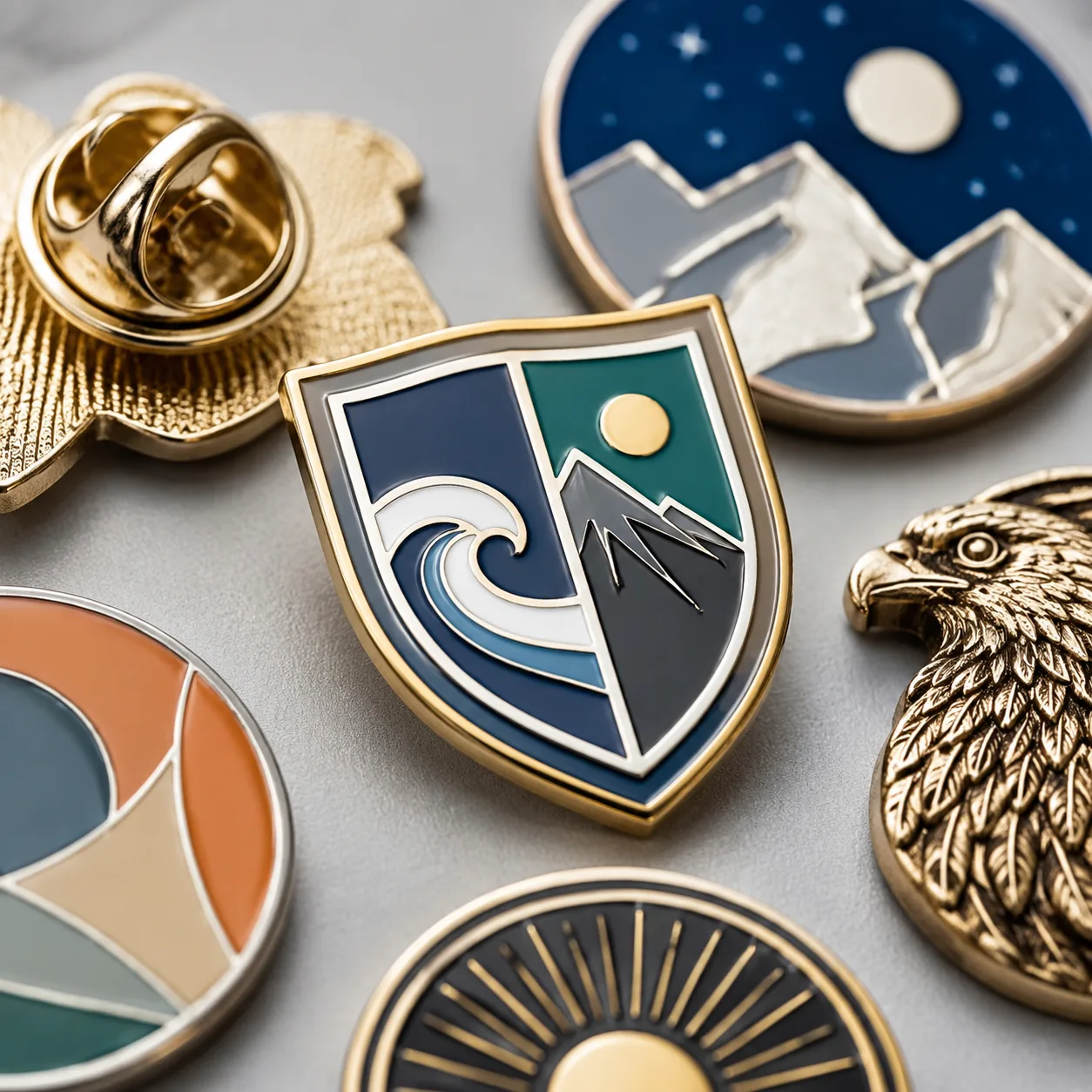
Use Offset Printing When Enamel Loses Detail
Offset printed pins and badges solve a specific manufacturing problem: artwork that looks correct on screen but cannot be separated into enamel cells without losing information. Soft and hard enamel require raised metal lines between color areas. Those lines are usually 0.18 to 0.25 mm wide at minimum, and enamel color areas need enough open space to fill cleanly. That makes enamel poor for gradients, skin tones, photo backgrounds, map detail, small sponsor logos, halftones, shaded crests and fine QR codes.
Offset printing keeps the artwork flat and photographic. The image is printed onto a plated metal, stainless steel, aluminum or acrylic base, then protected with epoxy, UV varnish or a clear film. It is the right process when artwork fidelity matters more than raised metal texture: museum merchandise with paintings, sports event badges with many sponsor marks, corporate campaign pins, school crests with fine lettering, tourism magnets and commemorative brooches with portraits.
It is not automatically cheaper or more durable than enamel. Printed badges depend on coating quality, cure time and packing discipline. A printed pin used once at a conference can use lighter specifications than a keychain handled daily. At RFQ stage, review the artwork at 1:1 size. If a 25 mm badge contains text below 1.2 mm high, line work below 0.15 mm, soft shadows, or colors that cannot be assigned to solid Pantone fills, offset printing or a printed-enamel hybrid is usually safer than forcing the design into standard enamel.
Choose the Base Construction Before Quoting
The base material controls weight, edge quality, tooling cost and durability. Most printed metal pins use iron or zinc alloy. Iron is economical for flat badges, event pins and magnets; a 0.8 to 1.2 mm iron blank is common for 25 to 40 mm pieces. Zinc alloy costs more but gives better thickness, rim definition and hand feel. For premium brooches, coins or badges with raised borders, 1.5 to 3.0 mm zinc alloy is the normal range.
Stainless steel suits clean corporate name badges and corrosion-resistant styles, but plating options are more limited. Aluminum is light and low cost for larger pieces, yet it dents more easily than iron or zinc alloy. Acrylic works well for bright charms, keychains and lightweight promotional items, especially when reverse printing protects the image behind the material, but acrylic edges scratch and can crack if hardware holes are too close to corners.
| Build | Best use | Typical specification | Main advantage | Main risk |
|---|---|---|---|---|
| Iron plus offset print plus epoxy | Budget pins, event badges, magnets | 0.8 to 1.2 mm iron; 0.3 to 0.8 mm epoxy dome | Low tooling cost with strong print detail | Thin oversized pieces can bend |
| Zinc alloy raised rim plus printed insert | Premium badges, coins, brooches | 1.5 to 3.0 mm zinc alloy; 0.4 to 0.8 mm epoxy | Better weight and protected artwork edge | Higher mold cost and longer polishing time |
| Stainless steel plus flat print | Name badges, corporate badges | 0.8 to 1.5 mm stainless; UV varnish or thin epoxy | Clean surface and good corrosion resistance | Fewer plating colors and visible scratches |
| Acrylic reverse print | Keychains, charms, lightweight tags | 2.0 to 4.0 mm acrylic sheet; 1.5 to 2.0 mm hole offset minimum | Bright color with low unit weight | Cracked holes and scratched edges |
| Hybrid enamel plus offset detail | Collector pins, crests, mascots | 1.2 to 2.0 mm metal base; printed eyes, text or gradients | Combines raised metal with fine printed features | More registration and coating checks |
For artwork with a printed center and metal border, specify the rim height and rim width. A 0.3 to 0.5 mm raised rim helps contain epoxy and protects the print edge. On very small pins, keep the rim at least 0.6 mm wide so polishing does not expose uneven plating or distort the printed area.
Artwork Specs That Prevent Soft Printing
Offset printing is more sensitive to source files than simple enamel. Provide vector AI, PDF or EPS files for logos, text, cut lines and QR codes. Embed photographic or painted raster artwork at 600 dpi at final production size. A 30 mm badge needs an image roughly 709 pixels wide at 600 dpi; using a 300 pixel web image will print soft after color separation, coating and final inspection. Clean 450 dpi artwork can pass for some photographic designs, but 600 dpi gives safer detail retention.
Separate the cut line, print bleed and safe area. A practical standard is 1.0 mm bleed beyond the trim edge and 1.0 to 1.5 mm safe area inside the trim edge for logos, faces and text. For round pins and die-cut shapes, keep critical elements at least 1.5 mm from the edge because die cutting, polishing and plating create real variation. Standard production tolerance is plus or minus 0.2 mm for print registration on metal badges and plus or minus 0.3 mm on acrylic or large magnets.
Small text needs a production limit, not only a design preference. Dark text on a light background can be readable at 1.0 mm capital height on a controlled sample, but 1.3 to 1.5 mm is safer for mass production. Reversed white text on dark color should be at least 1.5 mm high, with strokes no thinner than 0.18 mm. Fine line art should stay above 0.12 to 0.15 mm depending on contrast. QR codes should be supplied as vector files and tested from a printed 1:1 proof; for reliable phone scanning on a giveaway badge, use at least 18 by 18 mm after allowing the quiet zone.
- Provide AI, PDF or EPS vector files for logos, outlines, text paths and QR codes.
- Embed raster artwork at 600 dpi at final size; do not enlarge low-resolution web images.
- Add 1.0 mm bleed and keep critical text or logos 1.0 to 1.5 mm inside the trim edge.
- Avoid reversed text below 1.5 mm capital height or strokes below 0.18 mm.
- Use CMYK values, Pantone references or an approved physical sample as the color target.
- Print and scan QR codes at 1:1 size before releasing mass production.
Control Color, Plating and Coating Together
Offset printing uses CMYK process color, so it will not match every Pantone solid exactly. Bright orange, neon green, metallic gold, reflex blue and deep corporate navy are common risk colors. If brand color is critical, define the standard before sampling. Many buyers use Delta E 3 to 5 as a practical visual target for printed areas, but the enforceable reference should be an approved physical sample viewed under D65 or neutral daylight. For strict logos, add a spot-color screen print layer for one or two key colors rather than relying only on CMYK.
Plating remains important because most printed badges include a border, back face or raised metal detail. For promotional nickel, gold, black nickel and antique finishes, specify 3 to 5 microns plating thickness. Use 5 to 8 microns when the item needs better wear resistance, a richer gold tone or more handling durability. Flash plating below 2 microns may save a few cents, but it increases the risk of rub-through on high points, inconsistent color between batches and visible base metal after use.
The protective coating changes appearance and service life. Epoxy doming is typically 0.3 to 0.8 mm above the print surface. It gives high gloss, protects ink from direct abrasion and hides minor print texture, but it adds a lens effect and can look less premium on fine-art designs. UV varnish is much thinner, usually 10 to 25 microns, and keeps the surface flatter. It suits conference lapel pins and name badges, but it is less forgiving for keychains, bag charms and magnets shipped in bulk. Matte varnish should be sampled carefully because it shows rub marks sooner than gloss.
MOQ, Price and Lead-Time Benchmarks
Offset printing reduces color complexity, but the factory still needs cutting dies or molds, plating setup, print setup, coating, curing, inspection and packing. The cost advantage appears when the artwork has many colors, gradients or small details that would make enamel filling slow or impossible. For a simple two-color logo with strong outlines, soft enamel may still be cheaper and more tactile.
For custom metal printed pins in the 25 to 35 mm range, 100 pieces is often possible for a small campaign or pilot run, but 300 to 500 pieces is the efficient MOQ tier. Acrylic keychains usually start at 100 to 300 pieces depending on hardware and print method. New tooling commonly runs 35 to 120 USD for simple flat iron shapes, 80 to 180 USD for more complex cut shapes and 120 to 280 USD for zinc alloy pieces with raised rims or 3D relief. Prices below are typical FOB China ranges for normal artwork, standard plating and individual polybags; retail cards, barcodes and premium packaging add cost and time.
| Item type and size | MOQ tier | Typical FOB unit range | Sample lead time | Mass lead time |
|---|---|---|---|---|
| 25 to 30 mm iron printed pin with epoxy | 300 to 500 pcs | 0.45 to 0.95 USD | 7 to 10 days | 12 to 18 days |
| 35 to 45 mm zinc alloy printed brooch | 300 to 500 pcs | 0.90 to 1.80 USD | 8 to 12 days | 15 to 22 days |
| 50 to 70 mm printed fridge magnet | 500 to 1000 pcs | 0.55 to 1.40 USD | 7 to 11 days | 14 to 20 days |
| 40 to 60 mm acrylic printed keychain | 300 to 500 pcs | 0.50 to 1.25 USD | 6 to 10 days | 12 to 18 days |
| Hybrid enamel plus offset detail pin | 300 to 500 pcs | 0.85 to 1.90 USD | 9 to 14 days | 18 to 26 days |
Rush orders are realistic only when artwork is final, plating is standard and packaging is simple. Custom backing cards, barcode labels, retail cartons, FSC paper requests or client-specific carton marks can add 3 to 7 days for proofing and packing. Courier delivery usually adds 3 to 5 working days after shipment release. Sea freight can take 25 to 40 days depending on route, consolidation schedule and customs clearance.
Inspect Samples and Mass Production by Failure Mode
The main defects in offset printed badges are different from enamel defects. Instead of low enamel fill or uneven polishing, inspect for color shift, dot gain, dust under epoxy, bubbles, image misregistration, coating overflow, coating delamination, scratches around the rim and burrs on the back. Inspect samples under normal daylight, then tilt them under a strong lamp. Dust, trapped fibers and faint coating waves often appear only at a low angle.
For normal promotional orders, AQL 2.5 for major defects and AQL 4.0 for minor defects is a practical inspection level. Retail-critical orders can tighten to AQL 1.5 major and 2.5 minor. Major defects should include wrong artwork, unscannable QR code, color clearly outside the approved sample, coating peeling, sharp burrs, broken attachments, heavy front scratches and missing plating. Minor defects can include tiny edge marks, slight epoxy waviness outside the logo area, small back-side plating variation or pin posts slightly off center if function is unaffected.
Functional tests should match the product. For lapel pins, pull-test the clutch, nail or brooch bar to 2 to 3 kgf for a basic promotional standard. Heavier brooches should be tested higher by agreement. For keychains, test jump rings and split rings to 5 to 8 kgf depending on wire gauge. For magnets, test holding strength on 0.8 to 1.0 mm painted steel, not only on a thick factory bench. For acrylic charms, check hole cracking after ring assembly and after a short drop test from desk height.
- Approve a physical pre-production sample before mass production, not only a digital mockup.
- Check print registration within plus or minus 0.2 mm for metal badges.
- Reject bubbles or dust larger than 0.3 mm in faces, logos, QR codes or key artwork areas.
- Scan each QR or barcode type from the coated sample before approving the order.
- Use AQL 2.5 major and AQL 4.0 minor for normal promotional shipments.
- Define attachment pull-test values and magnet holding requirements before production starts.
Pack Printed Surfaces to Avoid Transit Damage
Printed surfaces are more vulnerable during packing than recessed enamel. Epoxy protects the ink, but it can take pressure marks if pieces are stacked face-to-face before full cure. UV varnish and matte coatings scratch more easily, so they need separators or individual bags. Do not approve bulk packing for retail goods only to reduce the unit price; the savings can disappear if the clear coating arrives rubbed or the backing cards arrive dented.
For standard pins, an individual opp bag plus backing card is usually enough. For glossy printed keychains or magnets, add a paper separator or use single-compartment bags so hardware cannot rub the face. Keep export cartons under 12 to 15 kg gross weight for dense metal items. Inner cartons of 100 to 250 pieces improve counting and reduce damage during warehouse repacking.
Large magnets and acrylic charms need extra edge protection. If the piece is above 60 mm or has sharp corners, specify 2 to 3 mm clearance inside the retail pack or add bubble wrap for bulk shipments. For sea freight, use moisture control when paper cards are included. Damp cartons can stain cards, dull plating and create claims even when the printed badge itself remains usable.
Build a Precise RFQ Before Tooling
Start by deciding whether the artwork truly needs offset printing. If the design has solid colors, large shapes and strong metal outlines, enamel may give a more durable and dimensional result. If it contains gradients, photo elements, tiny sponsor logos, detailed crests or QR codes, build the RFQ around print fidelity, coating choice and inspection criteria.
A complete RFQ should include final size, base material, thickness, plating finish, coating type, attachment, quantity tiers, packing method and 1:1 artwork files. State the production controls clearly: print registration plus or minus 0.2 mm for metal badges, general size tolerance plus or minus 0.3 mm for small metal pieces, plating thickness 3 to 5 microns unless otherwise agreed, epoxy height 0.3 to 0.8 mm, and AQL 2.5 major and 4.0 minor for shipment inspection. For daily-use items such as keychains, specify epoxy protection and hardware pull testing instead of a thin varnish.
When comparing suppliers, request one safest-build quotation and one cost-down quotation. A useful factory review should flag unreadable text, weak QR size, risky brand colors, poor coating choice, thin plating, unsuitable attachment hardware or packaging that allows abrasion. That check before tooling is where most rework is prevented, especially for orders with detailed artwork and tight launch dates.
Have a project? Send your artwork and target quantity and we’ll reply with a detailed quotation within 12 working hours.
Ready to get this made?
Send your sketch, target quantity and ship-date. Detailed quotation in 12 hours.



