Offset Print vs Screen Print for Custom Pins and Keychains
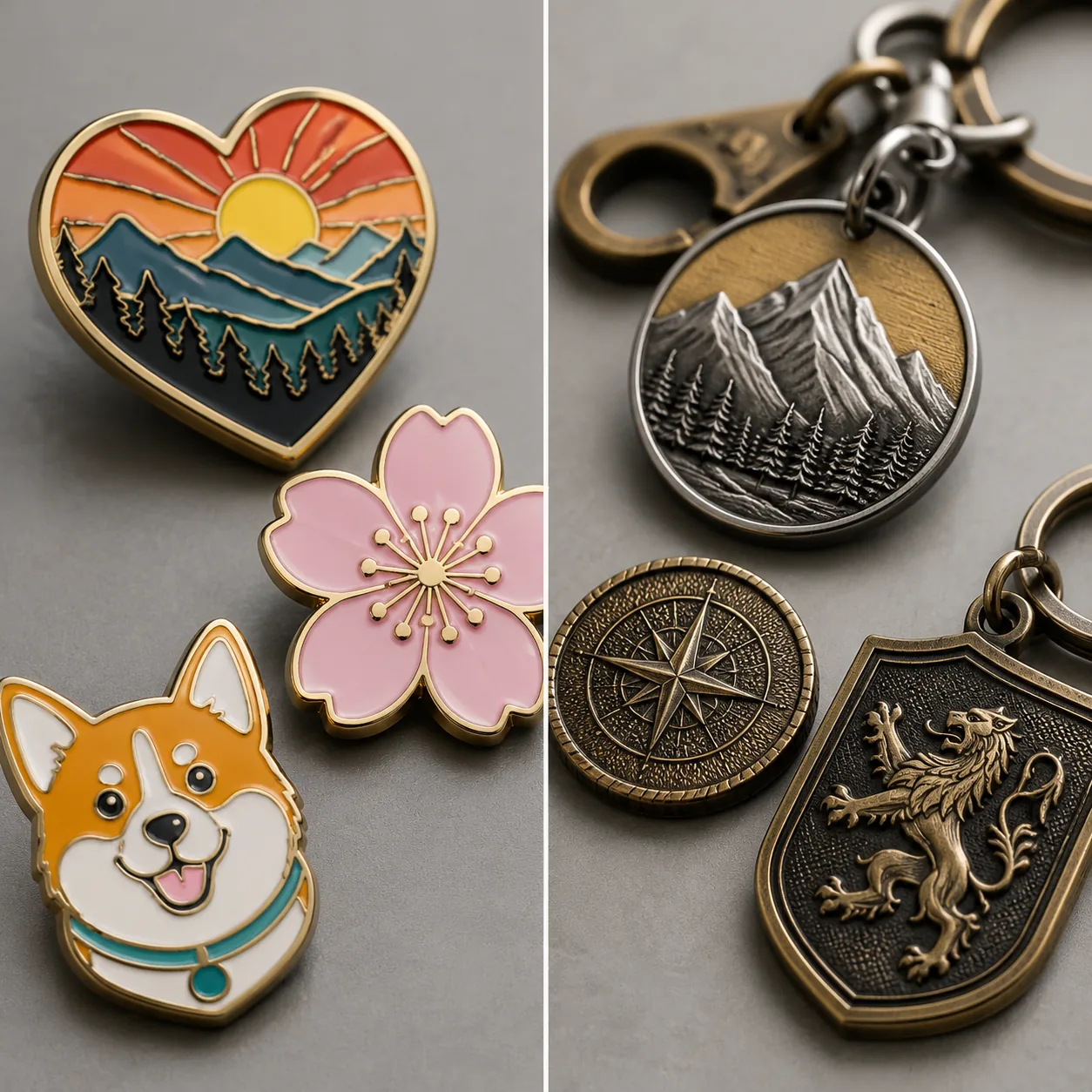
Start With the Artwork, Not the Unit Price
A buyer sends a 30 mm metal pin design with a full-color mascot, 0.4 mm eye highlights, a gradient shadow and a 6 pt URL. One factory quotes offset print with epoxy. Another quotes screen print. The screen-print price may look 15 to 25 percent lower, but the cheaper process can fail if the artwork depends on photographic detail or smooth tonal changes.
Offset print and screen print are both valid for custom pins and keychains, but they solve different production problems. Offset print is strongest when the design has CMYK artwork, gradients, character illustrations, small color transitions or more than four colors in a compact area. Screen print is stronger when the artwork uses flat Pantone colors, simple logos, safety icons, text blocks or bold geometric shapes.
A 35 mm keychain can be correct as offset print for an esports character, screen print for a two-color corporate logo, or enamel for a premium logo with raised metal borders. The right decision depends on artwork type, viewing distance, base metal, plating color, expected wear and packaging. Price should be compared only after those variables are aligned.
Specification Comparison for Buyers
The table below is a practical RFQ and purchase-order starting point. Exact limits vary by item shape, surface flatness, ink system, curing method and whether the print is protected with epoxy or only a thin clear coat.
| Spec item | Offset print on metal | Screen print on metal |
|---|---|---|
| Best artwork fit | CMYK images, gradients, photos, mascots, complex illustrations | 1 to 4 solid spot colors, logos, text, icons, simple shapes |
| Typical item size | 20 to 60 mm pins or plates; over 60 mm needs tighter flatness control | 20 to 80 mm; small text and registration become the main limits |
| Minimum line width | 0.10 to 0.15 mm under epoxy when artwork is high resolution | 0.18 to 0.25 mm for stable ink deposit and clean edges |
| Minimum readable text | 4.5 to 5 pt for dark positive text; 6 pt safer for production | 6 to 7 pt positive text; 8 pt safer for reversed text |
| Color control | CMYK simulation, optional Pantone target; delta E 3 to 5 is realistic | Pantone spot ink, usually over white base; delta E 2 to 4 is realistic |
| Ink thickness | 8 to 15 microns before clear coat or epoxy | 12 to 25 microns per color pass |
| Protective layer | Epoxy dome 0.8 to 1.2 mm; flat clear coat 15 to 30 microns | Epoxy optional; clear coat 15 to 30 microns for low-profile finish |
| Decorative plating under print | Nickel, black nickel, gold or brass; 0.08 to 0.20 micron typical | Same plating range; white primer often needed for bright colors |
| Factory MOQ | 100 pcs possible; 300 to 500 pcs more economical | 100 pcs possible for 1 to 2 colors; 300 pcs common; higher for many screens |
| FOB price range | USD 0.62 to 1.85 for 25 to 45 mm printed pins, excluding premium packaging | USD 0.55 to 1.60 for 25 to 45 mm printed pins, depending on color count |
| Sample lead time | 7 to 10 days after artwork approval | 6 to 9 days after artwork approval |
| Mass lead time | 12 to 20 days after sample approval for 500 to 5000 pcs | 10 to 18 days after sample approval for 500 to 5000 pcs |
The real difference is process control. Offset print requires image resolution, CMYK conversion, print registration and coating control. Screen print requires ink opacity, screen alignment, drying, trapping and spot-color matching. Both can produce clean promotional items when the artwork is matched to the process.
Color Accuracy and Artwork Limits
Choose offset print when the design contains gradients, shadows, skin tones, illustrated characters or many colors in a small area. Offset uses process color, so it can simulate a broad color range without making a separate screen for every shade. The trade-off is that a Pantone color is approximated through CMYK unless a spot pass is added. Gold, black nickel and brass plating can also shift the visible color if the print is not laid over a white base.
Choose screen print when the buyer cares about solid brand color more than photographic detail. A white underbase plus Pantone spot ink gives stronger opacity on nickel, black nickel and gold plating. This is useful for safety logos, school crests, corporate marks and text-heavy keychains. However, every added color means another screen, another registration step and more setup time. A six-color logo may cost more by screen print than by offset even if it looks simple in the brand guide.
For brand-controlled work, define the color standard before sampling. A realistic screen-print requirement is Pantone Solid Coated reference with delta E 3 maximum on the approved color patch, or delta E 4 where the substrate is metallic and the color is not printed over white. For offset print, use a CMYK proof plus a signed master sample, with delta E 4 to 5 on key colors. Delta E 1 is a paper-printing expectation and is usually unrealistic for a 25 to 40 mm plated metal item with epoxy.
Durability: Coating, Edges and Real Use
Printed artwork sits on the surface, so it needs protection when the item will be handled often. Pins worn on clothing face moderate risk from fingers, packaging abrasion and humidity. Keychains face heavier abuse from keys, coins, bag hardware and split rings. A print-only keychain may look good at shipment but show scratches after weeks of use.
Epoxy is the most common protection for printed pins and keychains. A 0.8 to 1.2 mm dome protects the ink, increases gloss and makes the item feel thicker. It also magnifies dust, trapped fibers, print misregistration and bubbles, so the factory must inspect before and after doming. A flat clear coat of 15 to 30 microns gives a lower-profile finish, but it does not resist key abrasion as well as epoxy.
Edge design is often more important than buyers expect. If artwork prints to the outside edge, specify 0.3 to 0.5 mm bleed and accept print-position tolerance of plus or minus 0.2 mm on normal shapes, or plus or minus 0.3 mm on irregular outlines. For keychains, a raised metal rim of 0.4 to 0.8 mm around the print area reduces epoxy chipping and protects the print edge during daily use.
MOQ, Tooling and FOB Cost Drivers
For 100 to 300 pcs, the cheaper method depends mainly on color count. A one-color or two-color screen print on a 30 mm iron badge is usually economical because setup is simple and ink coverage is predictable. A full-color mascot at the same size is usually better by offset because screen printing would require separations, multiple screens and tighter registration checks.
At 500 to 5000 pcs, the unit price is often driven more by base metal, size, plating, attachment and packaging than by the print method alone. As a practical factory range, a 30 mm iron pin with nickel plating, offset print, epoxy and butterfly clutch may quote around USD 0.65 to 1.10 FOB at 1000 pcs. A similar two-color screen-printed pin may quote around USD 0.58 to 0.98 FOB. The saving can disappear when the screen-print version needs four or more spot colors, a white underbase and extra registration.
Tooling should be shown separately from unit price. For flat printed metal pins, a simple shape die or mold charge is commonly USD 35 to 90. Larger keychains, cutouts or zinc alloy casting can move tooling to USD 80 to 180. Print setup may be included at higher quantities but charged separately at small runs. Ask for price breaks at 300, 500, 1000 and 3000 pcs so reorders are not priced from a one-time sample quote.
Sampling and QC Limits to Put in the PO
A purchase order should not say only "offset print with epoxy" or "screen print logo." It should define measurable acceptance limits for print position, color, dust, bubbles, plating and hardware strength. Without those limits, the buyer and factory can disagree even when both are acting reasonably.
- Artwork file: vector AI, EPS or PDF for screen print; 300 dpi or higher at actual size for offset images
- Print position: plus or minus 0.2 mm for normal shapes; plus or minus 0.3 mm for irregular edges
- Small text: approve the smallest text on a physical pre-production sample, not only on a digital proof
- Epoxy: no bubbles over 0.3 mm in the logo area, no overflow beyond rim, no sticky surface after curing
- Plating: no exposed base metal on the front face; decorative plating 0.08 to 0.20 micron unless higher corrosion resistance is specified
- Hardware: butterfly clutch, jump ring or split ring pull tested to the agreed attachment spec before packing
- Inspection: AQL general inspection level II, critical 0, major 2.5, minor 4.0 for standard promotional orders
Keep one signed golden sample at the factory and one with the buyer or distributor. Mark the approved sample with item code, date, plating finish, print process, epoxy type, attachment and packaging method. This prevents color drift and finish disputes on repeat event programs where the artwork changes slightly each year but the brand must remain consistent.
When Printing Is the Wrong Construction
Do not choose offset or screen print if the customer expects raised metal borders, enamel separation or a jewelry-like tactile finish. Soft enamel or hard enamel is better for that construction, even though it limits gradients and very small internal artwork. Printed metal can look sharp, but it still reads as a printed surface.
Do not use print-only construction for rough-use keychains unless the artwork is protected. For daily keyring use, epoxy, a recessed print area or both should be treated as functional requirements. For outdoor or long-term programs, specify humidity or salt-spray expectations. Standard decorative plating and print are usually acceptable for short campaigns, but not for prolonged corrosion exposure.
Do not force screen print for a complex illustration just because the brand guide lists Pantone colors. Separations can create trapping lines, and small misregistration is obvious on faces, hands and character outlines. Do not force offset print for a two-color safety logo either; screen print usually gives stronger color, cleaner edges and simpler QC.
RFQ Details That Prevent Bad Quotes
Before asking factories for price, classify the artwork into three groups: photographic or gradient-heavy, solid-color logo, or mixed artwork with one critical brand color plus full-color detail. That classification tells the supplier whether to quote offset, screen print or a hybrid process. It also prevents comparisons where one factory includes epoxy and another quotes only a thin clear coat.
Send the supplier the final size, base metal, plating finish, attachment, packaging, quantity tiers and use environment. Request FOB prices at 300, 500, 1000 and 3000 pcs, sample lead time in days, mass-production lead time in days and confirmation of whether epoxy is included. If the order is part of a campaign set with lanyards, patches, coins or magnets, tell the factory early so color and packaging can be controlled together.
A useful RFQ line is: 35 mm custom metal keychain, zinc alloy or iron subject to factory recommendation, nickel plating 0.08 to 0.20 micron, offset print or screen print recommendation required, epoxy dome 0.8 to 1.2 mm if needed for durability, 25 mm split ring, individual OPP bag, MOQ 500 pcs with price breaks to 3000 pcs, pre-production sample required, AQL level II with critical 0, major 2.5, minor 4.0. With that level of detail, a competent factory can quote the real construction instead of guessing from a JPEG.
Have a project? Send your artwork and target quantity and we’ll reply with a detailed quotation within 12 working hours.
Ready to get this made?
Send your sketch, target quantity and ship-date. Detailed quotation in 12 hours.



