Need Custom Pins for a 2026 Trade Show in 15 Days?
Q: Can a factory realistically deliver custom metal pins before my trade show?
Yes—sometimes. But the 15-day clock only works if you count from final proof approval, not from the first inquiry. In rush pin programs, the factory needs one locked specification package: vector art, finished size, thickness, metal, plating, colors, attachment, backing, packaging, ship method, and consignee details. If any of those are still open, your real lead time has not started.
For 2026, a realistic ex-factory lead time for a simple custom pin is usually 7-10 calendar days after approval. That assumes a stamped soft enamel pin in iron or brass, 25-35 mm on the long side, 1.2-1.5 mm thick, 1-4 enamel fills, one standard plating, no epoxy dome, and standard butterfly clutch. If you add imitation hard enamel, zinc alloy casting, screen print, glitter, glow pigment, transparent enamel, dual plating, backing cards, barcode labels, or individual retail packing, expect 11-16 days ex-factory instead.
A workable rush schedule often looks like this: day 0 RFQ review and artwork cleanup; day 1 proof approval and tooling release; days 2-3 die making; days 3-5 stamping or casting; days 5-7 plating; days 6-8 color fill and curing; days 8-9 soldering posts, polishing, and in-line QC; day 9 or 10 final pack and export handoff. Zinc alloy casting, epoxy doming, or card-and-bag kitting usually adds 2-4 more days.
Transit is a separate risk. International courier is commonly 3-6 days door-to-door for small cartons, while airport airfreight plus customs clearance and local delivery is more often 5-9 days. If your booth opens in 15 days, production probably needs to finish by day 8-10. That means you must approve the proof within 12-24 hours and accept a standard build. Most late shipments are not caused by stamping speed; they are caused by spec drift, approval delay, or packing changes after production has started.
Q: Which products are genuinely rush-safe, and which become schedule traps?
Rush-safe products share three characteristics: common raw materials, in-house processing, and low hand assembly. In practice, stamped soft enamel pins, die-struck metal pins with no color, basic sublimation lanyards, and standard embroidered patches are more predictable than cast zinc keychains, spinner parts, challenge coins with presentation boxes, or mixed gift sets that need kitting across several suppliers.
| Product type | Rush-safe ex-factory lead time | Typical MOQ | 2026 FOB unit price | Main schedule risks |
|---|---|---|---|---|
| Soft enamel pin, 25-35 mm, stamped iron, 1.2-1.5 mm | 7-10 days | 100 pcs | $0.35-$0.88 | Proof revisions, plating queue, enamel cure |
| Die-struck pin, no color, 25-35 mm, iron/brass | 6-9 days | 100 pcs | $0.30-$0.78 | Die correction, plating fallout, polishing |
| Imitation hard enamel pin, 25-35 mm | 10-14 days | 100 pcs | $0.55-$1.10 | Extra polish cycles, color flatness, inspection time |
| Zinc alloy keychain, 45-60 mm, 2.5-3.0 mm | 9-14 days | 100 pcs | $0.85-$1.95 | Mold time, casting porosity, accessory assembly |
| Challenge coin, 40-45 mm, 3.0 mm thick | 10-16 days | 100 pcs | $1.25-$3.40 | High-relief polish, edge detail, capsule/box packing |
| Fridge magnet, metal + ferrite backing, 50-70 mm | 8-12 days | 100 pcs | $0.60-$1.45 | Magnet bonding cure, alignment, adhesive hold |
| Sublimation lanyard, 20 mm x 900 mm with hook | 5-8 days | 100 pcs | $0.48-$1.15 | Accessory stock, sewing queue |
| Embroidered patch, 75 mm with merrow border | 7-10 days | 100 pcs | $0.32-$0.95 | Thread approval, border finish, trim accuracy |
If the event is fewer than 12 days away, avoid products that rely on outsourced subcomponents or layered finishing. Common schedule traps are spinner keychains, thick epoxy domes above about 0.6-0.8 mm, custom magnetic gift boxes, assortments split by design, barcoded retail labels, and mixed hardware sets. One missing subcomponent can stop the entire shipment.
A practical sourcing rule: if the product needs more than one specialist partner beyond the main factory—such as separate casting, outsourced plating, screen printing, and custom retail packaging—it is a weak candidate for a 15-day deadline.
Q: What exact specs keep a rush pin order manufacturable?
For speed, the safest configuration is still a standard stamped soft enamel pin. Keep the longest side at 25-35 mm, thickness at 1.2-1.5 mm, and enamel fills to 4 or 5 colors maximum. Once the pin gets smaller, details become harder to hold; once it gets larger, flatness, post stability, and plating consistency become harder to maintain on a compressed schedule.
For stamped construction, use minimum raised metal line width of 0.25-0.30 mm and minimum recessed color area width of 0.45-0.50 mm. Open cutouts should generally be at least 0.80 mm wide, with connecting bridges no thinner than 0.60 mm. Below those limits, die wear increases, plating buildup can partially close openings, and small details can wash out after polishing. Recessed text should usually be at least 0.8 mm cap height, with simple sans serif letterforms. Fine serifs, hairlines, and reverse-out microtext that look clean on screen often fail in actual striking.
Material choice matters. Iron is normally the lowest-cost and fastest option for giveaway pins. Brass typically costs more but gives a cleaner strike and sharper edges for logos with narrow outlines or small type. Zinc alloy is better when you need 3D relief, curved profiles, larger cutouts, or thickness above 2.0 mm, but casting commonly adds 1-3 days on small runs and brings more porosity-control risk than stamping.
Standard plating saves time. Bright gold, bright nickel, black nickel, antique bronze, and dyed black are commonly available. On promotional pins, decorative gold-tone topcoat is typically thin—often around 0.03-0.08 microns—over a nickel undercoat that may be roughly 3-8 microns depending on substrate and process. Heavy precious-metal plating, custom matte finishes, or dual plating adds queue time and masking complexity without much practical value for booth giveaways.
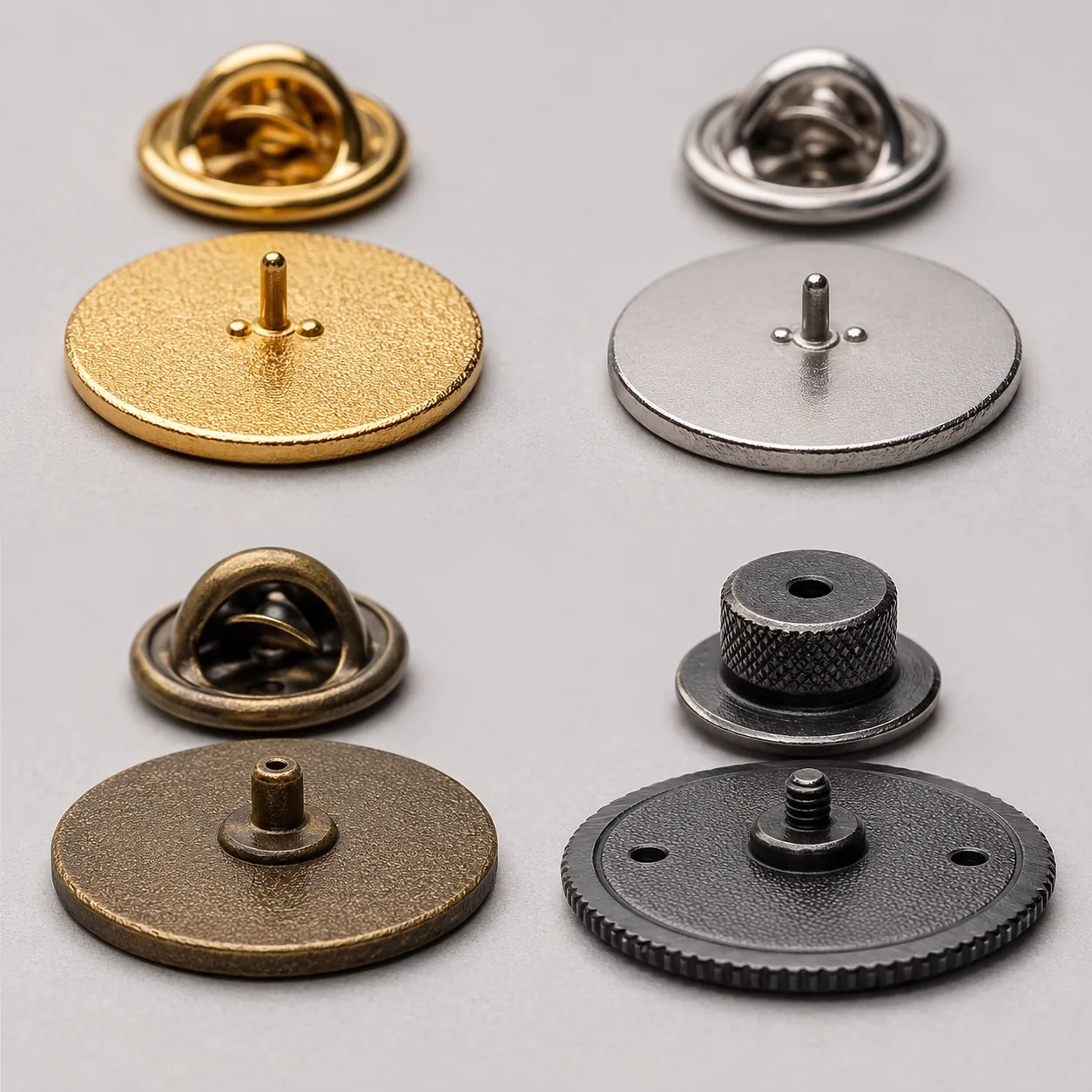
Attachment geometry is often overlooked. One post is usually enough up to about 30 mm. For wide, horizontal, or top-heavy shapes above 35 mm, specify two posts spaced roughly 18-22 mm apart to reduce spinning. Post position tolerance is commonly ±0.5 mm. For thin apparel, rubber clutches can reduce fabric pull; for standard handouts, butterfly clutches remain the fastest and lowest-cost option.
Checklist: What must I send today so production can start tonight?
Rush orders move quickly only when the RFQ package answers every predictable factory question in one message. Most lost time comes from incomplete specifications, not from machine capacity.
- Vector artwork in AI, EPS, or clean PDF with all fonts outlined
- Finished size in mm and target thickness, for example 30 x 28 x 1.5 mm
- Pantone references for each enamel area, or written approval for closest visual match
- Base material: iron, brass, or zinc alloy
- Finish: bright gold, bright nickel, black nickel, antique bronze, or dyed black
- Attachment type and quantity per piece: butterfly clutch, rubber clutch, magnet, or keyring
- Backside requirement: plain, sandblast, logo backstamp, laser-number panel, or text
- Packaging level: bulk 50 pcs/OPP bag, individual OPP bag, backing card, velvet pouch, or gift box
- Inspection standard requested, typically AQL 2.5 major / 4.0 minor / 0 critical
- Required ex-factory date, ship-to country, courier preference, and whether partial shipment is allowed
Also state the commercial structure clearly. Many factories quote MOQ breaks at 100, 300, 500, and 1,000 pcs. Those breaks affect both price and feasibility. A 300-piece rush order may fit a standard plating lot; a 1,000-piece order may require split lots, extra oven cycles, or weekend overtime to hit the same ship date.
If this package reaches the supplier before the end of their workday, many factories can return a proof, tooling charge, and production estimate the same day. The largest avoidable delay is usually internal approval after the factory is already waiting to cut the die.
Q: Where do rush orders actually lose time, and how do you control that risk?
The first bottleneck is artwork cleanup. Common issues are unsupported floating islands, gradients not converted into spot-fill regions, cutouts with hidden bridges, and text too small for metal separation. A logo that looks fine in Illustrator can still be unmanufacturable at 28 mm. Cleaning the art before die release is much faster than correcting a cut die.
The second bottleneck is buyer-side approval. Teams often lose 24-48 hours debating minor choices such as bright gold versus black nickel or bulk bagging versus individual OPP. On a 15-day event timeline, appoint one approver who can lock artwork, colors, finish, and packaging in a single reply.
The third bottleneck is sample logic. A physical pre-production sample can be useful on normal schedules, but on a true rush order it often consumes too much time. A more realistic control method is to approve the digital proof, then require first-off photos before mass production continues: front, back, side thickness, ruler scale, and color callouts. For higher-value runs, ask for a short video showing glare, enamel fill, and edge finish under neutral light.
The fourth bottleneck is packing complexity. In many emergency jobs, custom back cards, barcode labels, assortment sorting, and one-by-one gift boxing take as long as the pin run itself. If the pins are for booth distribution, bulk packing in 50 or 100 pcs per OPP bag with standard export cartons is usually the lowest-risk option.
Freight booking is the final risk point. Ask whether the supplier can use your nominated courier account, confirm carton dimensions and gross weight before pickup, and release a partial shipment once the first lot passes QC. On a 1,000-piece order, even receiving the first 250-300 pcs in time can protect the event.
Q: What quality level is realistic when speed matters?
Rush production still needs controls, but the QC target should match the use case. For promotional pins handed out at a trade show, a practical standard is AQL 2.5 major, AQL 4.0 minor, and zero tolerance for critical defects. Critical defects include sharp burrs that can cut skin, detached posts, missing clutches, wrong artwork, wrong finish, exposed base metal on the front face, or loose magnetic components.
Major defects generally include missing enamel, obvious underfill or overflow visible at arm's length, wrong color placement, severely bent posts, deep front scratches, plating burns, or die-strike deformation that changes the logo shape. Minor defects usually include tiny dust points in enamel, light haze on the back, small backside plating marks, or slight color variation within normal process tolerance.
Reasonable promo-grade tolerances are usually ±0.20 mm on stamped dimensions, ±0.30 mm on cast zinc dimensions, and about ±0.10-0.15 mm on thickness. Post placement is commonly held to ±0.5 mm. Pantone matching on enamel is visual rather than laboratory-grade, and some reds, oranges, purples, and fluorescent-adjacent shades can shift slightly after cure. Buyers should judge front-face consistency under normal viewing distance, not under magnification.
For fast verification, request four controls: front photo on a neutral background, back photo showing post positions, side photo for thickness, and pack-count photo by inner bag and master carton. On larger orders, ask for random inspection photos from at least 32 pcs or from more than one carton. That gives a better view of lot consistency than asking for perfect hidden surfaces.
Q: How much extra should I budget for a rush order in 2026?
Rush pricing is driven more by queue priority, overtime, spoilage risk, and faster freight than by the metal itself. For a simple 30 mm soft enamel pin in 2026, FOB pricing often falls near these tiers: 100 pcs at $0.58-$0.88 each, 300 pcs at $0.38-$0.68, 500 pcs at $0.35-$0.60, and 1,000 pcs at $0.30-$0.52, assuming one standard plating, 1-4 colors, and butterfly clutch. Brass instead of iron may add roughly $0.05-$0.12 per piece on small runs.
A realistic rush surcharge is usually 10%-25% on manufacturing price. If the job needs weekend production, split shipments, special packing, repeated proof revisions, or unusual plating, the premium can rise to 30%-40%. Tooling for stamped iron or brass pins commonly runs about $45-$95 for standard 25-35 mm shapes. Zinc alloy molds are more often $80-$160, with larger or deeper 3D forms going higher.
Freight can dominate the economics on small emergency orders. A 200-piece pin order may have goods value under $150 FOB, while international courier can cost $60-$150 depending on destination, fuel surcharge, and delivery terms. That is why simplification matters more than hard bargaining. Removing epoxy, cutting colors from 6 to 4, choosing one standard plating, and skipping custom retail cards usually saves more time and money than negotiating a few cents on the base metal.
Q: If the original deadline is impossible, what is the least-bad fallback plan?
If the supplier's honest answer is no, do not force a weak yes. The best fallback is to remove variables quickly. Convert imitation hard enamel to soft enamel, delete cutouts narrower than 0.8 mm, drop dual plating, use standard packing, or move from gift-box presentation to bulk bags. Each simplification removes one failure point from the schedule.
Partial shipment is often the best commercial compromise. For example, on a 1,000-piece order, air-ship 250-300 pcs for booth use and send the remaining 700-750 pcs by standard air service for post-event follow-up. That protects the launch date without forcing the entire quantity through the most expensive freight lane.
Product substitution is the other practical fallback. If a cast keychain with epoxy dome and insert card cannot make the date, a stamped pin, standard lanyard, or embroidered patch often can. In rush event sourcing, you usually cannot maximize all three variables at once: exact product type, exact design complexity, and exact delivery date. Pick the two that matter most.
What to do next: a 24-hour decision plan for your team
If your trade show is within three weeks, align the team today on non-negotiables: in-hands date, max unit budget, acceptable process substitutions, proof approval method, and whether a partial shipment is acceptable. Then appoint one final approver who can answer factory questions within hours, not days.
- Freeze the product type today: pin, keychain, magnet, coin, patch, or lanyard
- Choose the simplest manufacturable build: standard size, one plating, standard hardware
- Keep rush pins at 25-35 mm, 1.2-1.5 mm thick, and ideally 4-5 colors max
- Send one complete artwork-and-spec package instead of multiple partial emails
- Approve or reject the digital proof within 12-24 hours
- Use bulk packaging unless retail presentation is essential
- Request ex-factory date, ship method, carton count, and tracking responsibility in writing
- Ask in advance whether partial shipment is possible for orders above 300 pcs
If a supplier reviews your files and says the schedule is too tight, that is often a positive sign. Reliable factories surface risk early instead of protecting the sale with an unrealistic promise. The fastest successful rush orders are usually the simplest ones: standard specs, quick approval, low packing complexity, and very few moving parts.
Have a project? Send your artwork and target quantity and we’ll reply with a detailed quotation within 12 working hours.
Ready to get this made?
Send your sketch, target quantity and ship-date. Detailed quotation in 12 hours.



