Need 5,000 Trade-Show Pins in 18 Days? A Rush Plan
Build the schedule from the booth date backward
An 18-day custom pin program can work, but only if the calendar starts from the day the pins must be physically available for booth setup, exhibitor move-in or contractor check-in. Do not plan from the supplier’s "ship date." For Las Vegas, Frankfurt, Birmingham, Dubai or similar trade-show destinations, reserve 2 to 4 calendar days after arrival for customs release, local transfer, venue receiving windows, security screening and carton count verification. If the consignee is a convention center, hotel or official show contractor rather than a normal warehouse, use the full 4-day buffer because deliveries may be accepted only during fixed dock hours and often require exhibitor name, booth number and carton labeling in a specific format.
That leaves about 14 to 16 days for artwork cleanup, tooling, approvals, stamping, polishing, color fill, plating, assembly, inspection, packing and export dispatch. In rush programs, the usual failure is not factory capacity alone. It is late buyer decisions: switching from 28 mm to 32 mm after tooling, adding a backing card after production is queued, or changing shiny nickel to black nickel once plating slots are booked. Every unresolved decision uses the same calendar that freight and customs need.
A workable 18-day path for 5,000 pieces is usually: Day 0 RFQ with vector art, quantity, destination and delivery type; Day 1 final specification lock, quotation approval and deposit; Day 2 tooling release; Day 3 digital production sheet approval plus first struck sample photos; Days 4 to 8 stamping, deburring, polishing and enamel fill; Day 9 drying and plating queue; Days 10 to 11 plating and clutch assembly; Day 12 inline inspection and count confirmation; Day 13 final packing and export handoff; Days 14 to 18 transit, customs and local delivery. That is aggressive but realistic only when approvals are same-day and the supplier already runs promotional metal pins at scale.
Choose a rush-safe build instead of a complex build
Rush orders succeed by removing operations, not by forcing every operation to go faster. A pin with 7 colors, glitter, offset print, dual posts, backing card, barcode sleeve and retail bagging can be made, but each extra step adds queue time, manual handling and defect exposure. For a 5,000-piece trade-show giveaway, the safest structure is one the factory can run through stamping, fill, plating and packing with minimal hand correction.
For most logo pins, the rush-safe choice is a stamped iron soft enamel pin at 25 to 32 mm, thickness 1.2 to 1.5 mm, 4 to 6 spot colors, one butterfly clutch and bulk packing by 50 or 100 pieces per polybag. MOQ is usually not the constraint; many factories accept 100 to 300 pieces on this structure. The real constraint is daily throughput. Stamped iron is generally faster than zinc die casting, imitation hard enamel or printed epoxy styles because tooling is simpler and the finishing path is more standardized.
Design geometry matters more than many buyers expect. Recessed metal lines below 0.25 mm often fill inconsistently; 0.30 to 0.35 mm is safer for repeatable color separation. Cap-height text under 1.2 mm is frequently soft after plating and enamel; 1.5 mm or more is safer for readable booth giveaways. Unsupported projections under 1.0 mm wide, deep internal cut-outs and tiny isolated color islands increase polishing damage and rework. Simplifying those details can save 1 to 2 days by reducing touch-up, sorting and reject rates.
| Spec area | Rush-safe choice | High-risk choice | Why it matters |
|---|---|---|---|
| Base process | Stamped iron soft enamel | Imitation hard enamel, offset print or cast 3D build | Fewer finishing steps and faster line throughput |
| Size | 25-32 mm | 40 mm+ | Larger parts slow stamping, polishing, counting and increase freight weight |
| Thickness | 1.2-1.5 mm | 2.0 mm+ | Thicker metal raises material use, plating time and FOB cost |
| Color count | 4-6 spot colors | 7+ colors, glitter or translucent fills | More hand filling and wider cosmetic variation risk |
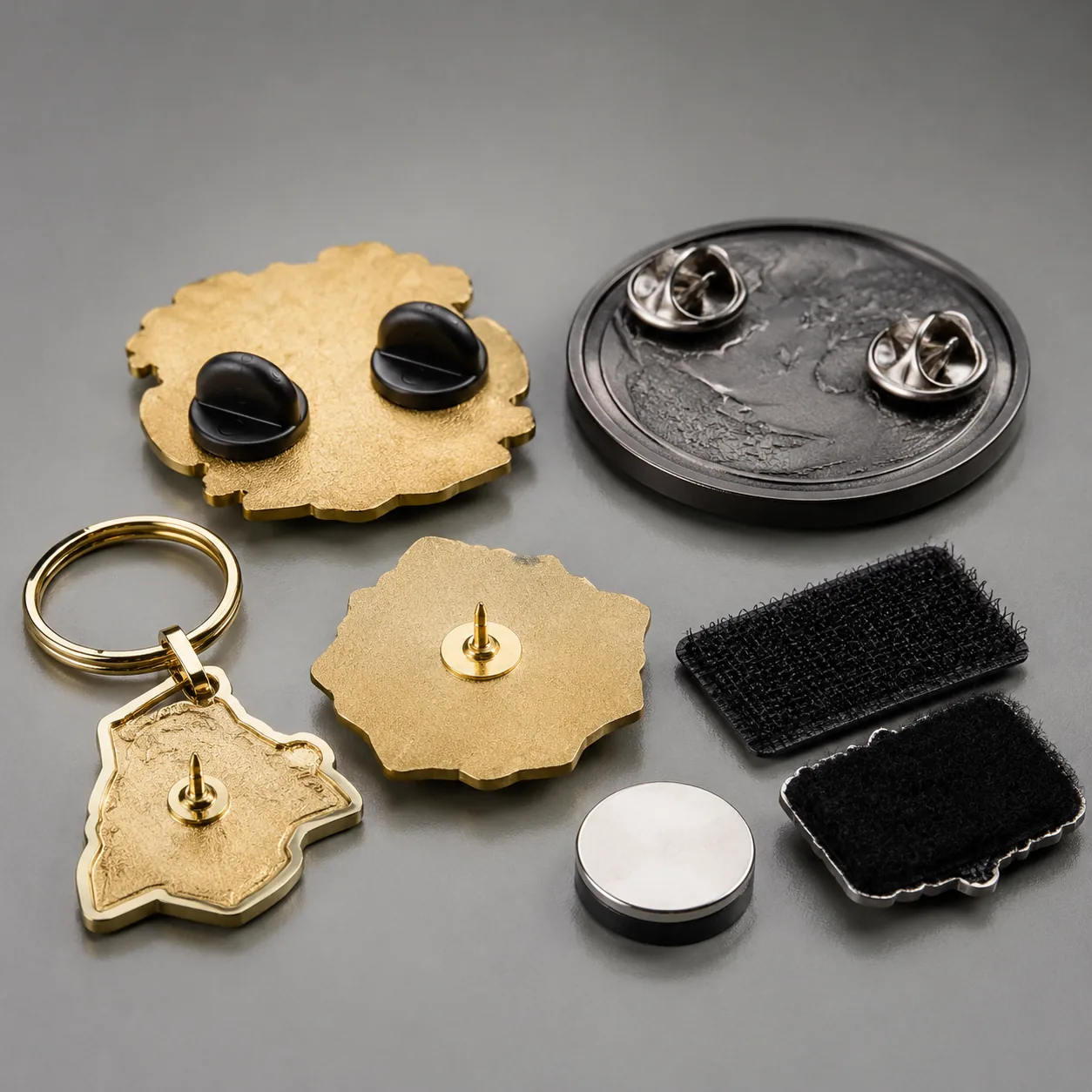
| Attachment | 1 butterfly clutch | 2 posts, magnet back or safety pin | Extra assembly, alignment and hardware sourcing steps |
| Packaging | Bulk by 50/100 or plain polybag | Backing card, sleeve, barcode label, retail set | Custom pack-out often delays more than core production |
| Finish | Shiny nickel or black nickel | Dual plating, antique hand-rub or sandblast contrast | Special finishes add queue time and consistency risk |
Price the right process and know the real lead times
For a standard logo pin around 30 mm, stamped iron soft enamel is usually the fastest and lowest-risk route. Typical tooling for one front design is about USD 60 to 120 FOB, with an additional USD 20 to 50 if a custom backstamp is required. For 5,000 pieces in 2026, common FOB unit pricing is roughly USD 0.28 to 0.45 for 25 to 28 mm and USD 0.34 to 0.56 for 30 to 32 mm, assuming 4 to 6 colors, shiny nickel or black nickel plating, one standard clutch and bulk packing. Individual polybags usually add USD 0.01 to 0.03 each; a plain backing card with hand insertion typically adds USD 0.05 to 0.12 each and often 1 extra day.
Zinc alloy die casting is justified when the artwork needs openwork, irregular relief, sculpted 3D surfaces or undercuts that stamped iron cannot hold cleanly. But in a rush program it is usually slower and more expensive. Comparable cast zinc alloy soft enamel pins at 5,000 pieces often range from USD 0.48 to 0.90 FOB, with tooling more often USD 120 to 220. Because cast parts are usually thicker and heavier, chargeable freight cost also rises sooner than many buyers expect.
For lead time, expect 1 to 2 days for tooling after final vector approval if the mold room is in-house, then about 5 to 7 production days for 5,000 simple stamped pins when line capacity is open. Add about 1 day for backing cards, 1 day for barcode labeling and hand insertion, and 1 to 2 days for epoxy domes, antique finishes, glow fill or glitter. If a supplier claims 5,000 custom pins with retail pack-out in 4 total days, ask exactly which step is being compressed: drying, inspection, count verification or pack-out accuracy.
In a genuine rush scenario, physical pre-production samples are usually the first step removed. Mailing one sample internationally can cost 2 to 4 calendar days before bulk production even starts. Experienced buyers often approve a digital production sheet showing exact size in mm, Pantone references, plating note, attachment position, backside copy and packing instruction, then request first-article photos and a short inline video from the line. That approach is less comfortable than touching a sample, but it often protects the date.
Set quality limits before tooling starts
Rush does not mean unstructured quality. It means defining in writing what must be corrected, what tolerance is acceptable and what cosmetic variation is normal for a promotional metal giveaway. For 5,000 trade-show pins, a practical final inspection plan is AQL 0 for critical defects, 2.5 for major defects and 4.0 for minor defects under ANSI/ASQ Z1.4 General Inspection Level II, unless your brand standard is stricter.
Critical defects include sharp burrs that can cut skin, missing post or clutch, wrong logo content, wrong finish, severe plating peel, exposed rust, contamination that transfers to hands or fabric, or any hardware failure that makes the pin unusable. Major defects include unreadable text, obvious color contamination, missing fill in visible areas, post placement outside tolerance, mixed finishes in one lot, warped parts, or short quantity inside sealed inner packs. Minor defects usually include light backside scratches, slight enamel dips within approved range, mild tone variation and polish haze in hidden areas.
Tolerances should fit the product class. For stamped event pins, overall width and height tolerance of plus or minus 0.20 mm is normal; thickness tolerance of plus or minus 0.10 to 0.15 mm is workable; post placement tolerance of plus or minus 0.50 mm is achievable on a 30 mm pin and better than a vague 1.0 mm limit if brand alignment matters. Decorative nickel or black nickel top-layer thickness is often around 0.03 to 0.08 microns over the base plating system, which is adequate for indoor promotional use but not the same as engineering-grade corrosion protection. If you need REACH, Proposition 65, CPSIA, ASTM F963 heavy-metals limits, nickel release controls or 24 to 48 hour salt-spray performance, state that before quotation approval because testing and compliant plating can add USD 150 to 500 and 3 to 7 days.
- Approve one final production sheet with size in mm, Pantone codes, plating, post location, quantity and exact pack-out
- Use AQL 0 critical, 2.5 major and 4.0 minor as a realistic rush benchmark unless your standard is tighter
- Define no-go defects clearly: sharp burrs, missing clutch, wrong finish, unreadable text, severe enamel overflow, rust or short count
- Allow limited cosmetic variation on hidden backside areas so the line does not stop for non-visible issues
- State packing precisely: bulk by 50, bulk by 100, or individual polybag, with pieces per export carton and required carton marks
Book freight early because logistics become the bottleneck
By Day 5 or Day 6, many teams are still discussing production photos while freight is not yet booked. That is too late for a hard event deadline. For 5,000 stamped iron pins around 30 mm and 1.2 to 1.5 mm thick, net product weight is often about 55 to 85 kg depending on exact size, thickness and hardware. After polybags, inner bags, desiccant, export cartons and labels, gross weight often reaches 65 to 95 kg. Typical export packing might be 8 to 12 cartons at roughly 38 x 28 x 22 cm each, though this varies by pack-out. If cartons are bulky relative to weight, express carriers may bill by dimensional weight rather than actual weight.
International express is usually the lowest-risk option because it minimizes handoffs and commonly moves door-to-door in 3 to 6 days after dispatch. For a shipment in the 70 to 100 kg chargeable range, 2026 express cost can easily run from about USD 700 to 1,800 depending on origin, destination, fuel surcharge and remote-area fees. Air freight plus local courier can lower spend on some lanes, but the airport transfer, broker coordination and last-mile handoff add failure points. Standard air cargo makes sense only when the buyer already has a customs broker, receiving warehouse and local transfer support in place.
FOB unit pricing matters only if the supplier can hand off export cartons the same day or next day after packing. If the goods then wait 48 hours for a booking slot, the lowest factory price no longer protects the event date. Before production starts, confirm who books freight, who acts as importer of record if required, the estimated carton count, gross and volumetric weights, the HS code to be used and whether the venue or show contractor can accept courier deliveries on the intended arrival date.
| Freight mode | Typical transit after dispatch | Best use case | Main caution |
|---|---|---|---|
| International express | 3-6 days | Hard event deadline with direct door delivery | Highest cost; dimensional-weight billing can exceed actual-weight assumptions |
| Air freight plus local courier | 5-9 days | Buyer wants some savings and has good receiving coordination | More handoffs, customs steps and final-mile risk |
| Standard air cargo | 6-10 days | Buyer has broker, warehouse and airport handling support | Airport or broker delays can erase savings |
| Sea freight | 20-40+ days | Non-rush replenishment only | Not suitable for an 18-day trade-show deadline |
Run approvals through one owner and one live spec
Rush orders often fail because approvals are fragmented. The supplier may be able to cut tooling in one day, but if marketing emails one logo, procurement changes dimensions in chat and packaging comments arrive later in a meeting summary, the working file becomes unreliable. For urgent programs, one buyer-side owner should have authority to approve artwork, acceptable deviation, packaging and freight without reopening each internal debate.
The fastest teams keep one live specification sheet and one approval thread. They freeze the primary build first: process, size, thickness, colors, finish, attachment, quantity and packing. Secondary details such as carton mark wording, insert phrasing or barcode position can be settled later if they do not block tooling or assembly. Many delayed programs make the opposite mistake and spend half a day on backing-card layout before approving the actual pin geometry.
A strong RFQ for an 18-day window includes one primary build and one fallback build. Example primary: 30 mm stamped iron soft enamel, 1.2 mm thick, shiny nickel, 5 Pantone-matched spot colors, one butterfly clutch, individual polybag, 5,000 pieces, target FOB USD 0.38 to 0.52. Example fallback: same artwork reduced to 28 mm, 4 colors, shiny nickel or black nickel, bulk packed by 50, no card, target FOB USD 0.30 to 0.44. That fallback gives the factory room to protect the date if color separation, pack-out or line capacity becomes the real constraint.
Check the predictable defect points from Day 7 onward
Once bulk production starts, the defect pattern is usually predictable. Enamel inconsistency appears first in narrow cells, acute corners and high-contrast color adjacency such as white next to black or yellow next to dark blue. Plating variation shows up next, especially if the order is split across batches or if pre-plate polishing is uneven. Assembly defects then appear at the post and clutch stage, where rush pressure can lead to loose clutches, tilted posts or weak welds. Adhesive-backed fittings are generally a poor choice for rush pins because cure time and bond reliability are harder to control than welded hardware.
Ask for specific checkpoints rather than a generic message saying QC passed. Useful requests include a photo of the first 50 plated pieces under neutral 5000K to 6500K lighting; a macro close-up of the smallest text; a side profile confirming thickness; a backside photo confirming post location; and a packing photo showing pieces per inner bag and the carton label. If the finish is black nickel, gunmetal or another dark tone, request a scratch-visibility check because handling marks show more clearly on dark plating than on bright nickel.
For a giveaway order, outbound quality control should include 100 percent visual sorting for sharp burrs, missing hardware and severe plating failure, plus random carton count verification. Carton labels should show PO number, item code, quantity, net weight, gross weight and carton sequence such as 1/8, 2/8 and 3/8. Count accuracy matters. On a 5,000-piece booth order, a 2 percent shortage means 100 missing pins onsite, which is much more visible than a small factory variance on paper.
Budget for the full rush program, not just the unit price
If the event is less than three weeks away, stop collecting exploratory quotes from ten factories. Send a clean RFQ to two or three suppliers that already specialize in custom pins, medals or badges. State the in-hand date, destination country, delivery address type, quantity, preferred process, target size in mm, maximum color count, finish, attachment, pack-out requirement and whether a physical sample is mandatory. A supplier can quote a rush-feasible path only when the fixed variables and negotiable variables are clearly separated.
In most cases, the best on-time strategy is to protect four non-negotiables: readable branding, safe edges, secure attachment and correct quantity delivered on time. Premium packaging, exact backside cosmetics, antique effects, specialty coatings and extra accessories are usually negotiable. If buyers separate must-haves from nice-to-haves in the first 24 hours, a supplier with in-house tooling, stable plating access, dedicated assembly and export experience can often still deliver 5,000 event pins inside an 18-day window.
As a realistic 2026 planning range, 5,000 simple rush pins usually land at a FOB goods value of about USD 1,400 to 2,800 for stamped iron soft enamel, or roughly USD 2,400 to 4,500 for more complex cast zinc builds. Tooling is commonly USD 60 to 120 for stamped iron and USD 120 to 220 for zinc alloy. Express freight for a hard-deadline move is often USD 700 to 1,800, while testing, retail packaging, compliance documentation, magnet backs, show-contractor handling fees and remote-area surcharges sit on top. The earlier the build is frozen, the more likely those costs stay controlled and the less likely the deadline fails in the last mile.
Have a project? Send your artwork and target quantity and we’ll reply with a detailed quotation within 12 working hours.
Ready to get this made?
Send your sketch, target quantity and ship-date. Detailed quotation in 12 hours.



