Need 5,000 Event Pins in 18 Days? A Rush Order Playbook
Day 0: lock the spec before the schedule starts moving
The hard part is not making a lapel pin. The hard part is delivering 5,000 usable, brand-correct pins with stable plating, readable artwork, correct attachments, clean packing, and export-ready paperwork inside an 18-day event clock. A normal custom pin cycle from approved production art to cargo handoff is usually 18 to 28 calendar days: 0.5 to 1 day for artwork cleanup, 1 day for die layout approval, 7 to 12 days for tooling, stamping, coloring, plating, assembly, and packing, then 2 to 5 days for inspection, rework, and freight handoff.
For an event opening in 18 days, the freight cutoff is the real deadline. If the pins ship from Guangdong, Zhejiang, or Jiangsu to a US venue, a forwarder will often want cargo ready by Day 13 to protect pickup, export clearance, airport handling, flight uplift, import clearance, and final delivery. That leaves roughly 12 production days after Day 0, and fewer if approvals move across time zones.
A realistic rush brief might be: 5,000 pcs, 28 mm logo pin, soft-enamel look, black nickel plating, one post, butterfly clutch, individual polybag, delivery to Chicago. The buyer should not ask the factory to quote every finish. The buyer should freeze one manufacturable path and remove variables: one plating, one attachment, one packing method, one artwork approver, one written sign-off.
Use the fastest build that still looks intentional
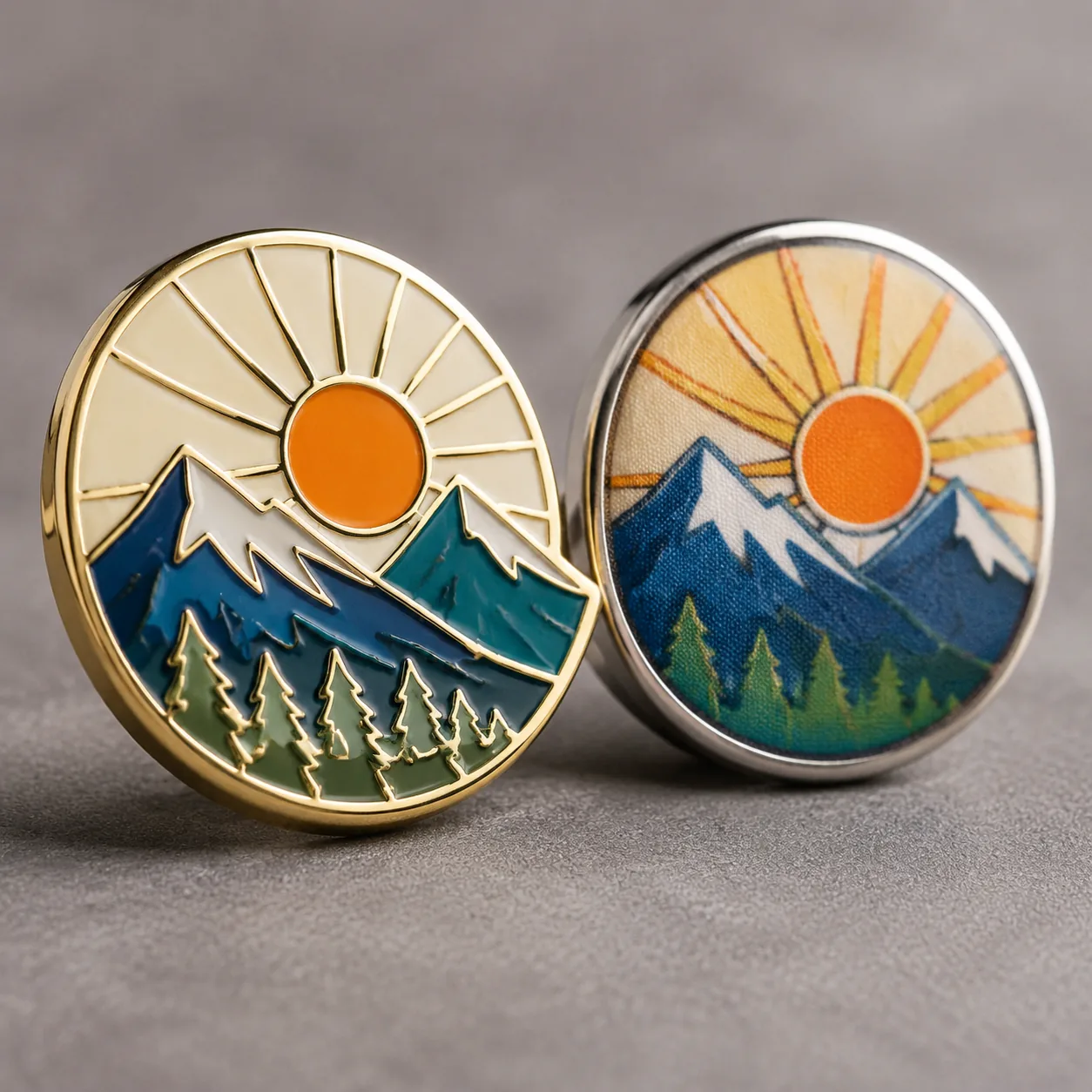
For 5,000 event pins on an 18-day schedule, the lowest-risk construction is usually die-struck iron with soft enamel, bright nickel or black nickel plating, one standard butterfly clutch, and simple packing. This route uses common dies, familiar coloring work, standard plating baths, and routine post welding. It is faster and more predictable than zinc alloy die-casting with cutouts, imitation hard enamel with face polishing, spinner pins, magnets, chain assemblies, or multi-part badges.
A practical rush specification is 28 to 30 mm wide, 1.2 to 1.5 mm thick, 4 to 6 enamel colors, no interior cutouts unless the logo requires them, and one post for compact shapes. Use two posts if the pin is wider than 32 mm, strongly horizontal, or likely to rotate on lanyards, tote straps, or jacket lapels. A 28 mm iron soft-enamel pin with one post and butterfly clutch normally weighs about 5.5 to 7.0 g. Add epoxy or a second post and the range moves closer to 6.5 to 8.5 g.
The main trade-off is surface flatness versus process speed. Imitation hard enamel gives a flatter, more jewelry-like face, but it needs tighter color filling, oven curing, polishing, and face leveling. On a rush order it commonly adds 2 to 4 days and increases rejection risk for color sink, uneven polish, or exposed metal edges. Soft enamel is more forgiving. If a smoother touch is important, a clear epoxy dome can hide the enamel recess, but it adds 12 to 24 hours of curing time and can soften fine metal-line definition.
| Build choice | Typical production time after approval | Rush fit | Indicative FOB unit price at 5,000 pcs |
|---|---|---|---|
| Iron soft enamel, nickel or black nickel | 7-9 days | Best | USD 0.38-0.58 |
| Iron soft enamel + epoxy dome | 8-10 days | Good | USD 0.42-0.64 |
| Offset printed iron pin + epoxy | 7-9 days | Good for detailed graphics | USD 0.36-0.60 |
| Imitation hard enamel | 10-13 days | Moderate | USD 0.52-0.88 |
| Die-cast zinc alloy with cutouts or 3D relief | 10-15 days | Weak for rush | USD 0.68-1.20 |
MOQ is rarely the obstacle. Many pin factories accept 300 to 500 pcs, but pricing improves sharply at event quantities. For a standard 28 mm soft-enamel iron pin, typical FOB levels are USD 0.75 to 1.15 at 500 pcs, USD 0.50 to 0.78 at 2,500 pcs, and USD 0.38 to 0.58 at 5,000 pcs, excluding tooling and freight. Simple die-struck iron tooling is commonly USD 80 to 180. If time is tight, ask whether the tool charge can be rolled into the unit price so production can start after one commercial approval instead of waiting for a separate tooling PO.
Redraw the artwork for metal, enamel, and 28 mm viewing distance
Rush schedules often fail before the die is cut. A marketing visual is not a production file. The factory must convert the artwork into raised metal lines, recessed enamel cells, post positions, and an outer cut line that can be stamped cleanly. Hairline typography, gradients, tiny sponsor names, low-contrast icons, and floating details below process limits cause approval loops and die rework.
For a 28 mm soft-enamel pin, use production thresholds that hold across 5,000 pcs. Minimum raised metal line width should be 0.25 mm, with 0.30 mm safer for clean separation. Minimum recessed enamel area should be at least 0.35 x 0.35 mm to reduce pinholes and incomplete fill. Minimum isolated raised-metal dot should be 0.40 mm. Minimum text height should be about 1.2 mm for bold uppercase and 1.5 mm for mixed-case or thin fonts. If a legal line, sponsor URL, or trademark notice cannot meet that threshold, move it to the backing card.
Color count matters because each Pantone fill adds handling, cure checks, and touch-up risk. For a 5,000-piece rush run, hold the design to 4 to 6 colors where possible. Merge near-duplicate brand shades if the logo owner allows it. At 28 mm, attendees will notice a distorted logo shape before they notice that two similar blues were consolidated into one approved production color.
- Lock final size in millimeters, such as 28.0 x 28.0 mm
- Specify thickness: 1.2 mm for standard giveaway cost, 1.5 mm for a heavier feel
- Choose one plating only: bright nickel, bright gold, black nickel, or dyed black
- Limit the design to 4 to 6 Pantone colors unless there is a clear brand reason
- Avoid interior cutouts unless the logo structure requires them
- Use one post below 30 mm; use two posts above 32 mm or on long horizontal shapes
- Delete decorative backstamp artwork unless contractually required
- Approve artwork, plating, attachment, packing, and carton marking in one email
A competent factory can usually return production artwork within 2 to 6 hours for a simple pin if the brief is complete. If brand, procurement, legal, and events each approve in separate cycles, buyer-side delay can consume more schedule than tooling.
Day 1 to Day 3: sample only when the risk is worth the time
A physical pre-production sample is useful under normal lead times, but it can break an 18-day schedule. Making the sample, photographing it, dispatching it, delivering it, and collecting comments commonly adds 3 to 5 calendar days. If cargo must be ready by Day 13, that delay can consume most of the freight buffer.
For a straightforward promotional pin, many experienced buyers approve from production artwork plus a first-off photo set. The photo set should include front, back, side profile, plating close-up, enamel boundary close-up, post weld close-up, clutch fit, and one image with a ruler or digital caliper. Same-day approval is critical. A 12- to 15-hour time difference can turn a half-day hold into a full-day stoppage if no one is authorized to answer.
Use a physical sample for retail sale, licensed merchandise, executive gifting, museum programs, or any order where surface finish and hand feel carry commercial risk. If the deadline cannot absorb the delay, split the order: prioritize 1,500 to 2,000 loose-packed pins for opening day and send the remaining 3,000 to 3,500 pcs later with cards or premium packing.
| Approval route | Time impact | Best when | Main risk |
|---|---|---|---|
| Artwork approval only | Fastest | Simple event giveaway | Surface feel judged from proof only |
| First-off photo approval | Adds 0.5-1 day | Buyer can approve within hours | Photos may hide minor plating or enamel marks |
| Physical pre-production sample | Adds 3-5 days | Retail, licensing, premium gifts | Consumes freight buffer |
| Split order with priority first lot | Adds coordination | Partial delivery is acceptable | Higher freight and carton control burden |
A credible rush path is artwork approval by Day 1 morning, tooling started the same day, and first-off pieces available late Day 2 or Day 3. If final approval slips to Day 2 evening, the schedule should be recalculated instead of treated as unchanged.
Day 3 to Day 9: inspect the defects that break event use
On a rush order, not every defect carries the same business impact. Focus on failures that create visible inconsistency at registration desks, functional complaints, or carton-level rework: outer dimensions, enamel fill completeness, plating coverage on the front face, post weld strength, clutch retention, count accuracy, and packing segregation.
Use tolerances that match the process. For a 28 mm die-struck iron pin, outer dimension tolerance of +/-0.15 mm is practical. Thickness tolerance of +/-0.10 to +/-0.15 mm is common, depending on stamping consistency and plating buildup. Decorative flash plating for event pins is mainly cosmetic. Bright nickel or bright gold flash is often around 0.03 to 0.08 microns, with better-controlled runs sometimes reaching 0.10 microns. Buyers should not expect strong abrasion resistance at that thickness. If the pin must survive retail handling, zippers, bags, and long-term wear, change the construction or plating requirement instead of relying on stricter inspection wording.
Define appearance standards around the way the pin will be used. A workable promotional standard is no exposed base metal visible on the front face at 30 cm, no unfilled enamel cell visible at 30 cm, no sharp burr on the perimeter, no obvious color contamination, and no major plating pit on the primary display face. Minor marks on the back near the post weld are usually commercially acceptable for giveaway use.
For inspection, AQL 2.5 for major defects and AQL 4.0 for minor defects is common for promotional pins. Tightening to AQL 1.0 across the board on a compressed schedule usually creates a ship-date conflict or a price conflict. For 5,000 pcs under ISO 2859-1, General Inspection Level II, the sample size code is typically L, giving a 200-piece sample. At AQL 2.5, accept 10 and reject 11 for major defects. At AQL 4.0, accept 14 and reject 15 for minor defects.
- Confirm first-off photos show front, back, side thickness, clutch, and weld close-up
- Request one tray photo per color-filling lot to catch shade drift early
- Require a simple weld pull test, such as 3 kgf for 10 seconds on sample pieces
- Check butterfly clutch fit for retention and removability
- Reject sharp edges, heavy burrs, exposed base metal on the face, and wrong plating
- Count by sealed inner-bag quantity before master cartons are closed
- Verify backing-card orientation and pin placement if carded
- Mark cartons with PO, item code, quantity, gross weight, net weight, and carton number
Packaging errors can hurt as much as product defects. If the venue expects 500 VIP carded units and 4,500 general-distribution loose units, mixed cartons without clear labels can create hours of resorting at the loading dock.
Day 10 to Day 13: simplify packing before buying expensive freight
When the schedule tightens, packaging should be treated as a logistics decision. The fastest options are bulk packing at 50 or 100 pcs per polybag, or individual polybagging without a printed card. These methods reduce handwork, remove print dependencies, and lower mixed-count risk.
If presentation-ready units are required, keep the card basic: 300 to 350 gsm white or black card, 85 x 55 mm or 90 x 50 mm, one-side CMYK print, no foil, no spot UV, no die-cut window, no folded sleeve, no barcode unless required for inventory. A simple backing card usually adds 1 to 2 days. Premium inserts, envelope sets, SKU assortments, or individual barcode labels can add 2 to 4 days and increase packing errors.
| Packing option | Added unit cost | Added time | Best use |
|---|---|---|---|
| Bulk pack, 100 pcs per bag | USD 0.00-0.01 | Minimal | Fastest event delivery |
| Individual polybag | USD 0.01-0.02 | Low | Clean handout with low complexity |
| Simple printed backing card + polybag | USD 0.04-0.10 | 1-2 days | Sponsor desk or registration branding |
| Premium card, barcode, envelope set | USD 0.10-0.25 | 2-4 days | Retail or executive gifting, poor rush fit |
At 5,000 pcs, packing cost is smaller than emergency airfreight but still meaningful in factory time. A 28 mm iron pin at 6 to 8 g gives roughly 30 to 40 kg net product weight. After bags, cards, cartons, and padding, gross shipment weight often lands around 38 to 52 kg. Because pins are dense, air shipments usually rate by actual weight rather than volumetric weight. Decorative inner boxes mainly add cost, labor, and freight weight.
Day 13 to Day 18: manage freight, documents, and recovery plans
By Day 13, manufacturing is only half the problem. Choose freight based on the actual cargo-ready date, not the hoped-for date. For 5,000 pins from China to North America or Europe, express courier is often the fastest door-to-door method at about 3 to 5 days after pickup, but it is costly for dense metal cargo. Airport-to-airport airfreight may be cheaper per kilogram, but practical total transit is often 4 to 7 days after export handling, airline uplift, import clearance, and local delivery are included.
If cargo slips past Day 13, stop planning around full-quantity perfection. Recalculate immediately. A common recovery plan is couriering 1,500 to 2,000 loose-packed pins for opening day and moving the balance by deferred air. Another option is to ship all loose-packed pins first and send carded or VIP units later if the event team can distribute from trays or bins. The operational goal is enough correct pins physically at the venue when attendees arrive.
Indicative 2026 FOB China pricing for a 28 mm soft-enamel iron pin at 5,000 pcs is usually USD 0.38 to 0.72 each depending on color count, plating, thickness, attachment, epoxy, and packing. Rush surcharges commonly add 5% to 15% when overtime, weekend work, or line reshuffling is required. In many rush programs, the freight premium between planned air and emergency courier is larger than the manufacturing rush surcharge, so cargo readiness is more important than negotiating another USD 0.02 off the unit price.
Customs paperwork must match the goods. Use one consistent description, such as custom metal lapel pins with butterfly clutch, with quantity, unit value, country of origin, net weight, gross weight, carton count, and broker-confirmed HS code. Do not alternate between badge, souvenir, accessory, promotional gift, and jewelry unless the broker specifically instructs that language. On a compressed timeline, inconsistent documents are one of the few preventable errors that can still stop the shipment after production is finished.
The brief to send the factory today
Inside a three-week window, stop sending broad RFQs with multiple decorative options. Send a controlled brief to one or two factories that can execute quickly. Include final quantity, size in mm, thickness, base metal, plating, Pantone colors, attachment, packing method, destination country, cargo-ready deadline, and whether a split shipment is acceptable. Ask for milestone dates, not just a unit price.
A useful rush brief asks for three versions only: the fastest manufacturable version, the best-looking version still realistic for the deadline, and the exact time and cost penalty between them. That framing exposes the true schedule risk. Factories with in-house tooling, coloring, plating coordination, and assembly can usually give firmer commitments because fewer steps depend on outside workshops.
- Freeze artwork and all specifications in one approval email
- Choose the simplest build that still protects brand recognition
- Skip a physical sample unless the business risk justifies the delay
- Use realistic tolerances and AQL for a promotional event item
- Simplify packaging before trying to rescue the shipment with courier service
- Set the internal cargo-ready target at least 1 day before the forwarder cutoff
- Prepare a split-shipment plan before mass production starts
- Nominate one internal approver who can answer within hours
With that discipline on Day 0, an 18-day order for 5,000 event pins is difficult but often achievable. If the first four days are spent debating epoxy, premium cards, or details too small to survive at 28 mm, the schedule is usually lost before the die is cut.
Have a project? Send your artwork and target quantity and we’ll reply with a detailed quotation within 12 working hours.
Ready to get this made?
Send your sketch, target quantity and ship-date. Detailed quotation in 12 hours.



